Where it forms, where it's found
- Geological setting
It is typically a product of retrograde metamorphism, replacing <m>olivine</m>, <m>orthopyroxene</m> (<m>enstatite</m>), or other minerals in ultramafic igneous rocks.
- Type locality
- Eastern Cliff
- Kennack Cove (Kennack Sands)
- Kennack
- Grade-Ruan
- Cornwall
- England
- UK
50.0060°, -5.1607°
432recorded occurrences
Varieties
Physical
- Hardness
- 1Talc
- 2Gypsum
- 3Calcite
- 4Fluorite
- 5Apatite
- 6Orthoclase
- 7Quartz
- 8Topaz
- 9Corundum
- 10Diamond
- Transparency
- Translucent
- Colour
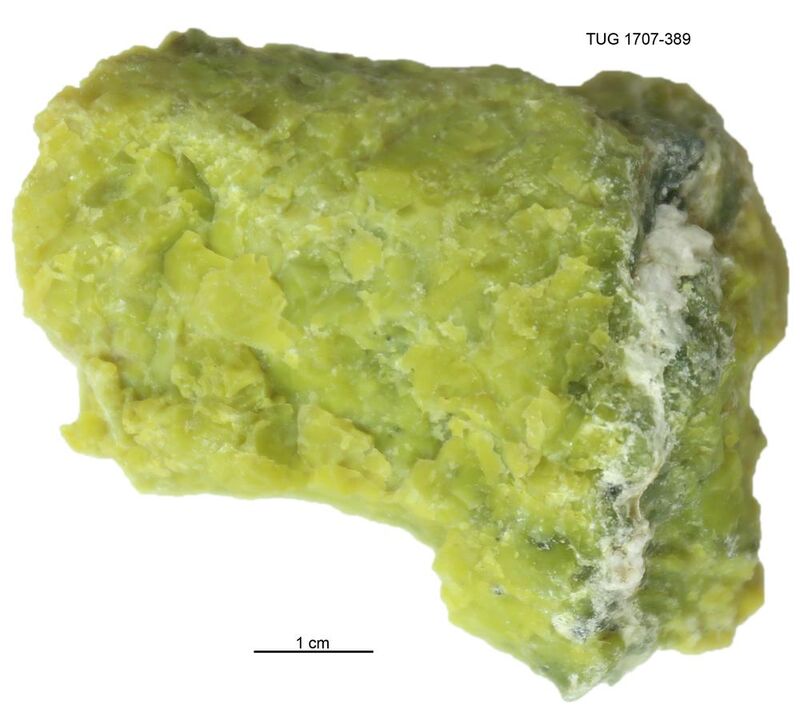
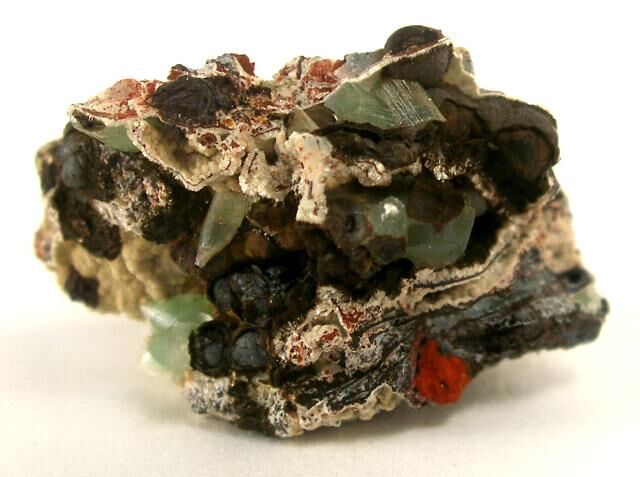
- green · brown · light yellow to white
- Streak
- white
- Tenacity
- flexible
- Cleavage
Rarely observed
crystals and scales can be easily bent
- Fracture
- Irregular/Uneven · Conchoidal · Sub-Conchoidal
- Density
- 2.55 g/cm³
Optical
- Optical type
- Biaxial (-) · 2V measured = 37 – 61° · 2V calc = 86°
- Refractive index
- 1.541 – 1.568
- Surface relief
- Moderate
- Principal indices
- nα 1.541 – 1.5625 · nβ 1.565 · nγ 1.553 – 1.568
- Birefringence
- 0.009
- Pleochroism
- Non-pleochroic
- Dispersion
- weak to distinct
- UV response
- Not known to be fluorescent in UV
Δ = 0Δmax
PPLpleochroism per grain
XPLindependent extinctions · rotate the stage
PPLpleochroism only · colour blends on rotation
XPLinterference colour · extinct every 90°
Retardation90 nm
Order1st order
XPL colour
Crystallography
- Space group
- #82
- Cell parameters
- a = 5.325(5) Å · c = 7.259(7) Å
- Z
- 2
- Morphology
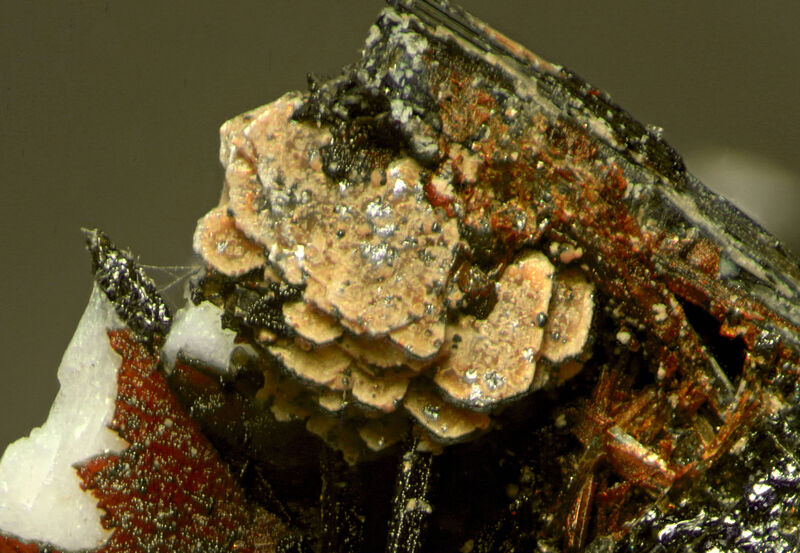
Trigonal plates to truncated trigonal pyramids.
- Comment
Pseudo-orthorhombic. Space group either P31m (1A polytype) with above cell parameters, or P63cm (2H1 polytype), with a = 5.318(4) c = 14.541(7) Å, Z = 4.
Crystal structure
Chemical composition
- Impurities
- Al
- Ni
- Fe
Synonyms
- Lizardiet
- Scyelit
- Scyelita
- Scyelite
In other languages
- French
- Lizardite
- German
- Lizardit
- Italian
- Lizardite
- Portuguese
- Lizardite
- Japanese
- リザード閃石
- Chinese
- 板蛇纹石 · 蜥蛇紋石
- Russian
- лизардит
Classification
Strunz
10th ed.9.ED.15
- 9SilicatesClass
- 9.EPhyllosilicatesDivision
- 9.EDPhyllosilicates with kaolinite layers composed of tetrahedral and octahedral netsGroup
- 9.ED.15LizarditeSpecies
Dana
8th ed.71.01.2b.02
- 71Phyllosilicates Sheets of Six-membered RingsClass
- 71.01Sheets of 6-membered rings with 1:1 layersType
- 71.01.2b— unnamed intermediate level —Group
- 71.01.2b.02LizarditeSpecies
CIM
—14.4.8
- 14Silicates not Containing AluminumClass
- 14.4Silicates of MgGroup
- 14.4.8LizarditeSpecies
Group, growth & confusion
 AmesiteMg2Al(AlSiO5)(OH)4Mineral—
 AntigoriteMg3Si2O5(OH)4Mineral—
 Berthierine(Fe2+,Fe3+,Al)3(Si,Al)2O5(OH)4Mineral—
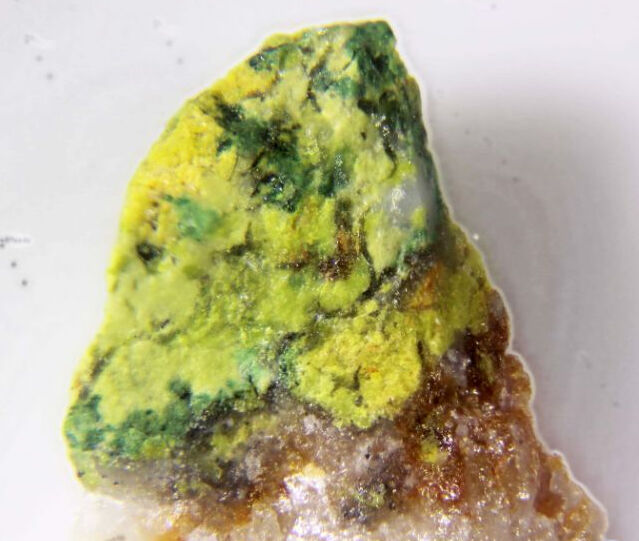 Brindleyite(Ni,Al)3(Si,Al)2O5(OH)4Mineral—
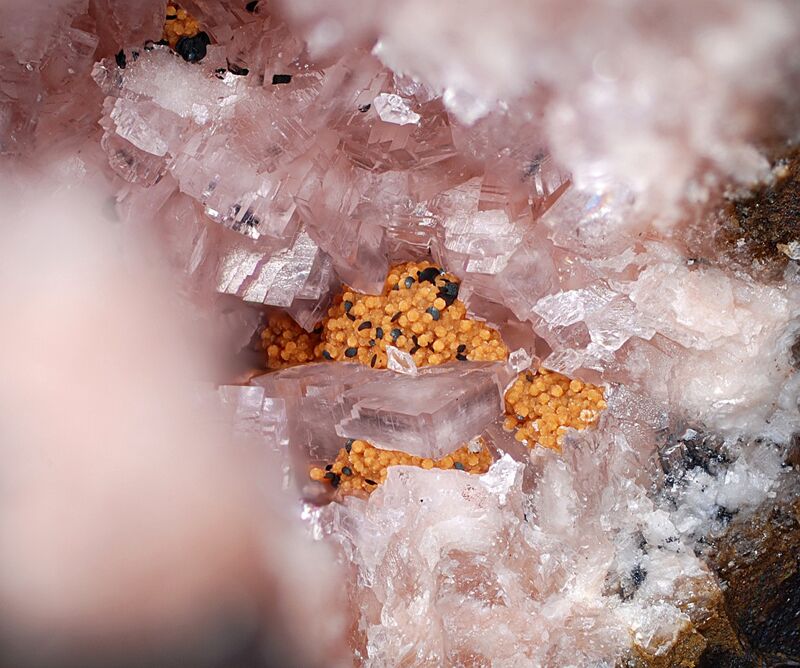 CaryopiliteMn2+3Si2O5(OH)4Mineral—
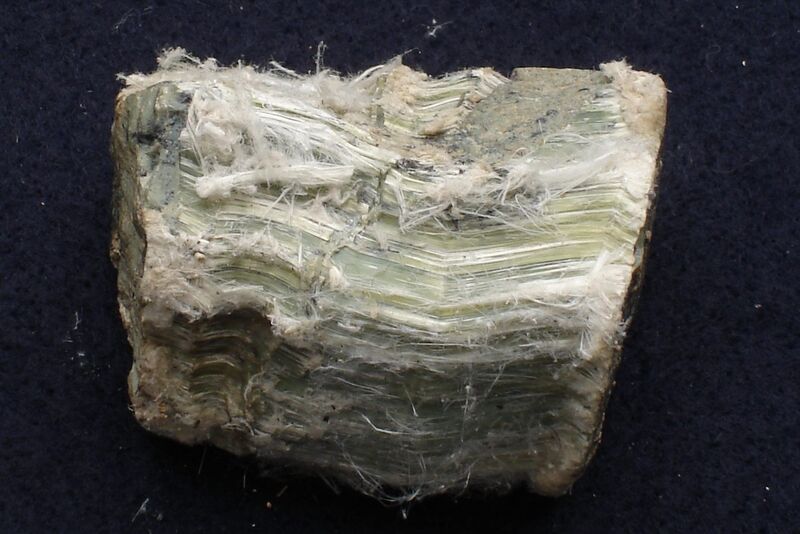 ChrysotileMg3Si2O5(OH)4Mineral—
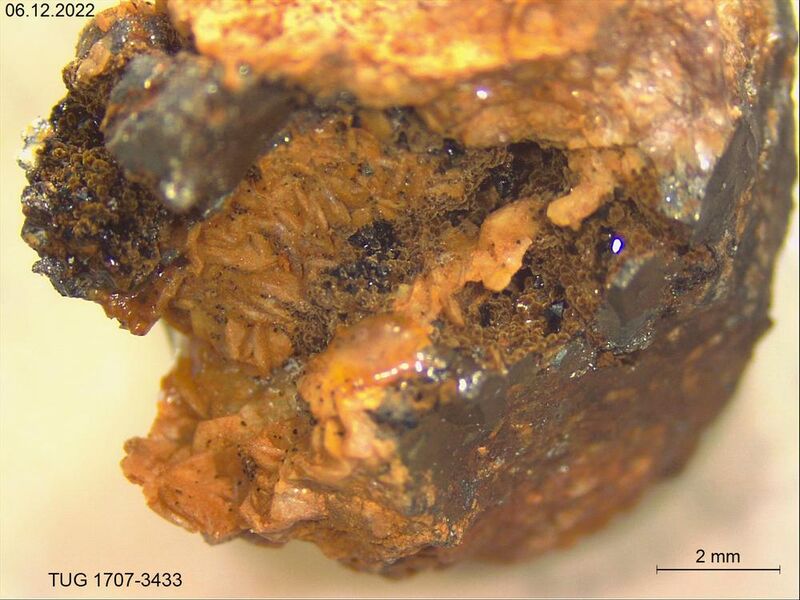 Cronstedtite(Fe2+,Fe3+)3(Si,Fe3+)2O5(OH)4Mineral—
 Fraipontite(Zn,Al)3(Si,Al)2O5(OH)4Mineral—
- GuidottiiteMn2Fe3+(SiFe3+)O5(OH)4Mineral—
 Kellyite(Mn2+,Mg,Al)3(Si,Al)2O5(OH)4Mineral—
Literature, links & citation
Citations
- —Caruso, L.J. and Chernosky, J.V. (1979) The stability of lizardite. The Canadian Mineralogist, 17 (4), 757–769.
- 1951Midgley, H.G. (1951): A serpentine mineral from Kennack Cove, Lizard, Cornwall. Mineralogical Magazine 29, 526-530.
- 1956Whittaker, E. J. W., Zussman, J. (1956) The characterization of serpentine minerals by X-ray diffraction. Mineralogical Magazine and Journal of the Mineralogical Society, 31 (233) 107-126 doi:10.1180/minmag.1956.031.233.01 DOI: 10.1180/minmag.1956.031.233.01
- 1968Page, Norman J. (1968) Chemical differences among the serpentine "polymorphs". American Mineralogist, 53 (1-2) 201-215
- 1970Whittaker, E. J. W., Wicks, F. J. (1970) Chemical differences among the serpentine "polymorphs": A discussion. American Mineralogist, 55 (5-6) 1025-1047
Cite this entry
Entry last updated
@misc{mineral2026,
  author    = {Mineral Index editorial board},
  title     = {Lizardite — Mineral Index},
  year      = {2026},
  url       = {https://mineralindex.org/minerals/lizardite-2425}
}