History
The mineral wears its name like a description. Rhodochrosite was coined in 1813 by the German mineralogist Johann Friedrich Ludwig Hausmann, from the Greek rhodon — rose — and chroma — colour. The species was first described from a sample from Cavnic, in the Maramureș region of present-day Romania. There it had turned up in the local silver mines.
The carbonate would later be tied to two very different localities: a high mountain in Colorado, and a mining district in Argentina.
The Sweet Home Mine
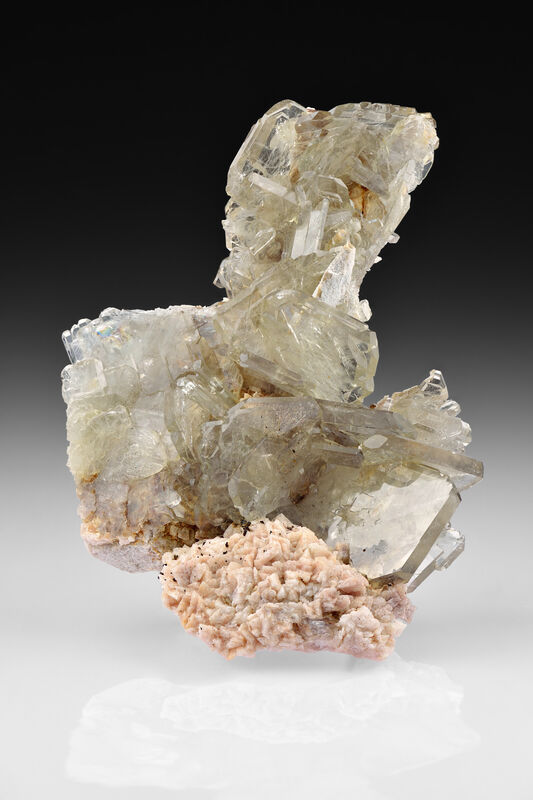
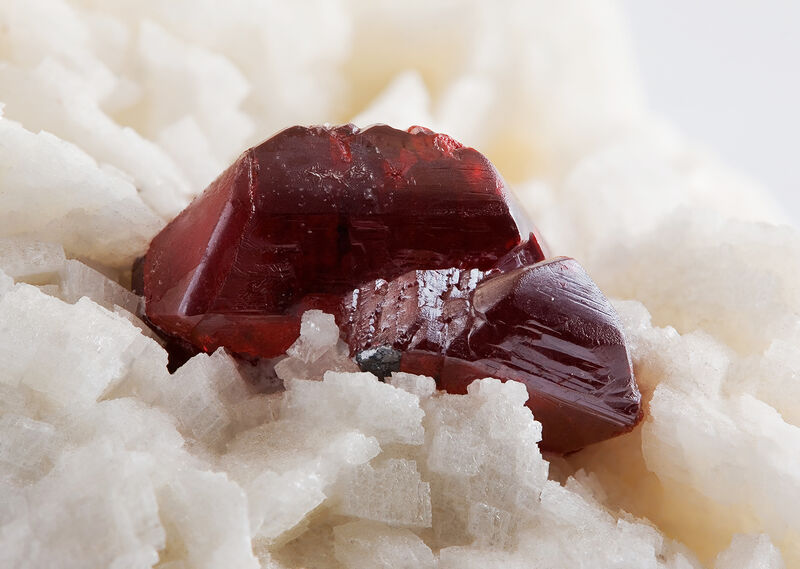
The Sweet Home Mine sits near Alma, Colorado, on the southern slope of Mount Bross. It was founded in 1873 as a silver mine. Its most famous product, though, turned out to be rhodochrosite — sharp red rhombs, a rhomb being a slanted-cube crystal form.
The largest known crystal of the species, called the Alma King, measures roughly 14 by 16.5 centimetres. It was found at the Sweet Home Mine and is displayed at the Denver Museum of Nature and Science.
Colorado officially named rhodochrosite its state mineral in 2002.
Capillitas and the Inca rose
In Argentina, banded rhodochrosite is mined at Capillitas. The banded material — pink and white layers running through the stone — is the variety carved and polished as a decorative stone. It is called Rosa del Inca, Inca Rose, or Rosinca, and rhodochrosite is recognised as Argentina's national gemstone.
Industrial & practical applications
Rhodochrosite earns its place in industry twice over — once as a metal ore, once as a stone to be cut.
The first role is as an ore of manganese. Manganese is a metal added in small amounts to a range of alloys. It goes into low-cost stainless steel formulations, into many tool steels, and into certain aluminium alloys. In steelmaking the metal usually enters the furnace as a ferromanganese alloy, an iron–manganese intermediate produced upstream from manganese ores.
As a decorative stone
Quality banded specimens are cut for decorative stones and jewellery. The banded material — pink and lighter layers running through the stone — takes a polish well. It is sold mostly as carved and polished pieces rather than faceted gems.
The mineral is rarely seen as a faceted gem at all. Rhodochrosite is soft and has perfect cleavage — meaning it splits cleanly along three internal planes. That property makes it hard to cut into the angular shapes a faceted stone needs. Collectors prize it instead in its natural crystal form.
Where it forms, where it's found
- Geological setting
Low to moderate temperature hydrothermal veins, metamorphic deposits, carbonatites, sedimentary deposits.
- Type locality
- Cavnic Mine
- Cavnic
- Maramureș County
- Romania
47.6639°, 23.8614°
Varieties
Physical
- Hardness
- 1Talc
- 2Gypsum
- 3Calcite
- 4Fluorite
- 5Apatite
- 6Orthoclase
- 7Quartz
- 8Topaz
- 9Corundum
- 10Diamond
- Lustre
- Vitreous
- Transparency
- Transparent · Translucent
- Colour
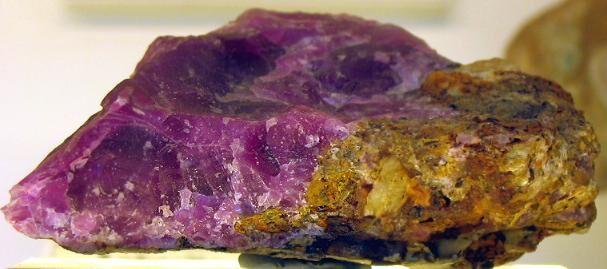
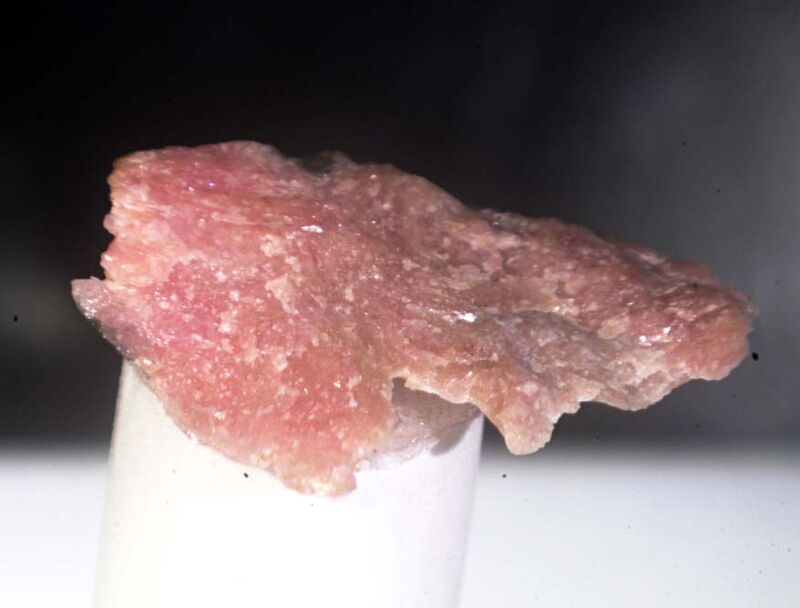
- Pink · rose · red · yellowish-grey · brown · white · gray · colourless to pale rose in transmitted light
Reds occur when the mineral has minimal iron content.
- Streak
- White
- Tenacity
- brittle
- Cleavage
- Perfect
On (101).
- Fracture
- Irregular/Uneven · Conchoidal
- Density
- 3.7 g/cm³
Optical
- Optical type
- Uniaxial (-)
- Refractive index
- 1.596 – 1.816
- Surface relief
- High
- Principal indices
- nω 1.814 – 1.816 · nε 1.596 – 1.598
- Pleochroism
- Weak
The deep red coloured material may be faintly dichroic with absorption O greater than E.
- UV response
- None.
Crystallography
- Space group
- #98
- Cell parameters
- a = 4.777 Å · c = 15.67 Å
- Z
- 6
- Morphology
Crystals rhombohedral (101) or less commonly (012), then frequently rounded and composite; scalenohedral rare; thick tabular (0001); prismatic [0001]. (110) and (211) often striated [1_10_1]. Massive, coarsely granular; compact; columnar; crusts; stalactitic (with zoned growth rings); botryoidal. For habits see:<A href="http://www.mindat.org/article.php/61/Rhodochrosite+Showcase">Rhodochrosite Habits</A>.
- Twinning
On (012), lamellar, uncommon.
- Parting
- On (012) at times.
- Translation gliding
- Translation gliding with T(0001), t[10_10].
Chemical composition
- Impurities
- Fe
- Ca
- Mg
- Zn
- Co
- Cd
Synonyms
- Blättriges Rotmanganerz
- Carbonate of Manganese
- Diallogit
- Diallogita
- Diallogite
- Dialogit
- Dialogita
- Dialogite
- Dichter Rothstein
- Himbeerspat
- Himbeerspath
- Inca Rose
- Kohlensaures Magnesium oxydul
- Luftsaures Braunsteinerz
- Magnesium acido aëro mineralisatum
- Magnesium ochraceum rubrum
- Manganèse oxydé carbonaté
- Manganese Spar
- Manganspat
- Manganspath
- Oxide de manganèse couleur de rose
- Raspberry Spar
- Rhodochrolit
- Rhodochrolita
- Rhodochrolite
- Rhodochrosita
- Rhodocrosite
- Rodokrosiitin
- Rosenspath
- Rother Braunsteinerz
- Rothspath
- Strömit
- Strömite
- Villaurite
In other languages
- French
- Diallogite · Manganèse oxydé carbonaté · MnCO3 · Rhodochroisite · rhodochrosite · Rhodocrosite · Torrensite · Villaurite
- German
- Himbeerspat · Manganspat · Rhodochrosit
- Spanish
- rodocrosita
- Italian
- rodocrosite
- Portuguese
- rodocrosita · Rodocrosite
- Japanese
- インカローズ · ロードクロサイト · 菱マンガン鉱
- Chinese
- 印加玫瑰石 · 菱錳礦 · 菱锰矿
- Simplified Chinese
- 菱锰矿
- Traditional Chinese
- 菱錳礦
- Russian
- Малиновый шпат · марганцевый шпат · Родохрозит
- Arabic
- رودوكروسيت
Classification
5.AB.05
- 5CarbonatesClass
- 5.ACarbonates without additional anions, without H2ODivision
- 5.ABAlkali-earth (and other M2+) carbonatesGroup
- 5.AB.05RhodochrositeSpecies
14.01.01.04
- 14Anhydrous Normal CarbonatesClass
- 14.01A(XO3)Type
- 14.01.01Calcite Group (Trigonal: R-3c)Group
- 14.01.01.04RhodochrositeSpecies
11.12.1
- 11CarbonatesClass
- 11.12Carbonates of MnGroup
- 11.12.1RhodochrositeSpecies
Group, growth & confusion
Literature, links & citation
- 1783Bergman, Torbern (1783) Sciagraphia Regni Mineralis Secundum Principia Proxima Digesti [Sketch of the Mineral Kingdom According to the Proximate Principles of Digestion]. Apud Johannem Murray, Londini. 165pp.
- 1794Lenz, D.G. (1794) Versuch einer vollständigen Anleitung zur Kenntniss der Mineralien. vol. 2, Leipzig (as Luftsaures Braunsteinerz).
- 1809Haüy, René Just (1809) Tableau comparatif des résultats de la Cristallographie et de l'analyse Chimique, relativement a la Classification des Minéraux.. Chez Courcier, Paris.
- 1813Hausmann, Johann Friedrich Ludwig (1813) Handbuch der Mineralogie (1st ed.). Vandenhoeck und Ruprecht.
- 1881Sansoni, F. (1881) Ein neues Vorkommen von krystallisirtem Manganspath. Zeitschrift für Kristallographie, Mineralogie und Petrographie, Leipzig, 5, 250-251.
Entry last updated
@misc{mineral2026,
  author    = {Mineral Index editorial board},
  title     = {Rhodochrosite — Mineral Index},
  year      = {2026},
  url       = {https://mineralindex.org/minerals/rhodochrosite-3406}
}