Where it forms, where it's found
- Geological setting
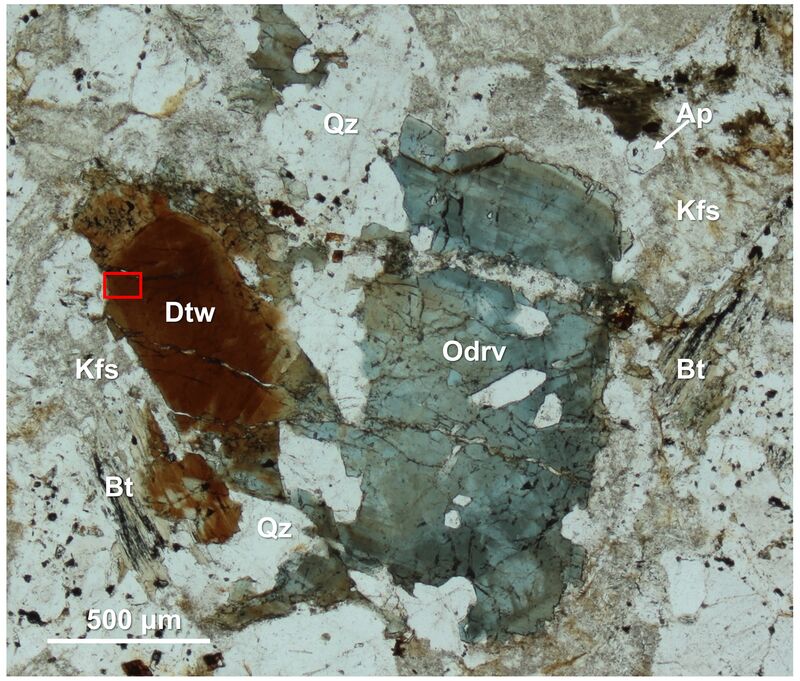
Ultrahigh-pressure quartzofeldspathic gneisses
- Type locality
- Kumdy-Kol area
- Kokchetav Massif
- Zerendi District
- Akmola Region
- Kazakhstan
52.8460°, 69.9031°
1recorded occurrences
Physical
Optical
- Optical type
- Uniaxial (-)
- Refractive index
- 1.632 – 1.652
- Surface relief
- Moderate
- Principal indices
- nω 1.632 – 1.636 · nε 1.650 – 1.652
- Pleochroism
- Visible
O = darkish brown, E = pale brown
- UV response
- Non-fluorescent
Δ = 0Δmax
PPLpleochroism per grain
XPLindependent extinctions · rotate the stage
PPLpleochroism only · colour blends on rotation
XPLinterference colour · extinct every 90°
Retardation170 nm
Order1st order
XPL colour
Crystallography
- Space group
- R3m
- Cell parameters
- a = 15.955(1) Å · c = 7.227(1) Å
- Unit cell volume
- 1593 ų
- Z
- 3
- Morphology
Anhedral to euhedral grains up to 2 mm across
- Parting
- No observable parting
- Type-locality form
Anhedral to euhedral grains up to 2 mm across, embedded in a matrix of anhedral quartz and K-feldspar. May contain inclusions of microdiamonds.
Chemical composition
Synonyms
- IMA2013-123
- Maruyamaiet
In other languages
- German
- IMA 2013-123 · Maruyamait
- Japanese
- 丸山電気石
Classification
Strunz
10th ed.9.CK.05
- 9SilicatesClass
- 9.CCyclosilicatesDivision
- 9.CK[Si6O18]12- 6-membered single rings, with insular complex anionsGroup
- 9.CK.05MaruyamaiteSpecies
Group, growth & confusion
- AdachiiteCaFe2+3Al6(Si5AlO18)(BO3)3(OH)3(OH)Mineral—
- Alumino-oxy-rossmaniteAl3Al6(Si5AlO18)(BO3)3(OH)3OMineral—
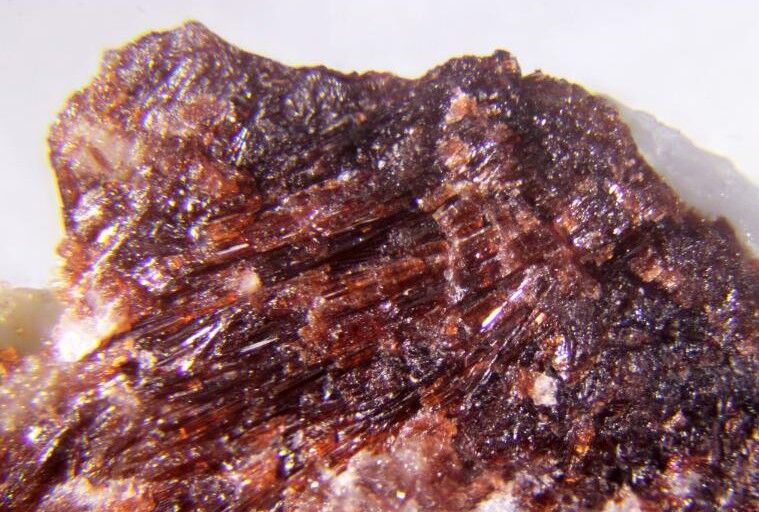 BosiiteNaFe3+3(Al4Mg2)(Si6O18)(BO3)3(OH)3OMineral—
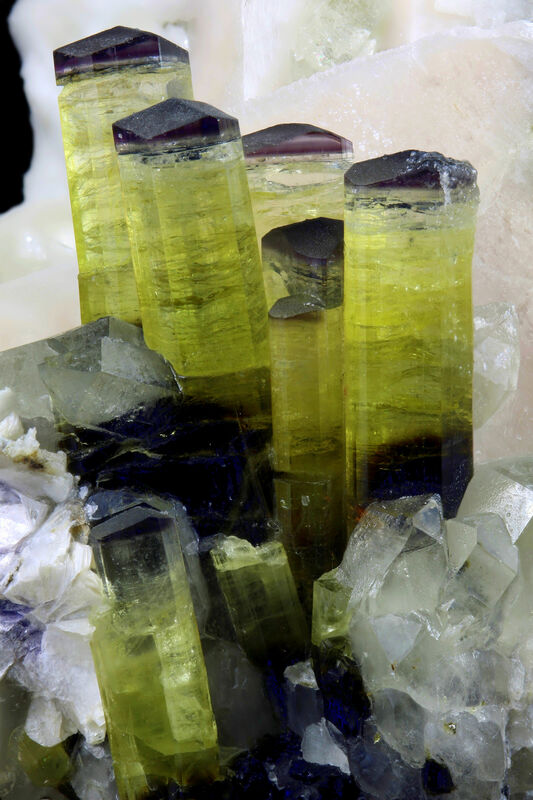 Celleriite◻(Mn2+2Al)Al6(Si6O18)(BO3)3(OH)3(OH)Mineral—
- Chromium-draviteNaMg3Cr3+6(Si6O18)(BO3)3(OH)3(OH)Mineral—
- Chromo-alumino-povondraiteNaCr3(Al4Mg2)(Si6O18)(BO3)3(OH)3OMineral—
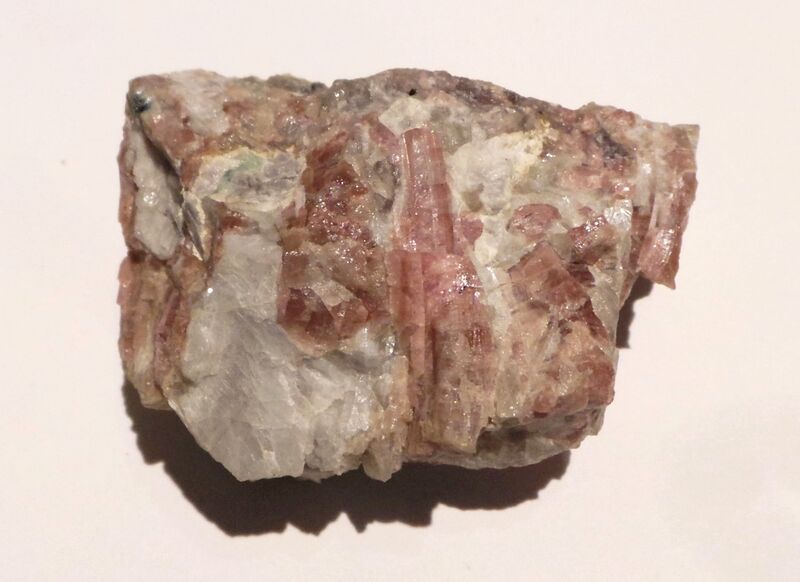 DarrellhenryiteNa(Al2Li)Al6(Si6O18)(BO3)3(OH)3OMineral—
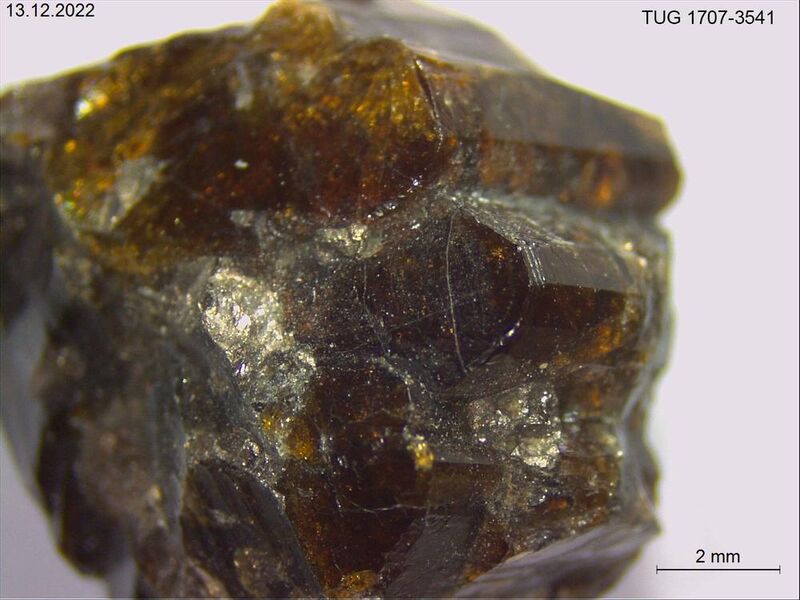 DraviteNaMg3Al6(Si6O18)(BO3)3(OH)3(OH)Mineral—
 DutrowiteNa(Fe2+2.5Ti0.5)Al6(Si6O18)(BO3)3(OH)3OMineral—
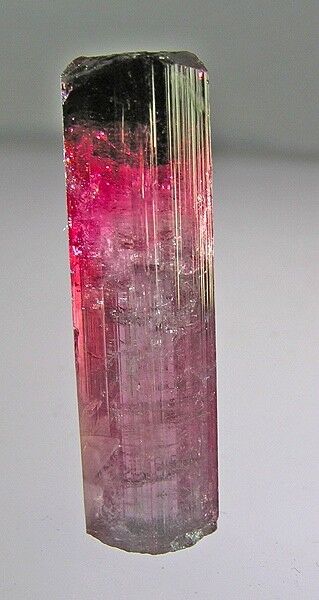 ElbaiteNa(Al1.5Li1.5)Al6(Si6O18)(BO3)3(OH)3(OH)Mineral—
Literature, links & citation
Citations
- 2014Williams, P. A., Hatert, F., Pasero, M., Mills, S. J. (2014) New minerals and nomenclature modifications approved in 2014, CNMNC Newsletter No 20. Mineralogical Magazine, 78 (3) 549-558 doi:10.1180/minmag.2014.078.3.05DOI: 10.1180/minmag.2014.078.3.05
- 2016Lussier, Aaron, Ball, Neil A., Hawthorne, Frank C., Henry, Darrell J., Shimizu, Rentaro, Ogasawara, Yoshihide, Ota, Tsutomu (2016) Maruyamaite, K(MgAl2)(Al5Mg)Si6O18(BO3)3(OH)3O, a potassium-dominant tourmaline from the ultrahigh-pressure Kokchetav massif, northern Kazakhstan: Description and crystal structure. American Mineralogist, 101 (2) 355-361 doi:10.2138/am-2016-5359 DOI: 10.2138/am-2016-5359
- 2017(2017) Maruyamaite. Handbook of Mineralogy. Mineralogical Society of America
Cite this entry
Entry last updated
@misc{mineral2025,
  author    = {Mineral Index editorial board},
  title     = {Maruyamaite — Mineral Index},
  year      = {2025},
  url       = {https://mineralindex.org/minerals/maruyamaite-46075}
}