History
The name comes from a Greek word meaning "to be solitary." When the mineral was first found, its crystals turned up one at a time, scattered and alone rather than clustered. That habit gave it its name in 1829, when the German mineralogist Johann Friedrich August Breithaupt described it.
The full name carries a second clue. Monazite is not one mineral but a small family, and its members differ by which rare-earth element fills the same slot in the crystal. The "-(Ce)" tag marks the cerium-dominant member — cerium is a soft, silvery rare-earth metal. The suffix follows a naming convention used across rare-earth minerals to flag the element present in the greatest amount.
For most of its working life, monazite was valued not for those rare earths but for the thorium mixed in with them. Thorium is a faintly radioactive metal. In the 1880s the Austrian chemist Carl Auer von Welsbach noticed monazite sand carried as ballast in the holds of ships arriving from Brazil. He was hunting thorium to feed his newly invented incandescent gas mantles. These were fragile woven hoods that glowed brilliant white when heated, lighting streets and homes before the electric bulb took over. Monazite sand was quickly taken up as the thorium source.
That demand built an industry. Brazilian and Indian monazite dominated it before the Second World War, with especially rich sands found in southern India. The mineral kept its place as the main thorium ore, and a major source of lanthanum and cerium, into the mid-twentieth century.
Then it lost ground. The thorium that had first made monazite useful became a liability. Thorium decays through a chain of radioactive daughter products, and disposing of them safely is difficult. In the 1960s a different rare-earth mineral, bastnäsite, displaced monazite in the production of the rare earths because it carries far less thorium.
Industrial & practical applications
Crack open a grain of monazite and you find a pantry of rare-earth elements. These are a set of seventeen metals prized for the unusual things they do in magnets, screens and catalysts. By weight, the rare earths inside the mineral run to roughly 45 to 48 percent cerium, about 24 percent lanthanum, around 17 percent neodymium, and about 5 percent praseodymium. That makes it one of the principal ore minerals from which the world's rare earths are won.
What those metals end up doing spans several industries. The largest single use is in catalysts — substances that speed chemical reactions, especially in refining crude oil. Others go into the strong permanent magnets that spin in electric motors and wind turbines, into the polishing powders that finish glass and silicon, into ceramics and specialty glass, and into metal alloys.
The mineral is rarely dug for on its own. It travels with the dense, dark grains of heavy-mineral sands, and is recovered as a by-product when those sands are mined for titanium and zirconium minerals. In the southeastern United States it is set aside as a separated concentrate or left in with the heavy-mineral-sand product rather than processed.
There is a catch that shadows every ton. Monazite is radioactive, because thorium and, less often, uranium sit alongside the rare earths in its structure. Handling that radioactivity, and disposing of it safely, is costly. It is a large part of why a competing mineral, bastnäsite, overtook monazite as the main rare-earth feedstock decades ago and still carries much of the load. World rare-earth production today is heavily concentrated, with China supplying the bulk of mined output.
Where it forms, where it's found
- Geological setting
Originally described from a "quartz-leeren Zirkon Granits", which could be the same as a syenite pegmatite.
Pegmatites of various kinds associated with granitic or syenitic igneous rocks.
- Type locality
- Ilmen Nature Reserve
- Chelyabinsk Oblast
- Russia
Varieties
Physical
- Hardness
- 1Talc
- 2Gypsum
- 3Calcite
- 4Fluorite
- 5Apatite
- 6Orthoclase
- 7Quartz
- 8Topaz
- 9Corundum
- 10Diamond
- Transparency
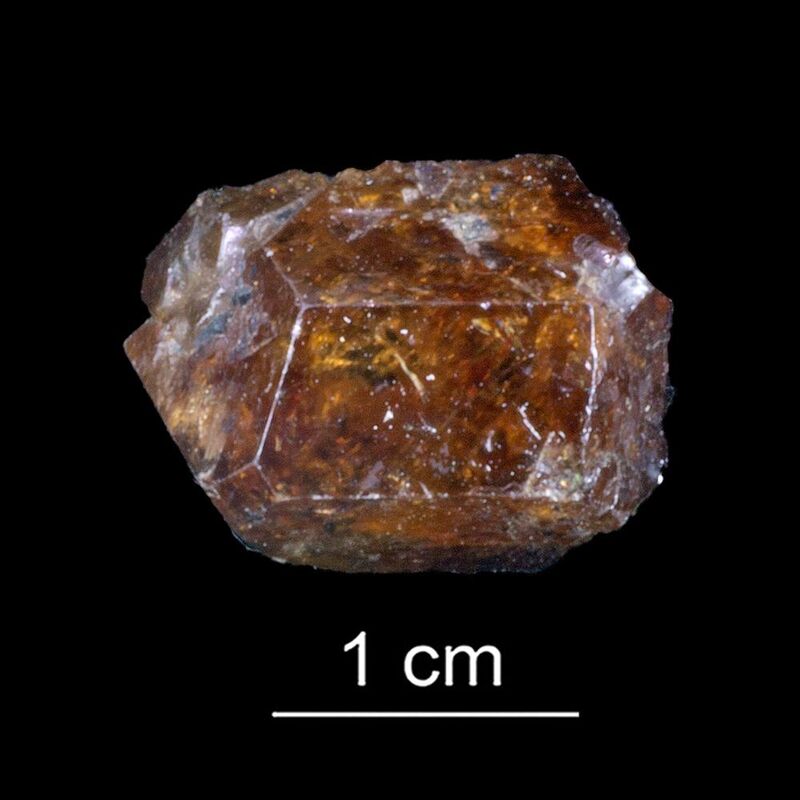
- Translucent
- Colour
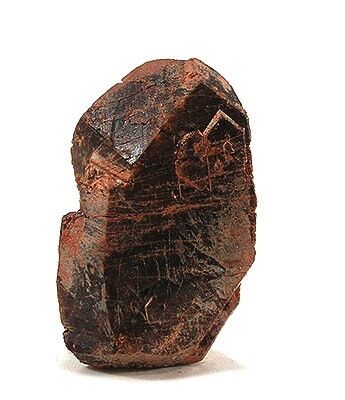
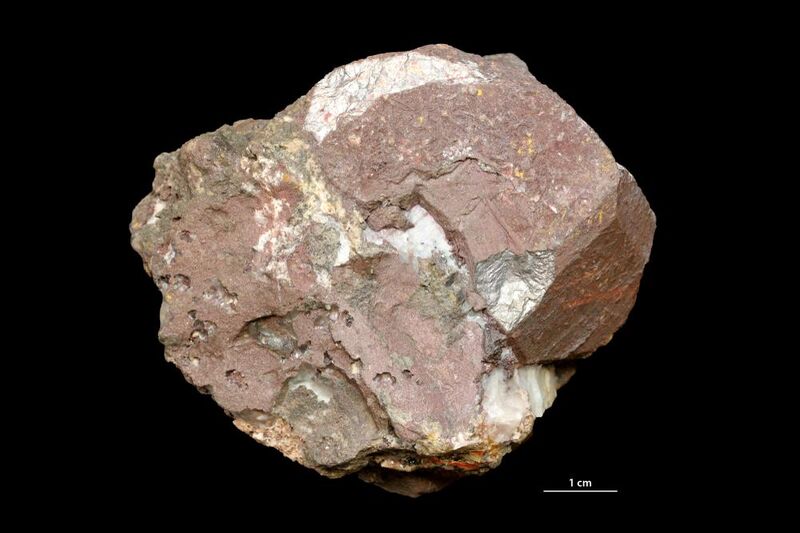
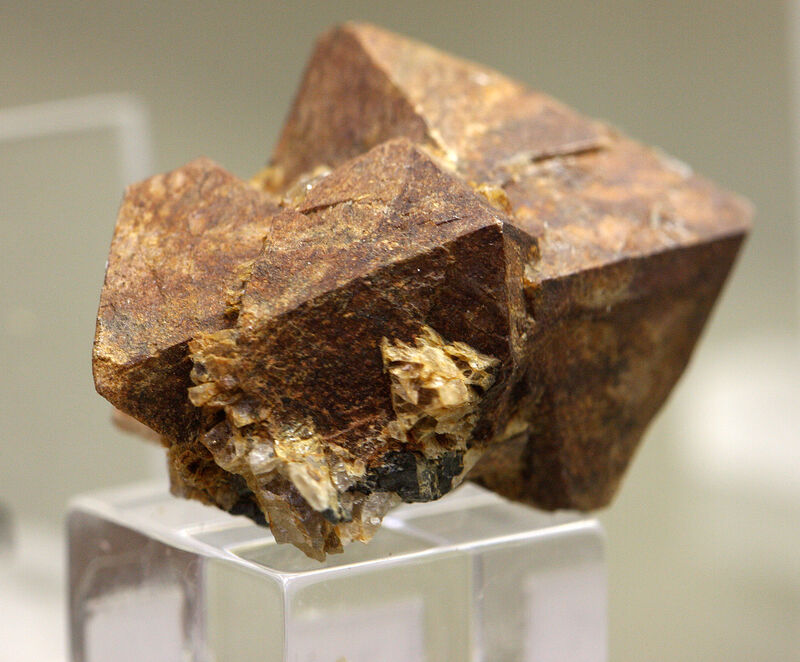
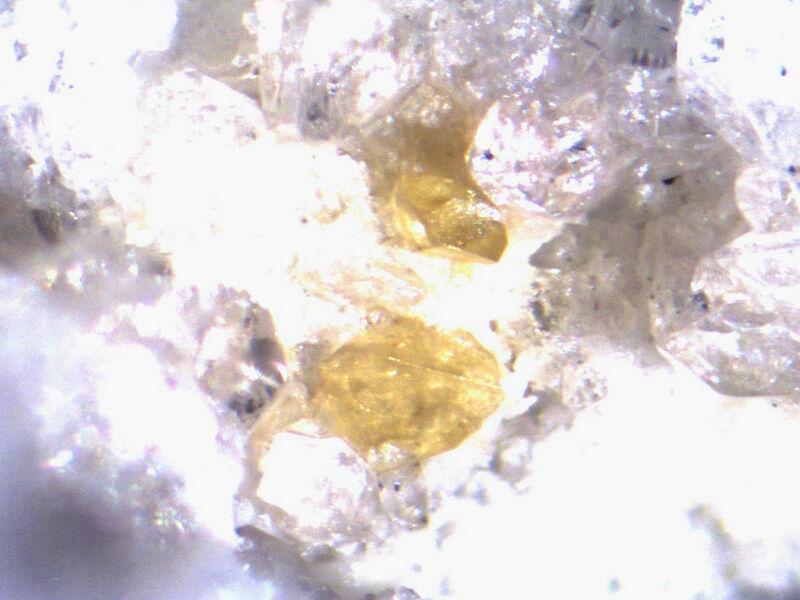
- Commonly reddish brown to brown · shades of green to brown · yellow brown · rarely nearly white · yellow · colourless in transmitted light.
- Streak
- White, faintly coloured.
- Tenacity
- brittle
- Cleavage
- Distinct/Good
On (100), distinct; on (010), difficult; also on (110), (101), and (011), indistinct as observed at times.
- Fracture
- Irregular/Uneven · Conchoidal
- Density
- 5 g/cm³
Optical
- Optical type
- Biaxial (+) · 2V measured = 10 – 26° · 2V calc = 18 – 24°
- Refractive index
- 1.77 – 1.86
- Surface relief
- Very high
- Principal indices
- nα 1.770 – 1.793 · nβ 1.778 – 1.800 · nγ 1.823 – 1.860
- Birefringence
- 0.060
- Pleochroism
- Weak
Faint to imperceptible. In pale yellows.
- Dispersion
- r > v or r < v, weak
- Extinction
- X=b, Z^c = 2° - 6°
- UV response
- Not fluorescent
Crystallography
- Cell parameters
- a = 6.7902(10) Å · b = 7.0203(6) Å · c = 6.4674(7) Å
- Cell angles
- β = 103.6 °
- Ratio a:b:c
- 1 : 1.034 : 0.952
- Z
- 4
- Morphology
Crystals usually small but may be large and coarse at times. Frequently flattened (100) or elongate [010]; prismatic by extension of (11) at times; equant, or wedge-shaped by the large development of (100) and (11). Crystal faces commonly rough, striated or uneven.
- Twinning
On (100), common; cruciform at times. Also on (001), lamellar, rare. Doubtfully reported on (201) and (02).
- Parting
- Well-marked frequently present on (001); on (11), rare.
- Type-locality form
Red to red-brown tabular crystals
- Comment
Space-group setting P21/n.
Chemical composition
Synonyms
- Edwardsita
- Edwardsite (of Shepard)
- Edwarsit
- Eremite
- Karafveit
- Kårarfveit
- Korarfveite
- Kularit
- Kularita
- Mengite (of Brooke)
- Monaziet-(Ce)
- Monazitoid
- Phosphocerite
In other languages
- German
- Monazit-(Ce)
- Italian
- Monazite- · Monazite-(Ce)
Classification
8.AD.50
- 8Phosphates, Arsenates, VanadatesClass
- 8.APhosphates, etc. without additional anions, without H2ODivision
- 8.ADWith only large cationsGroup
- 8.AD.50Monazite-(Ce)Species
38.04.03.01
- 38Anhydrous Normal Phosphates, Arsenates, and VanadatesClass
- 38.04AXO4Type
- 38.04.03Monazite Group (Monoclinic: P21/n)Group
- 38.04.03.01Monazite-(Ce)Species
19.9.3
- 19PhosphatesClass
- 19.9Phosphates of rare earths and ScGroup
- 19.9.3Monazite-(Ce)Species
Group, growth & confusion
Literature, links & citation
- 1823Phillips, William (1823) An Elementary Introduction to Mineralogy (3rd ed.)
- 1823Lévy (1823) Annals of Philosophy, London: 5: 241 (as Turnerite).
- 1829Breithaupt, A. (1829) Ueber den Monazit, eine neue Specie des Mineral-Reichs. Journal für Chemie und Physik, Nuremberg: 55: 301-303 (as Monazite).
- 1831Brooke, H. (1831) Philosophical Magazine and Journal of Science: 10: 189 (as Mengite).
- 1837Shepard, C.U. (1837) American Journal of Science: 32: 162 (as Edwardsite).
Entry last updated
@misc{mineral2026,
  author    = {Mineral Index editorial board},
  title     = {Monazite-(Ce) — Mineral Index},
  year      = {2026},
  url       = {https://mineralindex.org/minerals/monazite-ce-2751}
}