History
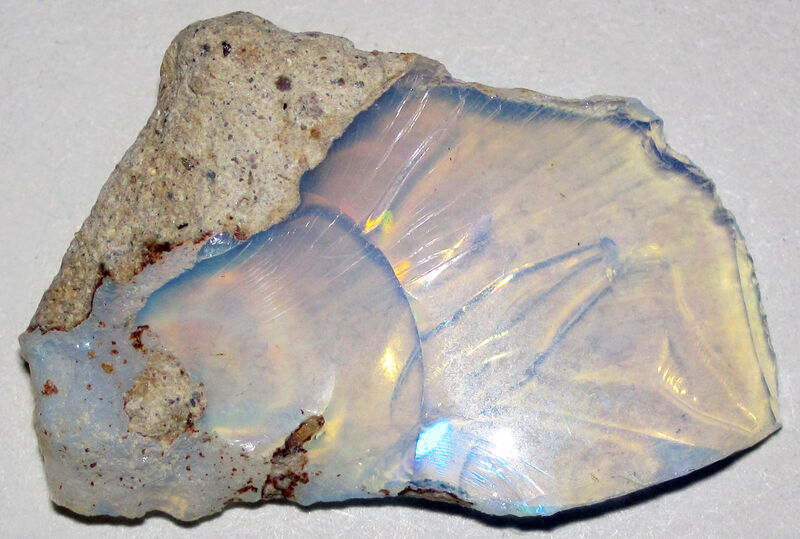
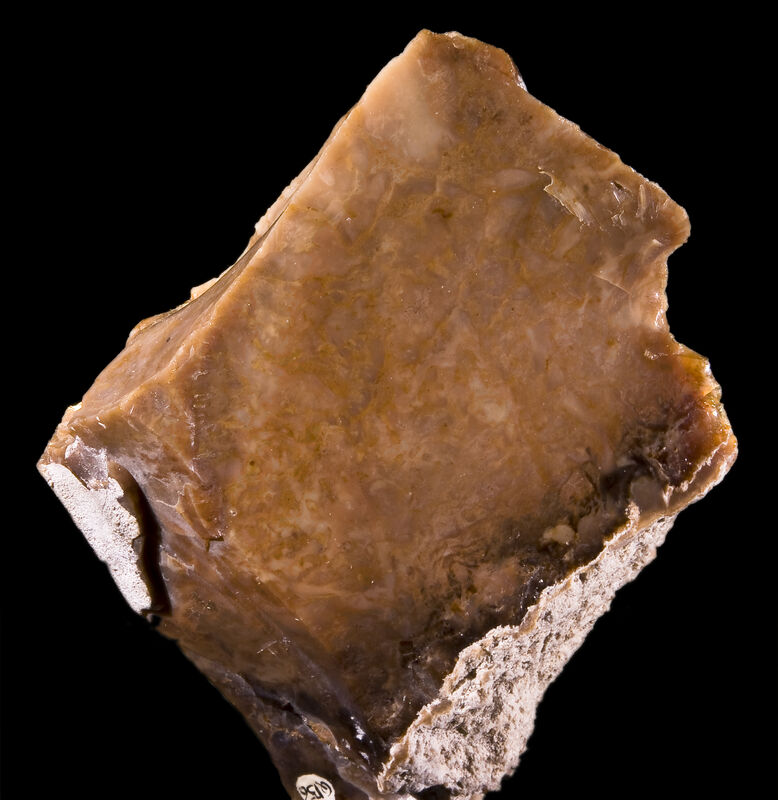
Opal-AN is the glassy, transparent end of the opal family — the variety mineralogists and jewellers have long called hyalite. The older of those two names came first. In 1794 the German geologist Abraham Gottlob Werner coined hyalite, from the Ancient Greek hyalos, meaning glass. The drops and crusts the name describes can be transparent enough to read through.
Two earlier labels still surface in older literature. Müller's glass honours Franz-Joseph Müller von Reichenstein, the Austrian mineralogist credited with the first description. Water opal and the rarer jalite refer to the same material. All four names describe what would much later be classified as a single sub-species of amorphous opal.
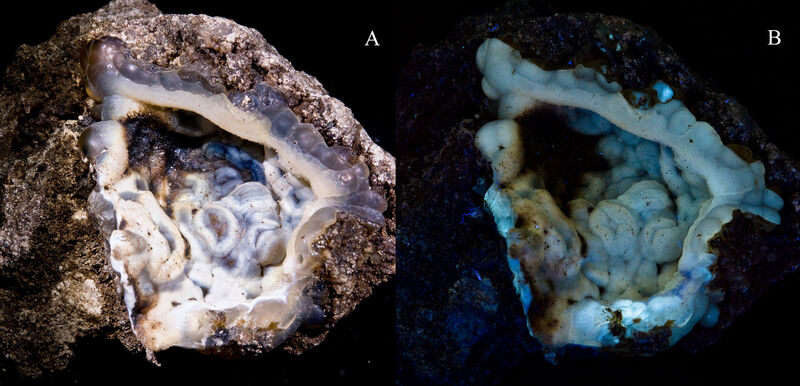
Through the nineteenth century, hyalite earned a place in collectors' cabinets for a reason that had little to do with transparency. Specimens from a handful of localities fluoresce a vivid green under ultraviolet light, and sometimes under ordinary daylight. The glow comes from trace amounts of the uranyl ion, (UO₂)²⁺, trapped inside the silica network. The uranium content stays well below any radiological hazard, but it is high enough to make hyalite one of the most spectacular ultraviolet performers in any cabinet.
A formal mineralogical place inside the opal family arrived in 1971. That year, the Australian mineralogists J. B. Jones and E. R. Segnit proposed grouping opals by their internal structure, using X-ray diffraction. The method separated truly amorphous opal from varieties with traces of crystalline order. They split the amorphous class, opal-A, into two sub-groups. Opal-AG is the gel-like form of most precious opal. Opal-AN is the form in which the silica builds a continuous random network closer to ordinary silica glass. The letter codes are short for the structure: A for amorphous, N for network. Hyalite is the type material of the opal-AN sub-group.
The most striking modern source of fluorescent hyalite was identified in 2013 at Zacatecas, in central Mexico. There, botryoidal coatings of green-luminescing material up to a centimetre thick line fractures in a poorly welded rhyolitic tuff. Other Mexican deposits at San Luis Potosí, and finds in Madagascar, have since added to the supply.
Industrial & practical applications
Opal-AN has almost no role in heavy industry. Unlike the opal-AG of Australian sedimentary fields, hyalite shows no play-of-colour — the optical fireworks that make precious opal a gemstone. Its uses are correspondingly narrow.
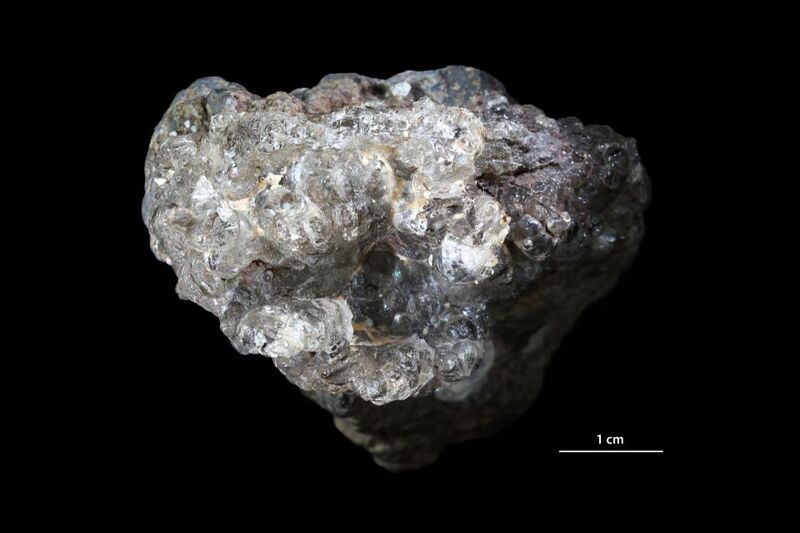
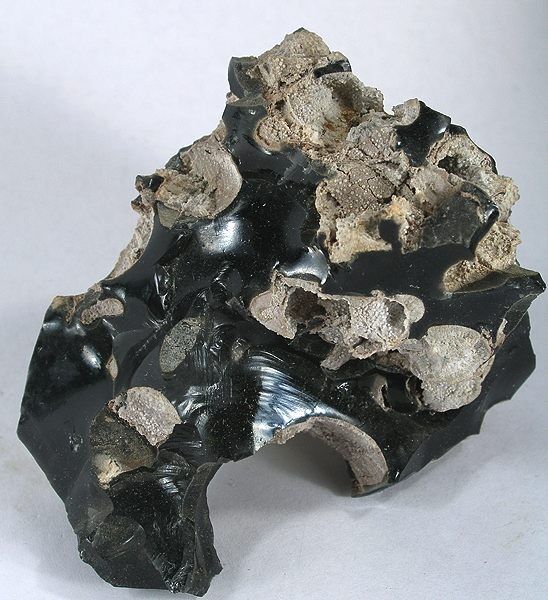
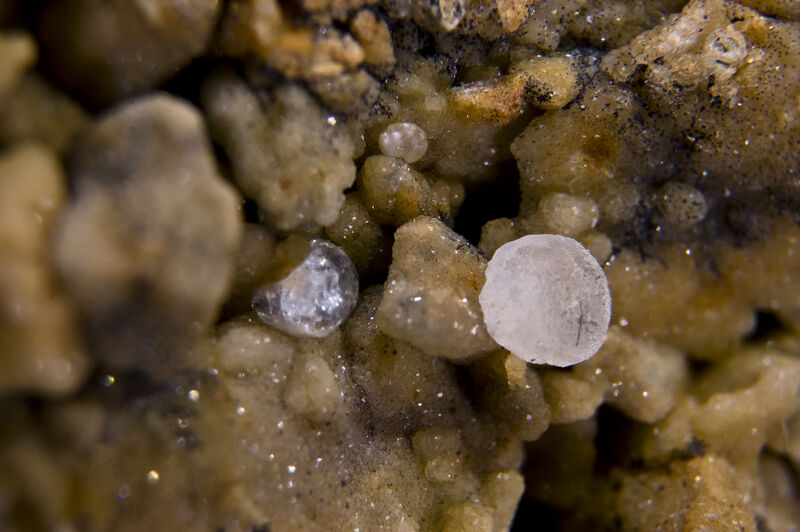
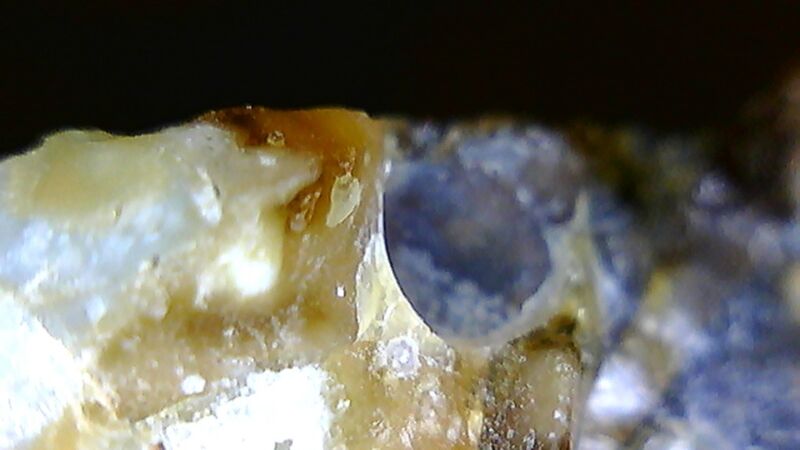
The main market today is collectors and museums. Well-formed botryoidal specimens — the grape-cluster habit of rounded, glassy droplets — are prized for their unusual mode of formation and their relative rarity. Demand concentrates on the vivid green ultraviolet response of uranyl-bearing material — the trait that distinguishes hyalite from look-alike colourless silica.
The 2013 Zacatecas discovery in central Mexico has anchored much of the supply since. Specimens cut there are sold as a registered trade-name gem, drawn from botryoidal coatings up to a centimetre thick. Uranium content runs as high as 0.3 weight percent of UO₂, but emitted radiation stays very low. The gem can be worn or cut without hazard.
A small jewellery trade follows the same supply. Transparent opalescent hyalite — the more lustrous, drop-shaped specimens — is occasionally faceted or cabbed for collector jewellery rather than the mainstream gem market. Outside of that, no significant industrial application is recorded.
Where it forms, where it's found
- Geological setting
Volcanic vugs, pegmatite pockets, fumaroles.
Varieties
Physical
Synonyms
- Gummistein
- Hyaline
- Hyalit
- Hyalita
- Hyalith
- Jalit
- Jalita
- Jalite
- Müller's Glass
Group, growth & confusion
Literature, links & citation
- 1973Flörke, O.W., Jones, J.B., Segnit, E.R. (1973) The genesis of hyalite. Neues Jahrbuch der Mineralogie, Monatshefte, H.2, 82-89.
- 1994Graetsch, H. (1994) Structural characteristics of opaline and microcrystalline silica minerals. in: Heaney, P.J., Gibbs, G.V., editors. Reviews in Mineralogy Volume 29 Silica - Physical behaviour, geochemistry and materials applications. Mineralogical Society of America, 209-232.
- 2008Kostov, Rusian I. (2008) Orphic Lithica As A Source Of Late Antiquity Mineralogical Knowledge. Annual Of The University Of Mining And Geology “ST. Ivan Rilski”, 51 (1) 109-115
- 2022Lee, Seungyeol, Xu, Huifang, Xu, Hongwu (2022) Reexamination of the structure of opal-A: A combined study of synchrotron X-ray diffraction and pair distribution function analysis. American Mineralogist, 107 (7) 1353-1360 doi:10.2138/am-2022-8017DOI: 10.2138/am-2022-8017
Entry last updated
@misc{mineral2026,
  author    = {Mineral Index editorial board},
  title     = {Opal-AN — Mineral Index},
  year      = {2026},
  url       = {https://mineralindex.org/minerals/opal-an-1959}
}