History
Rosasite carries a place name and nothing else. The "rosa" sound is a coincidence — the mineral is a blue-green crust, not a pink one. It takes its name from the Rosas Mine, an old lead-zinc-copper working in the Sulcis district of southwestern Sardinia.
The discovery was made in 1908 by Domenico Lovisato, one of the founding figures of Sardinian geology. Working through specimens from the Rosas Mine, he came across a sample whose structure, colour and properties did not match any known species. He showed it to be a new copper-zinc carbonate hydroxide and named it after the mine. The original description appeared the same year in the Atti della Reale Accademia dei Lincei, the proceedings of Italy's national academy of sciences. The type specimen analysed by Lovisato is held in the collections of the Museum of Natural History in Paris.
Beyond that founding episode, rosasite has little human story of its own. It is a secondary mineral — formed when groundwater weathers the upper, oxidised part of a copper-zinc sulfide ore body. It was identified too late, and stays too uncommon, to have left a mark in pigments, alchemy or industry.
Industrial & practical applications
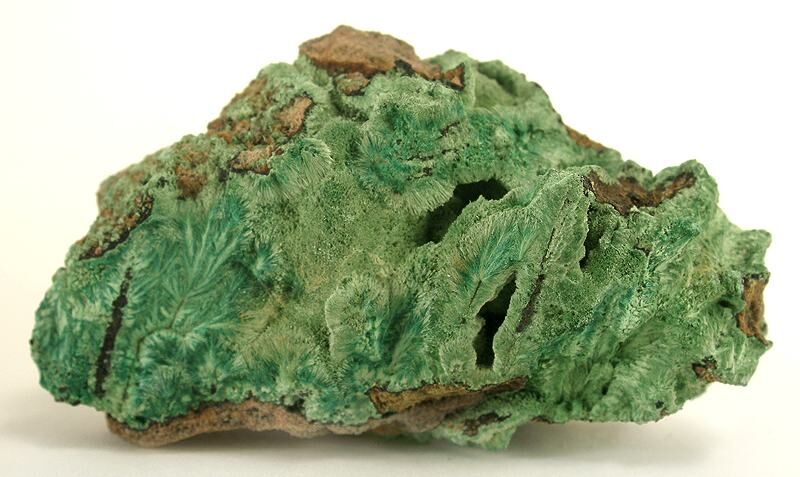
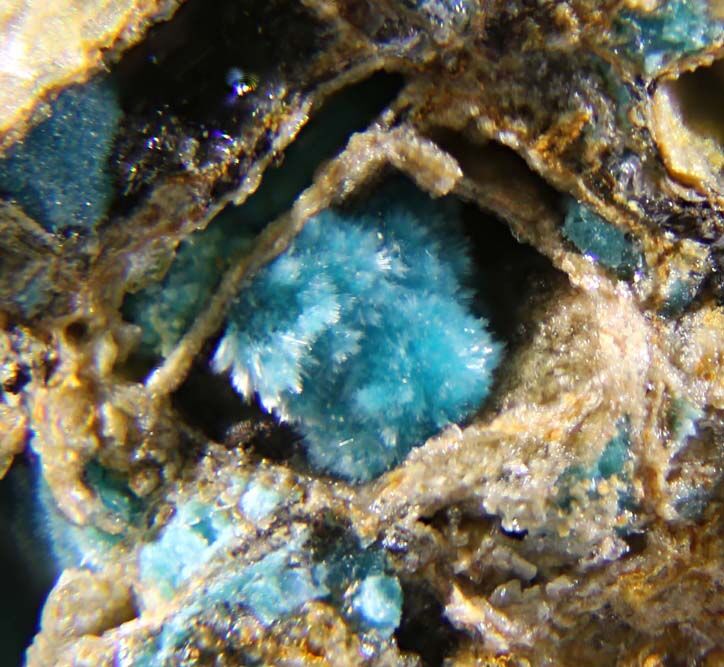
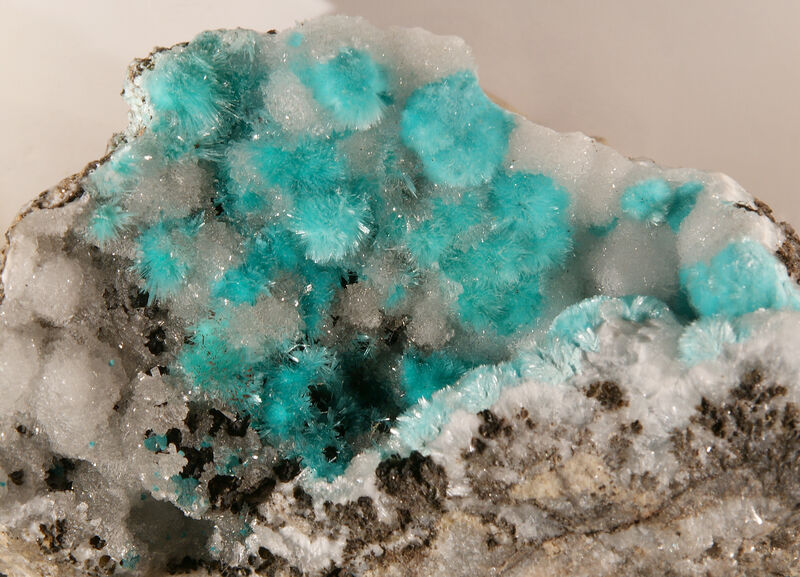
Rosasite has no industrial use of its own. Where it forms, it sits as thin botryoidal crusts and spherules — rounded, grape-like clusters of fibrous crystals. These crusts ride on top of more abundant copper and zinc minerals. Any furnace charge that includes them is dominated by the malachite, smithsonite or hemimorphite around the rosasite. At best, sources rate it as a minor potential ore of zinc and copper, not as a target species.
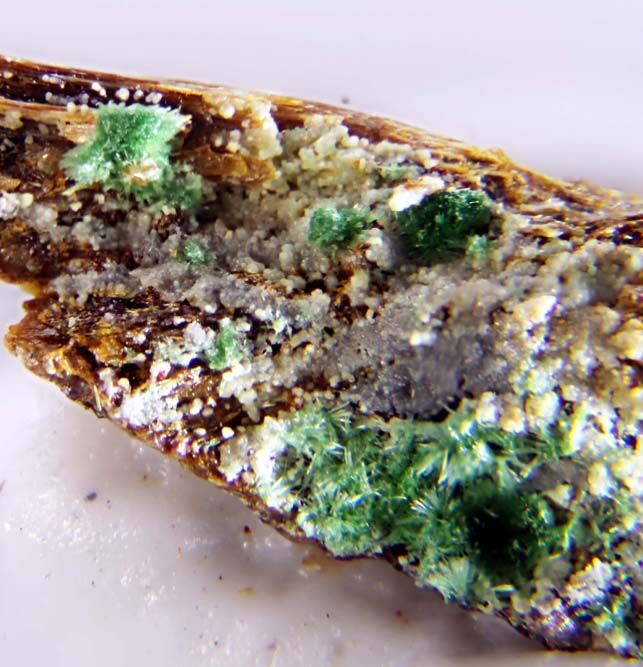
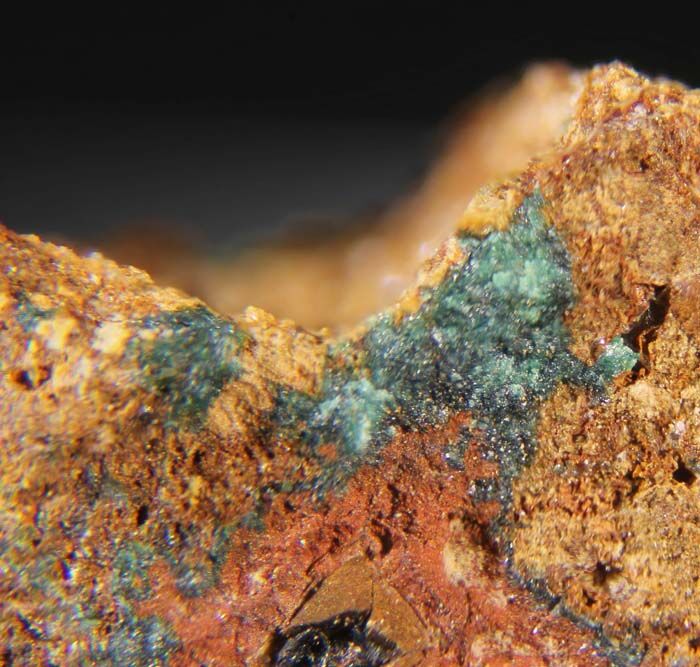
Its real value is the display cabinet. The vivid blue-green fibrous spherules, often perched on rusty limonite-stained matrix, are sought by collectors. For a field geologist, a patch of rosasite is also a marker. It forms in the oxidised, weathered zone of copper-zinc sulfide ore bodies, where descending groundwater turns primary sulfides into a suite of brightly coloured secondary minerals.
Where it forms, where it's found
- Geological setting
In the oxidised zone of a Zn-Cu deposit.
- Type locality
- Rosas Mine Complex (Rosas Mine)
- Narcao
- South Sardinia Province
- Sardinia
- Italy
39.2024°, 8.7191°
Varieties
Physical
- Hardness
- 1Talc
- 2Gypsum
- 3Calcite
- 4Fluorite
- 5Apatite
- 6Orthoclase
- 7Quartz
- 8Topaz
- 9Corundum
- 10Diamond
- Transparency
- Translucent
- Colour
- Blue · blue-green to green · sky-blue · colourless to light blue in transmitted light.
- Streak
- Light blue
- Tenacity
- brittle
- Cleavage
- Distinct/Good
In two directions at right angles.
- Density
- 4 g/cm³
Optical
- Optical type
- Biaxial (-) · 2V measured = 33° · 2V calc = 36°
- Refractive index
- 1.672 – 1.831
- Surface relief
- High
- Principal indices
- nα 1.672 – 1.688 · nβ 1.796 – 1.83 · nγ 1.811 – 1.831
- Pleochroism
- Strong
X = Pale emerald green or Colourless Y = Dark emerald green or Pale blue Z = Dark emerald green or Pale blue
- Dispersion
- r > v strong
- Extinction
- X = c; Y = a*; Z = b.
- Notes
Absorption: Z > Y > X.
Crystallography
- Space group
- P21/a
- Cell parameters
- a = 12.873(3) Å · b = 9.354(3) Å · c = 3.156(2) Å
- Cell angles
- β = 110.36(3) °
- Ratio a:b:c
- 1 : 0.727 : 0.245
- Z
- 4
- Morphology
Occurs as mammilary, botryoidal or <g>verruciform</g> crusts with a fibrous to spherulitic structure.
- Twinning
On (100).
- Comment
Space group P21/a. Perchiazzi et al. (2017) give (note different setting, with smaller beta): P21/a, a 12.2436(29) Å, b 9.3555(19) Å, c 3.1535(6) Å, β = 98.69(3)°.
Chemical composition
- Impurities
- Mg
- Fe
Synonyms
- Parauricalcite-I
In other languages
- French
- Rosasite
- German
- Rosasit
- Spanish
- Rosasita
- Italian
- Rosasite
- Chinese
- 锌孔雀石
- Arabic
- روزاسيت
Classification
5.BA.10
- 5CarbonatesClass
- 5.BCarbonates with additional anions, without H2ODivision
- 5.BAWith Cu, Co, Ni, Zn, Mg, MnGroup
- 5.BA.10RosasiteSpecies
16a.03.01.02
- 16aAnhydrous Carbonates Containing Hydroxyl or HalogenClass
- 16a.03(AB)2(XO3)ZqType
- 16a.03.01Rosasite GroupGroup
- 16a.03.01.02RosasiteSpecies
11.6.3
- 11CarbonatesClass
- 11.6Carbonates of Zn and CdGroup
- 11.6.3RosasiteSpecies
Group, growth & confusion
- ChukanoviteFe2(CO3)(OH)2Mineral—
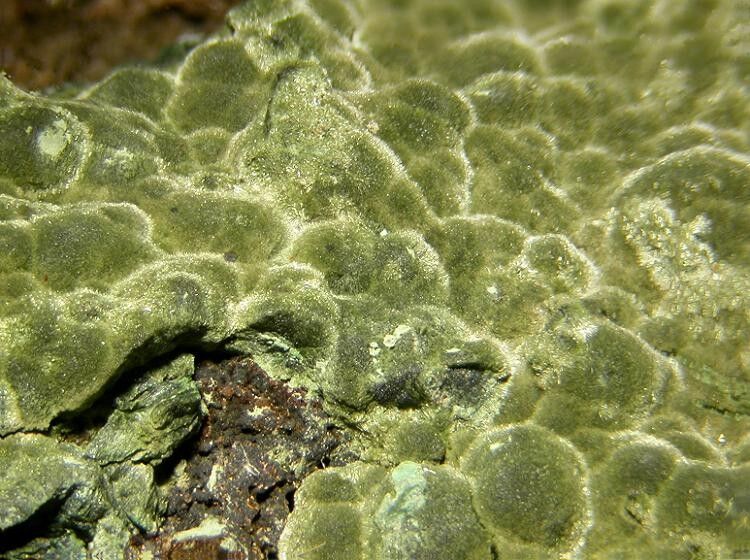
 GlaukosphaeriteCuNi(CO3)(OH)2Mineral—
 KolweziteCuCo(CO3)(OH)2Mineral—
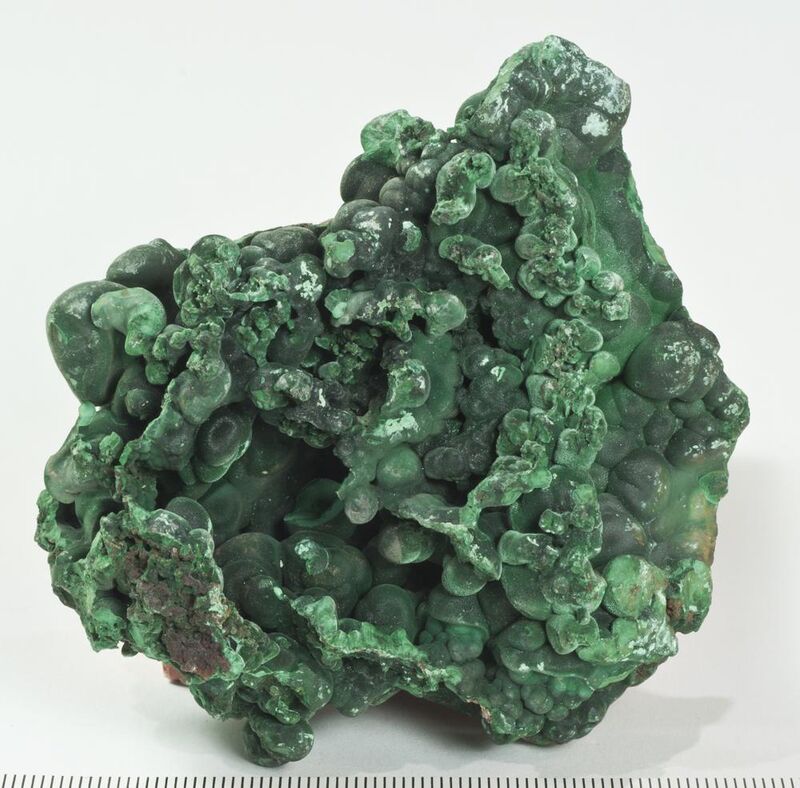 MalachiteCu2(CO3)(OH)2Mineral—
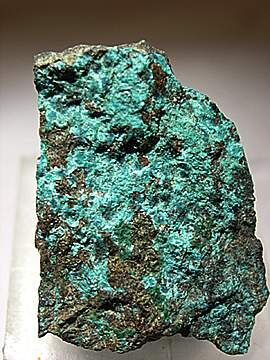 McguinnessiteCuMg(CO3)(OH)2Mineral—
 NullaginiteNi2(CO3)(OH)2Mineral—
 ParádsasváriteZn2(CO3)(OH)2Mineral—
- PerchiazziiteCo2(CO3)(OH)2Mineral—
 PokrovskiteMg2(CO3)(OH)2Mineral—
 Zincrosasite(Zn,Cu)2(CO3)(OH)2Mineral—
Literature, links & citation
- 1908Lovisato (1908) Reale accademia nazionale dei Lincei, Rend. Rome: 17: 723.
- 1921Biehl (1921) Mineral Abstracts: 1: 202 (as Paraurichalcite-I).
- 1921Perrier (1921) Reale accademia nazionale dei Lincei, Rend., Rome: 30(5): 119.
- 1930Barth and Berman (1930) Chemie der Erde, Jena: 5: 22.
- 1937Lauro, C. (1937) Sulla presenza della parauricalcite I nella miniera di Rosas (Sulcis). Periodico di Mineralogia: 151-160.
Entry last updated
@misc{mineral2026,
  author    = {Mineral Index editorial board},
  title     = {Rosasite — Mineral Index},
  year      = {2026},
  url       = {https://mineralindex.org/minerals/rosasite-3447}
}