History
Long before any Greek scholar wrote down its name, malachite was being mined for copper. The Great Orme mines in Britain were worked extensively about 3,800 years ago, in the European Bronze Age.
The Egyptians prized a different use. Ground malachite became a green pigment that lined the eyes of the dead — a colour associated with resurrection and fertility.
Pliny the Elder gave the mineral its first written name in 79 CE: molochitus. The word came from the Greek malachí — mallows — for the stone's resemblance to mallow leaves. The modern spelling malachites had taken hold by 1661 at the latest.
Ground malachite served as a green pigment in European painting, until synthetic alternatives largely replaced it around 1800.
In the 18th and 19th centuries, malachite found its decorative peak in imperial Russia. Tsars panelled their palaces with it and commissioned vases, tabletops, and architectural elements. The Hermitage in Saint Petersburg holds a Malachite Room whose centrepiece is an enormous carved vase.
Industrial & practical applications
Malachite's days as a working copper ore are mostly behind it. The mineral remains classified as a minor copper ore where deposits are rich enough, but the dominant modern use is decorative.
Where malachite is still processed for copper, modern operations use hydrometallurgy — extracting metal with water-based chemistry — rather than traditional smelting.
Cut shapes of the green stone go into vases, inlaid works, jewellery, and carved ornamental objects.
Notable deposits include Nizhny Tagil in Russia, Chessy in France, Tsumeb in Namibia, and Bisbee in Arizona.
Where it forms, where it's found
- Geological setting
It is the most common secondary mineral found in the oxidized zones of copper deposits.
Varieties
Physical
- Hardness
- 1Talc
- 2Gypsum
- 3Calcite
- 4Fluorite
- 5Apatite
- 6Orthoclase
- 7Quartz
- 8Topaz
- 9Corundum
- 10Diamond
- Transparency
- Opaque
- Colour
- Bright green · with crystals deeper shades of green · even very dark to nearly black · green to yellowish green in transmitted light.
- Streak
- Light green
- Tenacity
- brittle
- Cleavage
- Perfect
Perfect on (01), fair on (010).
- Fracture
- Splintery
- Density
- 3.6 g/cm³
Optical
- Optical type
- Biaxial (-) · 2V measured = 43° · 2V calc = 38°
- Refractive index
- 1.655 – 1.909
- Surface relief
- High
- Principal indices
- nα 1.655 · nβ 1.875 · nγ 1.909
- Pleochroism
- Visible
X = nearly colorless; Y = yellowish green; Z = deep green.
- Dispersion
- relatively weak
- Extinction
- Y = b; X ∧ c = 23.5°.
Crystallography
- Space group
- P21/a
- Cell parameters
- a = 9.502 Å · b = 11.974 Å · c = 3.240 Å
- Cell angles
- β = 98.75 °
- Ratio a:b:c
- 1 : 1.260 : 0.341
- Z
- 4
- Morphology
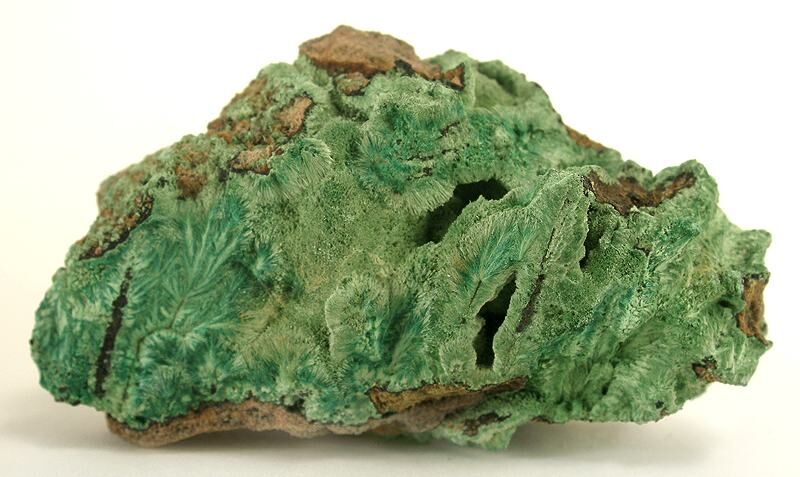
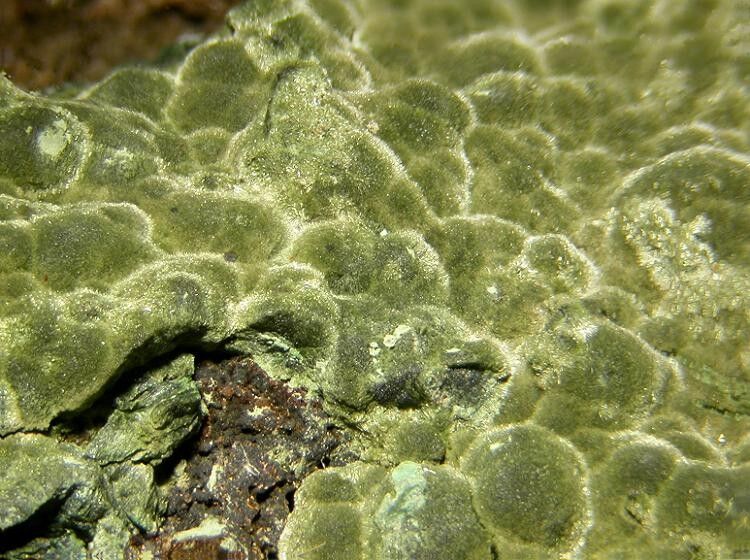
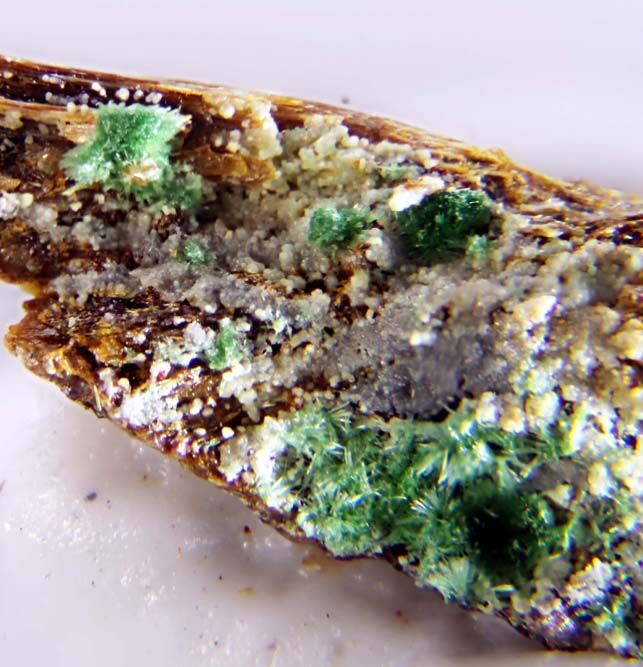
Crystals uncommon, usually short or long prismatic or acicular, parallel to [001]; often grouped in rosettes, sprays, or tufts. Botryoidal to mammillary aggregates of radiating fibrous crystals more common. It may also be massive, compact, and stalactitic. Very rarely as curls.
- Twinning
Untwinned crystals are extremely rare. Typically twinned on (100), sometimes as penetration or polysynthetic twinning with the axis parallel to [201].
Chemical composition
- Impurities
- Zn
- Co
- Ni
Synonyms
- Ærugo nativa
- Atlas Ore
- Bärggrönt
- Cuivre carbonaté vert
- Green Carbonate of Copper
- Green Copper
- Green Malachite
- Grünkupfer
- Hemiprismatischer Habronnem-Malachit
- Koppargrön
- Malachita
- Malakhit
- Malakhita
- Malakhite
- Molochit
- Molochita
- Mountain Green
- Rame carbonato verde
- Verdi di monte
- Χρυσοκόλλα
- Ψευδής Σμάργδος
In other languages
- French
- Cu2(CO3)(OH)2 · Cuivre carbonaté vert · Fleurs de cuivre vertes · malachite
- German
- Malachit
- Spanish
- malaquita
- Italian
- malachite · Verde azzurro di Magna Grecia · Verde azzurro di Spagna · Verde d'Alemagna · Verde minerale · Verde tedesco · Verdura delle rocce
- Portuguese
- Malaquita · malaquite
- Japanese
- クジャク石 · マーラカイト · マウンテングリーン · マラカイト · 孔雀石 · 岩緑青 · 青丹
- Chinese
- 孔雀石 · 碱式碳酸铜 · 碳酸铜氢氧化铜(1/1) · 铜绿 · 铜锈 · 鹼式碳酸銅
- Simplified Chinese
- 碱式碳酸铜
- Traditional Chinese
- 鹼式碳酸銅
- Russian
- гидроксокарбонат меди · малахит
- Arabic
- مالاكيت
- Hindi
- ताप्रांगीयिज
Classification
5.BA.10
- 5CarbonatesClass
- 5.BCarbonates with additional anions, without H2ODivision
- 5.BAWith Cu, Co, Ni, Zn, Mg, MnGroup
- 5.BA.10MalachiteSpecies
16a.03.01.01
- 16aAnhydrous Carbonates Containing Hydroxyl or HalogenClass
- 16a.03(AB)2(XO3)ZqType
- 16a.03.01Rosasite GroupGroup
- 16a.03.01.01MalachiteSpecies
11.2.1
- 11CarbonatesClass
- 11.2Carbonates of CuGroup
- 11.2.1MalachiteSpecies
Group, growth & confusion
- ChukanoviteFe2(CO3)(OH)2Mineral—
 GlaukosphaeriteCuNi(CO3)(OH)2Mineral—
 KolweziteCuCo(CO3)(OH)2Mineral—
 McguinnessiteCuMg(CO3)(OH)2Mineral—
 NullaginiteNi2(CO3)(OH)2Mineral—
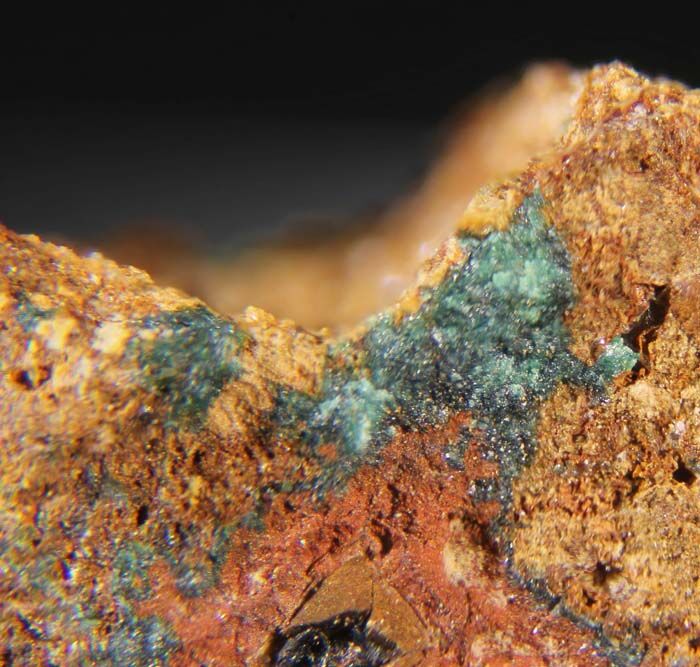 ParádsasváriteZn2(CO3)(OH)2Mineral—
- PerchiazziiteCo2(CO3)(OH)2Mineral—
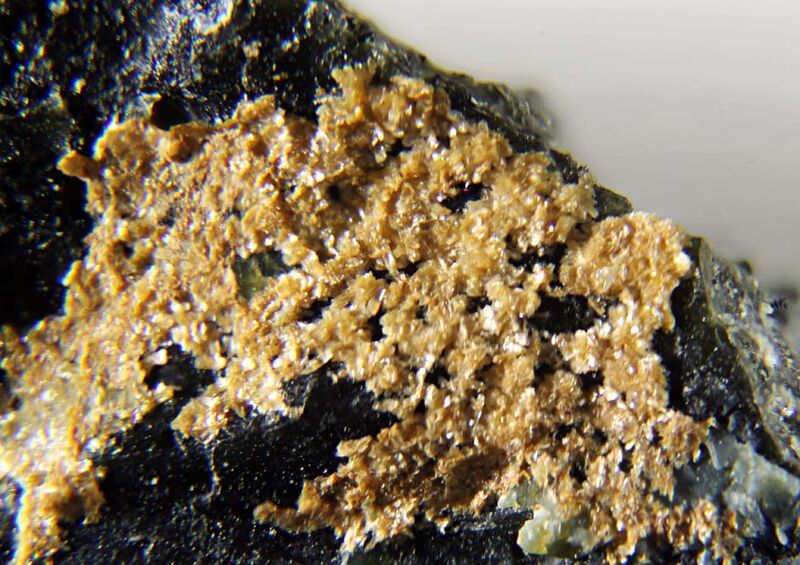 PokrovskiteMg2(CO3)(OH)2Mineral—
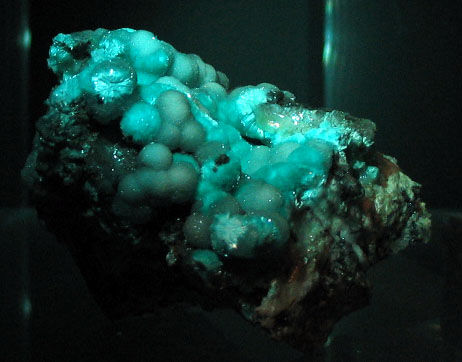 RosasiteCuZn(CO3)(OH)2Mineral—
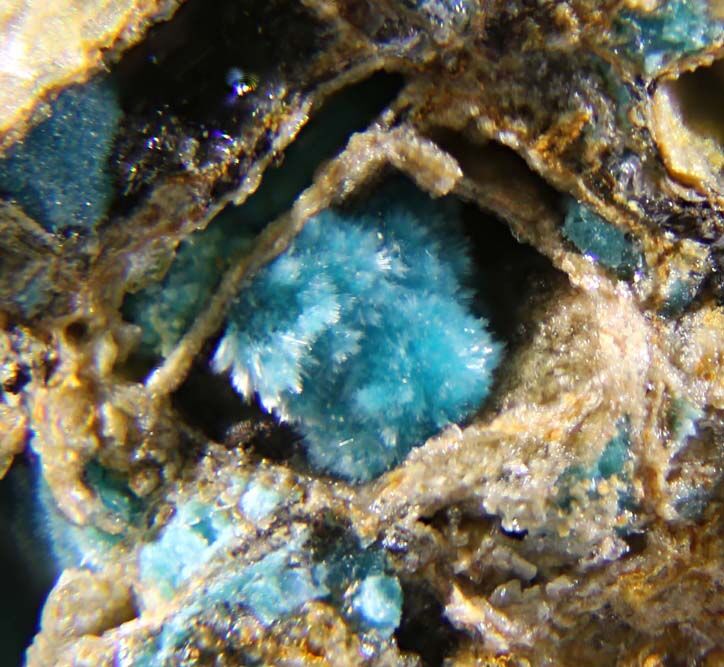 Zincrosasite(Zn,Cu)2(CO3)(OH)2Mineral—
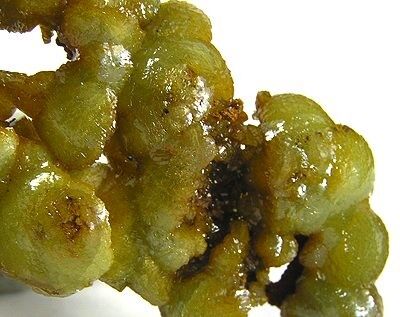 AdamiteZn2(AsO4)(OH)Mineral—
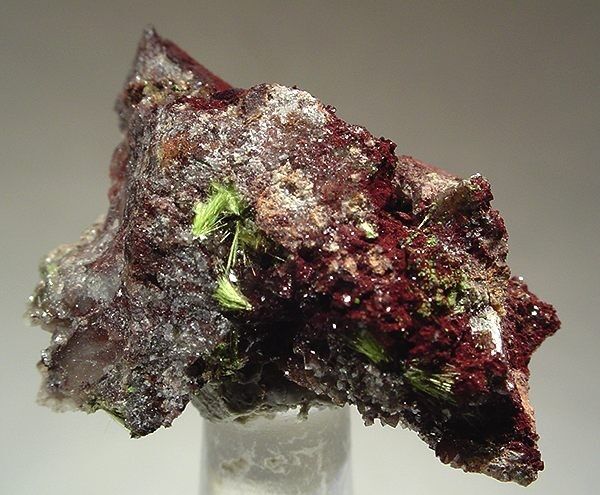 Agardite-(La)LaCu2+6(AsO4)3(OH)6 · 3H2OMineral—
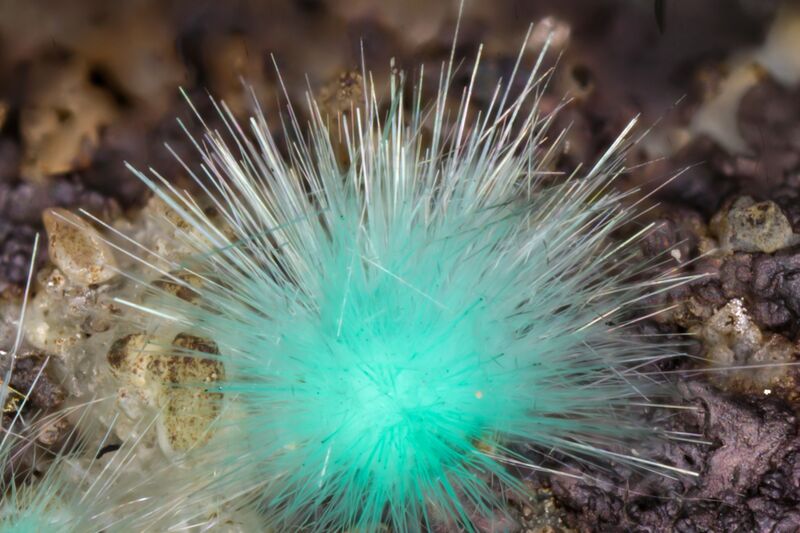 Agardite-(Y)YCu2+6(AsO4)3(OH)6 · 3H2OMineral—
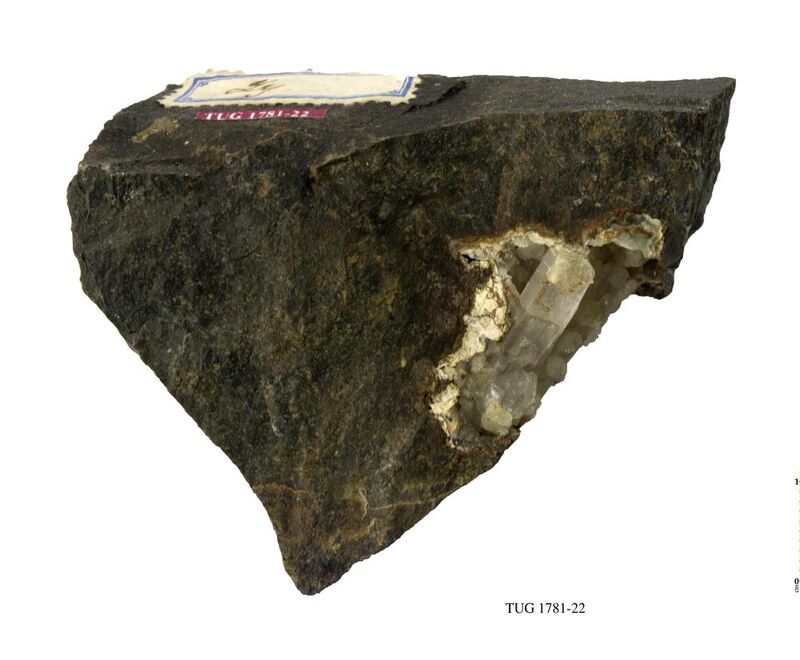 AragoniteCa(CO3)Mineral—
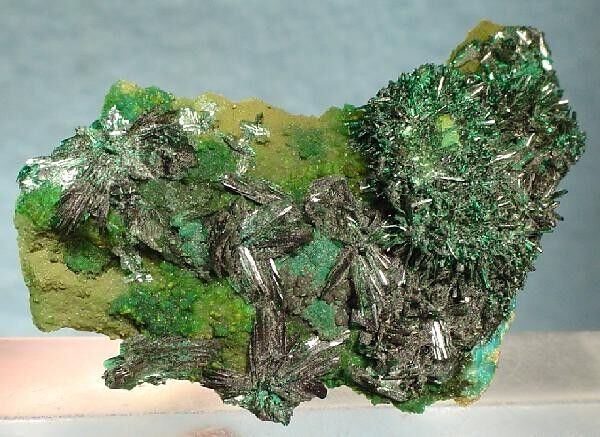 AtacamiteCu2Cl(OH)3Mineral—
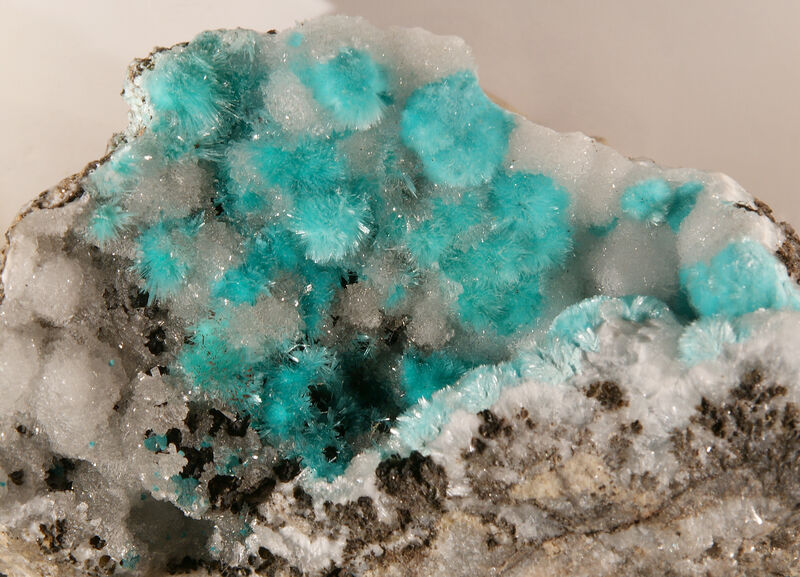 Aurichalcite(Zn,Cu)5(CO3)2(OH)6Mineral—
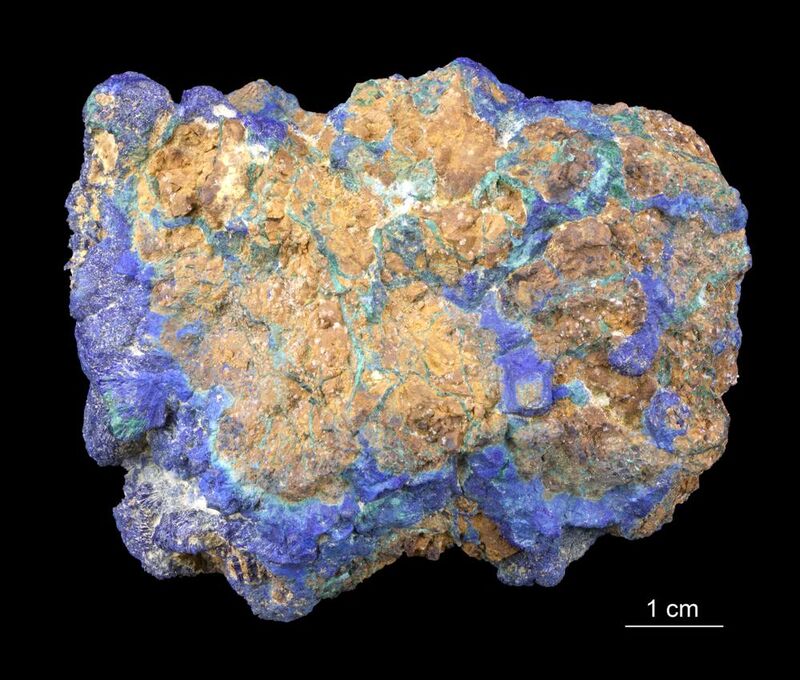 AzuriteCu3(CO3)2(OH)2Mineral—
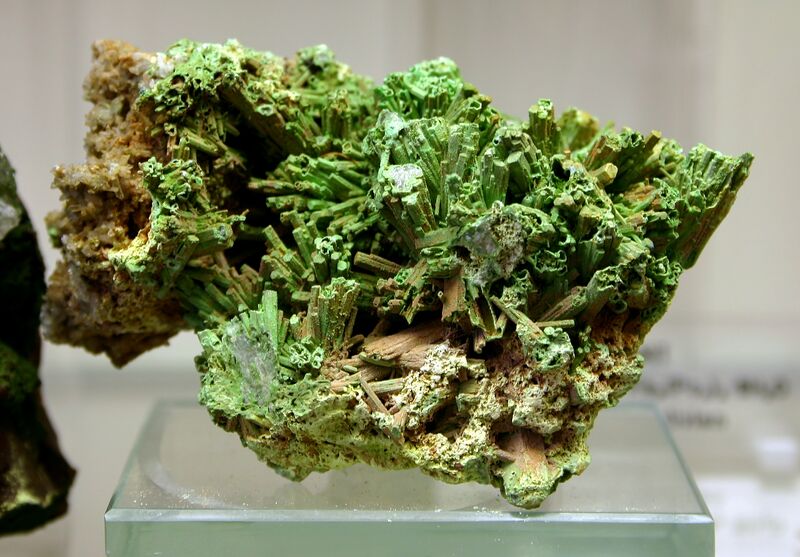 BayldoniteCu3PbO(AsO3OH)2(OH)2Mineral—
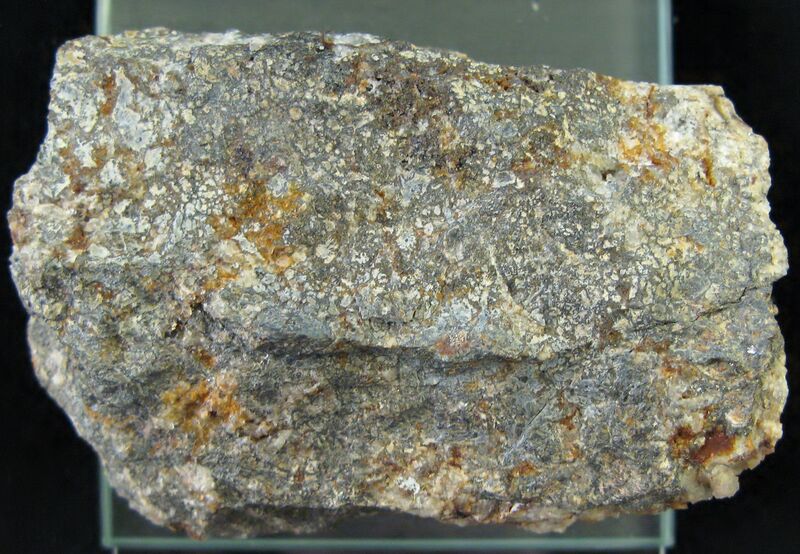 BismutiteBi2O2(CO3)Mineral—
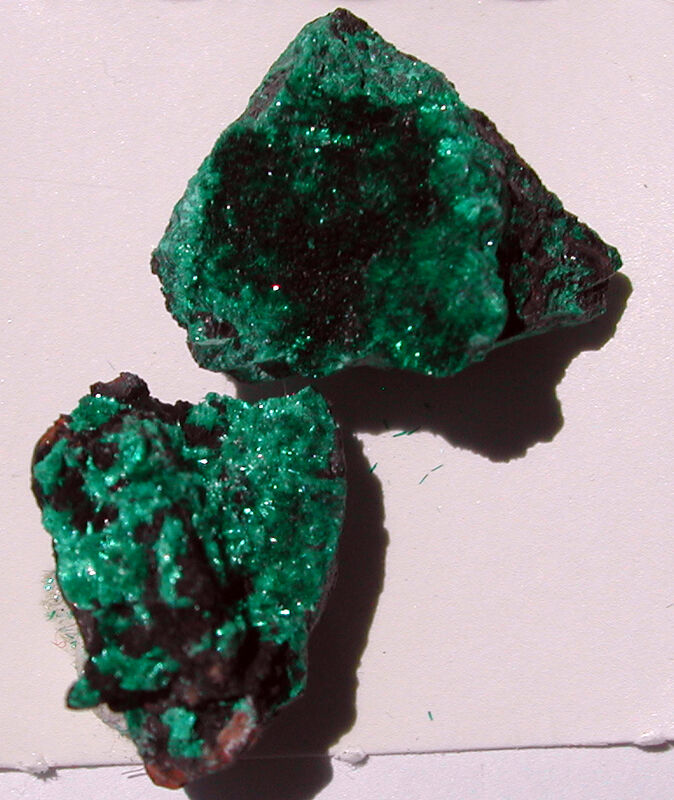 BrochantiteCu4(SO4)(OH)6Mineral—
Literature, links & citation
- 1747Wallerius, J.G (1747) Mineralogia, eller Mineralriket. Stockholm: 279 (as Malachit).
- 1778L' Abbé Fontana (1778) Le Journal de physique et le radium, Paris: 2: 509.
- 1836Thomson, Thomas (1836) Outlines of Mineralogy, Geology and Mineral Analysis Vol. 1. Baldwin & Craddock. 734 pp.
- 1842Zincken (1842) Berg.- und hüttenmännisches Zeitung, Freiberg, Leipzig (merged into Glückauf): 1 (as Kalk-malachit).
- 1863Maskelyne, N. S., von Lang, Viktor (1863) LX. Mineralogical notes. The London, Edinburgh, And Dublin Philosophical Magazine And Journal Of Science, S. 4 Vol. 25 (170) 432-453 doi:10.1080/14786446308643489DOI: 10.1080/14786446308643489
Entry last updated
@misc{mineral2026,
  author    = {Mineral Index editorial board},
  title     = {Malachite — Mineral Index},
  year      = {2026},
  url       = {https://mineralindex.org/minerals/malachite-2550}
}