History
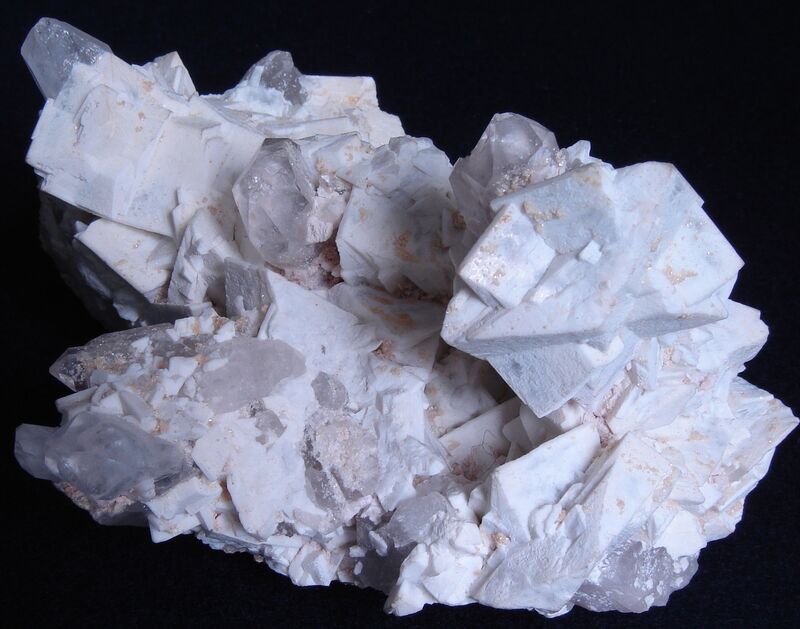
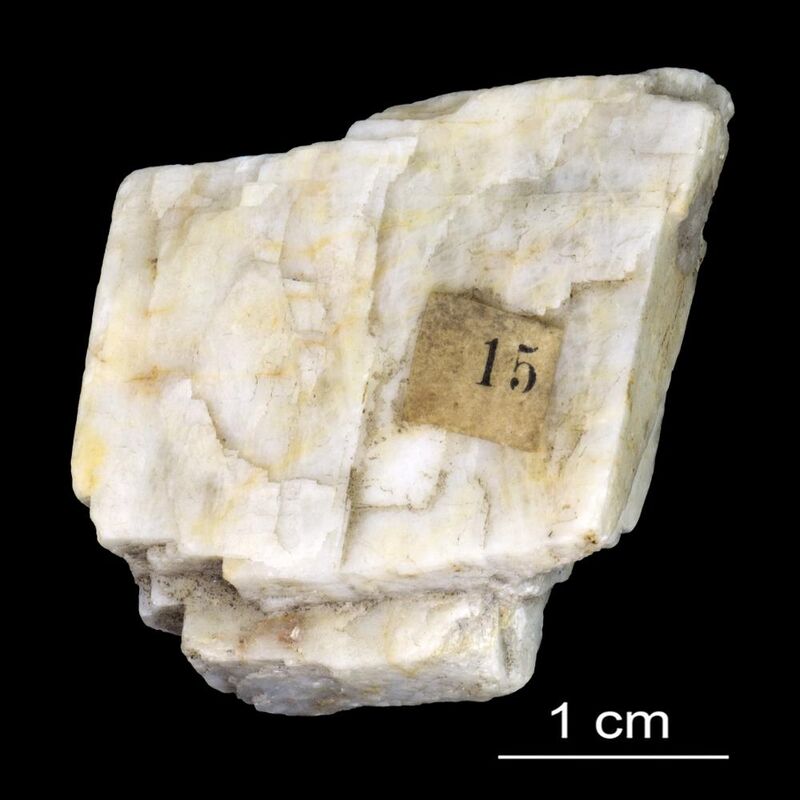
The name reads its own crystals. Sanidine comes from the Greek sanis — a board or tablet — joined to idos, appearance, because the mineral so often grows as flat, tablet-like crystals.
A German mineralogist, Karl Wilhelm Nose, coined the name in 1808. He was describing a feldspar — one of the rock-forming minerals that make up much of the Earth's crust — but a peculiar kind. Sanidine is the high-temperature form of potassium feldspar, the variant that crystallises when magma is very hot and then cools fast.
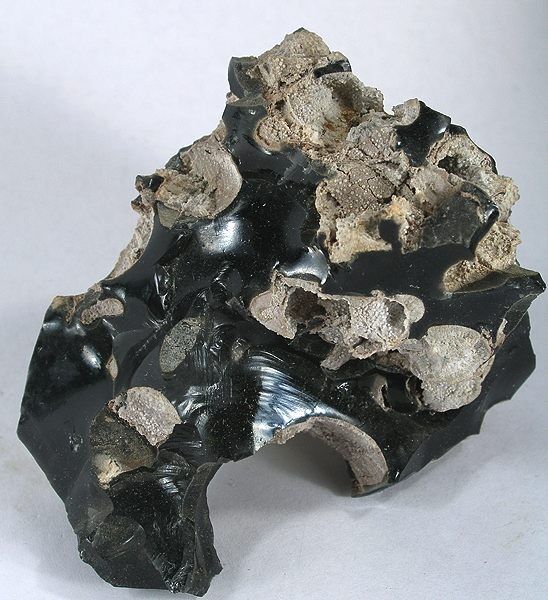
That speed lies behind the name. In slow-cooling rock, potassium feldspar settles into tidier, lower-temperature forms. But where lava chills quickly — in volcanic rocks such as obsidian, rhyolite and trachyte — the high-temperature structure is frozen in place before it can rearrange. The flat tablets Nose saw and named are the signature of that rapid quench.
Industrial & practical applications
Sanidine is worth more as a clock than as a commodity. Its value today is scientific: it tells geologists how old a volcanic rock is, and how it formed.
The clock runs on potassium. Sanidine packs a high concentration of the element potassium into its crystal structure as it grows from hot magma. A small fraction of that potassium is radioactive and decays, atom by atom, into the gas argon. Once the lava erupts and cools, the argon is trapped and starts to build up inside the crystal. Measure how much has accumulated, and you can read off the time since the eruption. This is the basis of potassium–argon dating and its more precise cousin, the argon–argon (⁴⁰Ar/³⁹Ar) method. The phenocrysts — the larger crystals set in fine volcanic rock — are especially useful for dating rhyolite ash beds this way. Much of what is known about the eruption history of Yellowstone rests on argon ages measured from sanidine in its rhyolites.
Its mere presence is also a signal. Because sanidine is the high-temperature, rapidly quenched form of potassium feldspar, finding it tells a geologist the rock cooled fast from a hot melt — a marker of volcanic origin.
Beyond the laboratory, the uses are slight. The potassium feldspar that industry mines for ceramics and glass is the lower-temperature kind, not volcanic sanidine. Rare transparent crystals, such as the gem-quality sanidine from the Eifel district of Germany, are faceted as collector stones, but the trade is small.
Where it forms, where it's found
- Geological setting
Acidic volcanic rocks
- Type locality
- Drachenfels
- Königswinter
- Rhein-Sieg-Kreis
- Cologne
- North Rhine-Westphalia
- Germany
50.6636°, 7.2100°
Physical
- Hardness
- 1Talc
- 2Gypsum
- 3Calcite
- 4Fluorite
- 5Apatite
- 6Orthoclase
- 7Quartz
- 8Topaz
- 9Corundum
- 10Diamond
- Lustre
- Vitreous - Pearly
- Transparency
- Transparent · Translucent
- Colour
- Colourless · white · grey · yellowish white · or reddish white
- Streak
- White
- Tenacity
- brittle
- Cleavage
- Perfect
(001) Perfect, (010) distinct
- Fracture
- Irregular/Uneven · Conchoidal
- Density
- 2.56 g/cm³
Optical
- Optical type
- Biaxial (-) · 2V measured = 60° · 2V calc = 48 – 64°
- Refractive index
- 1.518 – 1.531
- Surface relief
- Moderate
- Principal indices
- nα 1.518 – 1.525 · nβ 1.523 – 1.53 · nγ 1.525 – 1.531
- Dispersion
- r < v distinct
- Extinction
- Y = b; Z ∧ c ≃ -20° (low); Z = b; Y ∧ c ≃ -21° (high).
- Luminescence
- Non-fluorescent
Crystallography
- Space group
- C2/m
- Cell parameters
- a = 8.603(2) Å · b = 13.036(4) Å · c = 7.174(2) Å
- Cell angles
- β = 116.03(2) °
- Ratio a:b:c
- 1 : 1.515 : 0.834
- Z
- 4
- Morphology
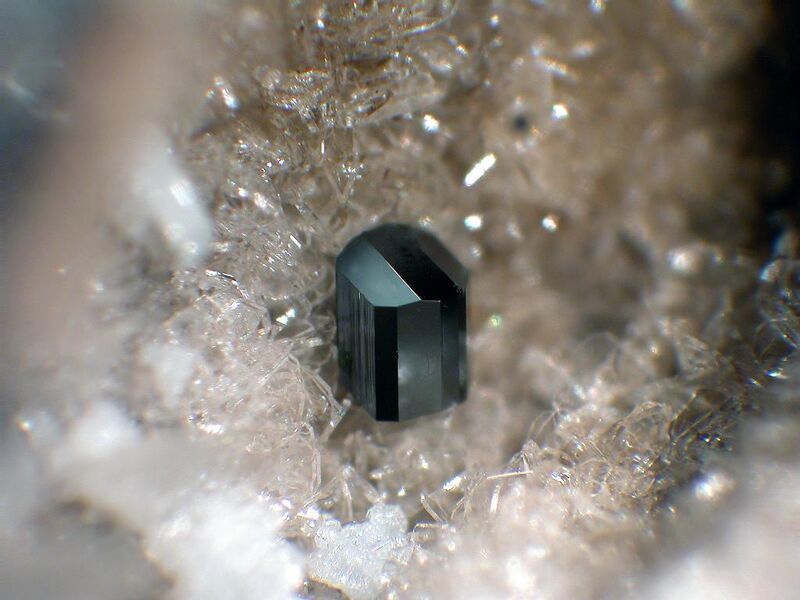
Tabular with square cross section
- Twinning
Carlsbad - common Baveno, Manebach - rarer
- Parting
- (100)
- Comment
High sanidine (forms a series with high albite).
Chemical composition
- Impurities
- Fe
- Ca
- Na
- H2O
Synonyms
- Glasiger Feldspath
- Glassy Feldspar
- Gränzerit
- Gränzerita
- Gränzerite
- Rhyacolit
- Rhyacolita
- Rhyacolite
- Riacolit
- Riacolita
- Riacolite
In other languages
- French
- Azulicite · Barium-sanidine · Gränzerite · Rhyacolite · Riacolite · Sanidine
- German
- Sanidin
- Spanish
- Sanidina
- Italian
- Sanidine · Sanidino
- Portuguese
- sanidina
- Japanese
- サニディン · ハリ長石 · 玻璃長石
- Chinese
- 透长岩 · 透长石
- Simplified Chinese
- 透长石
- Traditional Chinese
- 透長石
- Russian
- Санидин
- Arabic
- سانيدين
Classification
9.FA.30
- 9SilicatesClass
- 9.FTektosilicates without zeolitic H2ODivision
- 9.FATektosilicates without additional non-tetrahedral anionsGroup
- 9.FA.30SanidineSpecies
76.01.01.02
- 76Tectosilicates Al-si FrameworkClass
- 76.01Al-Si Framework with Al-Si frameworksType
- 76.01.01K (Na,Ba) feldsparsGroup
- 76.01.01.02SanidineSpecies
16.3.7
- 16Silicates Containing Aluminum and other MetalsClass
- 16.3Aluminosilicates of KGroup
- 16.3.7SanidineSpecies
Group, growth & confusion
Literature, links & citation
- 1810Klaproth, M. H. (1810) CLXXI. Untersuchung des Glasigen Feldspaths , vom Drachenfels. In Beiträge zur chemischen Kenntniss der Mineralkörper Vol. 5. Rottmann. p.12-18.
- 1963Onorato E., Penta M., Sgarlata F. (1963) Struttura del sanidino. Periodico di Mineralogia – Roma, 1-34.
- 1968Wright, Thomas L., Stewart, David B. (1968) X-ray and optical study of alkali feldspar: I. Determination of composition and structural state from refined unit-cell parameters and 2V. American Mineralogist, 53 (1-2) 38-87
- 1968Wright, Thomas L. (1968) X-ray and optical study of alkali feldspar: II. An X-ray method for determining the composition and structural state from measurement of 2θ values for three reflections. American Mineralogist, 53 (1-2) 88-104
- 1971Scott, Robert B., Bachinski, Sharon W., Nesbitt, Robert W., Scott, and Martha R. (1971) Rate of Al-Si ordering in sanidines from an ignimbrite cooling unit. American Mineralogist, 56 (5-6) 1208-1221
Entry last updated
@misc{mineral2026,
  author    = {Mineral Index editorial board},
  title     = {Sanidine — Mineral Index},
  year      = {2026},
  url       = {https://mineralindex.org/minerals/sanidine-3521}
}