History
The name is a small confession. Pseudobrookite joins the Greek pseudes — false — to brookite, an admission that the new mineral was a convincing impostor. Brookite is a form of titanium dioxide, and pseudobrookite's crystals looked enough like it to mislead the eye. Look past the surface, though, and the two are different minerals: pseudobrookite is an oxide of both iron and titanium, with the formula Fe₂TiO₅, not titanium alone.
The mineral was first described in 1878. The describing specimens came from Uroi Hill — also called Arany Hill — near Simeria, in Hunedoara County, Romania. That hill is the type locality, the place a mineral is formally tied to when it is named.
Pseudobrookite is a child of volcanic heat. It grows by pneumatolytic deposition — crystallising straight out of hot volcanic gases — and by alteration inside titanium-rich lavas. The host rocks are andesite, rhyolite and basalt. It is a frequent guest in lithophysae, the hollow bubble-like cavities that open in such lavas as trapped gas expands. The Romanian crystals that earned it a name sat in exactly this kind of volcanic setting.
Industrial & practical applications
Pseudobrookite has no recorded industrial use. It is a rare accessory mineral — a minor extra that turns up scattered through a rock rather than forming bodies large enough to mine. It crystallises from volcanic gases inside titanium-rich lavas and in the gas cavities called lithophysae, settings that never concentrate it into a workable ore. Its interest is scientific and aesthetic: it is collected as a representative of its species and studied as one of the iron–titanium oxides that record how a magma cooled. No source documents any present-day commercial application.
Where it forms, where it's found
- Geological setting
Magmatic, post-volcanic or young volcanic rocks. Typically formed by pneumatolytic processes in titanium-rich andesite, rhyolite, basalt, etc., and by reactions with xenoliths within these; in lithophysae. Rarely in plutonic rocks.
- Type locality
- Uroi Hill (Arany Hill)
- Simeria
- Hunedoara County
- Romania
45.8605°, 23.0444°
Physical
- Hardness
- 1Talc
- 2Gypsum
- 3Calcite
- 4Fluorite
- 5Apatite
- 6Orthoclase
- 7Quartz
- 8Topaz
- 9Corundum
- 10Diamond
- Lustre
- Adamantine - Metallic
- Transparency
- Transparent · Opaque
- Colour
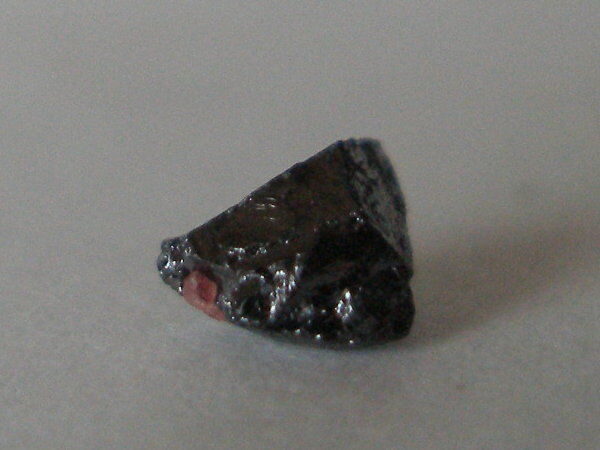
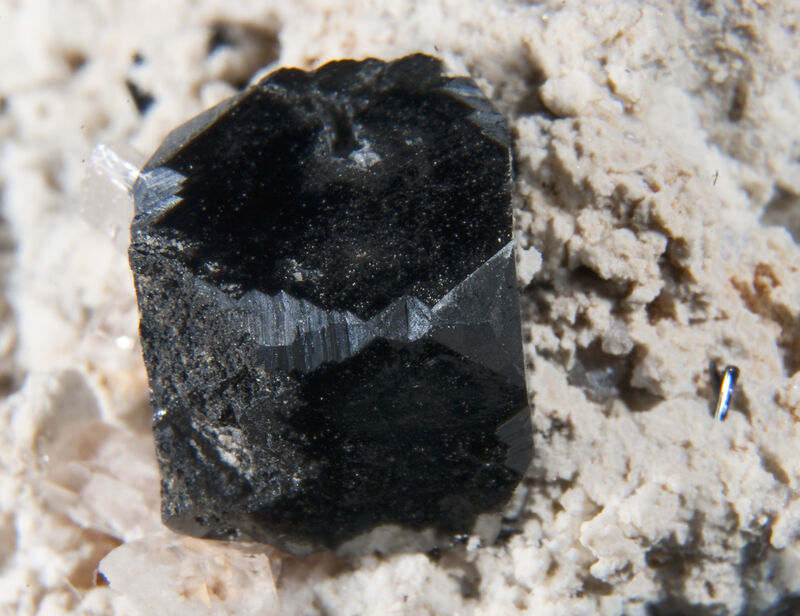
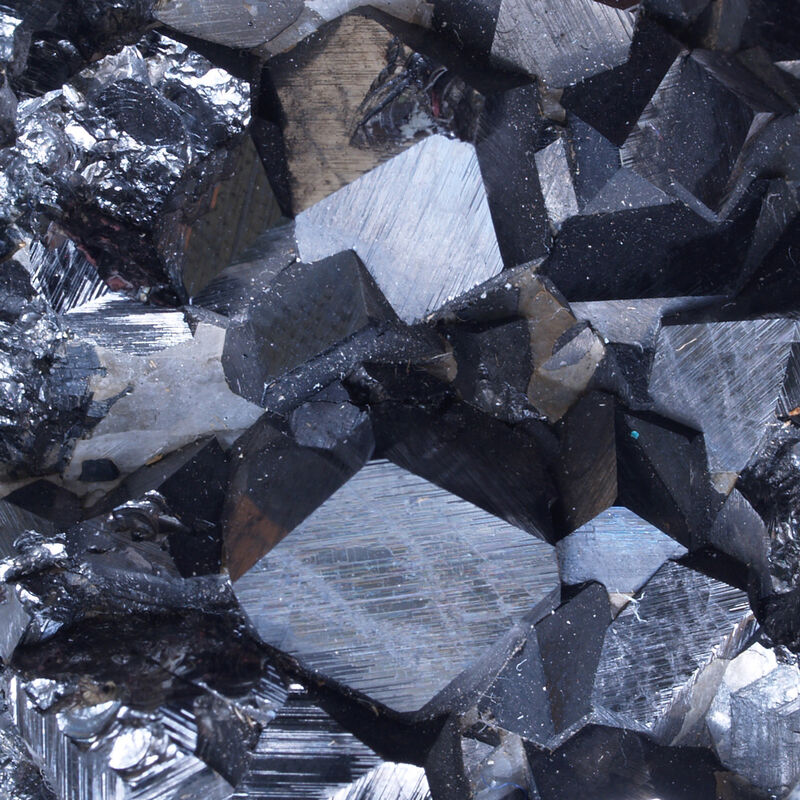
- Brownish black · reddish brown · or black
- Streak
- Reddish brown to ocher-yellow
- Cleavage
- Distinct/Good
On (010) distinct
- Fracture
- Irregular/Uneven · Sub-Conchoidal
- Density
- 4.33 g/cm³
Optical
- Optical type
- Biaxial (+) · 2V measured = 50° · 2V calc = 80°
- Refractive index
- 2.35 – 2.42
- Surface relief
- Very high
- Principal indices
- nα 2.35 – 2.38 · nβ 2.36 – 2.39 · nγ 2.38 – 2.42
- Pleochroism
- Weak
In browns.
- Dispersion
- none
- Extinction
- Y = a; Z = c; X ∧ a = 26°.
- Tropism
- Anisotropic
- Reflectance R%
- (22.8,24.0) 400, (21.9,23.1) 420, (21.2,22.3) 440, (20.5,21.4) 460, (19.8,20.7) 480, (19.4,20.4) 500, (19.0,19.9) 520, (18.5,19.3) 540, (18.1,18.8) 560, (17.8,18.5) 580, (17.5,18.1) 600, (17.3,17.9) 620, (17.1,17.7) 640, (17.0,17.6) 660, (16.8,17.4) 680, (16.7,17.3) 700
- Luminescence
- Non-fluorescent
Crystallography
- Space group
- #50
- Cell parameters
- a = 9.7965(25) Å · b = 9.9805(25) Å · c = 3.7301(1) Å
- Ratio a:b:c
- 1 : 1.019 : 0.381
- Z
- 4
- Morphology
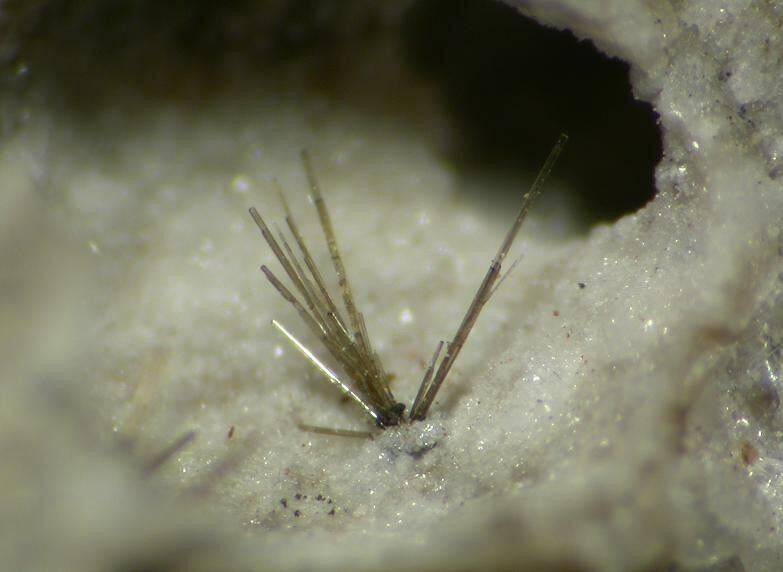
Crystals usually tabular (100) and elongated [001]; long prismatic at times or needle-like [001]. (100) and {hk0} striated [001].
- Twinning
Reported on various {hk0} planes (doubtful).
- Epitaxy
Pseudobrookite on hematite with pseudobrookite (121)[2_10] parallel to hematite (0001)[1_100]. Pseudobrookite on magnetite with pseudobrookite (100)[001] parallel to magnetite (111)[110]. Oriented inclusions of rutile in pseudobrookite.
- Comment
Space Group: Bbmm
Chemical composition
In other languages
- French
- Pseudobrookite
- German
- Pseudobrookit
- Spanish
- Pseudobrookita
- Italian
- Pseudobrookite
- Japanese
- 擬板チタン石
- Chinese
- 假板钛矿
Classification
4.CB.15
- 4OxidesClass
- 4.CMetal: Oxygen = 2: 3,3: 5, and similarDivision
- 4.CBWith medium-sized cationsGroup
- 4.CB.15PseudobrookiteSpecies
07.07.01.01
- 07Multiple OxidesClass
- 07.07AB2X5Type
- 07.07.01— unnamed intermediate level —Group
- 07.07.01.01PseudobrookiteSpecies
7.9.16
- 7Oxides and HydroxidesClass
- 7.9Oxides of TiGroup
- 7.9.16PseudobrookiteSpecies
Group, growth & confusion
Literature, links & citation
- —Ottemann, J., Frenzel, G. (1965) Der Chemismus der Pseudobrookite von Vulkaniten. Schweizerische Mineralogische und Petrographische Mitteilungen: 45: 819-836 (in German with English abstract).
- 1878Koch, A. (1878) XXII. Neue Minerale aus dem Andesit des Aranyer Berges in Siebenbürgen. Tschermaks Mineralogische und Petrographische Mitteilungen 1, Neue Folge: 331-361.
- 1878Koch, A. (1878) Neue Minerale. Pseudobrookite und Szabóit. Mineralogische und Petrographische Mittheilungen: 1: 77-79.
- 1892Traube, Η. (1892) Ueber den Pseudobrookit vom Aranyer Berge in Siebenbürgen. Zeitschrift für Krystallographie, 20 (1). 327 doi:10.1524/zkri.1892.20.1.327DOI: 10.1524/zkri.1892.20.1.327
- 1930Pauling, Linus (1930) The crystal structure of pseudobrookite. Zeitschrift für Kristallographie, 73 (1). 97-112 doi:10.1524/zkri.1930.73.1.97DOI: 10.1524/zkri.1930.73.1.97
Entry last updated
@misc{mineral2026,
  author    = {Mineral Index editorial board},
  title     = {Pseudobrookite — Mineral Index},
  year      = {2026},
  url       = {https://mineralindex.org/minerals/pseudobrookite-3302}
}