History
Break a fresh crystal of orthoclase and the two clean surfaces will meet at almost exactly 90°. That right angle is the mineral's name and its first claim on human attention.
The French crystallographer René Just Haüy noticed it in 1801 and called the mineral orthose, from the Greek orthos — "right" — in allusion to its right-angle cleavage. Haüy meant the name to designate a kind of feldspar but did not specify a type-locality, nor publish a chemical analysis. The label was provisional.
Two decades later the German mineralogist Johann Friedrich August Breithaupt rebuilt it. In 1823 he renamed the species orthoklas, from the same orthos plus klasis — "cleaving". The geometric reference was now explicit. The modern form orthoclase descends from Breithaupt's coinage.
Nineteenth- and twentieth-century work clarified what orthoclase actually is among the potassium feldspars. The species shares the formula K(AlSi₃O₈) with two siblings. Sanidine is the high-temperature form, with aluminium and silicon atoms randomly distributed across the available sites in the crystal framework. Microcline is the low-temperature form, with the same atoms fully ordered into fixed positions. Orthoclase sits between the two — the intermediate-temperature case, with atoms partially ordered rather than randomly arranged.
Industrial & practical applications
Orthoclase is one of the workhorse minerals of the ceramics trade. Crushed with the other potassium feldspars, it goes into porcelain, sanitaryware, wall tile, and tableware bodies as a flux. A flux is a fusible component that melts during firing and forms a glassy phase, binding the harder grains around it. Typical additions are 15 to 30 % feldspar in tableware, around 25 % in sanitaryware, and up to 80 % in dental porcelain. The same role carries into ceramic glazes, where feldspar lowers the temperature at which the glaze vitrifies and seals the surface.
Glassmaking takes the bulk of feldspar production. The mineral supplies both alkali (K₂O, Na₂O) and alumina (Al₂O₃) to the melt. The alkali fluxes the batch; the alumina improves hardness, durability, and resistance to chemical corrosion in the finished glass. About 66 % of feldspar consumed in the United States ends up in glassmaking, including glass containers and glass fibre.
Beyond bodies and batches, orthoclase has a third quiet job: as a mild abrasive in household scouring products. Bar Keepers Friend and Bon Ami both use feldspar as their abrasive grit, fine enough to clean a sink without scratching the enamel. Crushed orthoclase also serves as decorative facing in slabbed rock panels and as ordinary crushed stone.
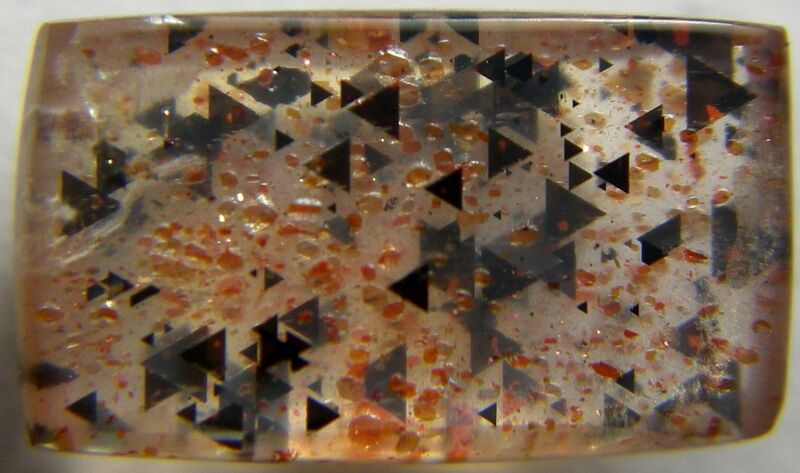
Two varieties move through the gem trade. Adularia is a low-temperature form whose intergrowths with albite scatter light in soft pearly sheets. That sheen, called adularescence, is what makes moonstone a moonstone.
World feldspar production reached an estimated 26 million tonnes in 2020, with Turkey, India, Italy, and China the four largest producers. The published figures aggregate orthoclase with the other potassium and sodium feldspars; orthoclase-specific tonnage is not separately reported.
Where it forms, where it's found
- Geological setting
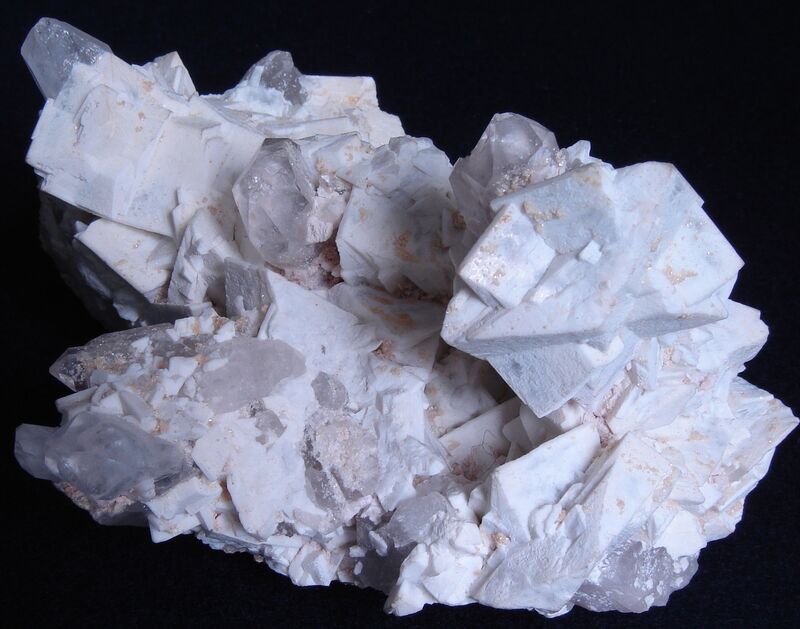
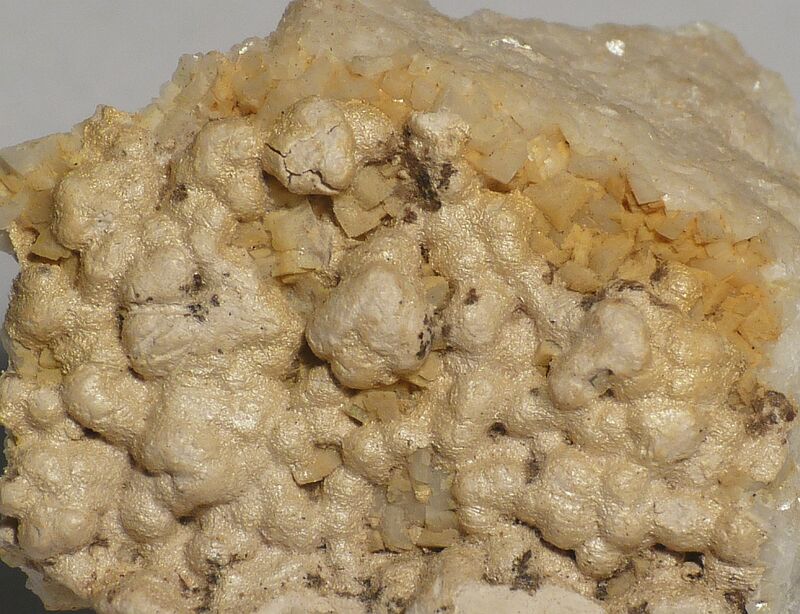
Common feldspar of high-temperature granites, syenites, high-grade metamorphic rocks, and some felsic extrusive rocks, eg some rhyolites (although these tend to contain sanidine when fresh).
Varieties
Physical
- Hardness
- 1Talc
- 2Gypsum
- 3Calcite
- 4Fluorite
- 5Apatite
- 6Orthoclase
- 7Quartz
- 8Topaz
- 9Corundum
- 10Diamond
- Transparency
- Transparent · Translucent
- Colour
- Colorless to white · greenish white · grayish yellow · pale pink
- Streak
- White
- Tenacity
- brittle
- Cleavage
- Perfect
Perfect on (001), good on (010)
- Fracture
- Irregular/Uneven · Conchoidal
- Density
- 2.55 g/cm³
Optical
- Optical type
- Biaxial (-) · 2V measured = 35 – 75° · 2V calc = 52 – 70°
- Refractive index
- 1.518 – 1.525
- Surface relief
- Moderate
- Principal indices
- nα 1.518 – 1.520 · nβ 1.522 – 1.524 · nγ 1.522 – 1.525
- Birefringence
- 0.004
- Pleochroism
- Non-pleochroic
- Dispersion
- r > v distinct
- Extinction
- X^a = 6°-14°, Y^c = -13° to 21°, Z = b
- UV response
- May fluoresce dull white or red in SW UV
Crystallography
- Space group
- C2/m
- Cell parameters
- a = 8.5632(11) Å · b = 12.963(14) Å · c = 7.299(11) Å
- Cell angles
- β = 116.073(9) °
- Ratio a:b:c
- 1 : 1.514 : 0.852
- Unit cell volume
- 724.57 ų
- Z
- 4
- Morphology
Short prismatic
- Twinning
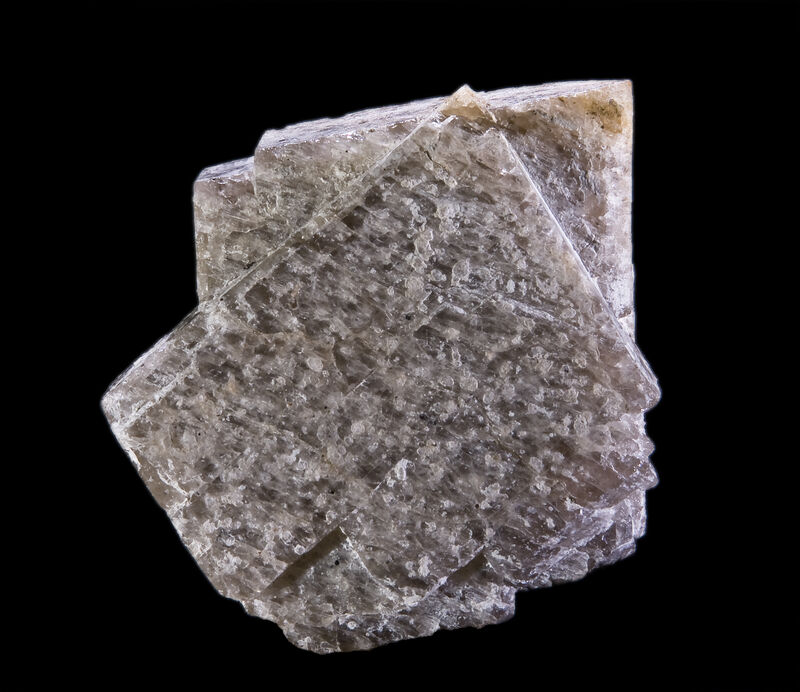
Common as Carlsbad, Baveno and Manebach.
- Parting
- On (100) (110) (10) (01)
Chemical composition
- Impurities
- Na
- Fe
- Ba
- Rb
- Ca
Synonyms
- Aglairit
- Argillyit
- Argillyita
- Argillyite
- Common Feldspar
- Cottait
- Cottaita
- Cottaite
- Leelit
- Leelita
- Leelite
- Muldan
- Murchisonit
- Murchisonita
- Murchisonite
- Ortose
- Paradoxit
In other languages
- French
- Orthose
- German
- Orthoklas
- Spanish
- ortoclasa
- Italian
- ortoclasio
- Portuguese
- ortoclase
- Japanese
- 正長石
- Chinese
- 正長石
- Russian
- ортоклаз
- Arabic
- أرثوكلاز · أرثوكليز · أورثوكلاز · أورثوكلاس · أورثوكليس
Classification
9.FA.30
- 9SilicatesClass
- 9.FTektosilicates without zeolitic H2ODivision
- 9.FATektosilicates without additional non-tetrahedral anionsGroup
- 9.FA.30OrthoclaseSpecies
76.01.01.01
- 76Tectosilicates Al-si FrameworkClass
- 76.01Al-Si Framework with Al-Si frameworksType
- 76.01.01K (Na,Ba) feldsparsGroup
- 76.01.01.01OrthoclaseSpecies
16.3.6
- 16Silicates Containing Aluminum and other MetalsClass
- 16.3Aluminosilicates of KGroup
- 16.3.6OrthoclaseSpecies
Group, growth & confusion
 AbelsoniteNiC31H32N4Mineral—
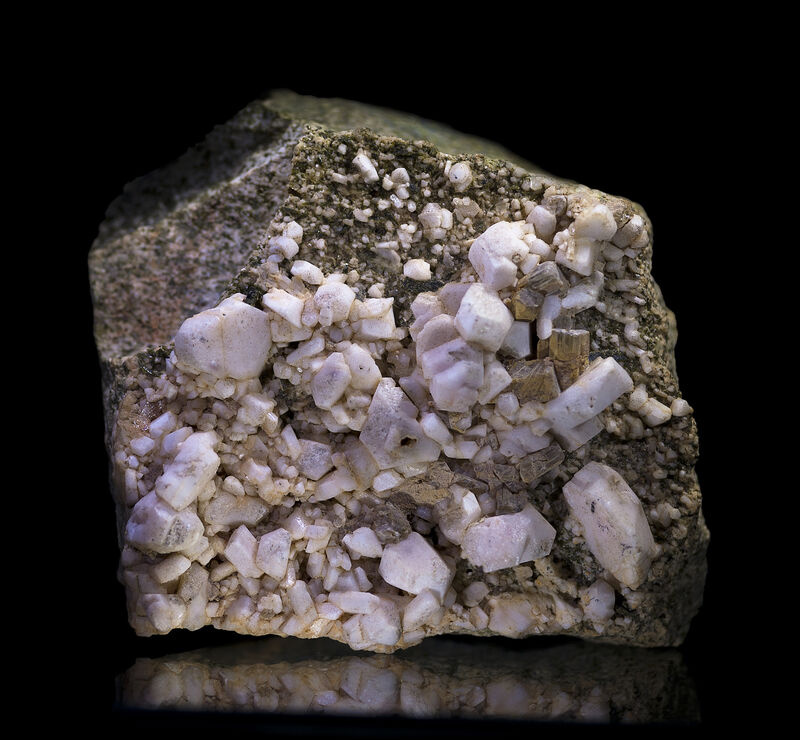 AlbiteNa(AlSi3O8)Mineral—
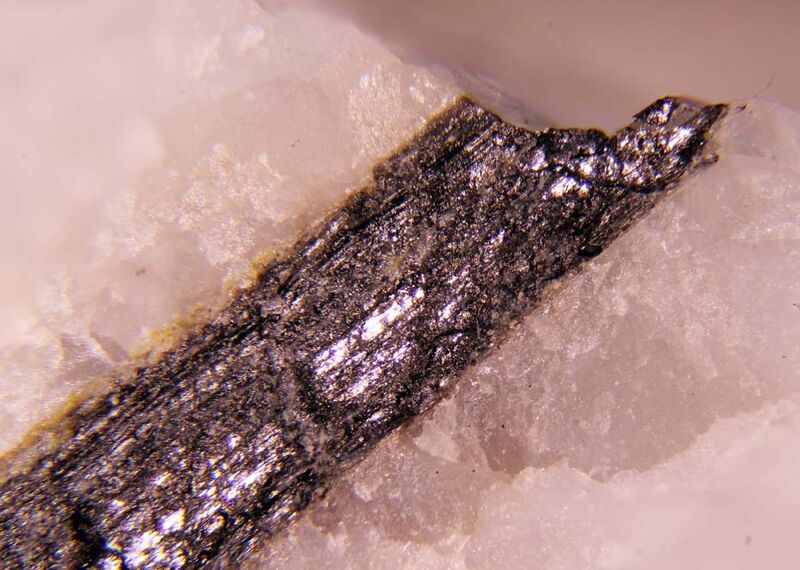 AschamalmitePb6-3xBi2+xS9Mineral—
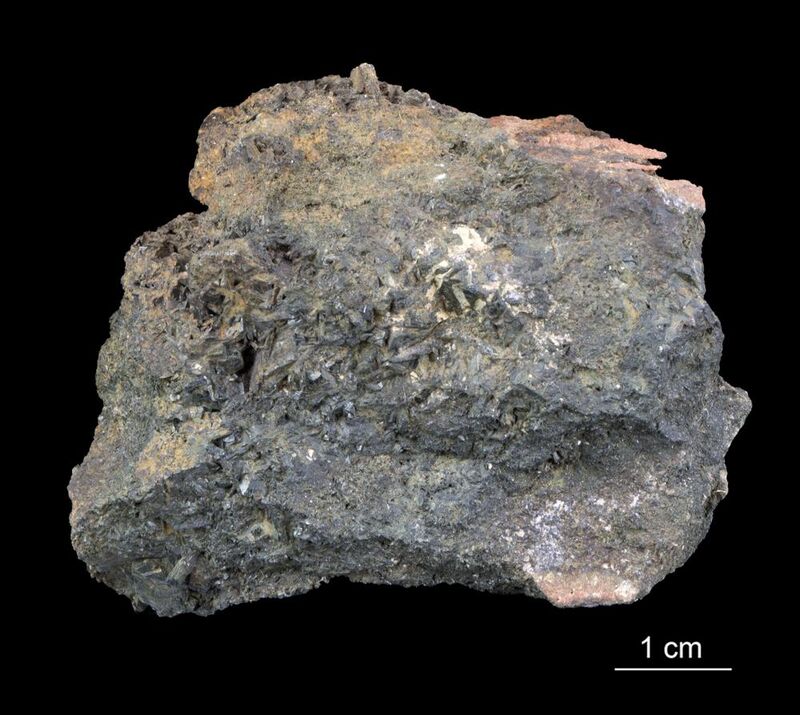 BabingtoniteCa2Fe2+Fe3+Si5O14(OH)Mineral—
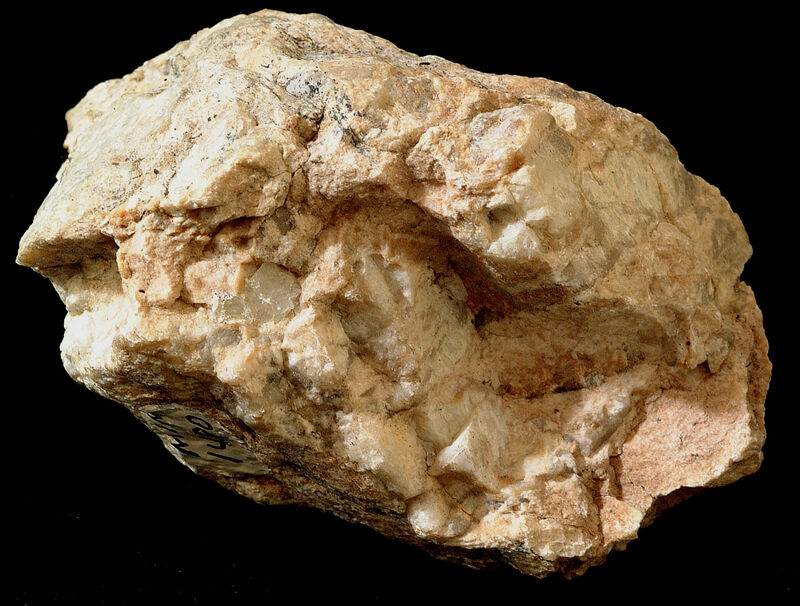 Beidellite(Na,Ca)0.3Al2(Si,Al)4O10(OH)2 · nH2OMineral—
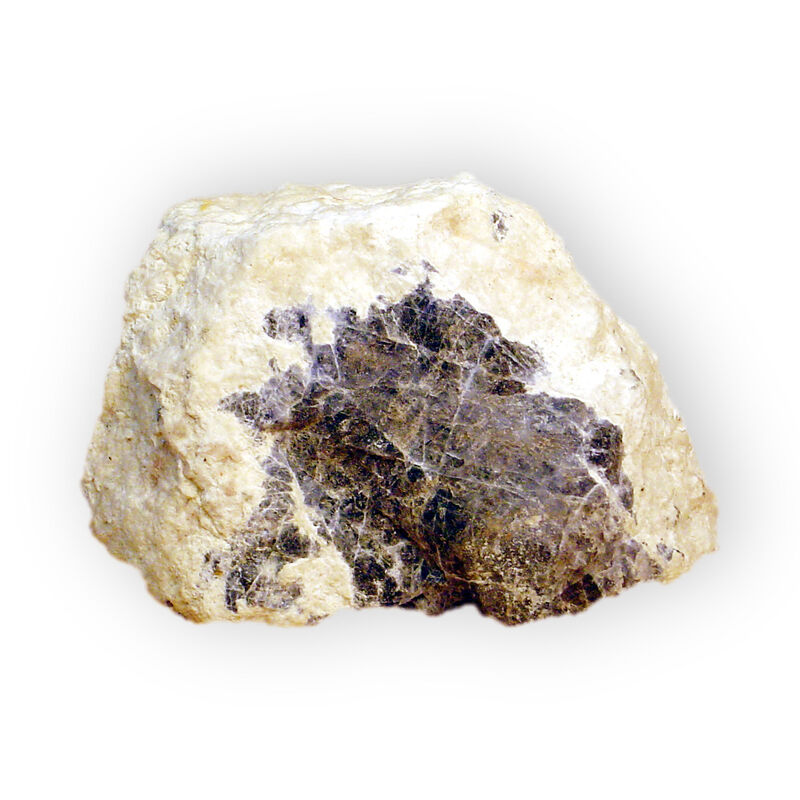 Cancrinite(Na,Ca,◻)8(Al6Si6)O24(CO3,SO4)2 · 2H2OMineral—
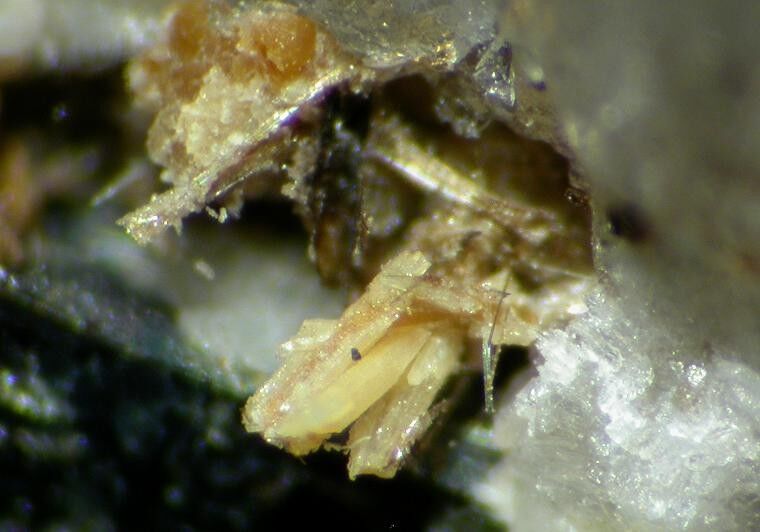 Gjerdingenite-FeK2Fe(Nb,Ti)4(Si4O12)2(O,OH)4 · 6H2OMineral—
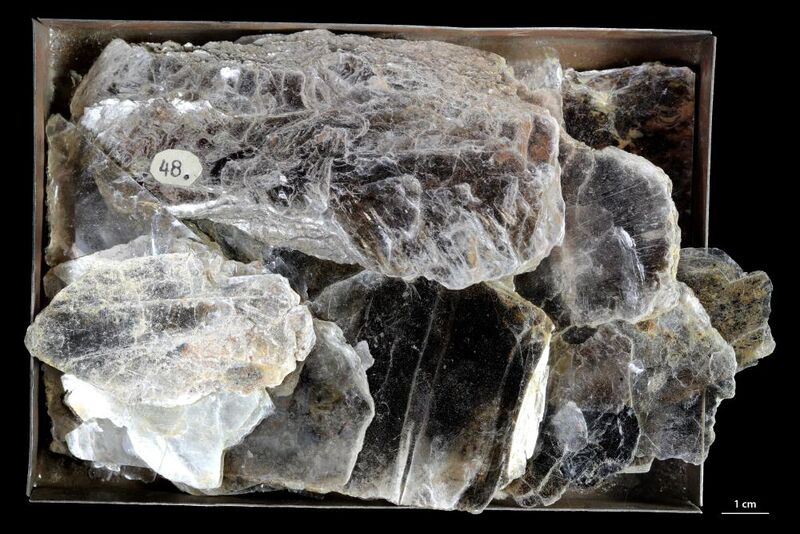 MuscoviteKAl2(Si3Al)O10(OH)2Mineral—
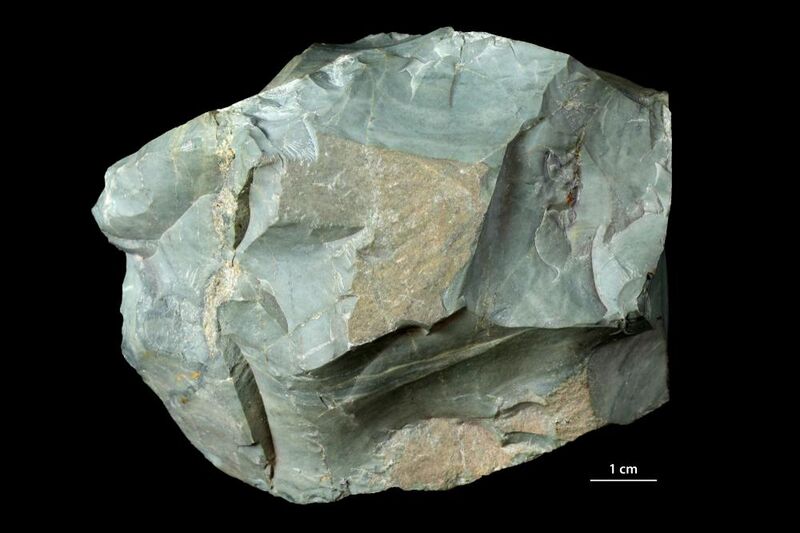 QuartzSiO2Mineral—
 Saponite(Ca,Na)0.3(Mg,Fe)3(Si,Al)4O10(OH)2 · 4H2OMineral—
Literature, links & citation
- 1954Coombs, D. S. (1954) Ferriferous orthoclase from Madagascar. Mineralogical Magazine and Journal of the Mineralogical Society, 30 (226) 409-427 doi:10.1180/minmag.1954.030.226.01 DOI: 10.1180/minmag.1954.030.226.01
- 1962Brace, W. F., Walsh, J. B. (1962) Some direct measurements of the surface energy of quartz and orthoclase. American Mineralogist, 47 (9-10) 1111-1122
- 1968Wright, Thomas L., Stewart, David B. (1968) X-ray and optical study of alkali feldspar: I. Determination of composition and structural state from refined unit-cell parameters and 2V. American Mineralogist, 53 (1-2) 38-87
- 1968Wright, Thomas L. (1968) X-ray and optical study of alkali feldspar: II. An X-ray method for determining the composition and structural state from measurement of 2θ values for three reflections. American Mineralogist, 53 (1-2) 88-104
- 1973Prince, Edward, Donnay, Gabrielle, Martin, R. F. (1973) Neutron diffraction refinement of an ordered orthoclase structure. American Mineralogist, 58 (5-6). 500-507
Entry last updated
@misc{mineral2026,
  author    = {Mineral Index editorial board},
  title     = {Orthoclase — Mineral Index},
  year      = {2026},
  url       = {https://mineralindex.org/minerals/orthoclase-3026}
}