Where it forms, where it's found
- Geological setting
Bedded manganese ore deposit in weakly metamorphosed Triassic chert.
- Type locality
- Mogurazawa mine
- Kiryu City
- Gunma Prefecture
- Japan
36.4397°, 139.3831°
5recorded occurrences
Physical
Optical
- Optical type
- Biaxial (-) · 2V measured = 90° · 2V calc = 88°
- Refractive index
- 1.73 – 1.748
- Surface relief
- High
- Principal indices
- nα 1.730 · nβ 1.739 · nγ 1.748
- Dispersion
- r > v moderate
Δ = 0Δmax
PPLpleochroism per grain
XPLindependent extinctions · rotate the stage
PPLpleochroism only · colour blends on rotation
XPLinterference colour · extinct every 90°
Retardation180 nm
Order1st order
XPL colour
Crystallography
- Cell parameters
- a = 7.089(2) Å · b = 15.261(2) Å · c = 5.364(1) Å
- Ratio a:b:c
- 1 : 2.153 : 0.757
- Z
- 2
- Morphology
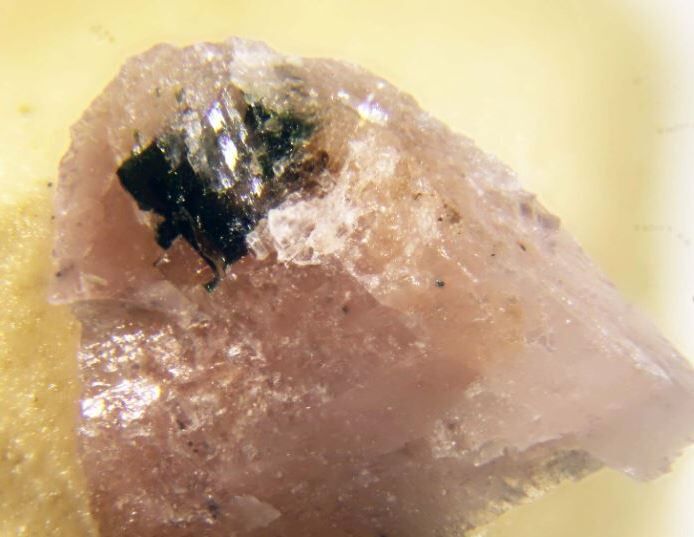
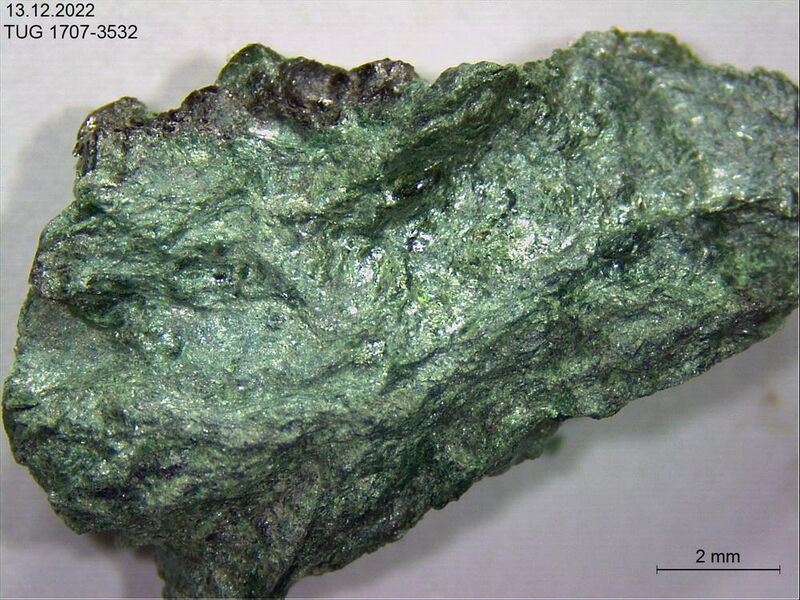
As tiny flakes forming aggregates around other minerals.
- Type-locality form
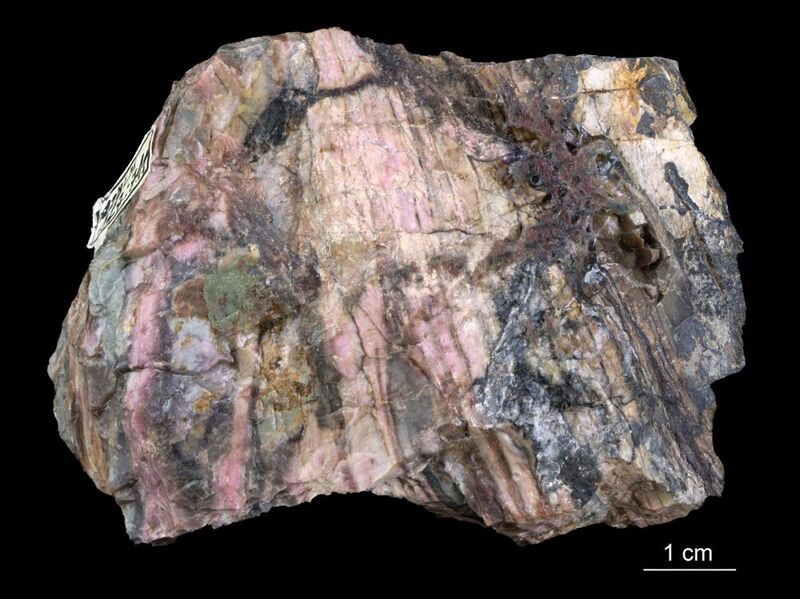
flaky green mineral in massive rhodonite-rhodochrosite ore
- Comment
Point Group: 2/m 2/m 2/m or mm2; Space Group: Amam or Ama2:
Chemical composition
- Impurities
- Ti
- Sr
Synonyms
- IMA1978-005
- Suzukiiet
In other languages
- German
- IMA 1978-005 · Suzukiit
- Italian
- Suzukiite
- Japanese
- 鈴木石
Classification
Strunz
10th ed.9.DH.15
- 9SilicatesClass
- 9.DInosilicatesDivision
- 9.DHInosilicates with 4-periodic single chains, Si4O12Group
- 9.DH.15SuzukiiteSpecies
Dana
8th ed.65.03.01.02
- 65Inosilicates Single-width, Unbranched Chains, (w=1)Class
- 65.03Single-Width Unbranched Chains, W=1 with chains P=4Type
- 65.03.01Haradaite groupGroup
- 65.03.01.02SuzukiiteSpecies
CIM
—17.7.1
- 17Silicates Containing other AnionsClass
- 17.7Silicates with vanadate, arsenate or antimonateGroup
- 17.7.1SuzukiiteSpecies
Group, growth & confusion
Literature, links & citation
Citations
- 1982Matsubara, Satoshi, Kato, Akira, Yui, Shunzo (1982) Suzukiite, Ba2V4+2(O2|Si4O12), a new mineral from the Mogurazawa mine, Gumma Prefecture, Japan. Mineralogical Journal, 11 (1) 15-20 doi:10.2465/minerj.11.15 DOI: 10.2465/minerj.11.15
- 1983Fleischer, Michael, Pabst, Adolf (1983) New Mineral Names. American Mineralogist, 68 (1-2) 280-283
- 2001(2001) Suzukiite. Handbook of Mineralogy. Mineralogical Society of America
- 2008Takahashi, Y., Konishi, T., Soga, K., & FUJIWARA, T. (2008). Origin of photoluminescence in suzukiite-type BaTiSi2O7. Journal of the Ceramic Society of Japan, 116(1358), 1104-1107.
- 2014Ito, Miku, Matsubara, Satoshi, Yokoyama, Kazumi, Momma, Koichi, Miyawaki, Ritsuro, Nakai, Izumi, Kato, Akira (2014) Crystal structure of suzukiite from the Mogurazawa mine, Gunma Prefecture, Japan. Journal of Mineralogical and Petrological Sciences, 109 (5) 222-227 doi:10.2465/jmps.140520 DOI: 10.2465/jmps.140520
Cite this entry
Entry last updated
@misc{mineral2025,
  author    = {Mineral Index editorial board},
  title     = {Suzukiite — Mineral Index},
  year      = {2025},
  url       = {https://mineralindex.org/minerals/suzukiite-3835}
}