Where it forms, where it's found
- Geological setting
Secondary mineral formed under late stage supergene low-temperature conditions.
- Type locality
- Block 14 opencut
- Broken Hill
- Broken Hill district
- Yancowinna Co.
- New South Wales
- Australia
-31.9591°, 141.4751°
3recorded occurrences
Safety & handling
Physical
Optical
- Optical type
- Biaxial (-) · 2V calc = 44.5°
- Refractive index
- 1.596 – 1.643
- Surface relief
- Moderate
- Principal indices
- nα 1.596 · nβ 1.636 · nγ 1.643
- Pleochroism
- Weak
X = pale yellowish blue; Y = pale blue; Z = pale greenish blue.
- Extinction
- Positive elongation and inclined extinction.
- Notes
Optical orientation uncertain.
Δ = 0Δmax
PPLpleochroism per grain
XPLindependent extinctions · rotate the stage
PPLpleochroism only · colour blends on rotation
XPLinterference colour · extinct every 90°
Retardation470 nm
Order1st order
XPL colour
Crystallography
- Space group
- C2/c
- Cell parameters
- a = 22.049(2) Å · b = 6.212(2) Å · c = 21.839(2) Å
- Cell angles
- β = 113.19(3) °
- Ratio a:b:c
- 1 : 0.282 : 0.990
- Unit cell volume
- 2749.8 ų
- Z
- 8
- Morphology
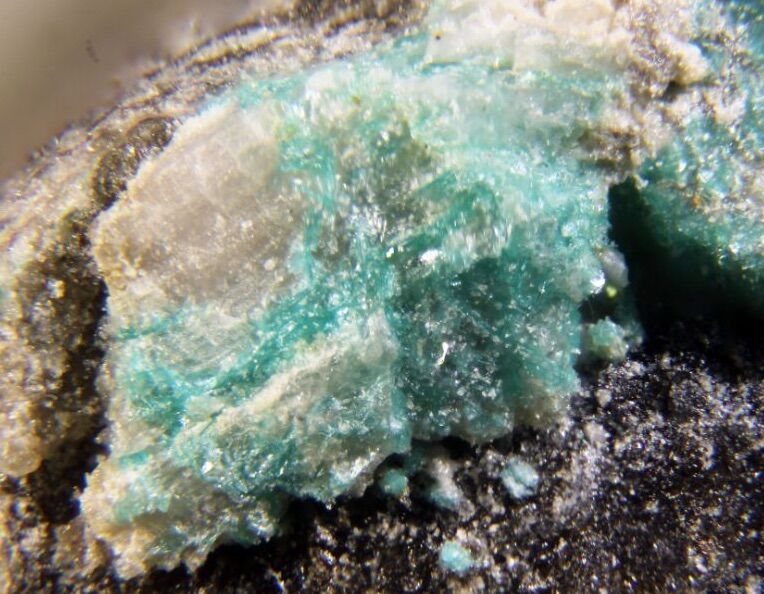
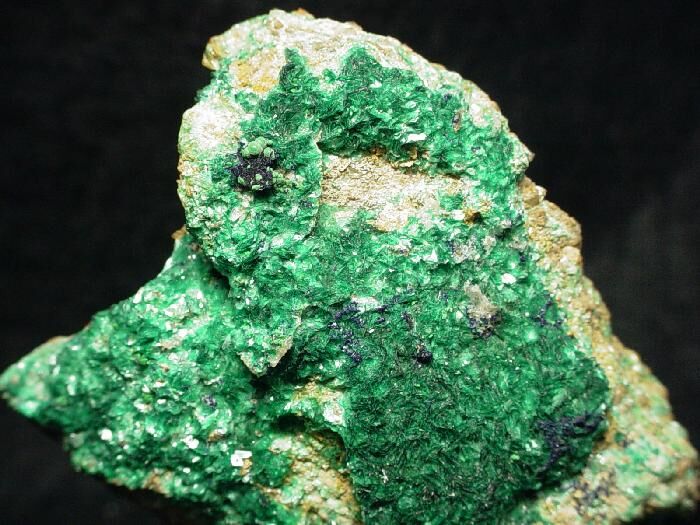
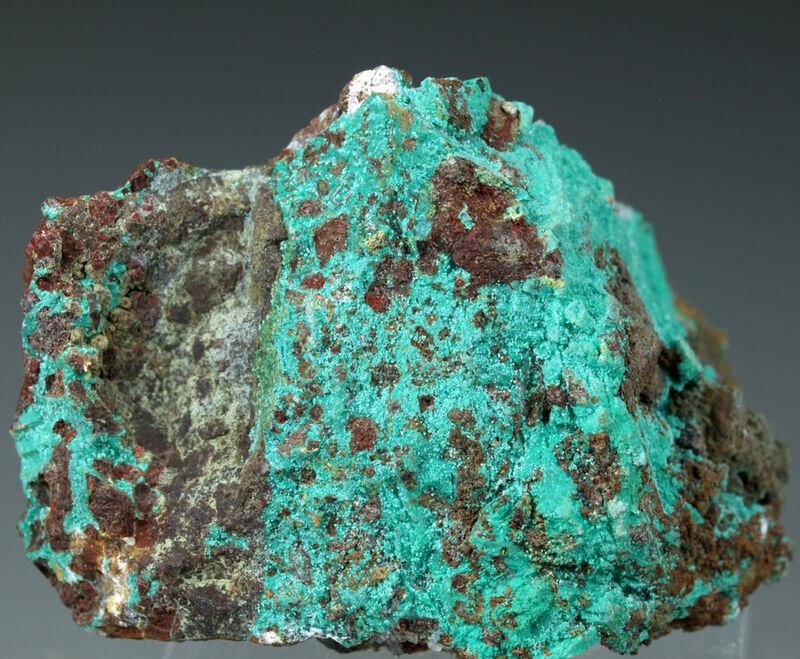
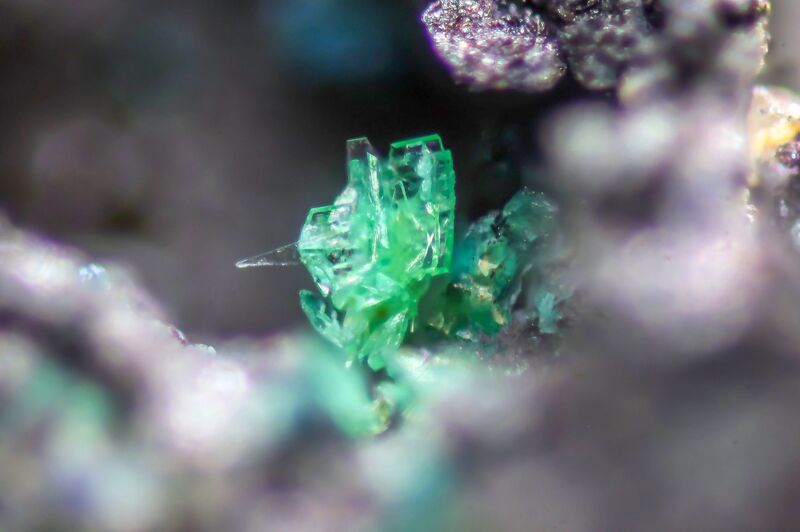
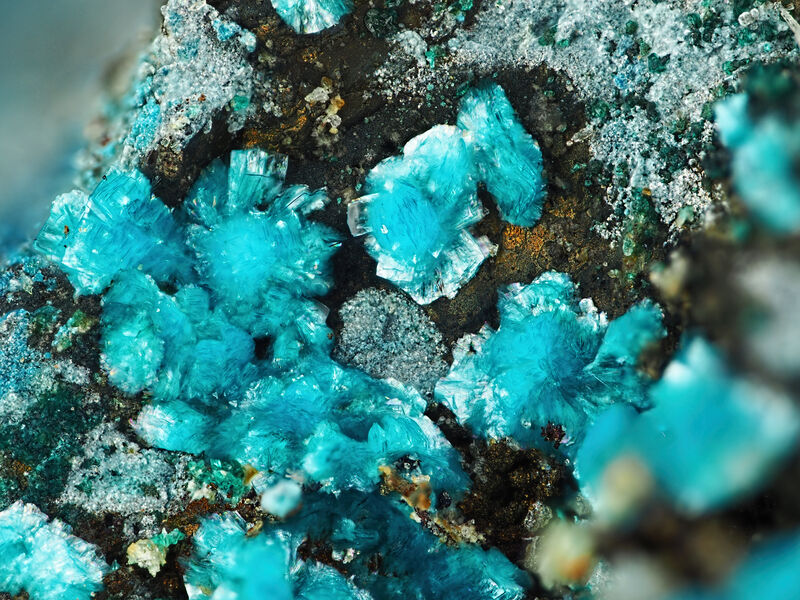
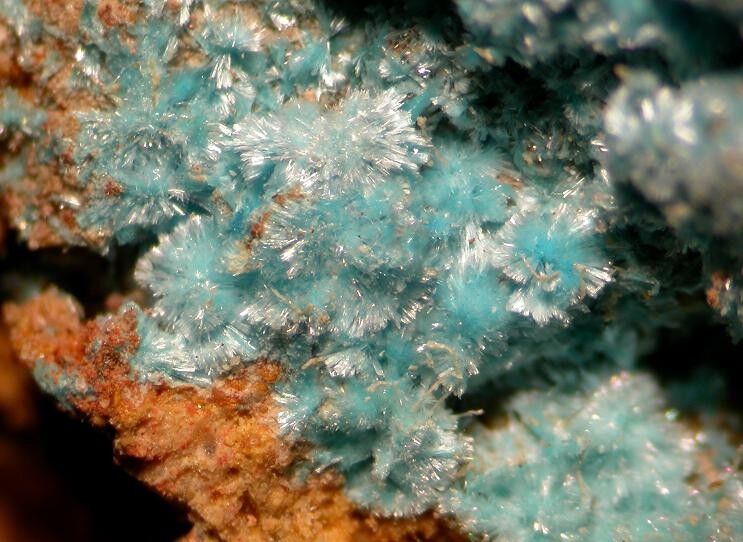
Forming sprays of acicular crystals to 0.8 mm across
- Type-locality form
Sprays of acicular crystals up to 0.8 mm across. Crystals are up to 0.4 x 0.005 mm in size and often form subparallel intergrowths. Found in cavities in a quartz-garnet-smithsonite matrix.
Chemical composition
Synonyms
- Aldridgeiet
- Aldridgeitt
- IMA2010-029
In other languages
- German
- Aldridgeit · IMA 2010-029
- Italian
- aldridgeite
Classification
Strunz
10th ed.7.DF
- 7SulfatesClass
- 7.DSulfates (selenates, etc.) with additional anions, with H2ODivision
- 7.DFWith large and medium-sized cationsGroup
- 7.DFAldridgeiteSpecies
Group, growth & confusion
Literature, links & citation
Citations
- 2010Williams, P. A., Hatert, F., Pasero, M., Mills, S. J. (2010) IMA Commission on New Minerals, Nomenclature and Classification (CNMNC) CNMNC Newsletter No 4. Mineralogical Magazine, 74 (4) 797-800 doi:10.1180/s0026461x00038925 DOI: 10.1180/s0026461x00038925
- 2015Elliott, P., Pring, A. (2015) Aldridgeite, a new mineral from the Block 14 Opencut, Broken Hill, New South Wales. Australian Journal of Mineralogy, 17. 67-71
- 2022(2022) Aldridgeite. Handbook of Mineralogy. Mineralogical Society of America
Cite this entry
Entry last updated
@misc{mineral2025,
  author    = {Mineral Index editorial board},
  title     = {Aldridgeite — Mineral Index},
  year      = {2025},
  url       = {https://mineralindex.org/minerals/aldridgeite-40398}
}