Where it forms, where it's found
- Geological setting
In cavities of a calcite-quartz vein.
- Type locality
- Kapital'naya mine
- Buldym Lake
- Vishnevye Mountains
- Chelyabinsk Oblast
- Russia
56.0092°, 60.6353°
3recorded occurrences
Physical
Optical
- Optical type
- Biaxial (-) · 2V measured = 50° · 2V calc = 47°
- Refractive index
- 1.602 – 1.679
- Surface relief
- Moderate
- Principal indices
- nα 1.602 · nβ 1.666 · nγ 1.679
- Pleochroism
- Visible
Medium, Z > Y > X; the mineral is bluish-green in all sections but the intensity depends on orientation.
- Dispersion
- Strong, r < v
- Extinction
- Z is close to the crystal elongation direction
- UV response
- Not fluorescent
Δ = 0Δmax
PPLpleochroism per grain
XPLindependent extinctions · rotate the stage
PPLpleochroism only · colour blends on rotation
XPLinterference colour · extinct every 90°
Retardation770 nm
Order2nd order
XPL colour
Crystallography
- Cell parameters
- a = 6.0731(6) Å · b = 11.0597(13) Å · c = 5.5094(6) Å
- Cell angles
- α = 102.883(9) ° · β = 92.348(8) ° · γ = 92.597(9) °
- Ratio a:b:c
- 1 : 1.821 : 0.907
- Unit cell volume
- 359.87 ų
- Z
- 1
- Type-locality form
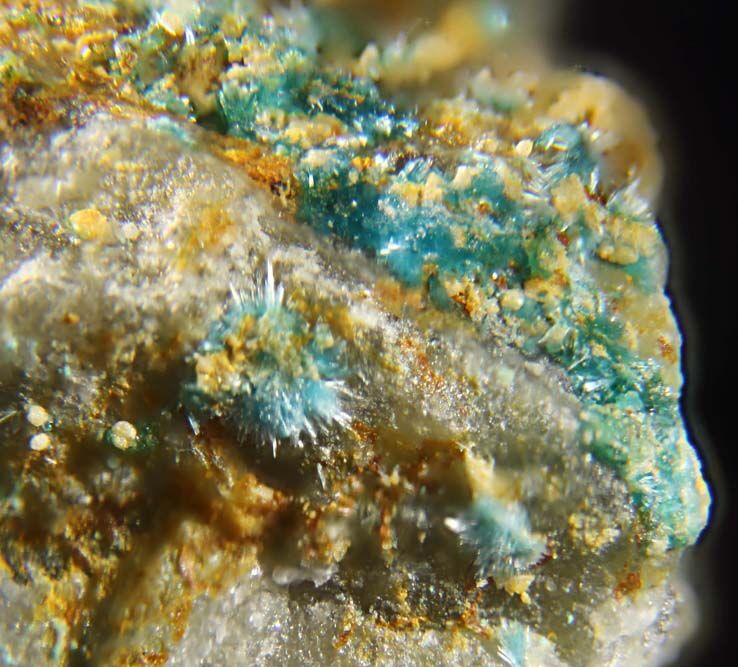
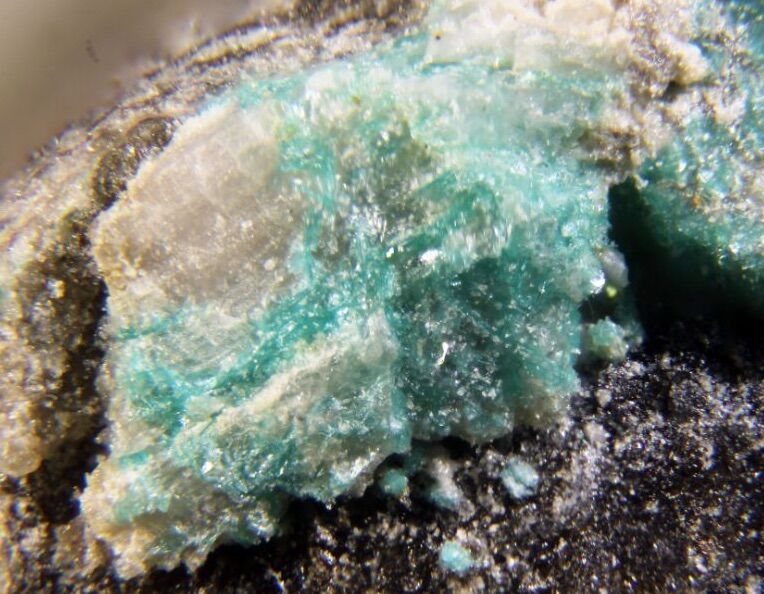
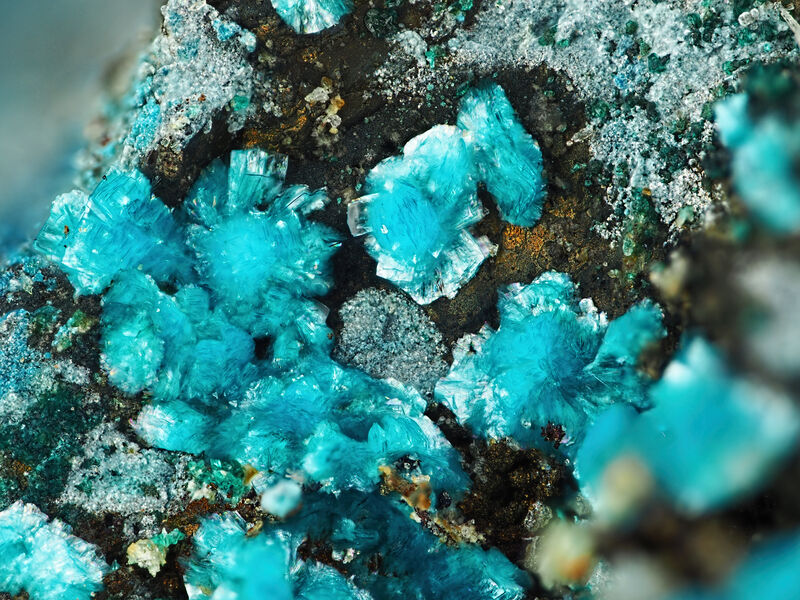
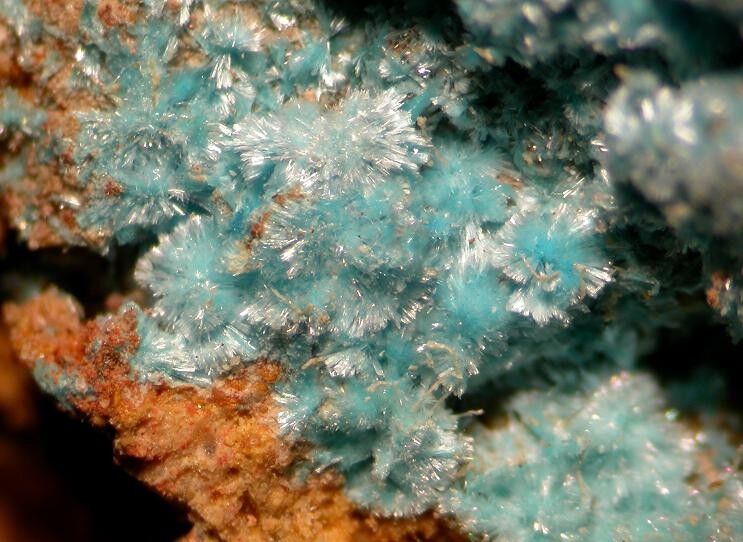
Elongated crystals up to 0.2 mm typically curved or split and combined into thin crusts up to 1 × 2 mm.
Crystal structure
Chemical composition
Synonyms
- IMA2011-066
- Kobyasheviet
- Strandbergite
In other languages
- German
- IMA 2011-066 · Kobyashevit
- Italian
- kobyashevite
Classification
Strunz
10th ed.7.DD.15
- 7SulfatesClass
- 7.DSulfates (selenates, etc.) with additional anions, with H2ODivision
- 7.DDWith only medium-sized cations; sheets of edge-sharing octahedraGroup
- 7.DD.15KobyasheviteSpecies
Group, growth & confusion
Literature, links & citation
Citations
- 1995Strandberg, Helena, Langer, Vratislav, Johansson, Lars-Gunnar, Bálint, József, Fogassy, Elemér, Christensen, Lene Krogh, Napoli, Anna, Sindona, Giovanni, Aksnes, Dagfinn W., Francis, George W., Aaberg, Atle (1995) Structure of Cu2.5(OH)3SO4.2H2O: a Novel Corrosion Product of Copper. Acta Chemica Scandinavica, 49. 5-10 doi:10.3891/acta.chem.scand.49-0005DOI: 10.3891/acta.chem.scand.49-0005
- 2002Krätschmer, A., Odnevall Wallinder, I., Leygraf, C. (2002) The evolution of outdoor copper patina. Corrosion Science, 44. 425-450 doi:10.1016/s0010-938x(01)00081-6DOI: 10.1016/s0010-938x(01)00081-6
- 2007Yoder, C. H., Agee, T. M., Ginion, K. E., Hofmann, A. E., Ewanichak, J. E., Schaeffer, C. D., Carroll, M. J., Schaeffer, R. W., McCaffrey, P. F. (2007) The relative stabilities of the copper hydroxyl sulphates. Mineralogical Magazine, 71 (5) 571-577 doi:10.1180/minmag.2007.071.5.571DOI: 10.1180/minmag.2007.071.5.571
- 2010Yoder, C. H., Gotlieb, N. R., Rowand, A. L. (2010) The relative stability of stoichiometrically related natural and synthetic double salts. American Mineralogist, 95 (1) 47-51 doi:10.2138/am.2010.3244DOI: 10.2138/am.2010.3244
- 2011Williams, P. A., Hatert, F., Pasero, M., Mills, S. J. (2011) New minerals and nomenclature modifications approved in 2011. CNMNC Newsletter No 11. Mineralogical Magazine, 75 (6) 2887-2893 doi:10.1180/minmag.2011.075.6.2887 DOI: 10.1180/minmag.2011.075.6.2887
Cite this entry
Entry last updated
@misc{mineral2025,
  author    = {Mineral Index editorial board},
  title     = {Kobyashevite — Mineral Index},
  year      = {2025},
  url       = {https://mineralindex.org/minerals/kobyashevite-42367}
}