Where it forms, where it's found
- Geological setting
hydrothermal in hyperagpaitic (peralkaline) rocks, resulting from low-temperature alteration (hydration + cation exchange) of a high-temperature phosphate-bearing titanosilicate precursor (possibly lomonosovite and/or beta-lomonosovite); associated minerals are those at the holotype locality (Flora Mt.)
- Type locality
- Eveslogchorr Mt
- Murmansk Oblast
- Russia
67.6790°, 33.9450°
4recorded occurrences
Physical
Optical
- Optical type
- Biaxial (-) · 2V measured = 58°
- Refractive index
- 1.68 – 1.743
- Surface relief
- High
- Principal indices
- nα 1.680 · nβ 1.728 · nγ 1.743
Δ = 0Δmax
PPLpleochroism per grain
XPLindependent extinctions · rotate the stage
PPLpleochroism only · colour blends on rotation
XPLinterference colour · extinct every 90°
Retardation630 nm
Order2nd order
XPL colour
Crystallography
- Cell parameters
- a = 5.3470(6) Å · b = 7.0774(7) Å · c = 12.146(1) Å
- Cell angles
- α = 91.827(4) ° · β = 107.527(4) ° · γ = 90.155(4) °
- Ratio a:b:c
- 1 : 1.324 : 2.272
- Unit cell volume
- 438.03 ų
- Z
- 1
- Type-locality form
lamellar crystals, up to 0.1 × 0.4 × 0.6 cm, may form fan-shaped aggregates, up to 3.5 cm
Chemical composition
- Impurities
- Mg
- Mn
- Fe
- Nb
- Al
Synonyms
- Calciomurmaniet
- IMA2014-103
In other languages
- German
- Calciomurmanit · IMA 2014-103
- Italian
- calciomurmanite
Classification
Strunz
10th ed.9.BE
- 9SilicatesClass
- 9.BSorosilicatesDivision
- 9.BESi2O7 groups, with additional anions; cations in octahedral [6] and greater coordinationGroup
- 9.BECalciomurmaniteSpecies
Group, growth & confusion
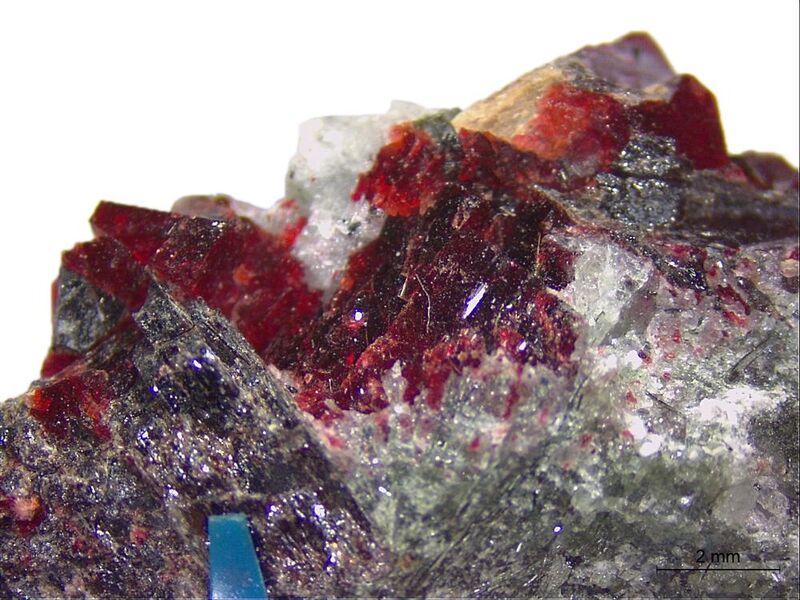
- Kolskyite(Ca◻)Ti2Na2Ti2(Si2O7)2O4(H2O)7Mineral—
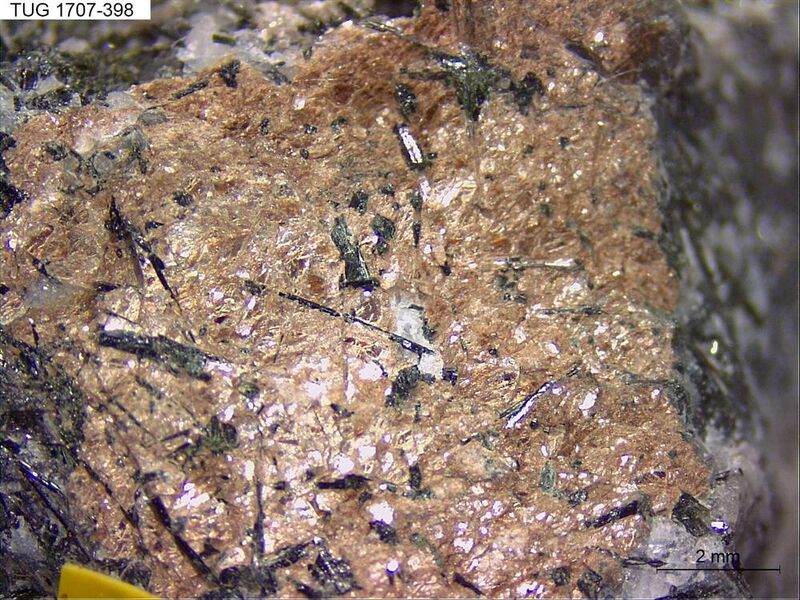
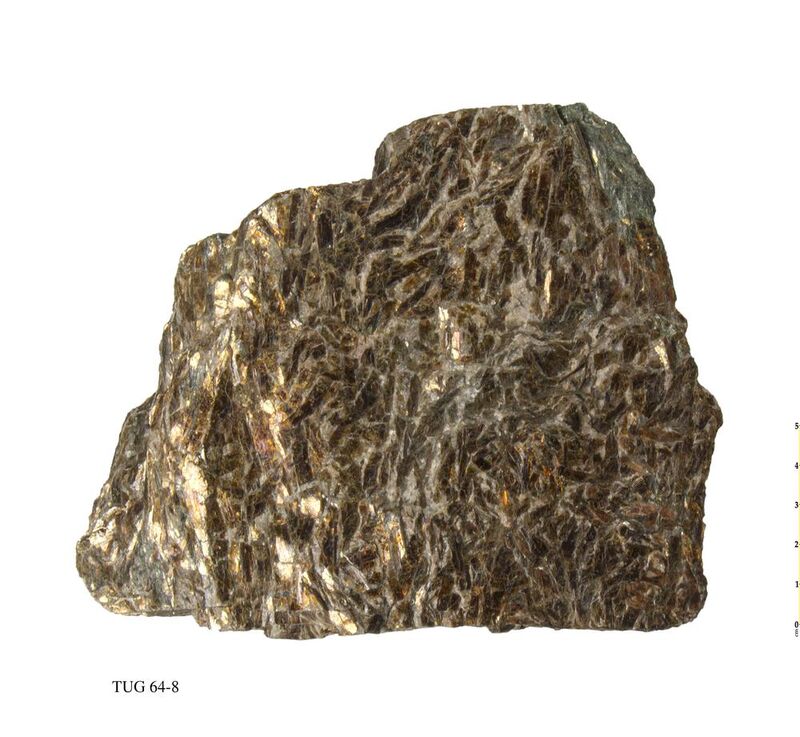
 LomonosoviteNa6Na2Ti2Na2Ti2(Si2O7)2(PO4)2O4Mineral—
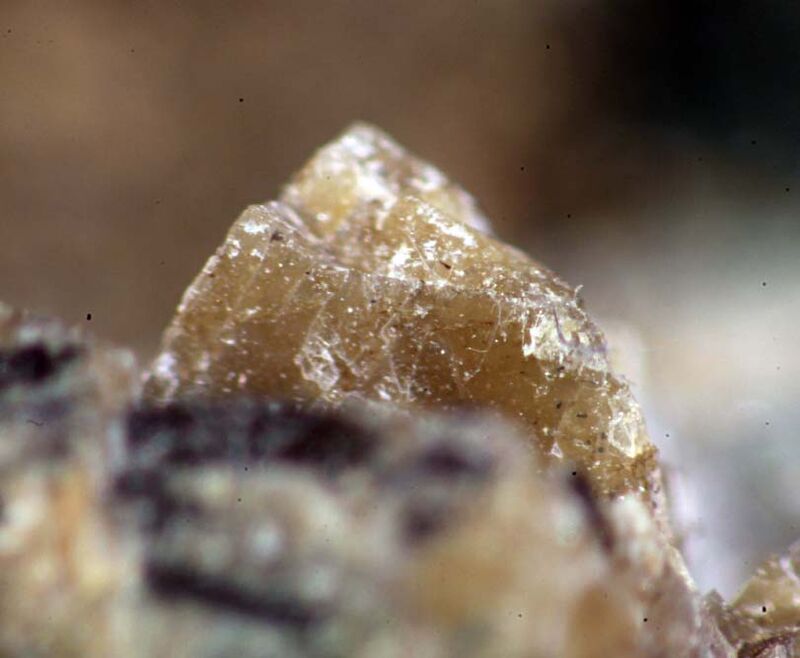
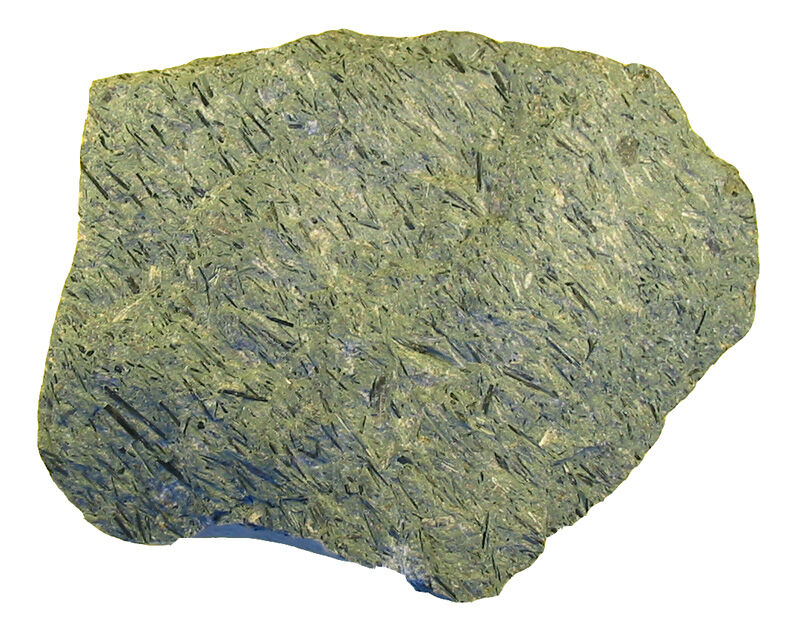
 MurmaniteNa2Ti2Na2Ti2(Si2O7)2O4(H2O)4Mineral—
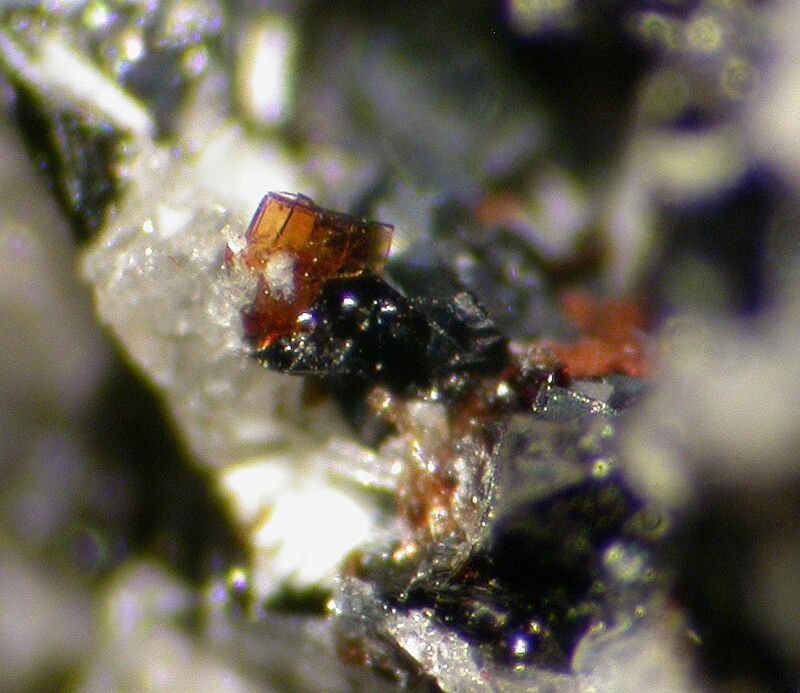
 ParalomonosoviteNa5+xTi4(Si2O7)2[PO3(OH)]2-y[PO2(OH)2]yO2[(OH,F)2-xOz], [0<x<2, 0<y<1, 0<z<1]Mineral—
- QuadruphiteNa6Na2(CaNa)2Na2Ti2Na2Ti2(Si2O7)2(PO4)4O4F2Mineral—
 SchülleriteBa2Ti2Na2Mg2(Si2O7)2O2F2Mineral—
- SelivanovaiteNaFe3+Ti4(Si2O7)2O4(H2O)4Mineral—
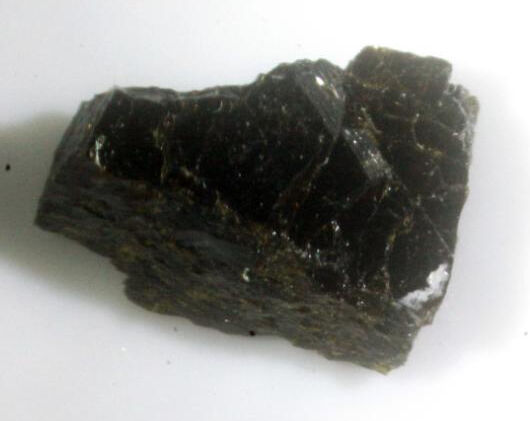 SoboleviteNa6(Na2Ca)(NaCaMn)Na2Ti2Na2(TiMn)(Si2O7)2(PO4)4O2(OF)F2Mineral—
- VigrishiniteNaZnTi4(Si2O7)2O3(OH)(H2O)4Mineral—
Literature, links & citation
Citations
- 2015Hålenius, U., Hatert, F., Pasero, M., Mills, S. J. (2015) New minerals and nomenclature modifications approved in 2015, CNMNC Newsletter No 25. Mineralogical Magazine, 79 (3) 529-535 doi:10.1180/minmag.2015.079.3.02DOI: 10.1180/minmag.2015.079.3.02
- 2016Lykova, Inna S., Pekov, Igor V., Chukanov, Nikita V., Belakovskiy, Dmitry I., Yapaskurt, Vasiliy O., Zubkova, Natalia V., Britvin, Sergey N., Giester, Gerald (2016) Calciomurmanite, (Na,□)2Ca(Ti,Mg,Nb)4[Si2O7]2O2(OH,O)2(H2O)4, a new mineral from the Lovozero and Khibiny alkaline complexes, Kola Peninsula, Russia. European Journal of Mineralogy, 28 (4) 835-845 doi:10.1127/ejm/2016/0028-2550 DOI: 10.1127/ejm/2016/0028-2550
- 2017(2017) Calciomurmanite. Handbook of Mineralogy. Mineralogical Society of America
- 2017Sokolova, E., Cámara, F. (2017) The seidozerite supergroup of TS-block minerals: nomenclature and classification, with change of the following names: rinkite to rinkite-(Ce), mosandrite to mosandrite-(Ce), hainite to hainite-(Y) and innelite-1T to innelite-1A. Mineralogical Magazine, 81 (6) 1457-1484 doi:10.1180/minmag.2017.081.010 DOI: 10.1180/minmag.2017.081.010
Cite this entry
Entry last updated
@misc{mineral2025,
  author    = {Mineral Index editorial board},
  title     = {Calciomurmanite — Mineral Index},
  year      = {2025},
  url       = {https://mineralindex.org/minerals/calciomurmanite-46606}
}