History
The mineral now called aegirine entered the literature twice, under two different names, before anyone realised the two specimens were one species.
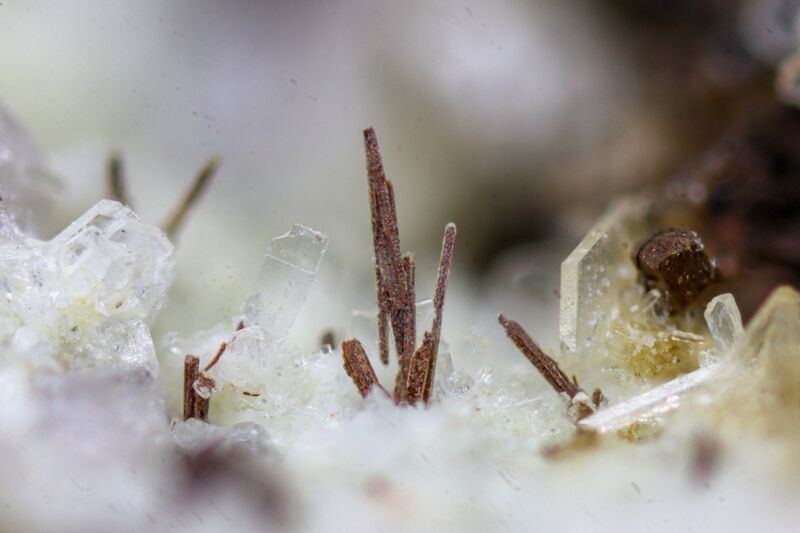
The first description came in 1821. The Norwegian mineralogist P. H. Ström examined a brown, pointed mineral from Rundemyr, in Øvre Eiker. The same locality had been noted, very briefly, in 1784, where the material was described as a kind of "crystallised hornstone" embedded in quartz. Ström recognised it as a new species and proposed naming it wernerin, after the German geologist Abraham Gottlob Werner. The Swedish chemist Jöns Jacob Berzelius carried out the analysis that same year. He overruled the proposal and chose achmit instead — from the Greek akmē, point, in reference to the sharply pointed crystals. The name reached English-language mineralogy as acmite.
A second discovery followed in 1834. The priest and mineralogist Hans Morten Thrane Esmark found another unfamiliar mineral on the island of Låven, in the Langesundsfjord on the Norwegian coast. Berzelius described and named it the following year, in 1835. He called it aegirine, after Ægir, the Norse god of the sea, because the type locality lay along the seashore.
For half a century, mineralogists treated acmite and aegirine as two distinct species. They even placed them in two different families — acmite among the amphiboles, aegirine among the pyroxenes, the two big groups of dark silicate minerals that build most volcanic and intrusive rocks. The Austrian mineralogist Gustav Tschermak settled the question in 1871. His analyses showed that both samples belonged to the pyroxene group, and were the same mineral. Acmite, as the older name, should by convention have taken precedence. But aegirine had become the more widely used term and stayed as the species name. Acmite survives as a synonym, today usually reserved for the pure sodium-iron end-member of the series.
Industrial & practical applications
Aegirine has no industrial application. The mineral is too scattered, and the rocks that carry it are too specialised, to support mining for any commercial product. What demand exists is from petrologists who study the rocks, and from collectors who keep the crystals.
For geologists, aegirine is a diagnostic mineral of peralkaline magmas — molten rocks unusually rich in sodium and potassium relative to aluminium. It appears almost exclusively in such rocks: nepheline syenites, syenite pegmatites, carbonatites, and a handful of metamorphic settings. Finding aegirine in a thin section of a rock — the wafer-thin slice geologists view under a microscope — is therefore a strong clue about the chemistry of the magma that produced it.
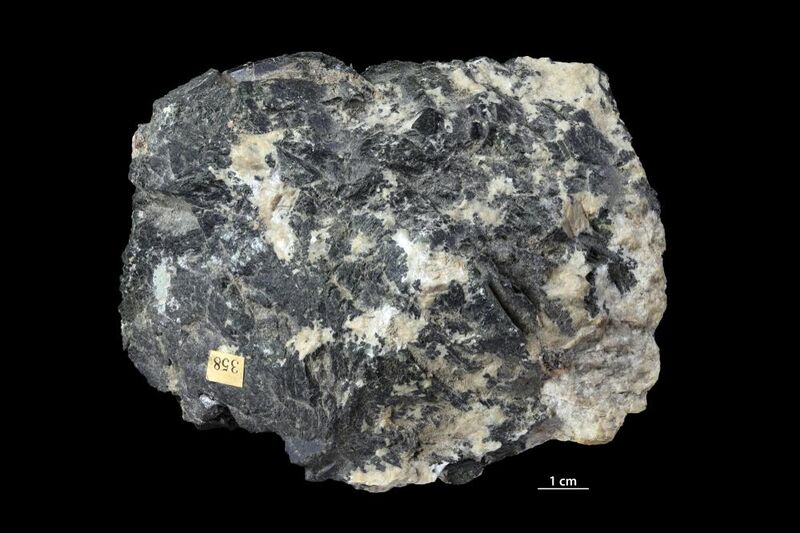
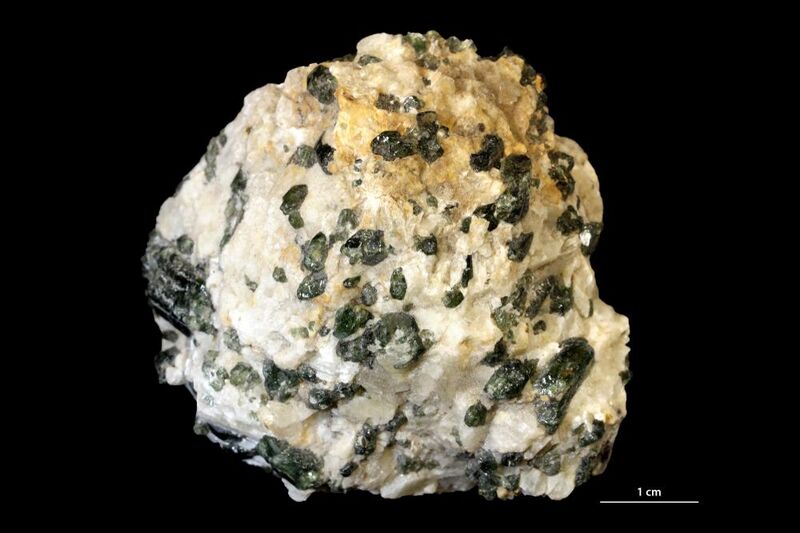
The collector market is the only domain where individual aegirine crystals are sought for their own sake. A few localities dominate the trade. Mont Saint-Hilaire in Quebec, Canada is an alkaline complex famous among mineralogists for the sheer variety of its species. It yields the largest aegirines — prismatic, lustrous black, up to about 30 centimetres long. They occur in pegmatites alongside pink eudialyte, white gonnardite, and colourless natrolite. The Kola Peninsula in Russia produces similar associations on an even larger geological scale, and Magnet Cove in Arkansas adds a smaller classic American occurrence. Notable specimens have also been recorded from Greenland, Scotland, Kenya, and Nigeria.
A few aegirines reach the gem trade as faceted stones, but the material is too dark and too scarce to compete with mainstream gem species, and it remains a curiosity rather than a working jewellery stone.
Where it forms, where it's found
- Geological setting
Common in alkalic igneous rocks, carbonatites, and pegmatites; from regionally metamorphosed schists, gneisses, and iron formations; in blueschist facies rocks, and from sodium metasomatism in granulites; authigenic in some shales and marls.
- Type locality
- Rundemyr
- Øvre Eiker
- Buskerud
- Norway
59.7116°, 9.9487°
Varieties
Physical
- Hardness
- 1Talc
- 2Gypsum
- 3Calcite
- 4Fluorite
- 5Apatite
- 6Orthoclase
- 7Quartz
- 8Topaz
- 9Corundum
- 10Diamond
- Lustre
- Vitreous · resious
- Transparency
- Transparent · Opaque
- Colour
- Dark green to greenish black · reddish brown · black
bright green to yellow-green in thin section
- Streak
- Pale yellowish grey
- Tenacity
- brittle
- Cleavage
- Distinct/Good
Good on (110)
- Fracture
- Irregular/Uneven
- Density
- 3.5 g/cm³
Optical
- Optical type
- Biaxial (-) · 2V measured = 60 – 90° · 2V calc = 68 – 84°
- Refractive index
- 1.72 – 1.839
- Surface relief
- High
- Principal indices
- nα 1.720 – 1.778 · nβ 1.740 – 1.819 · nγ 1.757 – 1.839
- Birefringence
- 0.061
- Pleochroism
- Visible
X= emerald green, deep green Y= grass green, deep green, yellow Z= brownish green, green, yellowish brown, yellow
- Dispersion
- moderate to strong r > v
- UV response
- Not fluorescent in UV
- Notes
Biaxial + for Ca,Mg,Fe varieties.
Crystallography
- Space group
- C2/c
- Cell parameters
- a = 9.658 Å · b = 8.795 Å · c = 5.294 Å
- Cell angles
- β = 107.42 °
- Ratio a:b:c
- 1 : 0.911 : 0.548
- Z
- 4
- Morphology
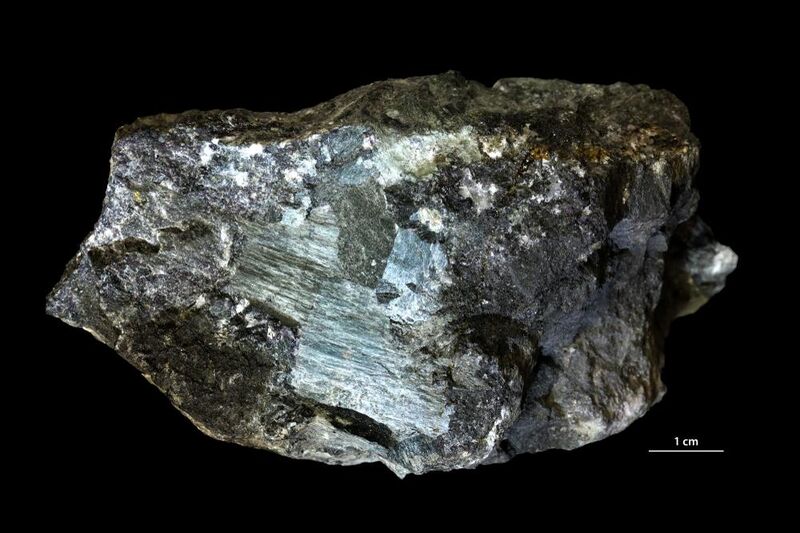
Prismatic crystals, showing 110, with blunt to steep terminations, to 35 cm, striated lengthwise, can be bent or twisted. In sprays of acicular crystals, fibrous, in radial concretions.
- Twinning
Simple and lamellar on (100)
- Parting
- on (100)
- Comment
On synthetic material.
Chemical composition
- Impurities
- Al
- Ti
- V
- Mn
- Mg
- Ca
- K
- Zr
- Ce
Synonyms
- Achmit
- Acmit
- Acmita
- Acmite
- Acnit
- Acnite
- Aegerine
- Aegerit
- Aegerite
- Aegirit
- Aegirite
- Aegyrina
- Aegyrine
- Aegyrit
- Aegyrite
- Aemit
- Aemite
- Agerit
- Ägirin
- Agirine
- Aigirin
- Akmit
- Manganacmite
- Natronägirin
- Soda-Aegirite
- Wernerin
In other languages
- French
- Achmite · Acmite · Acnite · Aegerine · Aegerite · Aegirine · Aegirite · Aegyrine · Aemite · Agirine · Ægyrine
- German
- Aegirin · Ägirin · Schefferit
- Spanish
- Acmita · Egirina
- Italian
- aegirine · egirina
- Portuguese
- Acnite · Aegirina · egirina
- Japanese
- エジリン輝石 · エジル輝石 · 錐輝石
- Chinese
- 霓石
- Russian
- Акмит · Эгирин
- Arabic
- أجيراين · أجيرين
Classification
9.DA.25
- 9SilicatesClass
- 9.DInosilicatesDivision
- 9.DAInosilicates with 2-periodic single chains, Si2O6; pyroxene familyGroup
- 9.DA.25AegirineSpecies
65.01.3c.02
- 65Inosilicates Single-width, Unbranched Chains, (w=1)Class
- 65.01Single-Width Unbranched Chains, W=1 with chains P=2Type
- 65.01.3c— unnamed intermediate level —Group
- 65.01.3c.02AegirineSpecies
14.20.2
- 14Silicates not Containing AluminumClass
- 14.20Silicates of Fe and alkali metalsGroup
- 14.20.2AegirineSpecies
Group, growth & confusion
 Aegirine-augite(Ca,Na)(Fe3+,Mg,Fe2+)Si2O6Mineral—
 Augite(Ca,Mg,Fe)2Si2O6Mineral—
- BurnettiteCaVAlSiO6Mineral—
- ClinoenstatiteMg2Si2O6Mineral—
 ClinoferrosiliteFe2+2Si2O6Mineral—
- ColomeraiteNaTi3+Si2O6Mineral—
- DavisiteCaScAlSiO6Mineral—
 DiopsideCaMgSi2O6Mineral—
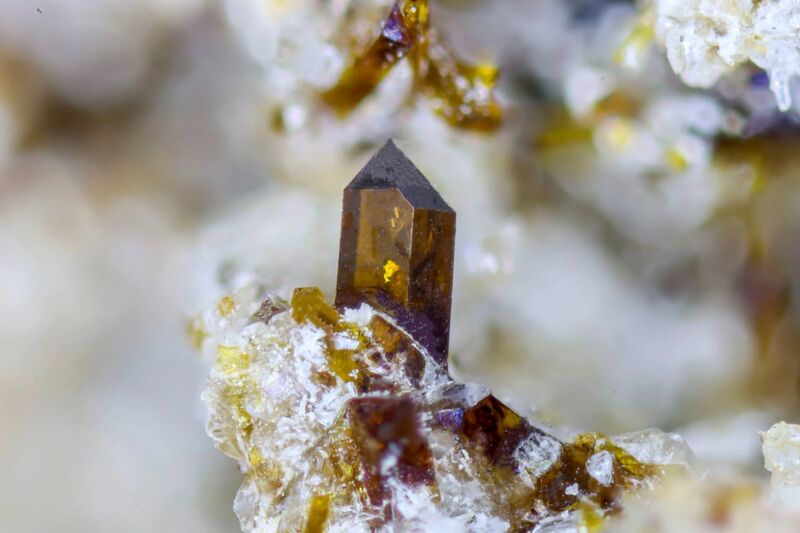 EsseneiteCaFe3+AlSiO6Mineral—
- GrossmaniteCa(Ti3+,Mg,Ti4+)AlSiO6Mineral—
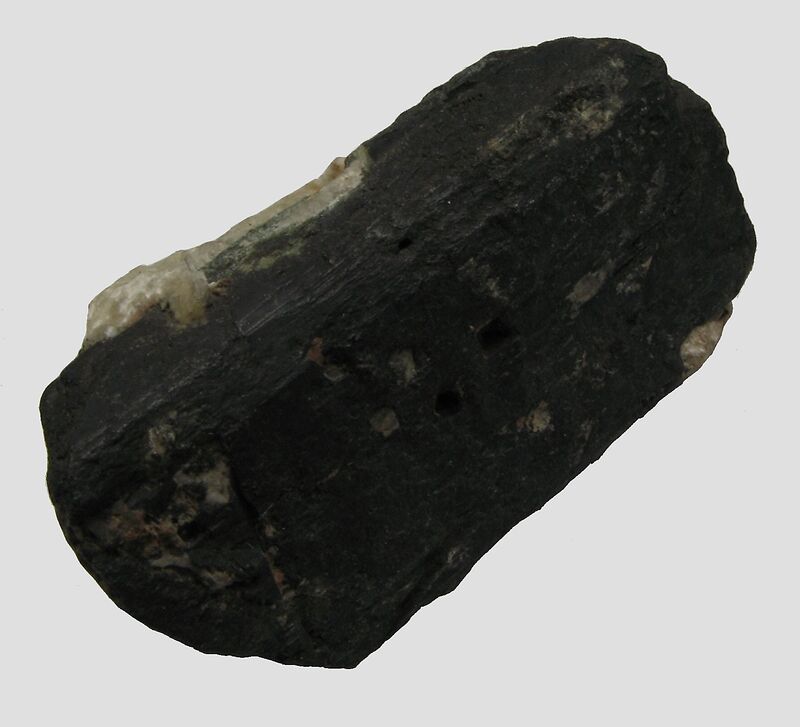 AenigmatiteNa4[Fe2+10Ti2]O4[Si12O36]Mineral—
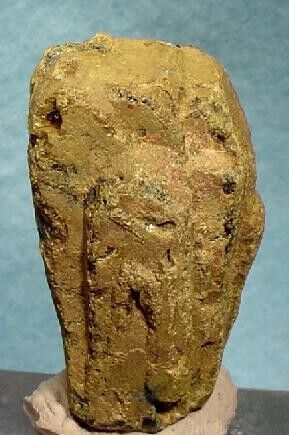 Aeschynite-(Nd)Nd(TiNb)O6Mineral—
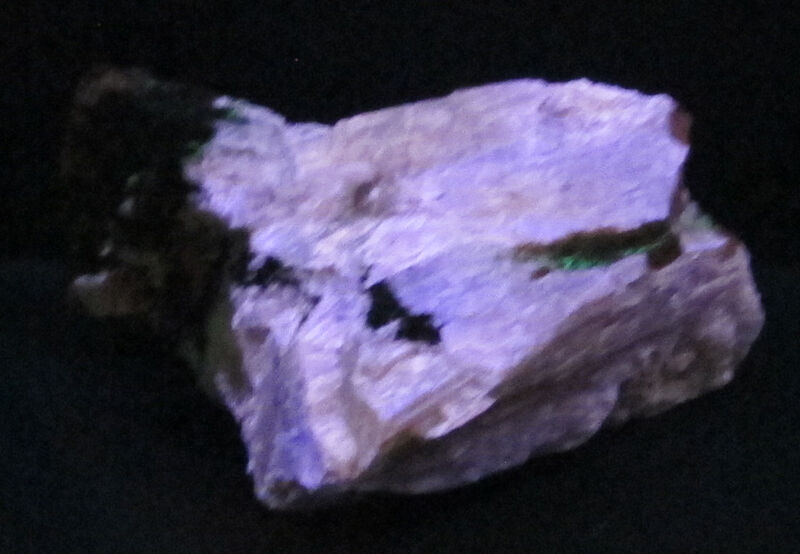 AgrelliteNaCa2Si4O10FMineral—
- AlfredcaspariteSr2TiO(Si2O7)Mineral—
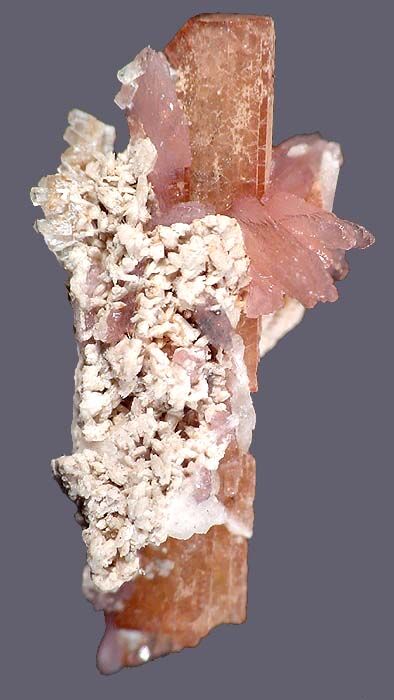 Ancylite-(Ce)CeSr(CO3)2(OH) · H2OMineral—
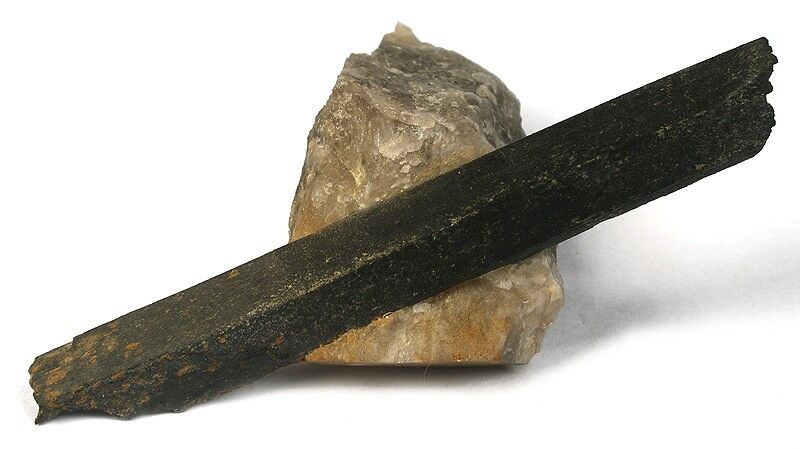 ArfvedsoniteNaNa2(Fe2+4Fe3+)Si8O22(OH)2Mineral—
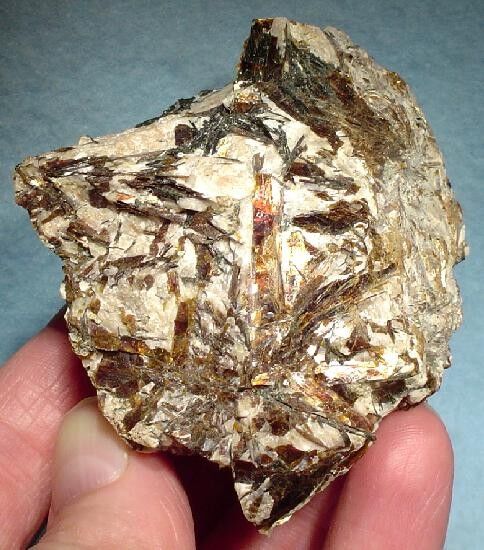 AstrophylliteK2NaFe2+7Ti2(Si4O12)2O2(OH)4FMineral—
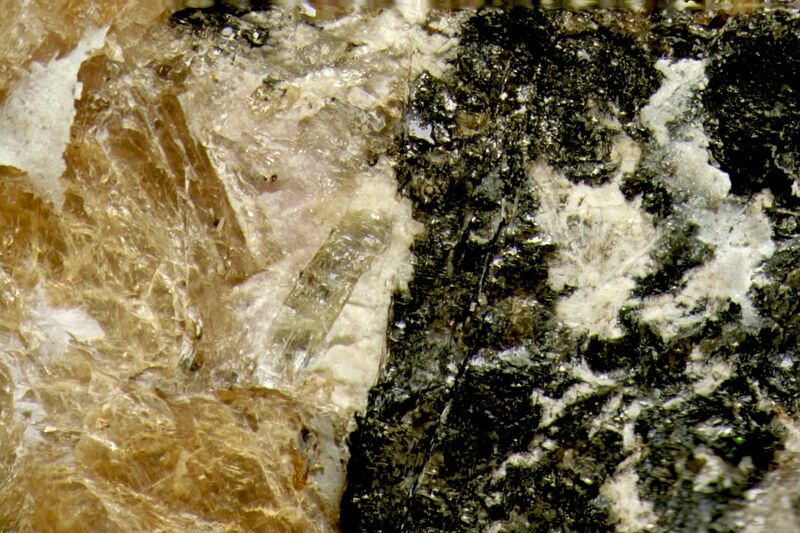 Belovite-(Ce)NaCeSr3(PO4)3FMineral—
- Calciomurmanite(Na,◻)2Ca(Ti,Mg,Nb)4[Si2O7]2O2(OH,O)2(H2O)4Mineral—
 CatapleiiteNa2Zr(Si3O9) · 2H2OMineral—
Literature, links & citation
- 1821Ström, P. (1821) Undersökning af ett nytt Fossil [Examination of a new Fossil]. Kungliga Svenska vetenskapsakademiens handlingar, S. 3 Vol. 9. 160-163
- 1821Berzelius, Jöns Jacob (1821) Tillägg til föregående Afhandling [Addendum to previous paper]. Kungliga Svenska vetenskapsakademiens handlingar, S. 3 Vol. 9. 163-166
- 1835Berzelius, Jöns Jacob (1835) [without titel dated 13 jan. 1835]. Neues Jahrbuch für Mineralogie, Geognosie, Geologie und Petrefaktenkunde, 184-185
- 1946(1946) Til opprinnelsen av mineralnavnet "Ægirin" [To the origin of the mineral name "Ægirin"], in Notiser. Norsk Geologisk Tidsskrift [Norwegian Journal of Geology], 26 (1-2). 144-145
- 1958Schüller, Karl-Heinz (1958) Das Problem Akmit-Ägirin. Beiträge zur Mineralogie und Petrographie, 6 (2). 112-138 doi:10.1007/bf01084744DOI: 10.1007/bf01084744
Entry last updated
@misc{mineral2026,
  author    = {Mineral Index editorial board},
  title     = {Aegirine — Mineral Index},
  year      = {2026},
  url       = {https://mineralindex.org/minerals/aegirine-31}
}