History
The name celestine comes from the Latin caelestis — celestial — chosen in allusion to the faint sky-blue colour of the original specimen. The mineral is also commonly called celestite, an older form still widespread in the United States, though celestine is the name the International Mineralogical Association recognises today.
Crystals from Sicily had been admired in European cabinets through the 18th century, but they were thought to be a barium-rich form of heavy-spar. The element strontium had not yet been recognised, and without it the mineral could not be properly placed.
That recognition arrived from a different corner of Europe. In 1790 Adair Crawford and William Cruickshank examined a lead-mine ore from the Scottish village of Strontian and noticed it behaved differently from any other "heavy spar" they knew. The following year, working independently with a fibrous specimen, the German mineralogist Andreas Gotthelf Schütz described what would later be called celestine as fasriger schwerspath — "fibrous heavy-spar". Thomas Charles Hope, a chemistry professor at the University of Glasgow, returned to the Strontian material and in 1793 proposed the name strontites for the new earth he had found in it.
The connection between the new earth and the Sicilian specimens followed quickly. In 1797 Martin Klaproth, working with a fresh specimen sent from Pennsylvania, renamed Schütz's mineral schwefelsaurer strontianite aus Pennsylvania — sulfated strontianite from Pennsylvania — recognising that it carried the same earth. Abraham Gottlob Werner gave the mineral its lasting name in 1798, drawing on the Latin caelestis for the pale celestial blue of the type material. Dietrich Ludwig Gustav Karsten tried once more in 1800, proposing Schützit in honour of the original describer, but the name did not take. The metal itself was not isolated until 1808, when Humphry Davy reduced a strontium chloride mixture by electrolysis.
Industrial & practical applications
Celestine is the dominant ore from which the element strontium is extracted. The mineral is crushed and converted to strontium carbonate by a carbothermic reduction with carbon; from there it enters a handful of distinct supply chains. About 300,000 tonnes are processed in this way each year.
The most visible of those uses is pyrotechnics. Strontium salts burn with a deep red colour, and they are the source of the crimson seen in fireworks displays and military signal flares. This application absorbs roughly five percent of world strontium production.
The largest historical use was something the public never saw. Cathode-ray tube televisions and computer monitors used a leaded faceplate doped with strontium to block the X-rays generated inside the tube. At its peak this single application accounted for about three-quarters of strontium consumption in the United States. The flat-panel transition has gutted that demand, and the share has since collapsed.
One industrial use has grown into the space the cathode-ray tube left behind. Strontium carbonate is a feedstock for ferrite magnets — the inexpensive ceramic magnets used in loudspeakers, small motors, and the magnets that hold notes to a refrigerator door.
A medical application has come and gone. Strontium ranelate was prescribed for osteoporosis, used to increase bone density in older patients. Cardiovascular safety concerns have steered prescribers toward other treatments and the market has narrowed sharply. A more durable niche sits in the food industry, where strontium compounds drawn from celestine are used in the refining of sugar from sugar beet.
Supply is concentrated. The United States has not mined a strontium deposit since 1959 and runs entirely on imports. The bulk of current celestine production comes from four countries: Spain and Iran lead, followed by China and Mexico.
Where it forms, where it's found
- Geological setting
Sedimentary rocks.
Occurs mainly in sedimentary rocks such as bedded deposits of gypsum and halite; also in bedded limestone and dolomite, in cavities.
- Type locality
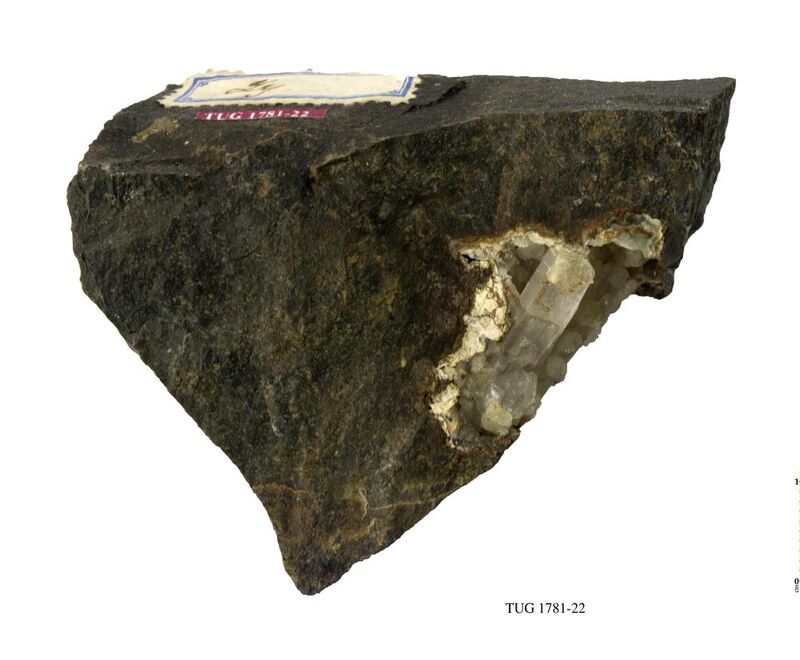
- Bell's Mill
- Bellwood
- Blair County
- Pennsylvania
- USA
40.6058°, -78.3231°
Varieties
Physical
- Hardness
- 1Talc
- 2Gypsum
- 3Calcite
- 4Fluorite
- 5Apatite
- 6Orthoclase
- 7Quartz
- 8Topaz
- 9Corundum
- 10Diamond
- Transparency
- Transparent · Translucent
- Colour
- Colourless · shades of light blue · white · reddish · greenish · brownish · greyish · colourless or lightly tinted in transmitted light
- Streak
- White
- Tenacity
- brittle
- Cleavage
- Perfect
On (001) perfect; on (210) good; on (010) poor. Also reported on (011).
- Fracture
- Irregular/Uneven
- Density
- 3.96 g/cm³
Optical
- Optical type
- Biaxial (+) · 2V measured = 50 – 51° · 2V calc = 54 – 58°
- Refractive index
- 1.619 – 1.632
- Surface relief
- Moderate
- Principal indices
- nα 1.619 – 1.622 · nβ 1.622 – 1.624 · nγ 1.63 – 1.632
- Pleochroism
- Weak
Blue-coloured material: shades of indigo- and lavender-blue, bluish green or violet.
- Dispersion
- moderate r < v
- Extinction
- X = c; Y = b; Z = a.
- Notes
Absorption: Z > Y > X.
Crystallography
- Space group
- #71
- Cell parameters
- a = 8.359 Å · b = 5.352 Å · c = 6.866 Å
- Ratio a:b:c
- 1 : 0.640 : 0.821
- Z
- 4
- Morphology
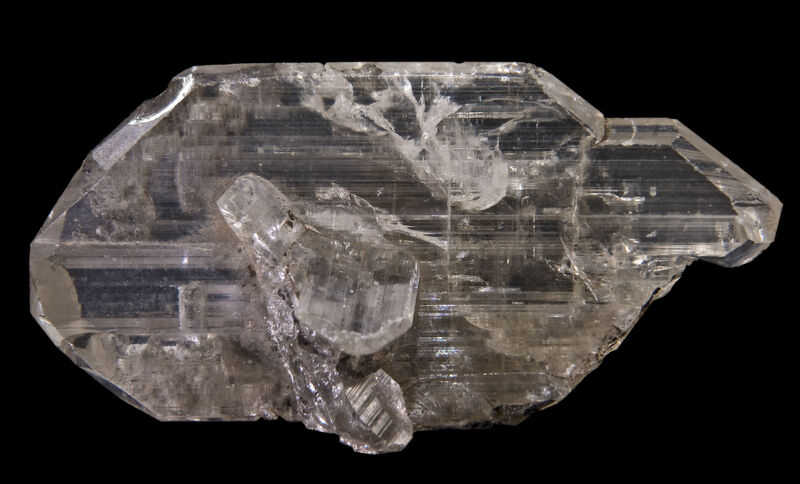
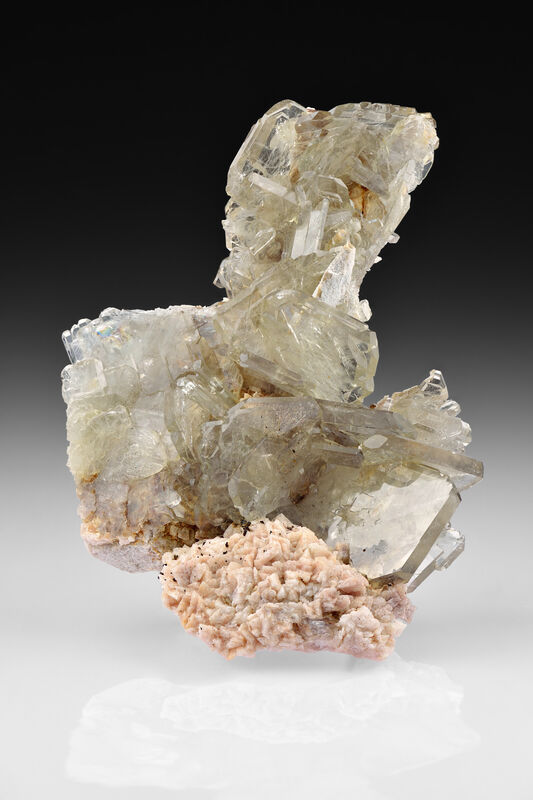
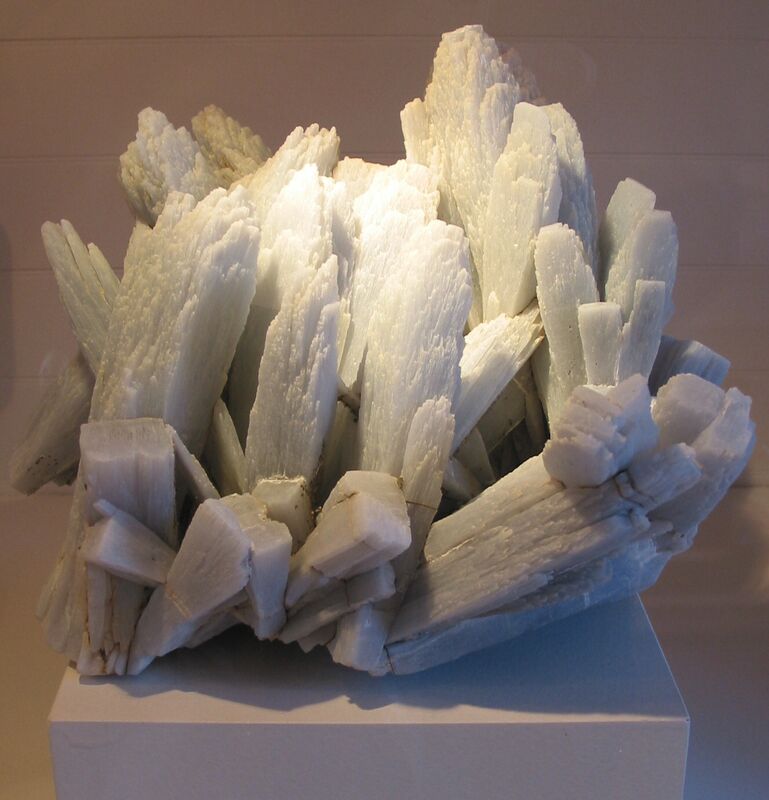
Crystals commonly thin to thick tabular (001), usually with large (210); tabular (001) and elongated [100] yielding lath-like forms; or elongated [100] with equant cross section. Equant by development of (001), (011), (101) of otherwise, less common. Pyramidal (122); elongated [010] or [001]; tabular (100), (100) commonly striated [001]. Fibrous veinlets or nodules with parallel or radiated fiber structure; massive granular; lamellar, earthy, rare.
- Twinning
Reported on (210), (101), and other planes (doubtful).
- Parting
- Twin gliding and translation gliding.
- Type-locality form
Fibrous veinlets.
Chemical composition
Synonyms
- Celestiet
- Celestita
- Celestite
- Coelestine
- Coelistin
- Eschwegite (of Lévy)
- Schätzit
- Schützit
- Schwefelsaurer Strontianit aus Pennsylvanien
- Sicilianite
- Strontiane sulfatée
- Zölestin
In other languages
- French
- barytocélestine · calciocélestine · célestine · celestite · coelestine · colestine · dioxynite · eschwegite · schutzite · sicilianite · Sr(SO4) · strontiane sulfatée
- German
- Coelestin · Cölestin · Strontiumerde · Zölestin
- Spanish
- celestina · celestita
- Italian
- Celestina · Celestite
- Portuguese
- Celestina · celestine · celestita · celestite
- Japanese
- セレスタイト · セレスタイン · 天青石
- Chinese
- 天青石
- Simplified Chinese
- 天青石
- Traditional Chinese
- 天青石
- Russian
- Целестин · Целестит
- Arabic
- سليستيت
- Hindi
- सेलेस्टीन
Classification
7.AD.35
- 7SulfatesClass
- 7.ASulfates (selenates, etc.) without additional anions, without H2ODivision
- 7.ADWith only large cationsGroup
- 7.AD.35CelestineSpecies
28.03.01.02
- 28Anhydrous Acid and Normal SulfatesClass
- 28.03AXO4Type
- 28.03.01Barite GroupGroup
- 28.03.01.02CelestineSpecies
25.4.15
- 25SulphatesClass
- 25.4Sulphates of Ca, Sr and BaGroup
- 25.4.15CelestineSpecies
Group, growth & confusion
Literature, links & citation
- 1791Schütz, Andreas Gotthelf (1791) Beschr. Nordamer. Foss., Leipzig: 12 (as Fasriger Schwerspath).
- 1792Vauquelin, Louis N. (1792) Du sulfate de strontiane. Observations sur la Physique, sur l’Histoire Naturelle et sur les Arts: 46: 150-152.
- 1797Klaproth, M. H. (1797) XXXIX. Untersuchung des schwefelsauren Strontianits aus Pensilvanien. In Beiträge zur chemischen Kenntniss der Mineralkörper Vol. 2. Rottmann. p.92-98.
- 1798Dolomieu, Deodat (1798) Journal des Phys.: 46: 203 (as Strontiane sulfatée).
- 1798Werner, Abraham Gottlieb (1798) (as Cœlestin) {published in L. A. Emmerling, Lehrbuch der Mineralogie}.
Entry last updated
@misc{mineral2026,
  author    = {Mineral Index editorial board},
  title     = {Celestine — Mineral Index},
  year      = {2026},
  url       = {https://mineralindex.org/minerals/celestine-927}
}