History
The name tells you what is missing. Anhydrite comes from the Greek anhydros — without water — and that absence is the whole point. It is calcium sulfate with no water built into its crystals, the dry counterpart of gypsum, which carries water in its structure.
A first specimen turned up in 1794, in a salt mine near Hall in Tirol, in the Austrian Alps. The mineral was not named, though, until 1804. In that year the German geologist Abraham Gottlob Werner gave it the name anhydrite, chosen precisely to set it apart from gypsum. Werner saw that the two minerals were close cousins — both calcium sulfate — but that one had taken on water and one had not.
That difference is not just a label. Left in contact with water, anhydrite slowly absorbs it and turns into gypsum, swelling as it does so. The change can be undone by heat, driving the water back off above about 200 °C. The mineral was even made artificially this way, crystallised from salty solutions kept warm.
Anhydrite also lent its name to an industrial recipe. Between 1930 and 1976, three plants in Britain — and others in Germany, France, Austria, and Poland — ran the so-called anhydrite process, baking the mineral in a kiln to make sulfuric acid and cement at the same time. One relic survives as a carved relief of an anhydrite kiln, cut from a block of the mineral itself for a sulphuric acid company.
The water-swapping habit took a destructive turn later. In the German town of Staufen im Breisgau, a 2007 geothermal drilling project let underground water reach a buried layer of anhydrite. As pockets of it converted to gypsum and expanded, the ground heaved unevenly and cracked buildings across the old town.
Industrial & practical applications
Pour a level floor and you may be standing on anhydrite. Ground to a powder and mixed with water, it sets back into a hard mass — the reverse of the slow weathering it undergoes in the ground. That single trick makes it a useful building material rather than a museum curiosity.
The largest use today is in flooring. Anhydrite is the binder in self-levelling floor screeds — the liquid layer poured over a sub-floor to smooth and flatten it before tiles or boards go down. Builders favour it for its better fluidity for self-levelling, its dimensional stability, and a high mechanical strength once cured. It also conducts heat well, which suits it to floors with heating pipes buried inside.
It plays a quieter part in cement. Added to the mix, anhydrite acts as a set time controller — slowing or tuning how fast the cement hardens — while also raising mechanical strength and curbing shrinkage as the concrete dries. It is also added to plasters and cement as a drying agent, drawing in stray moisture.
Anhydrite is calcium sulfate, so it carries two things plants want: calcium and sulfur. Crushed and spread on fields, it feeds both as fertilising elements, and it can double as a cheap mineral filler in fertiliser blends.
Two further uses turn on its chemistry. It is mixed into aerated building blocks, where it reacts with aluminium powder to release the gas that froths the block full of bubbles. And it is used to neutralise polluted soil, locking up contaminants so they spread no further.
Where it forms, where it's found
- Geological setting
Sedimentary evaporite deposits, cap rock of salt domes.
- Type locality
- Salt mine
- Hall valley
- Absam
- Innsbruck-Land District
- Tyrol
- Austria
47.3252°, 11.4764°
Varieties
Physical
- Hardness
- 1Talc
- 2Gypsum
- 3Calcite
- 4Fluorite
- 5Apatite
- 6Orthoclase
- 7Quartz
- 8Topaz
- 9Corundum
- 10Diamond
- Lustre
- Vitreous · greasy
- Transparency
- Transparent · Translucent
- Colour
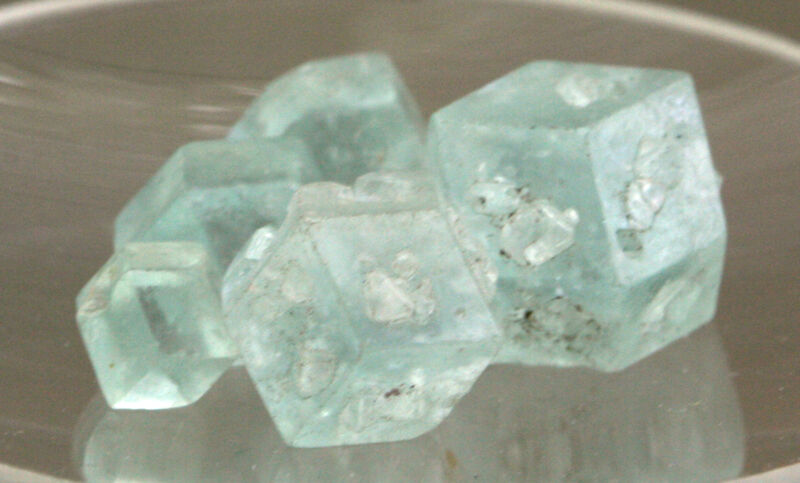
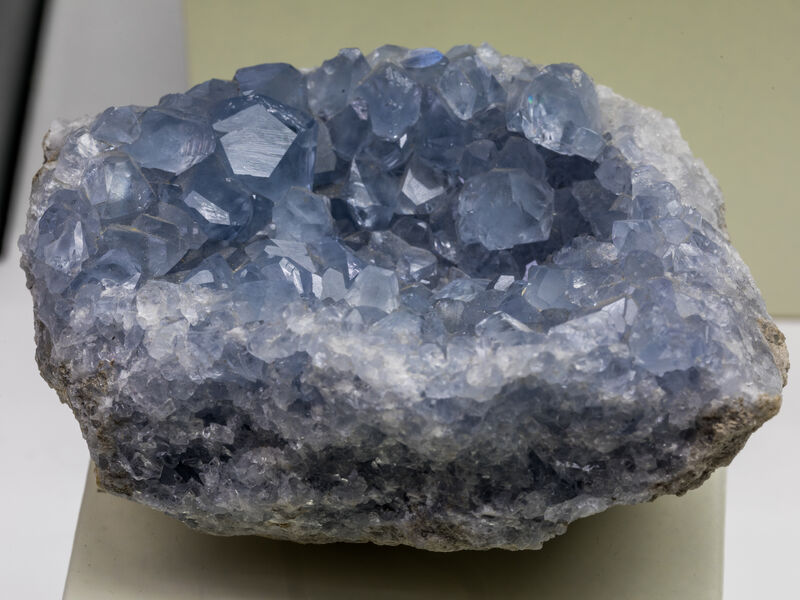
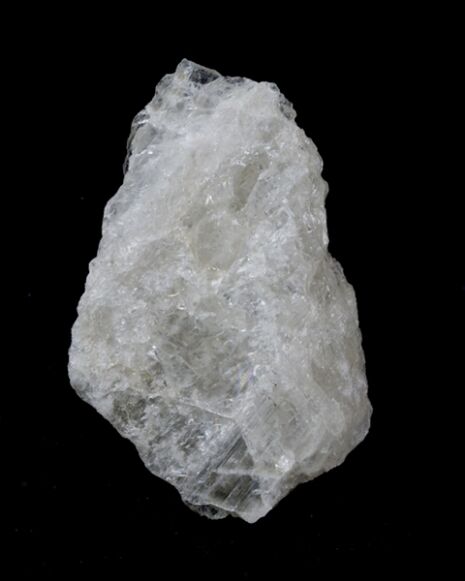
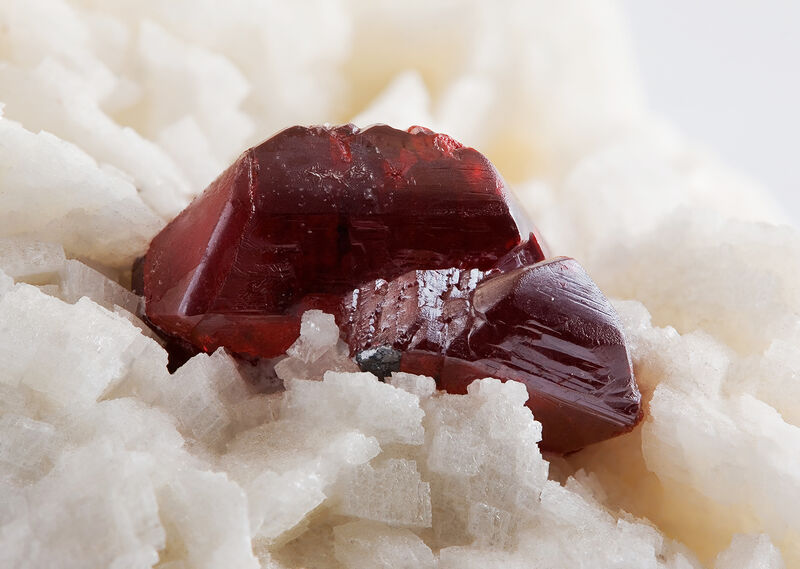
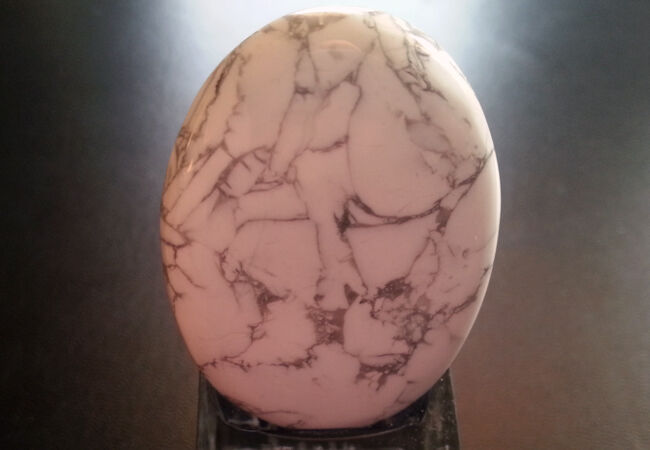
- Colourless · bluish · blue-grey · violet · burgundy-red · white · rose-pink · brownish · reddish · grey · dark grey · colourless in transmitted light
- Streak
- White, off-white, greyish
- Tenacity
- brittle
- Cleavage
- Perfect
On (010) perfect; on (100) nearly perfect; on (001) good to imperfect.
- Fracture
- Irregular/Uneven · Splintery
- Density
- 2.98 g/cm³
Optical
- Optical type
- Biaxial (+) · 2V measured = 36 – 45° · 2V calc = 44°
- Refractive index
- 1.567 – 1.618
- Surface relief
- Moderate
- Principal indices
- nα 1.567 – 1.574 · nβ 1.574 – 1.579 · nγ 1.609 – 1.618
- Pleochroism
- Visible
Violet coloured material: X = colourless to very light yellow or rose; Y = light violet or rose; Z = violet.
- Dispersion
- Strong, r < v.
- Extinction
- X = b; Y = a; Z = c.
- UV response
- Can show fluorescence under LW and/or SW. For example: bluish white response to SW: https://www.mindat.org/photo-1254482.html
- Notes
Absorption: Z > Y > X.
Crystallography
- Cell parameters
- a = 6.245(1) Å · b = 6.995(2) Å · c = 6.993(2) Å
- Ratio a:b:c
- 1 : 1.120 : 1.120
- Z
- 4
- Morphology
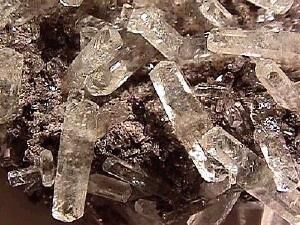
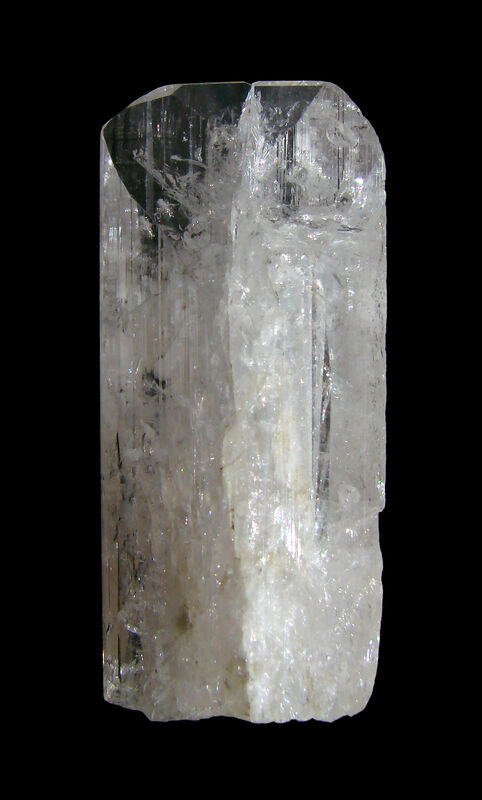
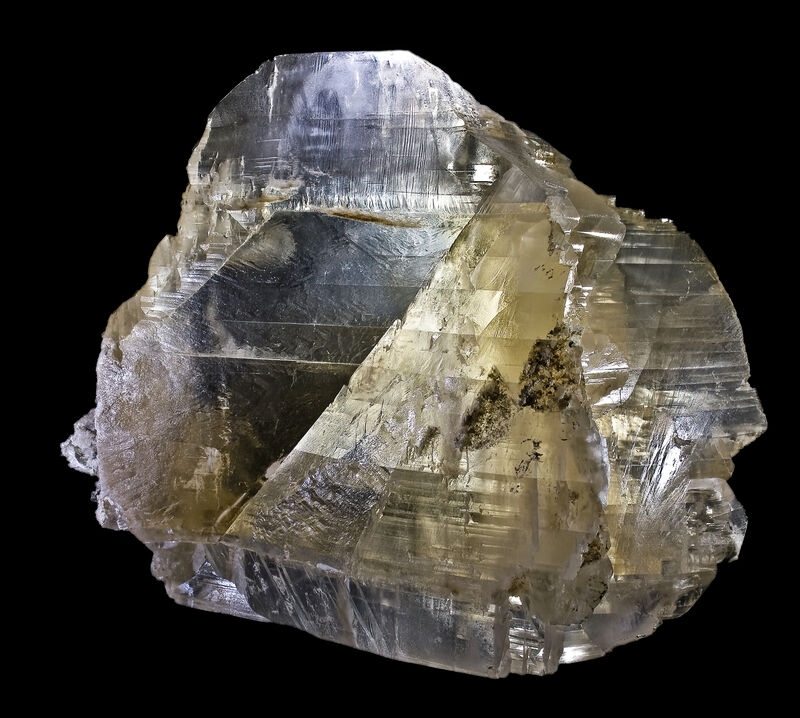
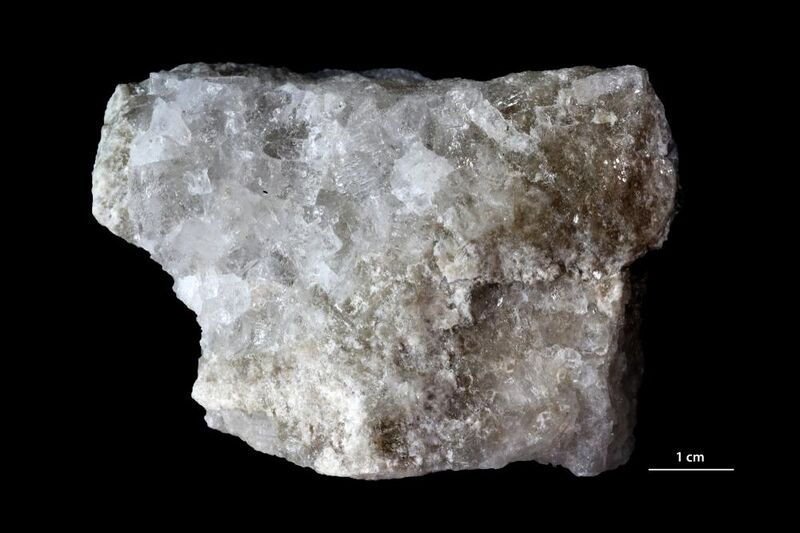
Crystals equant, or nearly so, with large pinacoidal faces. Also thick tabular on (010), (100), or (001); commonly elongated on [100], [010] or [001]. Massive. Fine granular to scaly; fibrous (either parallel, radiated or plumose) and frequently curved. Contorted concretionary forms (bowel stone).
- Twinning
1.) On (011) as contact twins and polysynthetic lamellae (may be produced by heating or pressure); 2.) On (120) as contact twins, rare.
- Comment
Space Group: Amma
Chemical composition
- Impurities
- Sr
- Ba
- H2O
Synonyms
- Anchydrit
- Anhydrita
- Anhydrous Gypsum
- Anhydrous Sulfate of Lime
- Anidrit
- Bardiglione
- Chaux sulfatée anhydre
- Chaux sulfatée quartzifère
- Cube Spar
- Gekrösstein
- Karstenit
- Karstenite
- Leuchtstein
- Marmor Bardiglio di Bergamo
- Metanhydrit
- Muriacit
- Muriacita
- Muriacite
- Muriazit
- Salzsaurer Kalk
- Siliceous Anhydrous Gypsum
- Soude muriatée gypsifère
- Würfelgips
- Würfelgyps
- Würfelspat
In other languages
- French
- 7778-18-9 · Anhydrite · Chaux sulfatée anhydre · Chaux sulfatée quartzifère · Karsténite · Muriacite · Pierre de tripes · Soude muriatée gypsifère · Vulpinite
- German
- Anhydrit · Anhydritbinder · Anhydritspat · Anhydritstein · Gekrösstein · Karstenit
- Spanish
- anhidrita
- Italian
- anhydrite · anidrite
- Portuguese
- anidrita · Anidrite
- Japanese
- 無水石膏 · 硬石膏
- Chinese
- 硬石膏
- Simplified Chinese
- 硬石膏
- Traditional Chinese
- 硬石膏
- Russian
- ангидрит
- Arabic
- أنهيدريت
Classification
7.AD.30
- 7SulfatesClass
- 7.ASulfates (selenates, etc.) without additional anions, without H2ODivision
- 7.ADWith only large cationsGroup
- 7.AD.30AnhydriteSpecies
28.03.02.01
- 28Anhydrous Acid and Normal SulfatesClass
- 28.03AXO4Type
- 28.03.02— unnamed intermediate level —Group
- 28.03.02.01AnhydriteSpecies
25.4.1
- 25SulphatesClass
- 25.4Sulphates of Ca, Sr and BaGroup
- 25.4.1AnhydriteSpecies
Group, growth & confusion
Literature, links & citation
- —Newman, E.S. (1941): BEHAVIOR OF CALCIUM SULFATE AT HIGH TEMPERATURES. Journal of Research of the National Bureau of Standards, 27, 191-196. https://nvlpubs.nist.gov/nistpubs/jres/27/jresv27n2p191_A1b.pdf
- —Langbein, R. (1979): Petrologische Aspekte der Anhydritbildung. Zeitschrift für geologische Wissenschaften, 7 (7), 913-926.
- 1794von Fichtel, J.E. (1794) Vom Lilalith. Mineralogische Aufsätze, Wien: 226-236. [as salzsaurer Kalk, Muriazit, schuppiger Gypsstein, footnote on p. 228 refering to Abbé Nicolaus Poda von Neuhaus].
- 1794Poda, A.N. (1794) Vom Lilalith. in: Mineralogische Aufsätze, Mathias Andreas Schmidt (Wein) 226-236.
- 1800Werner (1800). [as Würfelspath].
Entry last updated
@misc{mineral2026,
  author    = {Mineral Index editorial board},
  title     = {Anhydrite — Mineral Index},
  year      = {2026},
  url       = {https://mineralindex.org/minerals/anhydrite-234}
}