History
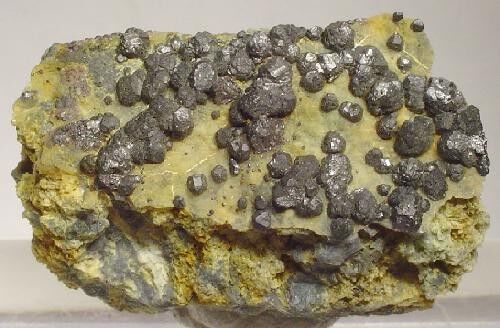
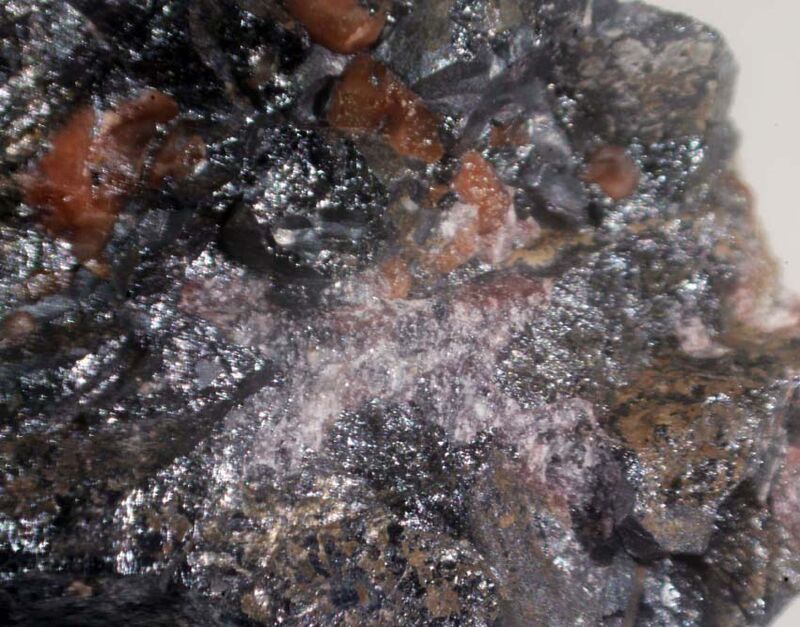
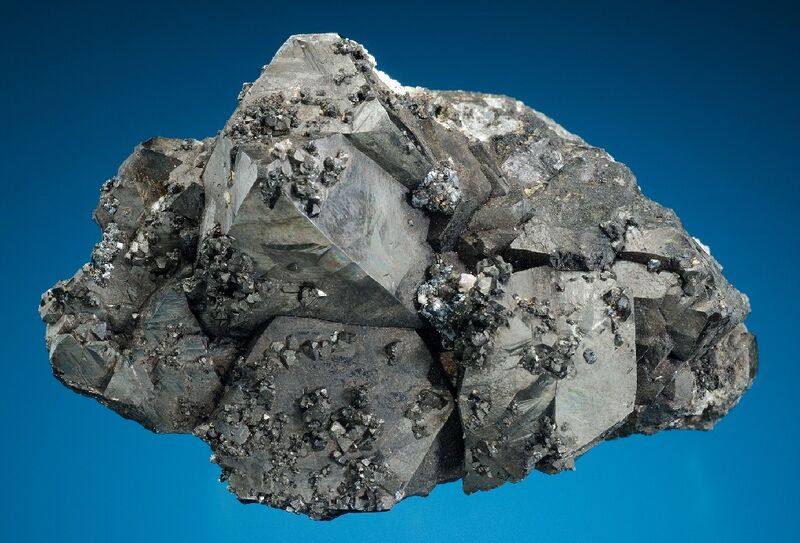
The name sphalerite carries a small joke about miners' frustration. Dark varieties looked so much like galena, the lead ore, that miners would dig them up only to find no lead. The German word for it was blende — from blind or deceiving — long before any scholar wrote it down.
Between the 7th and 16th century CE, smiths used the zinc in sphalerite to make brass. They heated the ore alongside copper to produce an alloy of copper with 3 to 45 percent zinc, before zinc itself was understood as a distinct element.
Georgius Agricola formalised blende in print in 1546. Various chemical-based names followed over the next three centuries, including zincum. Vernacular names piled up too: zinc blende, black-jack, ruby blende.
In 1847, the German mineralogist Ernst Friedrich Glocker drew the modern scientific name from the Greek sphaleros, meaning treacherous.
Industrial & practical applications
Roughly 95 percent of the world's primary zinc starts as sphalerite. The mineral is the chief ore of zinc — the source from which everything downstream is made.
Most of that zinc ends up coating other metals against corrosion. Galvanising layers it onto steel, giving sheet metal and structural shapes their rust-resistant surface. Smaller shares go into brass and into dry-cell batteries.
Sphalerite is also the principal source of several quieter metals. Cadmium, gallium, germanium, and indium substitute for zinc in the crystal lattice and are recovered as by-products of zinc refining.
Where it forms, where it's found
Varieties
Physical
- Hardness
- 1Talc
- 2Gypsum
- 3Calcite
- 4Fluorite
- 5Apatite
- 6Orthoclase
- 7Quartz
- 8Topaz
- 9Corundum
- 10Diamond
- Lustre
- Resinous
- Transparency
- Transparent · Translucent
- Colour
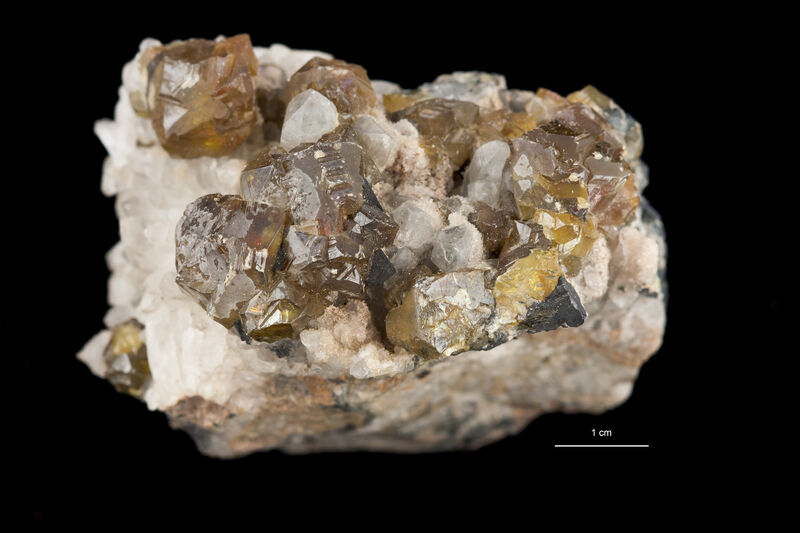
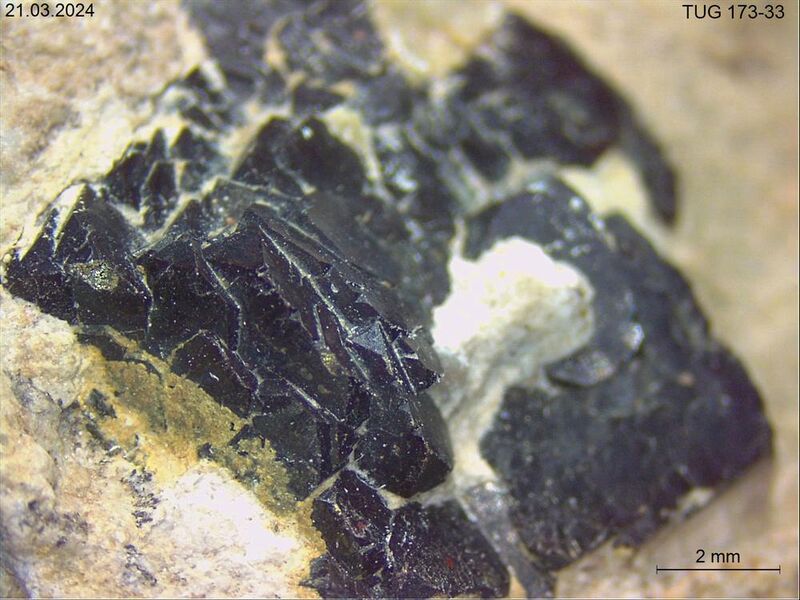
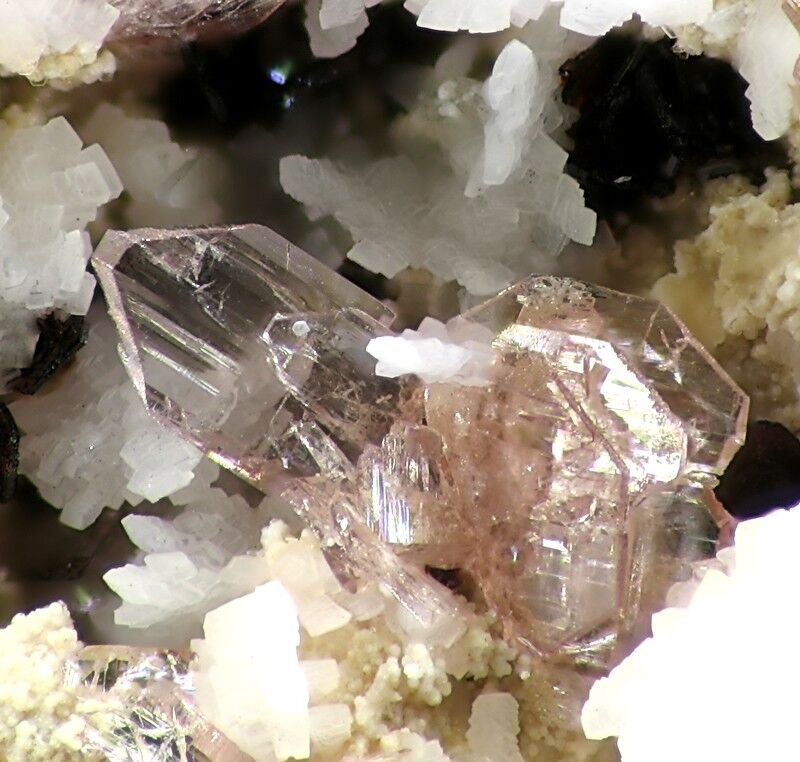
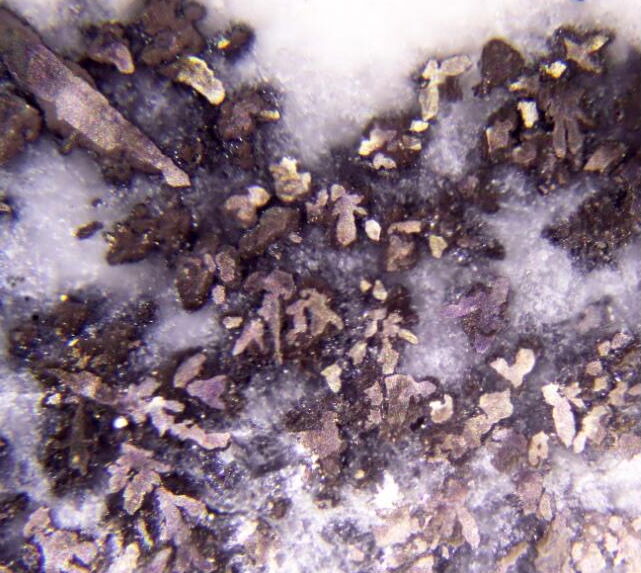
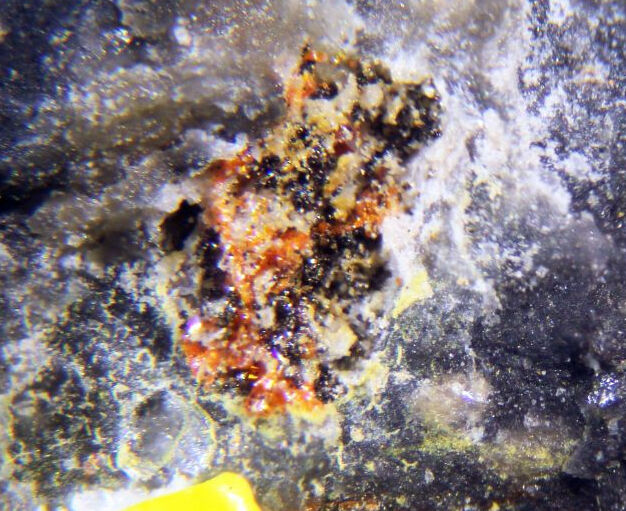
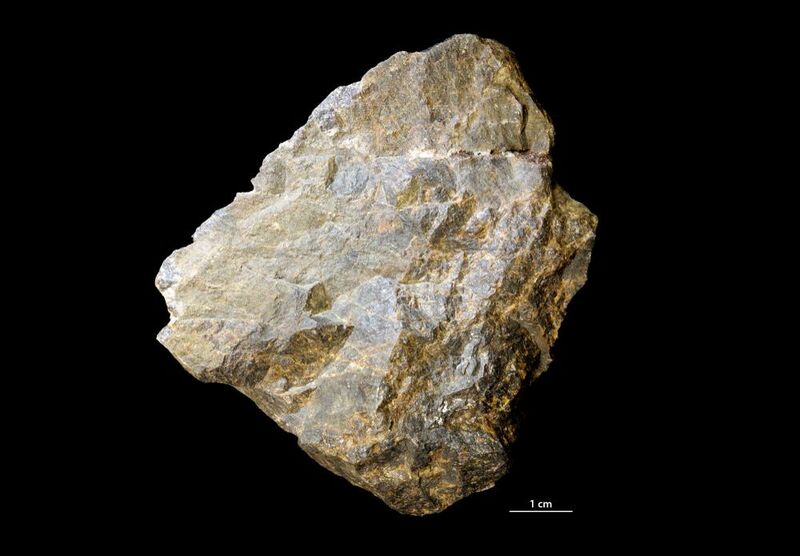
- Mostly light to dark brown to black · . Less commonly red · red-brown · colourless · light blue · or green
Coloration of sphalerites from the Binntal, CH - varying from yellow to black for nearly identical iron contents - seems to be strongly influenced by the manganese content (Graeser, 1969).
- Streak
- Pale yellow to brown.
- Tenacity
- brittle
- Cleavage
- Perfect
Perfect (011)
- Fracture
- Conchoidal
- Density
- 3.9 g/cm³
Optical
- Optical type
- Isotropic
- Refractive index
- 2.369
- Surface relief
- Very high
- Principal indices
- nα 2.369
- Birefringence
- May show strain induced birefringence
- Pleochroism
- Non-pleochroic
- Optical colour
- Medium gray
- Internal reflections
- White, yellow, red, brown
- Tropism
- Isotropic
- Reflectance R%
- (19.6) 400, (19.0) 420, (18.3) 440, (17.9) 460, (17.5) 480, (17.2) 500, (16.9) 520, (16.7) 540, (16.5) 560, (16.4) 580, (16.3) 600, (16.2) 620, (16.1) 640, (16.0) 660, (15.9) 680, (15.8) 700
- Luminescence
- Fluorescent and triboluminescent
- UV response
- Light colored sphalerite may fluoresce in blue or orange in LW. Fluoresces less strongly, sometimes not at all, in SW or MW.
Crystallography
- Space group
- #208
- Cell parameters
- a = 5.406 Å
- Z
- 4
- Twinning
(111)
Chemical composition
- Impurities
- Fe
- Mn
- Cd
- Hg
- In
- Tl
- Ga
- Ge
- Sb
- Sn
- Pb
- Ag
- Co
Synonyms
- Beta zinc sulfide
- Blackjack Zinc
- Blende
- Brunckit
- Brunkit
- False Galena
- Garnet Blende
- Granat-Blende
- Marasmolit
- Marasmolite
- Pseudogalena
- Ruby Blende
- Ruby Zinc
- Wild Lead
- Zinc Blende
In other languages
- French
- Blende · Calaem · Christophite · Chrystophite · Marasmolite · Pseudo-galène · sphalérite · Zinc sulfuré · Zinc-blende
- German
- Sphalerit · Sphalerith · Zinkblende
- Spanish
- blenda · cincblenda · Esfalerita · zincblenda
- Italian
- Blenda · Sfalerite · Zincoblenda
- Portuguese
- blenda · Esfalerita · Esfalerite
- Japanese
- スファレライト · セン亜鉛鉱 · 閃亜鉛鉱
- Chinese
- 閃鋅礦
- Simplified Chinese
- 闪锌矿
- Traditional Chinese
- 閃鋅礦
- Russian
- Медовая обманка · Рубиновая обманка · Сфалерит · Цинковая обманка
- Arabic
- السفاليريت · سفاليريت
Classification
2.CB.05a
- 2Sulfides and SulfosaltsClass
- 2.CMetal Sulfides, M: S = 1: 1 (and similar)Division
- 2.CBWith Zn, Fe, Cu, Ag, etc.Group
- 2.CB.05aSphaleriteSpecies
02.08.02.01
- 02SulfidesClass
- 02.08AmXp, with m:p = 1:1Type
- 02.08.02Sphalerite Group (Isometric: F4-3m)Group
- 02.08.02.01SphaleriteSpecies
3.4.4
- 3Sulphides, Selenides, Tellurides, Arsenides and Bismuthides (except the arsenides, antimonides and bismuthides of Cu, Ag and Au, which are included in Section 1)Class
- 3.4Sulphides etc. of Group II metals other than Hg (Mg, Ca, Zn, Cd)Group
- 3.4.4SphaleriteSpecies
Group, growth & confusion
Literature, links & citation
- —De natura fossilium - Lib. I-X
- —Schroll, E. (1953): Über Unterschiede im Spurengehalt bei Wurtziten, Schalenblenden und Zinkblenden. Sitzungsber. Österr. Akad. Wiss. Wien, math.-naturwiss. Kl., 162, 305-332.
- 1747Wallerius (1747) 248.
- 1782Bergmann (1782).
- 1847Glocker, Ernst Friedrich (1847) Generum et specierum mineralium, secundum ordines naturales digestorum synopsis, omnium, quotquot adhuc reperta sunt, mineralium nomina complectens [A synopsis of the genera and species of minerals, according to their natural orders, including the names of all the minerals that have yet been discovered.]. Eduardus Anton. 348 pp.
Entry last updated
@misc{mineral2026,
  author    = {Mineral Index editorial board},
  title     = {Sphalerite — Mineral Index},
  year      = {2026},
  url       = {https://mineralindex.org/minerals/sphalerite-3727}
}