Where it forms, where it's found
- Geological setting
Granite pegmatites.
- Type locality
- Brazil
Varieties
Safety & handling
Physical
- Hardness
- 1Talc
- 2Gypsum
- 3Calcite
- 4Fluorite
- 5Apatite
- 6Orthoclase
- 7Quartz
- 8Topaz
- 9Corundum
- 10Diamond
- Lustre
- Vitreous
- Transparency
- Transparent · Translucent
- Colour
- Green shades · emerald-green · greenish white · yellowish green · greenish brown · yellow · canary yellow · blue
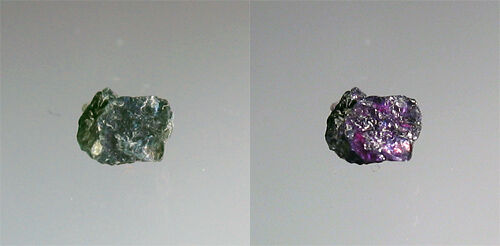
may be raspberry-red under incandescent light when chromian; colorless, pale shades of yellow, green, or red in transmitted light. Green varieties usually exhibit a green hue of medium to high saturation owing to the trace amount of vanadium within the crystalline structure. The chemical results showed a very good correlation between Cr and V, and both of them are at a low level; Fe is responsible for the canary yellow color.[[1]]
- Streak
- White
- Tenacity
- brittle
- Cleavage
- Distinct/Good
Distinct on (110), imperfect on (010), poor on (001)
- Fracture
- Irregular/Uneven · Conchoidal
- Density
- 3.75 g/cm³
Optical
- Optical type
- Biaxial (+) · 2V measured = 70° · 2V calc = 72°
- Refractive index
- 1.746 – 1.756
- Surface relief
- High
- Principal indices
- nα 1.746 · nβ 1.748 · nγ 1.756
- Pleochroism
- Visible
X = c = columbine-red Y = b = orange-yellow Z = a = emerald-green
- Dispersion
- r > v
- Notes
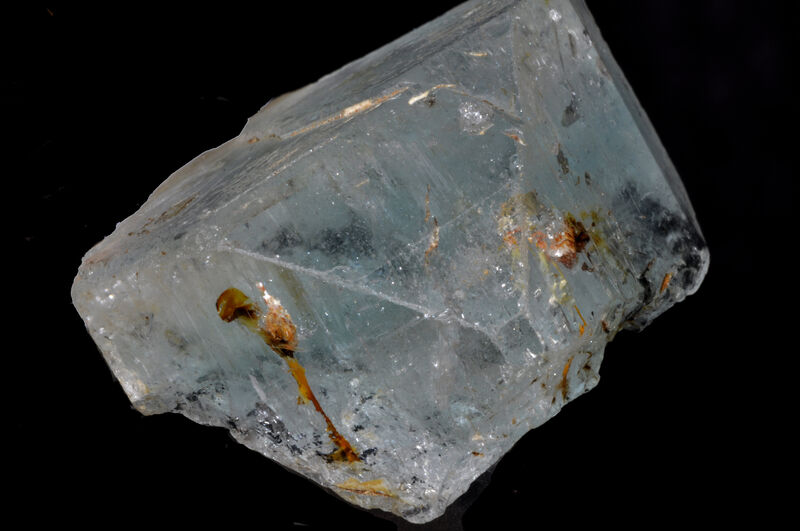
Exhibits a bluish opalescence or chatoyancy, notably on (010). Also asteriated with a cat's eye effect. Chatoyancy, or cat’s eye effect, which is brought on by parallel needle-like inclusions within the crystal structure, usually made of rutile or hematite. Due to the way these imperfections reflect light, a bright line that resembles a cat’s eye appears across the gemstone’s surface,
Crystallography
- Cell parameters
- a = 5.481 Å · b = 9.415 Å · c = 4.428 Å
- Ratio a:b:c
- 1 : 1.718 : 0.808
- Z
- 8
- Morphology
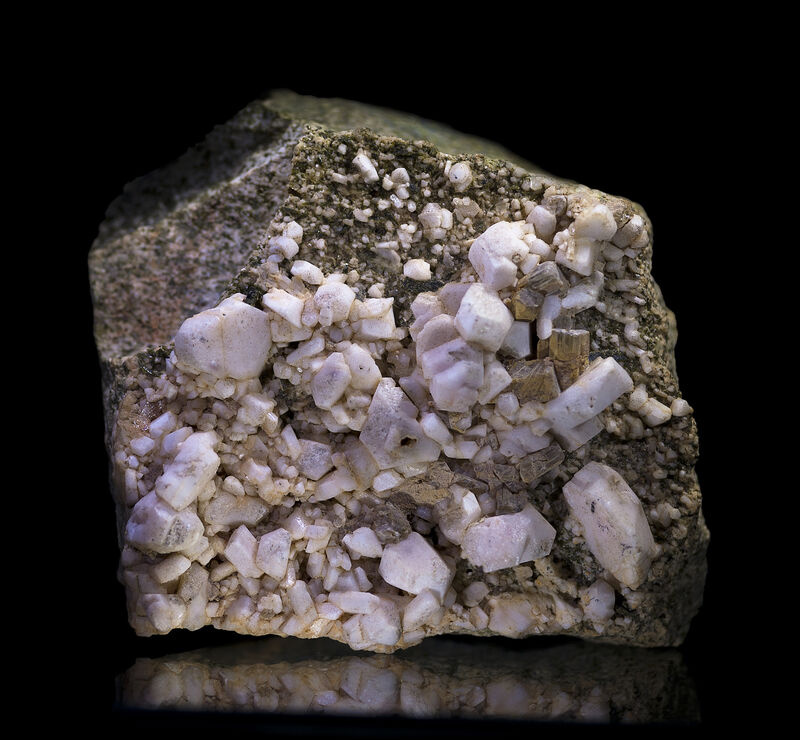
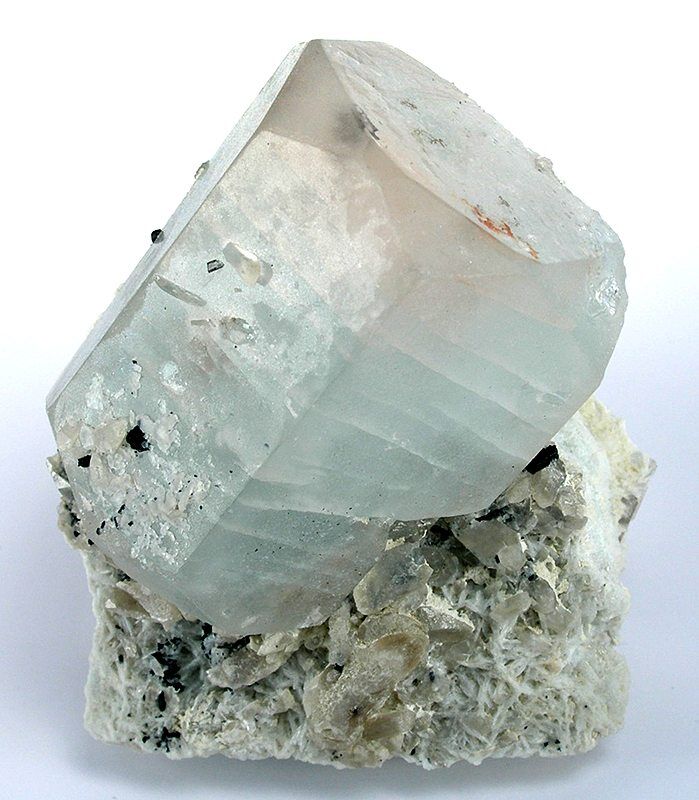
Simple crystals usually tabular (001); short prismatic [100] at times, or, less often, [001]. Striated on (001) parallel to [100]. Twinned crystals usually flattened perpendicular to the composition plane, and have a feather-like striation on (001). Twinning forms six-rayed spoke-like aggregates. Quartz occurs as an irregular and colorless grain within the chrysoberyl host without any intrinsically crystalline structure. All the quartz grains detected were distributed along the healed fractures, accompanied by mica and fluids, muscovite, graphite and calcite. Many long needles are distributed in the samples, and unlike the short needles within the growth lines, these needles are somehow curved and much longer, up to 1–2 mm. They are arranged randomly and show good transparency.
- Twinning
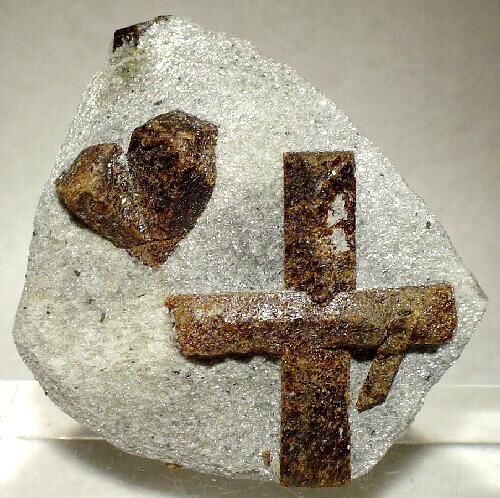
Common on twin plane (130). Both contact and penetration twins, frequently repeated and forming pseudohexagonal crystals as viewed along [001] with or without reentrant angles. Also flattened heart-shaped.
- Comment
Space Group: P bnm
Chemical composition
- Impurities
- Fe
- Cr
- Ti
Synonyms
- Aluminate of Glucina
- Alumoberyl
- Chrysberil
- Chrysopal (of Delamétherie)
- Krisoberil
- Krysoberril
- Oriental Chrysolite
In other languages
- French
- 1304-50-3 · Aluminate de Glucine · Alumoberyl · Chrysberil · Chrysoberil · chrysobéryl · Chrysobéryl « œil-de-chat » · Chrysolite orientale · Chrysopale · Cymophane · Cymophanite
- German
- Alexandrit · Chrysoberyll · Cymophan · Katzenauge
- Spanish
- cimofana · crisoberilo · crisolita · crisópalo · ojo de gato
- Italian
- Alluminato di berillo · Crisoberillo
- Portuguese
- crisoberilo
- Japanese
- クリソベリル · 金緑石
- Chinese
- 金绿宝石
- Russian
- хризоберилл
- Arabic
- شريسوبيريل · كريسوبيريل
Classification
4.BA.05
- 4OxidesClass
- 4.BMetal: Oxygen = 3:4 and similarDivision
- 4.BAWith small and medium-sized cationsGroup
- 4.BA.05ChrysoberylSpecies
07.02.09.01
- 07Multiple OxidesClass
- 07.02AB2X4Type
- 07.02.09— unnamed intermediate level —Group
- 07.02.09.01ChrysoberylSpecies
7.4.4
- 7Oxides and HydroxidesClass
- 7.4Oxides of Be, Mg and the alkaline earthsGroup
- 7.4.4ChrysoberylSpecies
Group, growth & confusion
Literature, links & citation
- —https://gem-a.com/wp-content/uploads/2025/02/JoG-Bibliography_2024_Chrysoberyl.pdf
- 1789Hoffmann, C.A.S. (1789) Mineralsystem des Herrn Inspektor Werners mit dessen Erlaubnis herausgegeben von C.A.S. Hoffmann. Bergmännisches Journal, 2 (1) 369-398
- 1789Werner (1789), Bergm. Journal: 373, 387 (as Krisoberil).
- 1790Werner, A.G. (1790) Chapitre IV. Explication des characteres exterieurs des fossiles. De la couleur verd. in Traité des Caracter Exterieurs des Fossiles, L.N. Frantin (Dijon, France), 109-116.
- 1792Delamétherie, J.C. (1792) Observations et mémoires sur la physique, sur l’histoire naturelle, et sur les arts et métiers. Discours préliminaire. Observations sur la Physique, sur l’Histoire Naturelle et sur les Arts, 40, 2-40.
Entry last updated
@misc{mineral2025,
  author    = {Mineral Index editorial board},
  title     = {Chrysoberyl — Mineral Index},
  year      = {2025},
  url       = {https://mineralindex.org/minerals/chrysoberyl-1039}
}