History
Long before any Greek or Roman naming, Egyptians ground galena into a black powder and lined the eyes with it. The kohl was thought to reduce the glare of the desert sun and to repel flies. Across the Atlantic, pre-Columbian peoples of North America used galena in decorative paints and cosmetics for similar pigment effects. Lead could be smelted from galena in an ordinary wood fire — a low-tech process available wherever the ore was found.
Pliny the Elder gave the mineral its written name in 77–79 CE, taking galene from the Greek — the word for lead ore.
In the early 20th century, the same mineral found a brief new career in radio. A polished crystal of galena, touched by a fine wire, acted as a point-contact diode. It rectified alternating current and pulled weak radio signals out of the air for the crystal radio receivers of the first wireless era.
Industrial & practical applications
Galena is the world's most important source of lead. Many of its deposits yield silver as a co-product as well.
The bulk of that lead becomes lead-acid storage batteries. In the United States, batteries accounted for about 88 percent of lead consumption by the early 2000s. Smaller fractions go into ammunition, glass and ceramics, casting metals, and sheet lead — none above a few percent of national demand. Lead also serves as radiation shielding in medical analysis and video display equipment.
Where ore bodies carry enough silver in solid solution, the two metals are recovered together — the silver as a by-product of lead refining.
Significant producing regions include Australia, Idaho, Germany, Cornwall, and Mexico.
Where it forms, where it's found
Varieties
Safety & handling
Physical
Optical
- Optical type
- Isotropic
- Optical colour
- White
- Tropism
- Isotropic
- Reflectance R%
- (51.9) 400, (50.5) 420, (49.1) 440, (47.7) 460, (46.6) 480, (45.4) 500, (44.4) 520, (43.7) 540, (43.1) 560, (42.8) 580, (42.7) 600, (42.7) 620, (42.8) 640, (42.9) 660, (42.9) 680, (42.6) 700
- Luminescence
- None
- UV response
- Not fluorescent in UV.
- Notes
Often will form triangular pits in poorly polished sections.
Crystallography
- Space group
- Fm3m
- Cell parameters
- a = 5.9362 Å
- Z
- 4
- Morphology
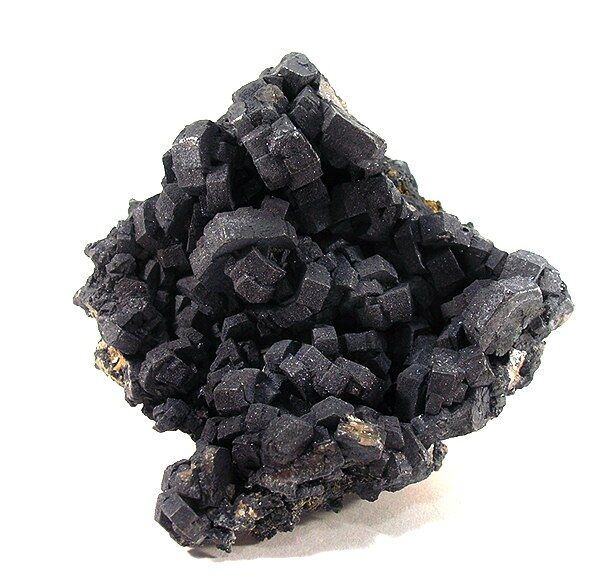
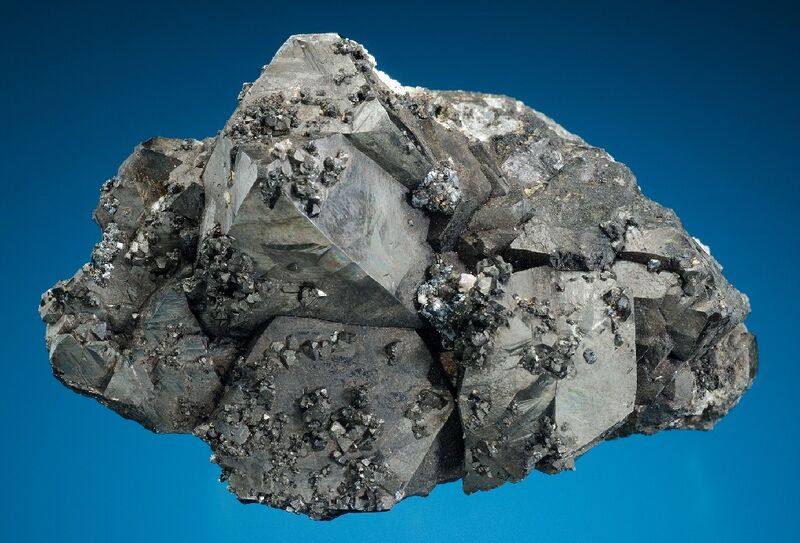
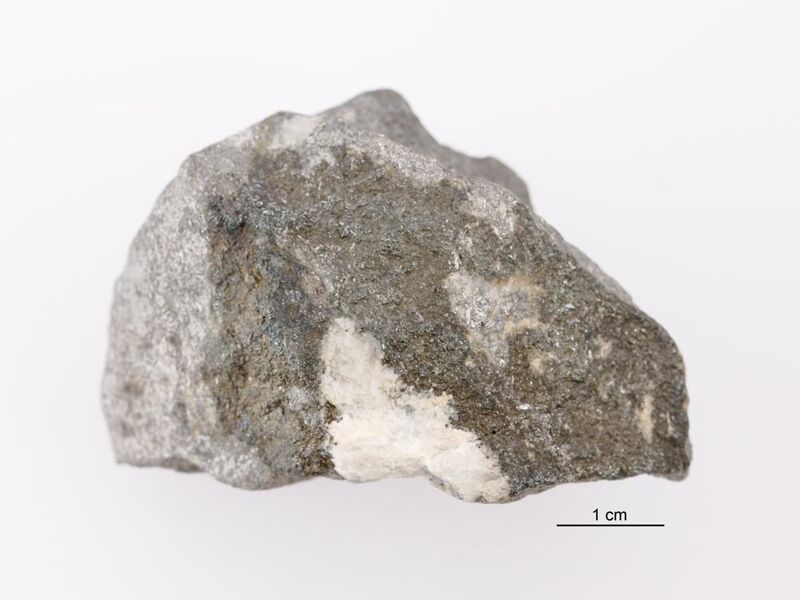
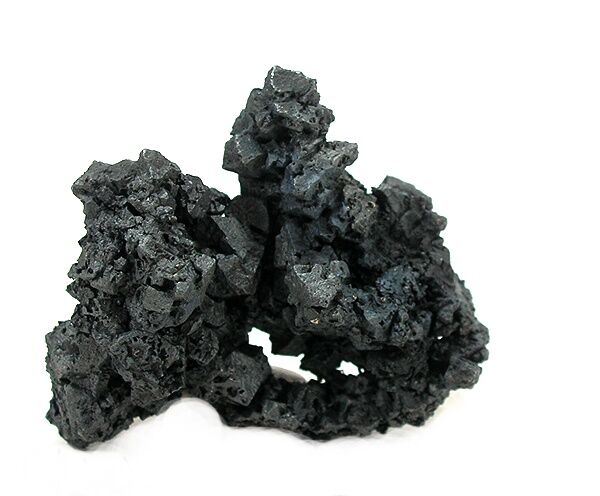
Cubes, octahedrons, cube-octahedron combinations and rarely dodecahedrons. Rarely, platy twins.
- Twinning
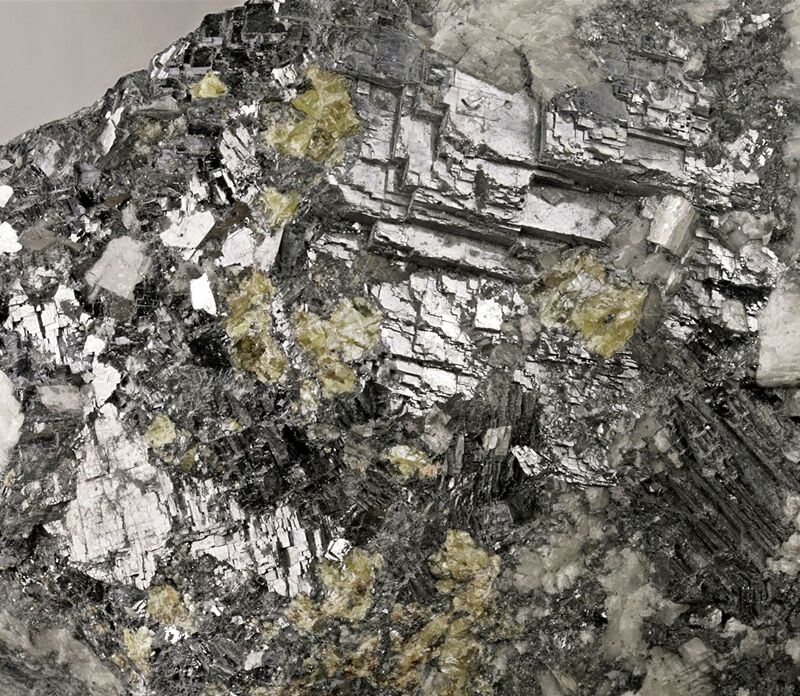
Spinel-type (111), lamellar (114)
- Parting
- (111); may be caused by exsolution lamellae (e.g. bismuth and bismuthinite, Meixner & Paar (1977); see also Ramdohr, 1975).
Chemical composition
- Impurities
- Ag
- Cu
- Fe
- Bi
Synonyms
- Acerilla
- Allquifoux
- Bleiglanz
- Bleyschweif
- Blue Lead Ore
- Carne de vaca
- Galenita
- Galenite
- Glasurerz
- Lead Glance
- Lead sulphide
- Lead sulphuret
- Lead-ore
- Parakobellit
- Parakobellita
- Parakobellite
- Potter's Ore
- Steinmannit
- Sulphuret of Lead
In other languages
- French
- galène · galenite · johnstonite · parakobellite · plomb argentifère · plomb sulfuré · sexangulite · sinkanite
- German
- Bleiglanz · Galenit · Parakobellit · Steinmannit
- Spanish
- galena · michoso
- Italian
- galena · piombo argentifero
- Portuguese
- galena
- Japanese
- ガレナ · 方鉛鉱
- Chinese
- 方铅矿
- Russian
- Галенит · Свинцовый блеск
- Arabic
- جالينا · غالينا
Classification
2.CD.10
- 2Sulfides and SulfosaltsClass
- 2.CMetal Sulfides, M: S = 1: 1 (and similar)Division
- 2.CDWith Sn, Pb, Hg, etc.Group
- 2.CD.10GalenaSpecies
02.08.01.01
- 02SulfidesClass
- 02.08AmXp, with m:p = 1:1Type
- 02.08.01Galena Group (Isometric: Fm3m)Group
- 02.08.01.01GalenaSpecies
3.6.5
- 3Sulphides, Selenides, Tellurides, Arsenides and Bismuthides (except the arsenides, antimonides and bismuthides of Cu, Ag and Au, which are included in Section 1)Class
- 3.6Sulphides etc. of Sb and PbGroup
- 3.6.5GalenaSpecies
Group, growth & confusion
Literature, links & citation
- 1936Brown, John Stafford (1936) Supergene sphalerite, galena, and willemite at Balmat, New York. Economic Geology, 31 (4) 331-354 doi:10.2113/gsecongeo.31.4.331DOI: 10.2113/gsecongeo.31.4.331
- 1939Evrard, P. (1939) Quelques observations relatives aux minéraux zonés de blende et de galène. Annales de la Société géologique de Belgique: 63: B104.
- 1944Palache, Charles, Berman, Harry, Frondel, Clifford (1944) The System of Mineralogy (7th ed.) Vol. 1 - Elements, Sulfides, Sulfosalts, Oxides. John Wiley and Sons, New York.
- 1965Bedarida F. (1965) Osservazioni su fenomeni di sfaldatura in cristalli di galena. Periodico di Mineralogia: 337-354.
- 1966Hertel, L. (1966): Die Fremdelementführung der Bleiglanze als Hilfe zur Bestimmung der Bildungstemperatur. Erzmetall, 19 (12), 632-635 (in German). [trace elements as indicators of the temperature of formation]
Entry last updated
@misc{mineral2026,
  author    = {Mineral Index editorial board},
  title     = {Galena — Mineral Index},
  year      = {2026},
  url       = {https://mineralindex.org/minerals/galena-1641}
}