History
Mordenite takes its name from a place, not a Greek root. In 1864 the chemist Henry How described it and named it after Morden, a small community on the Bay of Fundy shore in Nova Scotia, Canada, where the first specimens were found.
That first find sat in volcanic rock. Mordenite belongs to the zeolites — a family of minerals built around an open, cage-like framework of silicon, aluminium and oxygen that traps water and loose ions inside its pores. It is one of the six most abundant zeolites, and it forms readily where water has worked on volcanic rock such as rhyolite, andesite and basalt.
Industrial & practical applications
Most of mordenite's industrial value comes not from the mineral dug out of the ground but from a synthetic version grown in a factory. Like all zeolites, it is full of tiny, uniform pores. That makes it act as a sorbent and a molecular sieve — a material that traps molecules small enough to fit its pores and turns away the rest.
The synthetic form earns its keep in oil refining. There it works as a catalyst — a substance that speeds a chemical reaction without being consumed — for the acid-catalyzed isomerisation of alkanes and aromatics, the reshuffling of hydrocarbon molecules into more useful shapes.
Natural mordenite is mined in bulk in a coarser form. It comes from zeolitic tuff, a soft rock made of compacted volcanic ash. Sedimentary deposits are quarried in quantity in Bulgaria, Hungary, Japan and the United States. The tuff is dried and crushed into a range of low-tech products: adsorbents that soak up oil and chemical spills and animal wastes, animal feed supplements, water treatment media, sports turf and slow-release fertilizer.
Japanese output of this raw material has been estimated at 150,000 tons a year.
The same sieving trick separates gases. Plants built on mordenite-rich tuffs pull high-grade oxygen from ordinary air using pressure-swing generators, which cycle pressure to load and unload the sieve. Full-scale plants of this kind have run in Japan since the end of the 1960s.
Where it forms, where it's found
- Geological setting
Basalt.
Veins and amygdaloids in igneous rocks.
- Type locality
- Morden
- Kings Co.
- Nova Scotia
- Canada
45.1036°, -64.9497°
Physical
Optical
- Optical type
- Biaxial (+/-) · 2V measured = 76 – 104° · 2V calc = 78 – 88°
- Refractive index
- 1.472 – 1.487
- Principal indices
- nα 1.472 – 1.483 · nβ 1.475 – 1.485 · nγ 1.477 – 1.487
- Dispersion
- none
- Extinction
- X = c; Y = a; Z = b.
Crystallography
- Cell parameters
- a = 18.16 Å · b = 20.45 Å · c = 7.54 Å
- Ratio a:b:c
- 1 : 1.126 : 0.415
- Z
- 4
- Morphology
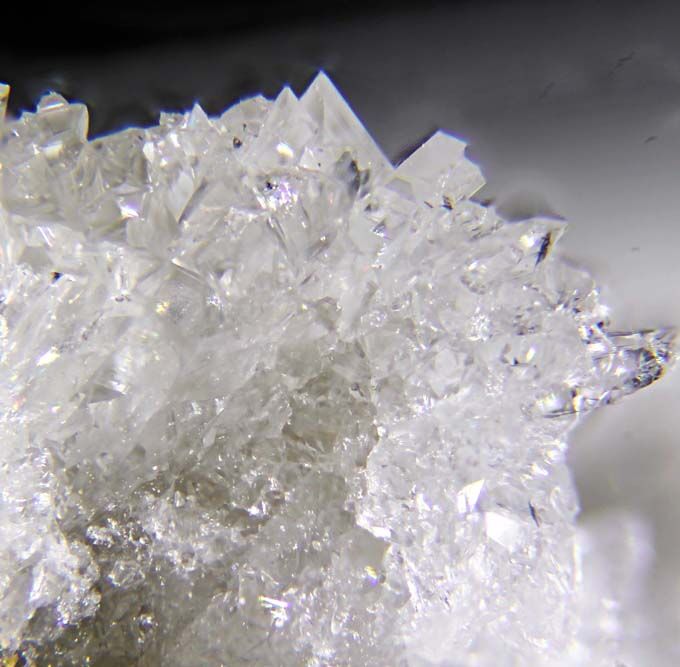
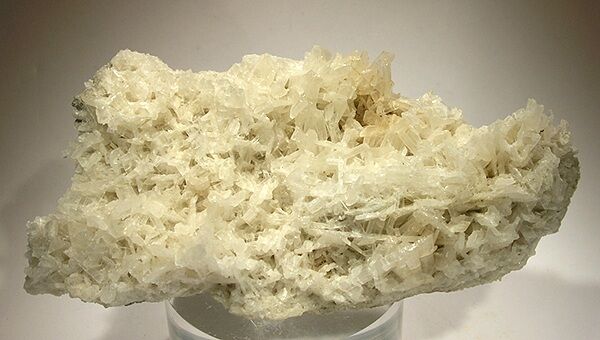
Prismatic crystals, acicular to fine fibrous, radiating groups, cottony aggregates, compact, porcelaneous.
- Type-locality form
Rounded masses to about 5 cm, blotched with green celadonite. White, yellowish or pink, sometimes with a thin yellowish crust. With a very fine fibrous structure.
- Comment
Point Group: mm2 or 2/m 2/m 2/m:; Space Group: Cmc21 or Cmcm
Chemical composition
Synonyms
- Arduinite
- Ptilolite
- Steelite
In other languages
- German
- Mordenit
- Spanish
- Mordenita
- Italian
- mordenite
- Japanese
- モルデナイト
- Chinese
- 丝光沸石
- Simplified Chinese
- 丝光沸石
- Traditional Chinese
- 絲光沸石
- Russian
- Морденит
Classification
9.GD.35
- 9SilicatesClass
- 9.GTektosilicates with zeolitic H2O; zeolite familyDivision
- 9.GDChains of 6-membered rings – tabular zeolitesGroup
- 9.GD.35MordeniteSpecies
77.01.06.01
- 77Tectosilicates ZeolitesClass
- 77.01Zeolite group - True zeolitesType
- 77.01.06Mordenite and related speciesGroup
- 77.01.06.01MordeniteSpecies
16.10.15
- 16Silicates Containing Aluminum and other MetalsClass
- 16.10Aluminosilicates of Ca and alkalisGroup
- 16.10.15MordeniteSpecies
Group, growth & confusion
- AlflarseniteNaCa2Be3Si4O13(OH) · 2H2OMineral—
 AmiciteK2Na2(Al4Si4O16) · 5H2OMineral—
- Ammonioleucite(NH4)(AlSi2O6)Mineral—
 AnalcimeNa(AlSi2O6) · H2OMineral—
- ArzamastseviteK6Al5Si6O20(OH)4ClMineral—
 Bellbergite(K,Ba,Sr)2Sr2Ca2(Ca,Na)4(Si,Al)36O72 · 30H2OMineral—
 BikitaiteLiAlSi2O6 · H2OMineral—
 BoggsiteNa3Ca8(Si77Al19)O192 · 70H2OMineral—
 ChiavenniteCaMn2+(BeOH)2Si5O13 · 2H2OMineral—
 CowlesiteCa(Al2Si3)O10 · 5-6H2OMineral—
Literature, links & citation
- —Matýsek, D., Jirásek, J., Pour, O.: Mordenit z hornin těšínitové asociace v Podbeskydí (Morava, Česká republika). Acta Musei Moraviae, Scientiae Geologicae, 2024, 109(1), 71-82.
- 1864How, Henry (1864) XI.—On mordenite, a new mineral from the trap of Nova Scotia. Journal of the Chemical Society, 17. 100-104 doi:10.1039/js8641700100DOI: 10.1039/js8641700100
- 1886Cross, C.W., Eakins, L.G. (1886). On ptilolite, a new mineral [from Jefferson County, Colorado]. American Journal of Science, 3(188), 117-121. (as ptilolite)
- 1890Pirsson, L.V. (1890) On mordenite. American Journal of Science, 3rd Series: 40(237): 232-237.
- 1892Cross, W., Eakins, L.G. (1892). ART. XIII.--A new occurrence of Ptilolite. American Journal of Science, 44(260), 96.
Entry last updated
@misc{mineral2026,
  author    = {Mineral Index editorial board},
  title     = {Mordenite — Mineral Index},
  year      = {2026},
  url       = {https://mineralindex.org/minerals/mordenite-2779}
}