History
The name analcime comes from the Greek analkimos — "weak" or "without force" — because the mineral develops only a feeble electrostatic charge when it is rubbed or heated. It is one of the few minerals named for a property a careful observer can test with their fingers and a warm hand.
The first description came in the late 18th century from the French geologist Déodat de Dolomieu (1750–1801), who found the mineral in lava from the Cyclopean Islands near Sicily and called it zéolithe dure — "hard zeolite". Dolomieu lent his name to dolomite the same decade, and his Sicilian volcanic specimens helped seed the new science of zeolite mineralogy.
In 1797 the French mineralogist René Just Haüy gave the mineral its modern name, swapping Dolomieu's descriptive label for the Greek root that captured its strange electrical quirk. The species was recognised in mineralogical literature as a valid pre-IMA species by 1801.
The Anglicised form analcite circulated through the 19th and 20th centuries and still appears in older textbooks, alongside the variants analcidite and analzim. Analcime is now the preferred spelling, but a reader meeting analcite in a Victorian catalogue is meeting the same mineral.
Industrial & practical applications
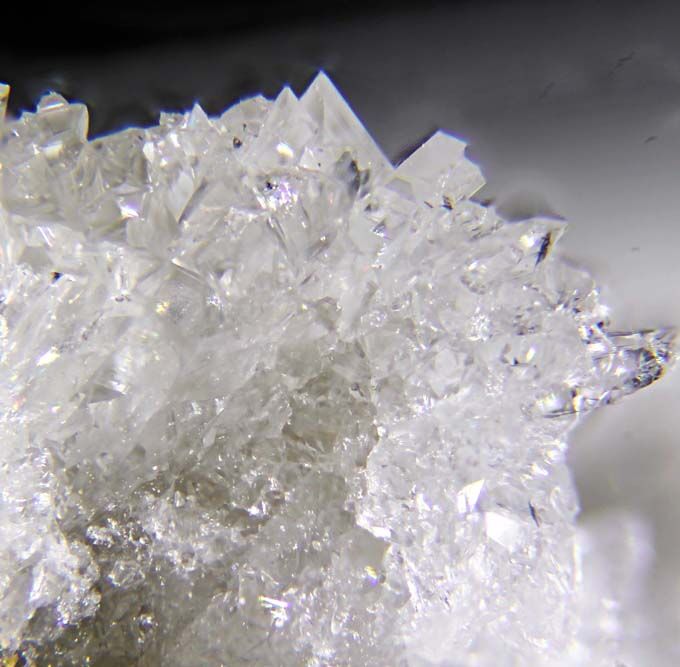
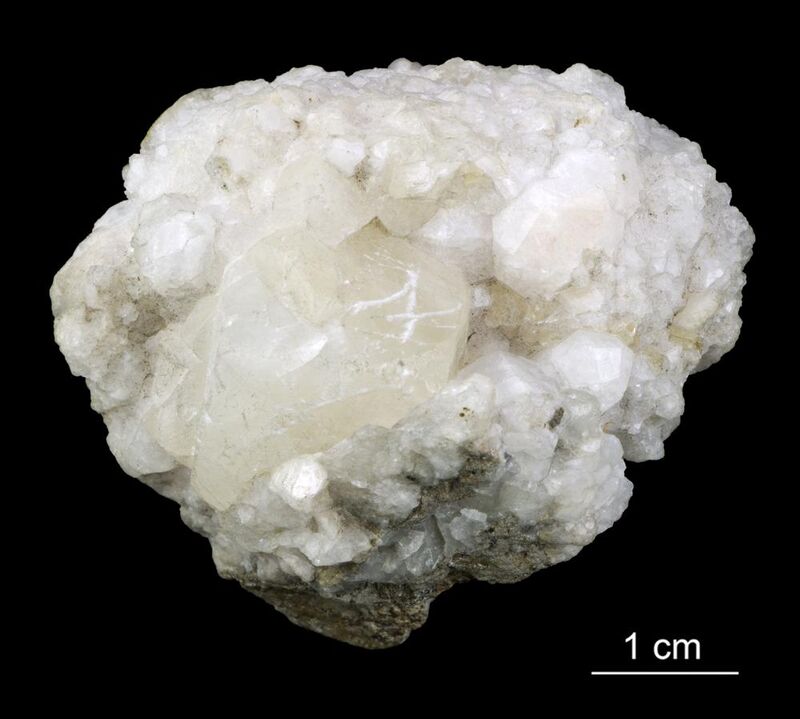
Natural analcime has no significant industrial role today. It is collected and displayed in museum cases for its glassy trapezohedral crystals, and no mine targets it as a commodity. The one local exception: analcime-bearing tuffs — volcanic ash beds where the mineral grew during burial — are sometimes quarried as lightweight building stone.
The mineral is often classed as a zeolite — one of a family of porous aluminosilicates whose framework cages can trap or exchange ions. Synthetic zeolites dominate the industrial side of that chemistry; natural analcime is rarely the zeolite of choice when a cheaper, more uniform synthetic will do.
Research interest persists at laboratory scale. Synthetic analcime, grown from kaolin or coal fly ash, has been tested as a sorbent for radioactive caesium and strontium in nuclear waste streams. It captures the ions through its cation-exchange capacity. High-temperature sintering can then lock them into a stable phase for long-term storage.
Where it forms, where it's found
- Geological setting
In the groundmass or vesicles of silica-poor intermediate and mafic igneous rocks, typically basalts and phonolites, from late-stage hydrothermal solutions, or disseminated due to deuteric alteration. In lake beds, altered from pyroclastics or clays, or as a primary precipitate; authigenic in sandstones and siltstones.
- Type locality
- Cyclopean Islands (Cyclopean Isles)
- Aci Trezza (Acitrezza)
- Aci Castello
- Metropolitan City of Catania
- Sicily
- Italy
Varieties
Physical
- Hardness
- 1Talc
- 2Gypsum
- 3Calcite
- 4Fluorite
- 5Apatite
- 6Orthoclase
- 7Quartz
- 8Topaz
- 9Corundum
- 10Diamond
- Lustre
- Vitreous
- Transparency
- Transparent · Translucent
- Colour
- White · colourless · gray · pink · green · yellow
colourless in thin section
- Streak
- White
- Tenacity
- brittle
- Cleavage
- Poor/Indistinct
on (100)
- Fracture
- Irregular/Uneven · Sub-Conchoidal
- Density
- 2.24 g/cm³
Optical
- Optical type
- Biaxial (-)
- Refractive index
- 1.479 – 1.494
- Principal indices
- nα 1.479 – 1.493 · nγ 1.48 – 1.494
- Birefringence
- 0.0010
- Dispersion
- weak
- UV response
- Sometimes fluorescent pale-yellow, blue-white, green (due to uranyl). Crystals from <l id=4526>Wassons Bluff</l>, Canada with copper inclusions fluoresce white in the vicinity of the inclusions.
- Notes
Also isotropic.
Crystallography
- Cell parameters
- a = 13.71 Å · b = 13.7044 Å · c = 13.7063 Å
- Cell angles
- α = 90.158 ° · β = 89.569 ° · γ = 89.543 °
- Ratio a:b:c
- 1 : 1.000 : 1.000
- Z
- 1
- Morphology
Crystals commonly trapezohedra (211), to 25 cm. Also granular, compact, massive, typically showing concentric structure. Forms: Common (211), (100). Rare (110), (111), (233), (345), (012), (421).
- Twinning
Polysynthetic on (001) and (110)
- Comment
May be cubic, tetragonal, orthorhombic, monoclinic depending upon ordering. Cubic/pseudocubic cell parameter: a = 13.723-13.733 A, Z = 16.
Chemical composition
Synonyms
- Analcidit
- Analcidita
- Analcidite
- Analcine
- Analcit
- Analcita
- Analzim
- Cubicit
- Cubicita
- Cubicite
- Cubizit
- Cubizita
- Cubizite
- Cuboit
- Cuboita
- Cuboite
- Eudnophite
- Euthalit
- Euthalite
- Euthalith
- Euthallit
- Euthallite
- Five Islands Garnet
- Kubizit
In other languages
- French
- analcime
- German
- Analcim
- Spanish
- analcima · analcita
- Italian
- analcime
- Portuguese
- analcite
- Japanese
- 方沸石
- Chinese
- 方沸石
- Russian
- Анальцим
- Arabic
- أنالسيم
Classification
9.GB.05
- 9SilicatesClass
- 9.GTektosilicates with zeolitic H2O; zeolite familyDivision
- 9.GBChains of single connected 4-membered ringsGroup
- 9.GB.05AnalcimeSpecies
77.01.01.01
- 77Tectosilicates ZeolitesClass
- 77.01Zeolite group - True zeolitesType
- 77.01.01Analcime and related speciesGroup
- 77.01.01.01AnalcimeSpecies
16.2.2
- 16Silicates Containing Aluminum and other MetalsClass
- 16.2Aluminosilicates of NaGroup
- 16.2.2AnalcimeSpecies
Group, growth & confusion
- AlflarseniteNaCa2Be3Si4O13(OH) · 2H2OMineral—
 AmiciteK2Na2(Al4Si4O16) · 5H2OMineral—
- Ammonioleucite(NH4)(AlSi2O6)Mineral—
- ArzamastseviteK6Al5Si6O20(OH)4ClMineral—
 Bellbergite(K,Ba,Sr)2Sr2Ca2(Ca,Na)4(Si,Al)36O72 · 30H2OMineral—
 BikitaiteLiAlSi2O6 · H2OMineral—
 BoggsiteNa3Ca8(Si77Al19)O192 · 70H2OMineral—
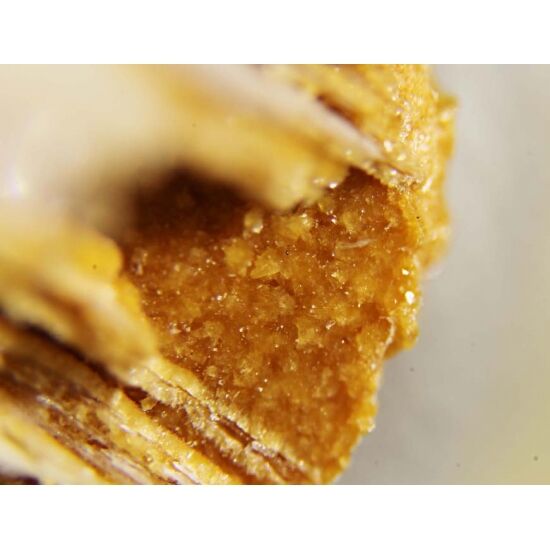 ChiavenniteCaMn2+(BeOH)2Si5O13 · 2H2OMineral—
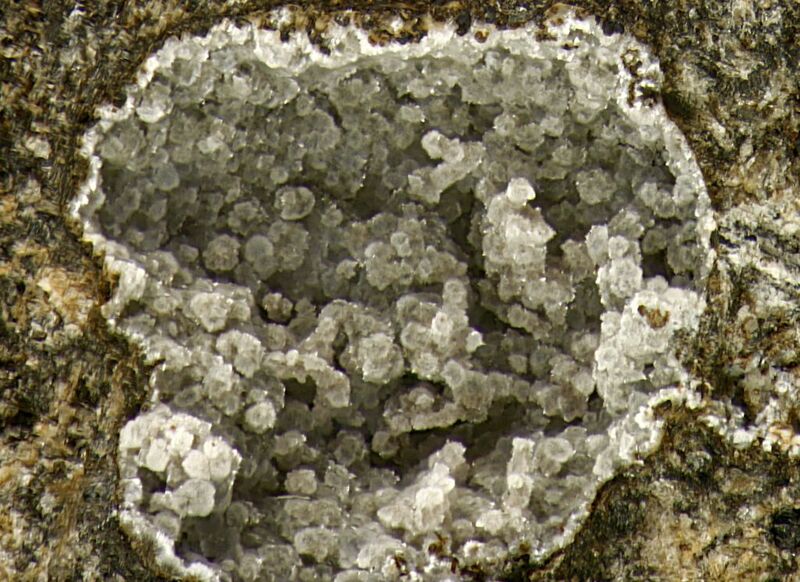 CowlesiteCa(Al2Si3)O10 · 5-6H2OMineral—
- DirenzoiteNaK6MgCa2(Al13Si47)O120 · 36H2OMineral—
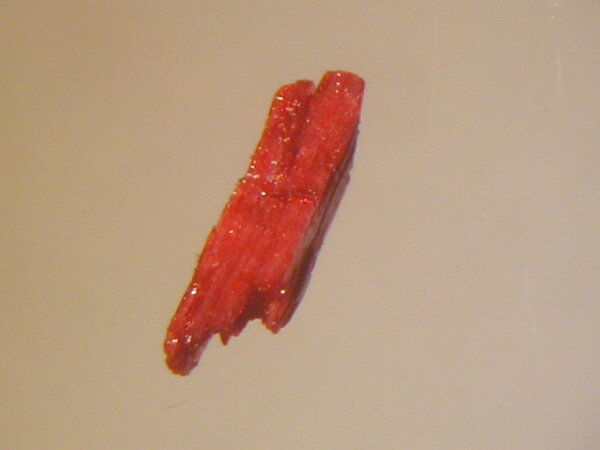 AbelsoniteNiC31H32N4Mineral—
- BerylliteBe3(SiO4)(OH)2 · H2OMineral—
 CalciteCa(CO3)Mineral—
- ChiavenniteCaMn2+(BeOH)2Si5O13 · 2H2OMineral—
- HomiliteCa2Fe2+B2Si2O10Mineral—
 JadeiteNaAlSi2O6Mineral—
 LeuciteK(AlSi2O6)Mineral—
 LeucophaniteNaCaBeSi2O6FMineral—
 MurmaniteNa2Ti2Na2Ti2(Si2O7)2O4(H2O)4Mineral—
- PennantiteMn2+5Al(Si3Al)O10(OH)8Mineral—
Literature, links & citation
- 1796Haüy, René Just (1796) Extrait du Traité Élémentaire de Minéralogie que le C.en Haüy s'occupe de rédiger. Journal des mines, 5 (28). 249-334
- 1877Laspeyres, H. (1877) Analcimkrystalle von den Kerguelen-Inseln (Analcime crystals from the Kerguelen Islands). Neues Jahrbuch für Mineralogie, Geognosie, Geologie und Petrefaktenkunde: 1877: 530-530. (rare forms)
- 1880Schulten, A. de (1880) Sur la reproduction artificielle de l'Analcime. Bulletin de Minéralogie, 3 (6) 150-153 doi:10.3406/bulmi.1880.1583DOI: 10.3406/bulmi.1880.1583
- 1882Schulten, A. de (1882) Sur la reproduction de l'analcime. Bulletin de Minéralogie, 5 (1) 7-9 doi:10.3406/bulmi.1882.1686DOI: 10.3406/bulmi.1882.1686
- 1885Cross, W.; Hillebrand, W.F. (1885) Contributions to the mineralogy of the Rocky Mountains. Bulletin 20. US Geological Survey 114 pp. doi:10.3133/b20 DOI: 10.3133/b20
Entry last updated
@misc{mineral2026,
  author    = {Mineral Index editorial board},
  title     = {Analcime — Mineral Index},
  year      = {2026},
  url       = {https://mineralindex.org/minerals/analcime-210}
}