History
The name opal is one of the oldest gem names still in everyday use. Most modern sources trace it back to the Sanskrit upala, meaning precious stone or simply stone. From Sanskrit it passed into Latin as opalus, the form Pliny the Elder used when he wrote about the gem between 75 and 79 CE. A Greek route through opallios is sometimes proposed, but the Greek references appear later than the Roman ones. Pliny also used a separate Latin name, paederos. Closer modern reading suggests it did not refer to the gem we call opal today.
Pliny's account in his Natural History is the source of the most famous opal story in antiquity. He ranked opal among the most valuable of all gemstones in the Empire, and described its play of light in lines gem dealers still quote: "for in them you shall see the living fire of ruby, the glorious purple of the amethyst, the sea-green of the emerald, all glittering together in an incredible mixture of light". He also told of the senator Nonius, who owned an almond-sized opal that Mark Antony coveted. When Nonius refused to sell, Antony forced him into exile rather than yield the stone. The Romans ranked opal second only to emerald among precious stones.
For most of the next eighteen centuries, the precious opal that reached European jewellers came from a single district: Červenica, in what is now eastern Slovakia, beyond the old Roman frontier. The mines there were worked until the late nineteenth century. The gem held its courtly status throughout — in 1584 Sir Christopher Hatton presented Queen Elizabeth I with an opal parure, a full set of matching jewellery.
That reputation almost did not survive the nineteenth century. In 1829 Sir Walter Scott published Anne of Geierstein, a novel built around an opal talisman that turned colourless when touched by holy water and killed its wearer. The literary association was enough to crater the market. The sale of opals in Europe fell by about half, and stayed there for roughly twenty years.
Australian discoveries reset the trade. From the 1880s onward, deposits opened at White Cliffs in New South Wales, then at Lightning Ridge — the source of black opal, with a dark grey to blue-black background. Coober Pedy and Andamooka followed in South Australia, and the boulder-opal fields of western Queensland around Jundah and Quilpie. By the twentieth century Australia was supplying 95 to 97 percent of the world's precious opal, with South Australia alone accounting for about 80 percent. The largest and most valuable gem opal ever recovered, the Olympic Australis, was unearthed at Coober Pedy in 1956 and weighs about 17,000 carats.
Two further sources joined the map later. The volcanic deposits around Querétaro in Mexico became, and remain, the most famous source of fire opal. And in 2008 a new find near Wegeltena in the Wollo province of Ethiopia produced Welo opal — light-bodied and often with vivid play-of-colour. In style it sits closer to Australian sedimentary opals than to the Mexican volcanic kind.
Industrial & practical applications
Opal is the gemstone the chemistry textbook is unsure how to classify. Its formula, SiO₂·nH₂O, is hydrated silica — chemically the same family as quartz, but assembled differently. Amorphous opal (opal-A) has no crystal lattice at all. Opal-CT and opal-C are built from nanometre-scale crystals of cristobalite and tridymite — two high-temperature forms of silica. Because the amorphous variety lacks a proper crystal structure, opal is classed as a mineraloid rather than a true mineral. That split is what divides the two industries that use it.
As a gemstone
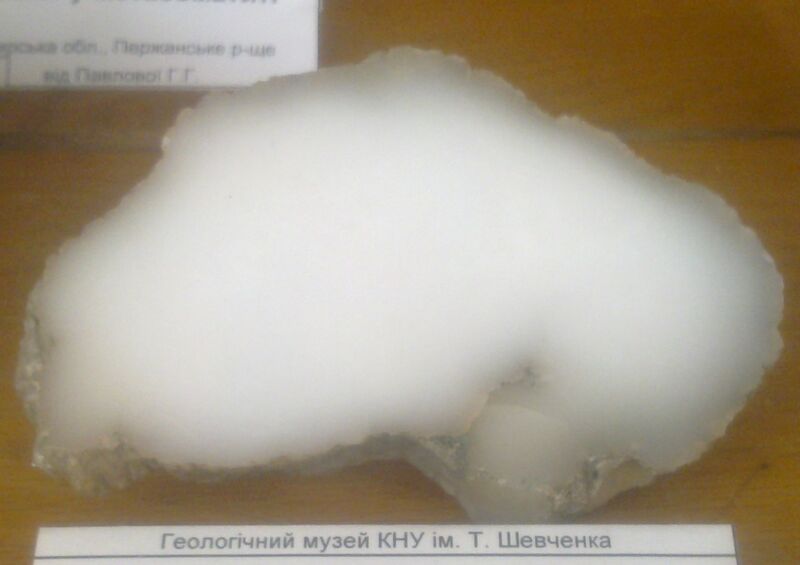
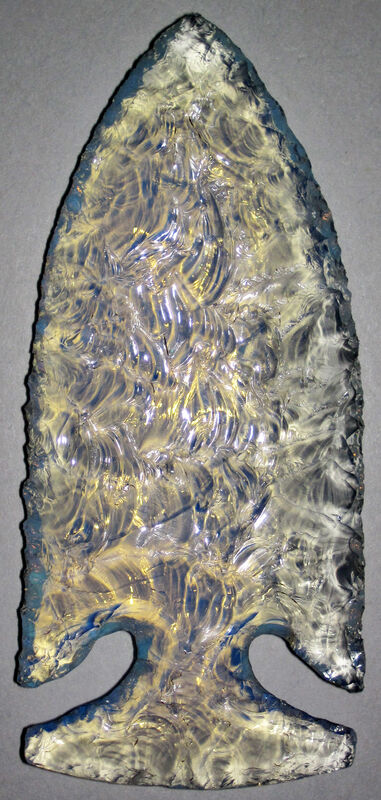
The defining feature of precious opal is play-of-colour — the iridescent flashes of red, green and blue that shift as the stone is turned. The effect is structural, not pigment-based. Silica nanospheres roughly 150 to 300 nanometres across stack into a regular array. That array diffracts visible light the way a thin film does on soap or oil. Common opal is built from the same hydrated silica but lacks the ordered spheres, and so has no play-of-colour.
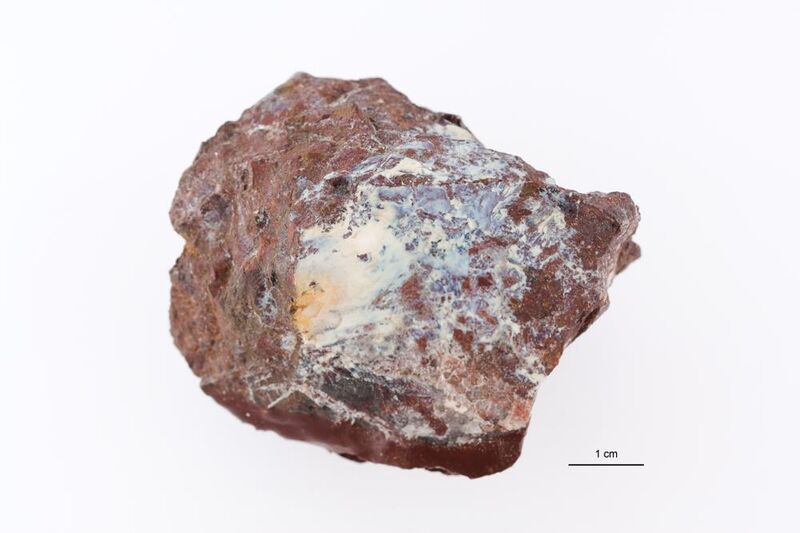
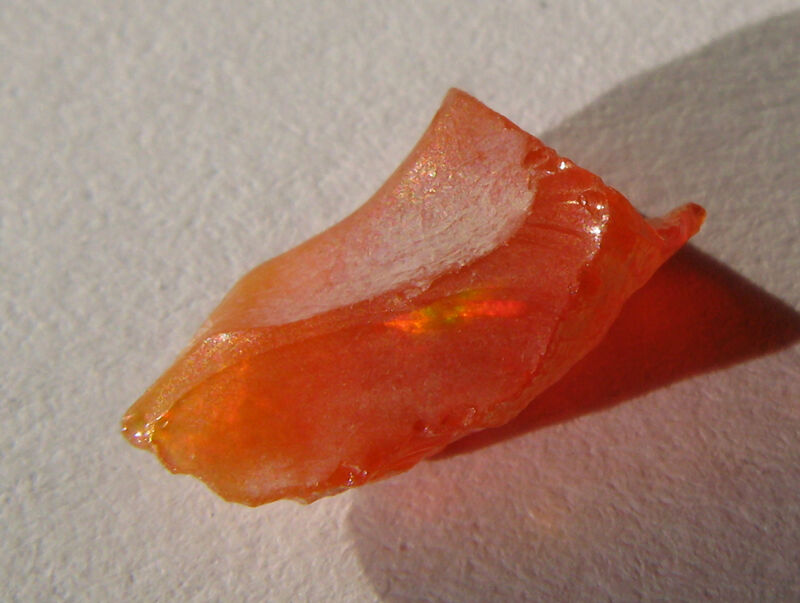
Several named varieties trade on this difference. Black opal, mined mainly at Lightning Ridge in New South Wales, has a dark grey to blue-black background that makes the play-of-colour read especially bright. Fire opal is transparent to translucent with warm body colours running from yellow through orange to red, often with no play-of-colour at all. The most famous source of fire opal is Querétaro in Mexico. Boulder opal, from western Queensland, occurs as concretions and fracture fillings in a dark siliceous ironstone matrix. Gem and matrix are cut and polished together.
Precious opal is almost always cut as a cabochon — a smooth dome rather than a faceted stone. Play-of-colour is a surface effect, and flat facets would chop it up. Thin or fragile slices are mounted into composite gems. Doublets pair an opal slice with a dark backing; triplets add a protective quartz cap on top. Doublets and triplets are not classed as precious gemstones in their own right. Australia supplies 95 to 97 percent of the world's precious opal, with South Australia alone responsible for about 80 percent.
As an industrial silica
The other industry uses opal of a very different kind. Diatomaceous earth — also called diatomite — is a soft, light sedimentary rock. It is made almost entirely of the fossil shells of diatoms, single-celled algae that build their skeletons from hydrated silica. Mineralogically those shells are common opal, and diatomite as a whole sits in the opal-CT range. The material has multiple industrial uses, the chief ones being filtration and adsorption. Various forms of common opal are also mined for use as abrasives, insulation media, fillers, and ceramic ingredients. None of these uses care about play-of-colour; what they trade on is the silica's porous, high-surface-area microstructure.
Where it forms, where it's found
- Geological setting
Altering volcanic tuffs, basalts. Silicious deep-water marine sediments. Opal-C, opal-CT and opal-AG formation is restricted to low pressure and low-temperature environments.
Varieties
Physical
- Hardness
- 1Talc
- 2Gypsum
- 3Calcite
- 4Fluorite
- 5Apatite
- 6Orthoclase
- 7Quartz
- 8Topaz
- 9Corundum
- 10Diamond
- Transparency
- Transparent · Translucent
- Colour
- Colourless · white · yellow · red · orange · green · brown · black · blue
- Streak
- White
- Tenacity
- brittle
- Cleavage
- None Observed
- Fracture
- Irregular/Uneven · Splintery · Conchoidal
- Density
- 1.9 g/cm³
Optical
- Optical type
- Isotropic
- Refractive index
- 1.4 – 1.46
- Principal indices
- nα 1.40 – 1.46
- Birefringence
- Opal-AG and Opal-AG are optically isotropic but may show anomalous birefringence due to strain. The microcrystalline varieties show birefringence: opal-C is length-fast, opal-CT is length-slow, but almost isotropic.
- Pleochroism
- Non-pleochroic
- UV response
- Yellow to green (uranyl)
Crystallography
- Comment
No Data
Synonyms
- Achates unguium colore oculus mundi
- Đá opal
- Gel-Cristobalite
- Gel-pristobalite
- Half-Opal
- Hemiopal
- Hungarian Opal
- Indivisible Quartz
- Iridot
- Lechosopal
- Lechosos
- Livit
- Ljardit
- Neslit
- Neslita
- Neslite
- Nevada Opal
- Paederos
- Pædros
- Rumanit
- Rumanita
- Semiopal
- Vidrit
- Vidrita
- Vidrite
- Virgin Valley Opal
- White Cliffs Opal
In other languages
- French
- Cachalong · opale · Opale AG · Opale commune · Opale potch · Vidrite
- German
- Amatit · Ljardit · Opal · Pyrophan · Vidrit
- Spanish
- ópalo · opalos
- Italian
- opale
- Portuguese
- opala
- Japanese
- オパール · オパル · 蛋白石
- Chinese
- 澳宝 · 蛋白石 · 貓眼石 · 閃山雲
- Simplified Chinese
- 蛋白石
- Traditional Chinese
- 蛋白石
- Russian
- Гиалит · Гидрофан · Джиразоль · Ирисопал · Кахолонг · опал · Солнечный камень
- Arabic
- أوبال
- Hindi
- ओपल
Classification
4.DA.10
- 4OxidesClass
- 4.DMetal: Oxygen = 1:2 and similarDivision
- 4.DAWith small cations: Silica familyGroup
- 4.DA.10OpalSpecies
75.02.01.01
- 75Tectosilicates Si Tetrahedral FrameworksClass
- 75.02Si Tetrahedral Frameworks - SiO2 with H2O and organicsType
- 75.02.01— unnamed intermediate level —Group
- 75.02.01.01OpalSpecies
7.8.8
- 7Oxides and HydroxidesClass
- 7.8Oxides of SiGroup
- 7.8.8OpalSpecies
Group, growth & confusion
 ChalcedonySiO2Variety—
 CinnabarHgSMineral—
 CristobaliteSiO2Mineral—
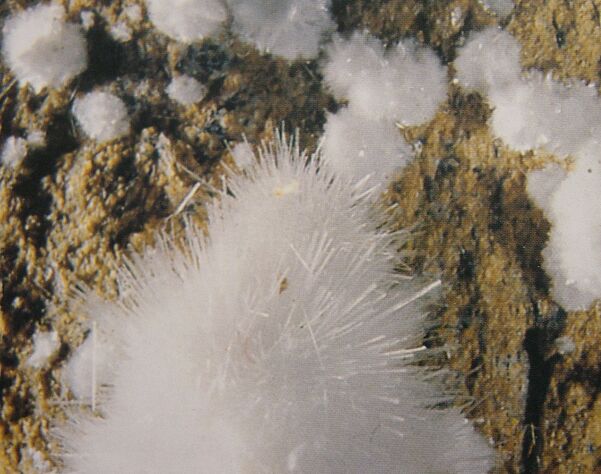 HydromagnesiteMg5(CO3)4(OH)2 · 4H2OMineral—
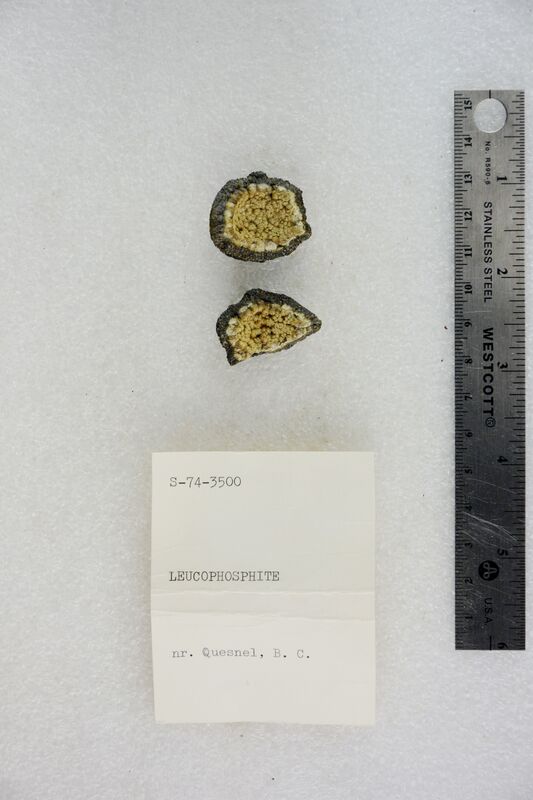 LeucophosphiteKFe3+2(PO4)2(OH) · 2H2OMineral—
- MagnesiovoltaiteK2Mg5Fe3+3Al(SO4)12 · 18H2OMineral—
- MetazelleriteCa(UO2)(CO3)2 · 3H2OMineral—
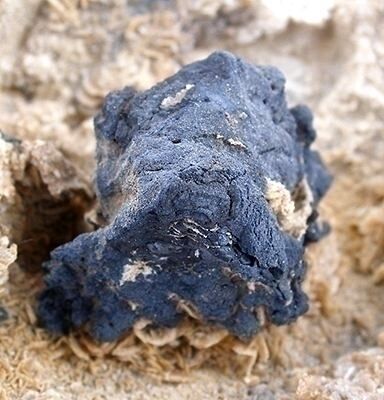 Todorokite(Na,Ca,K,Ba,Sr)1-x(Mn,Mg,Al)6O12 · 3-4H2OMineral—
Literature, links & citation
- —Pineau, M., Chauviré, B., Rondeau, B. (2023): Near-infrared signature of hydrothermal opal: a case study of Icelandic silica sinters. European Journal of Mineralogy, 35, 949–967.
- 1964JONES, J. B., SANDERS, J. V., SEGNIT, E. R. (1964) Structure of Opal. Nature, 204 (4962). 990-991 doi:10.1038/204990a0DOI: 10.1038/204990a0
- 1964SANDERS, J. V. (1964) Colour of Precious Opal. Nature, 204 (4964). 1151-1153 doi:10.1038/2041151a0DOI: 10.1038/2041151a0
- 1966JONES, J. B., BIDDLE, J., SEGNIT, E. R. (1966) Opal Genesis. Nature, 210 (5043). 1353-1354 doi:10.1038/2101353a0DOI: 10.1038/2101353a0
- 1968Sanders, J. V. (1968) Diffraction of light by opals. Acta Crystallographica Section A, 24 (4) 427-434 doi:10.1107/s0567739468000860DOI: 10.1107/s0567739468000860
Entry last updated
@misc{mineral2026,
  author    = {Mineral Index editorial board},
  title     = {Opal — Mineral Index},
  year      = {2026},
  url       = {https://mineralindex.org/minerals/opal-3004}
}