History
Long before chemists settled on the name arsenopyrite, German miners called this brassy iron-arsenic sulfide mispickel — a word of German origin that still surfaces in older mineralogical literature.
The modern name was coined in 1847 by the mineralogist Ernst Friedrich Glocker, as a contraction of arsenical pyrite. Pyrite is the familiar iron sulfide the mineral visibly resembles; the arsenical prefix flagged the arsenic that distinguishes it. The new term was also a near-direct translation of the older German arsenkies, which had long sat alongside mispickel in mining and assay manuals. Both earlier names predate Glocker's coinage, and the mineral itself had been recognised and worked under them well before 1847.
Industrial & practical applications
Arsenopyrite is, on paper, a principal ore of arsenic — its formula carries 46% arsenic by mass. In practice, very little of today's arsenic comes from mining it. The metal is recovered primarily from the smelter dust of copper, gold, and lead refineries. There it concentrates as an unwanted impurity in ores worked for other metals. When arsenopyrite is roasted in air the arsenic sublimes off as arsenic(III) oxide, leaving iron oxides behind — but the same product falls out of copper smelting at much larger scale.
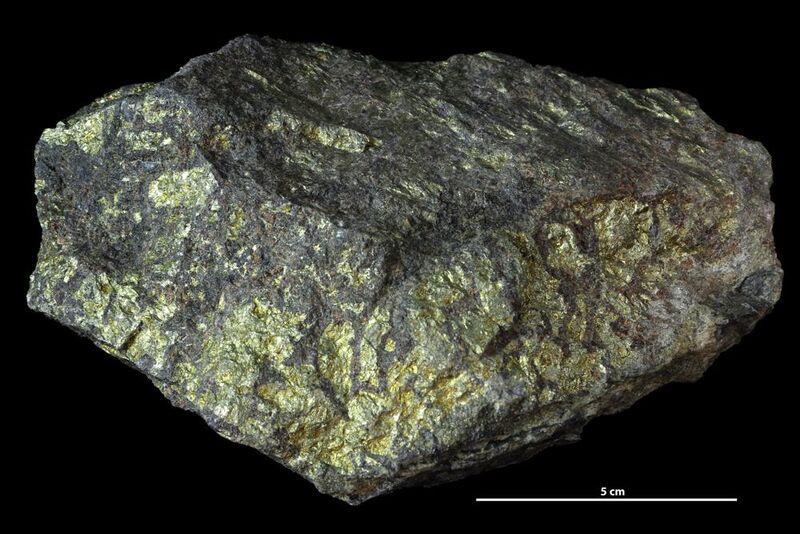
That leaves arsenopyrite's most consequential modern role outside the arsenic trade entirely. The mineral often hosts gold, locked inside its crystal structure so tightly that conventional cyanide leaching cannot reach it. Such ores are called refractory. Recovering the gold requires a pre-oxidation step that breaks the arsenopyrite apart before cyanidation. Three methods are in industrial use: roasting in air, pressure oxidation in an autoclave, and bio-oxidation by acidophilic bacteria that metabolise the sulfide. Each releases the gold; each also concentrates arsenic into a waste stream that has to be stabilised, not vented. For modern gold producers working refractory ore, arsenopyrite is the obstacle the whole flow sheet is designed around.
Where it forms, where it's found
- Geological setting
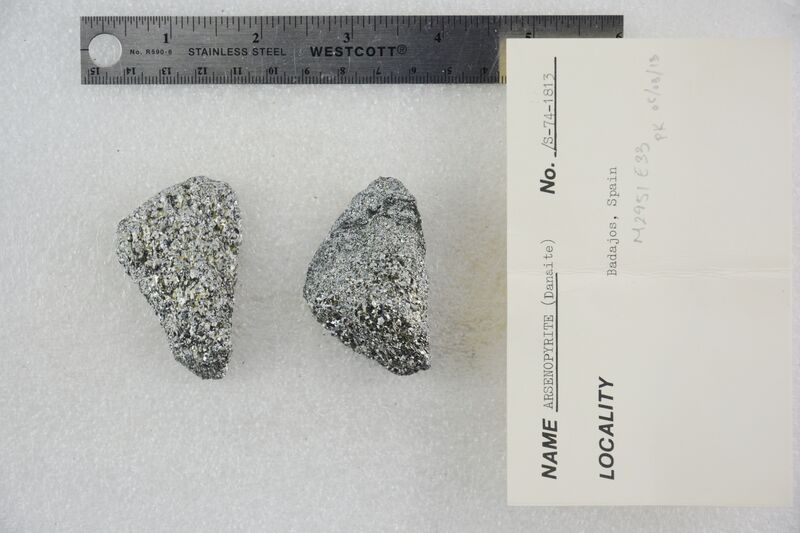
High-temperature gold-quartz or tin hydrothermal veins, pegmatites, contact metamorphic rocks, gneisses, schists.
Varieties
Safety & handling
Physical
- Hardness
- 1Talc
- 2Gypsum
- 3Calcite
- 4Fluorite
- 5Apatite
- 6Orthoclase
- 7Quartz
- 8Topaz
- 9Corundum
- 10Diamond
- Lustre
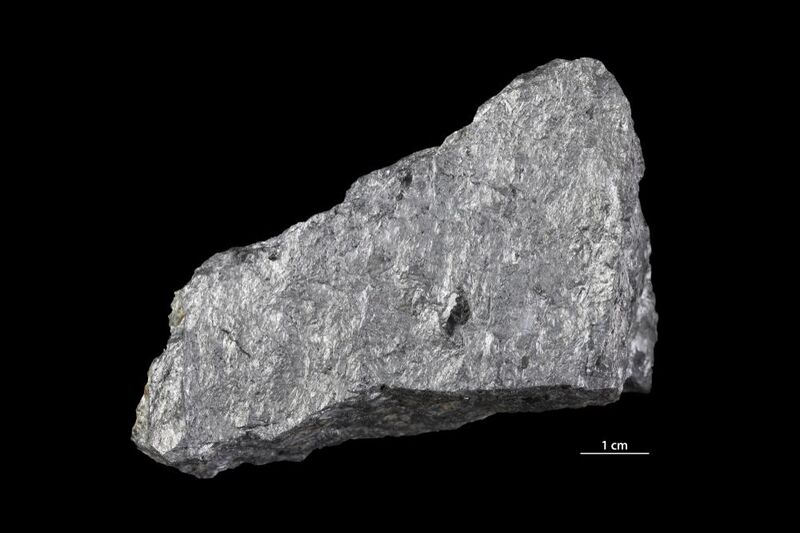
- Metallic.
- Transparency
- Opaque
- Colour
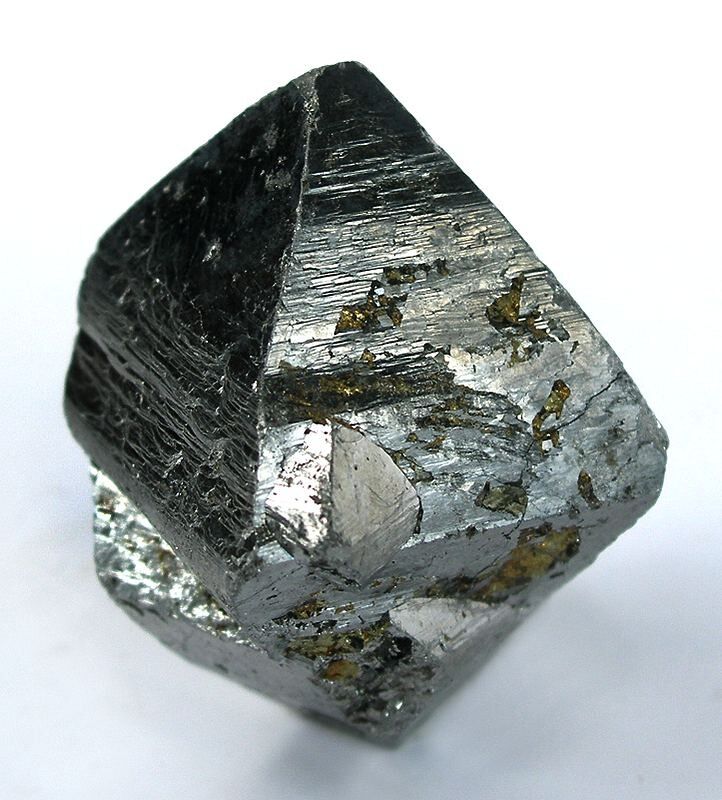
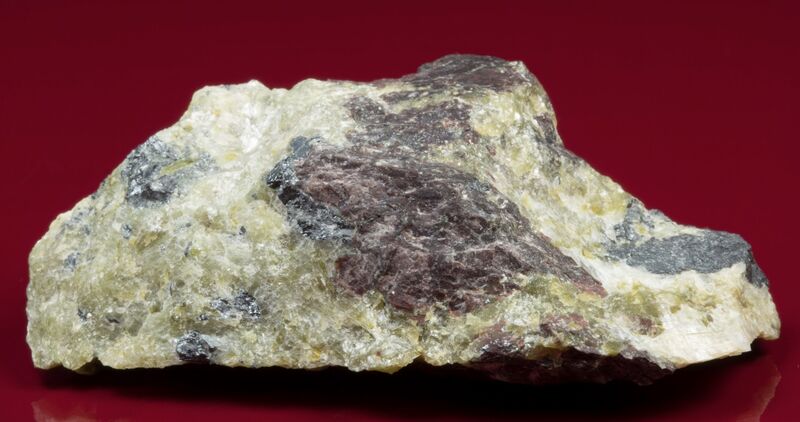
- Silver-white to steel-gray · may have a slight yellow appearance
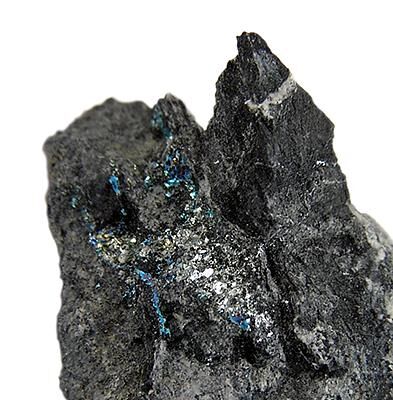
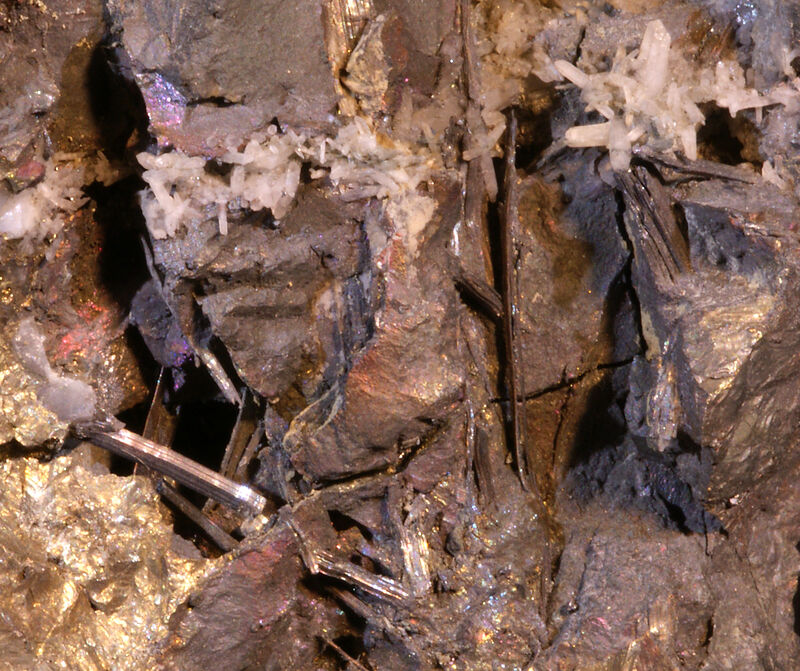
Tarnished material common, some iridescent
- Streak
- Gray-black
- Tenacity
- brittle
- Cleavage
- Distinct/Good
Distinct on (001); (010) in traces
- Fracture
- Irregular/Uneven
- Density
- 6.07 g/cm³
Optical
- Pleochroism
- Weak
White or bluish tint, faint reddish yellow
- Optical colour
- White with faint yellow tint
- Anisotropism
- Strong red-violet
- Tropism
- Anisotropic
- Reflectance R%
- (50.3, 51.8) 400, (50.3, 51.8) 420, (51.3, 51.8) 440, (50.6, 51.8) 460, (51.0, 51.9) 480, (51.4, 51.9) 500, (51.8, 51.9) 520, (52.2, 51.9) 540, (52.5, 51.9) 560, (53.0, 51.8) 580, (53.4, 51.6) 600, (53.6, 51.5) 620, (53.6, 51.3) 640, (53.6, 51.3) 660, (53.4, 51.2) 680, (53.2, 51.0) 700
- Luminescence
- None
- UV response
- Not fluorescent
Crystallography
- Space group
- P21/c
- Cell parameters
- a = 5.7612(8) Å · b = 5.6841(7) Å · c = 5.7674(8) Å
- Cell angles
- β = 111.721(8) °
- Ratio a:b:c
- 1 : 0.987 : 1.001
- Unit cell volume
- 175.46 ų
- Z
- 4
- Morphology
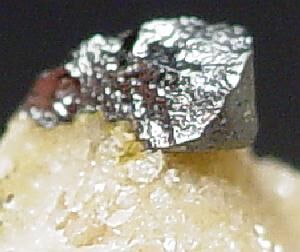
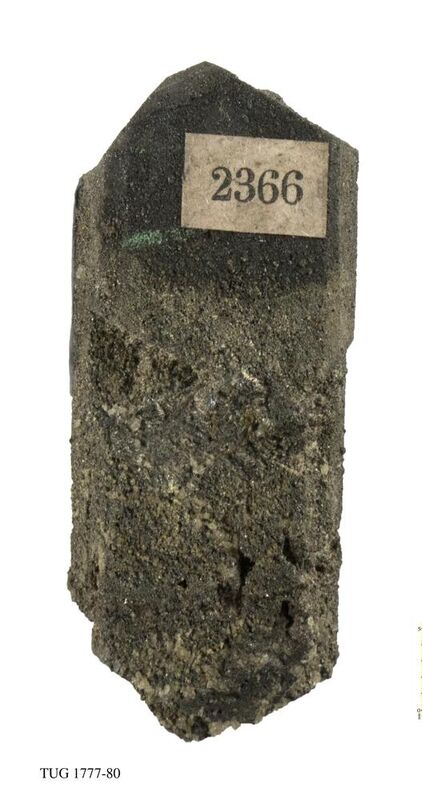
Flat tabular to blocky (sometimes pseudo-octahedral or rhombic) to prismatic.
- Twinning
Common on (100) and (001). Contact or penetration on (101), on (012) trillings or cruciform.
- Comment
Cell parameters from Bindi et al. (2012), using stoichiometric crystals. Pseudo-orthorhombic, face-centred cell: ~5.7, ~6.4, ~9.6 A.
Chemical composition
- Impurities
- Ag
- Au
- Co
- Sn
- Ni
- Sb
- Bi
- Cu
- Pb
Synonyms
- Agujillas
- Arsenical Iron
- Arsenical Pyrite
- Arsenical Pyrites
- Arsenikkies
- Arsenikstein
- Arsenkies
- Arsenkis
- Arsenomarcasit
- Arsenomarcasita
- Arsenomarcasite
- Arsenomarkasit
- Dalarnit
- Dalarnite
- Hüttraucherz
- Mispickel
- Mispiquel
- Mistpuckel
- Pirita de Arsénico
- Plinian
- Rauschgelbkies
- Thalheimit
- Thalheimite
In other languages
- French
- Arsenomarcasite · Arsénopyrite · Dalarnite · Delarnite · Hoffamnnite · Mispickel · Pyrite arsenicale · Thaleimite
- German
- Arsenikstein · Arsenkies · Arsenomarkasit · Arsenopyrit · Dalarnit · Giftkies · Glanzarsenikkies · Mispickel · Mißpickel · Mistpuckel · Rauschgelbkies · Thalheimit
- Spanish
- arsenopirita · mispiquel
- Italian
- Arsenopirite · Arsenopyrite
- Portuguese
- arsenopirita · Arsenopirite
- Japanese
- 硫ヒ鉄鉱 · 硫砒鉄鉱
- Chinese
- 毒砂 · 砷黃鐵礦
- Simplified Chinese
- 砷黄铁矿
- Traditional Chinese
- 砷黃鐵礦
- Russian
- арсенопирит · Миспикель · Мышьяковый колчедан · Тальгеймит
- Arabic
- أرسينوبيريت · ارسينوبيريت
Classification
2.EB.20
- 2Sulfides and SulfosaltsClass
- 2.EMetal Sulfides, M: S <= 1:2Division
- 2.EBM:S = 1:2, with Fe, Co, Ni, PGE, etc.Group
- 2.EB.20ArsenopyriteSpecies
02.12.04.01
- 02SulfidesClass
- 02.12AmBnXp, with (m+n):p = 1:2Type
- 02.12.04Arsenopyrite Group (Monoclinic: P21/c (Pseudo-orthorhombic))Group
- 02.12.04.01ArsenopyriteSpecies
3.9.12
- 3Sulphides, Selenides, Tellurides, Arsenides and Bismuthides (except the arsenides, antimonides and bismuthides of Cu, Ag and Au, which are included in Section 1)Class
- 3.9Sulphides etc. of FeGroup
- 3.9.12ArsenopyriteSpecies
Group, growth & confusion
Literature, links & citation
- 1884Renard, A. (1884) Sur les pseudocristaux de quartz affectant la forme de la pyrite arsénicale. Bulletin de l'Académie royale de Belgique, 3e série, 8, 324.
- 1936Buerger, M. J. (1936) A Systematic Method of Investigating Superstructures, Applied to the Arsenopyrite Crystal Structural Type. Zeitschrift für Kristallographie, 94 (1). 425-439 doi:10.1524/zkri.1936.94.1.425DOI: 10.1524/zkri.1936.94.1.425
- 1936Buerger, M. J. (1936) The Symmetry and Crystal Structure of the Minerals of the Arsenopyrite Group. Zeitschrift für Kristallographie, 95 (1-6). 83-113 doi:10.1524/zkri.1936.95.1.83 DOI: 10.1524/zkri.1936.95.1.83
- 1944Palache, Charles, Berman, Harry, Frondel, Clifford (1944) The System of Mineralogy (7th ed.) Vol. 1 - Elements, Sulfides, Sulfosalts, Oxides. John Wiley and Sons, New York.
- 1960Clark, Lloyd A. (1960) The Fe-As-S system - Phase relations and applications. Economic Geology, 55 (7). 1345-1381 doi:10.2113/gsecongeo.55.7.1345DOI: 10.2113/gsecongeo.55.7.1345
Entry last updated
@misc{mineral2026,
  author    = {Mineral Index editorial board},
  title     = {Arsenopyrite — Mineral Index},
  year      = {2026},
  url       = {https://mineralindex.org/minerals/arsenopyrite-305}
}