History
Long before anyone gave it a mineral name, actinolite was being carved. The mineral belongs to a three-member series — tremolite, actinolite, and ferro-actinolite — whose felted, fibrous aggregate is the gemstone nephrite, one of the two true jades. Neolithic communities worked this material across three continents, and most of "jade" in the human story is, mineralogically, the tremolite–actinolite series.
The oldest known European working dates to the Early Neolithic, in the 7th millennium BC, and continues through the Late Chalcolithic in the 5th millennium BC, with tools and amulets cut from the stone. In China, the Liangzhu culture of the Yangtze River Delta worked nephrite for ritual and ornamental objects between 3400 and 2250 BC. From the earliest Chinese dynasties onward, the working stone shifted to deposits near Khotan, in the western province of Xinjiang. A long maritime trade route in Southeast Asia carried the same material across the region for some three thousand years, peaking between 2000 BCE and 500 CE. In New Zealand, Māori carvers know nephrite as pounamu.
The names the stone has carried reflect this long use. The Latin lapis nephriticus — literally kidney stone — gave us the modern word nephrite, by way of Ancient Greek, because the polished material was once believed to relieve kidney complaints. The English word jade follows the same logic: it descends from the Spanish piedra de ijada — flank stone — first recorded in 1565.
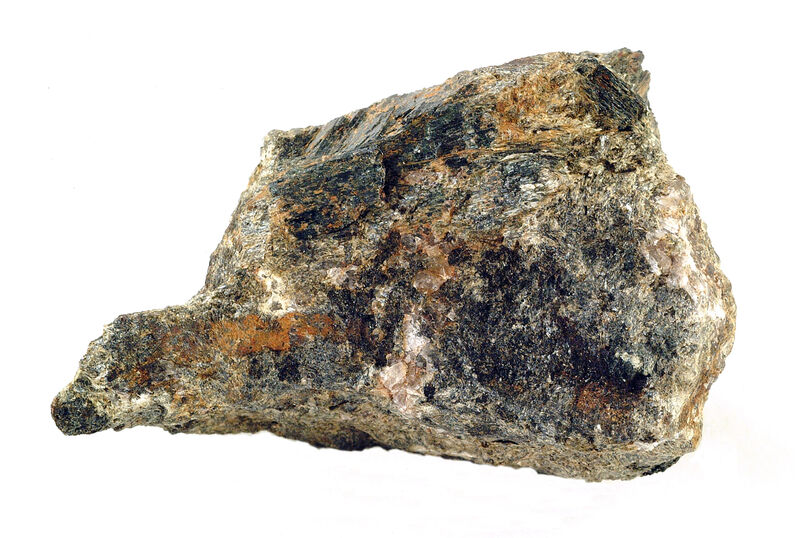
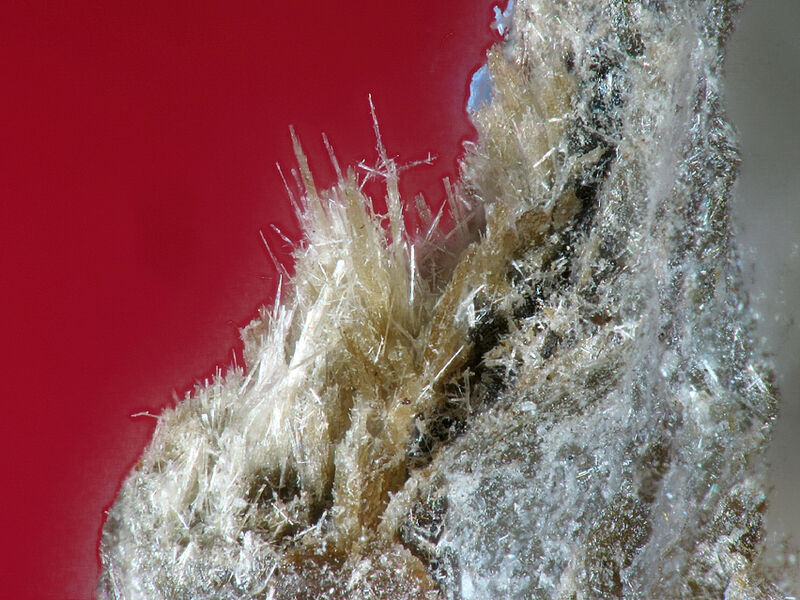
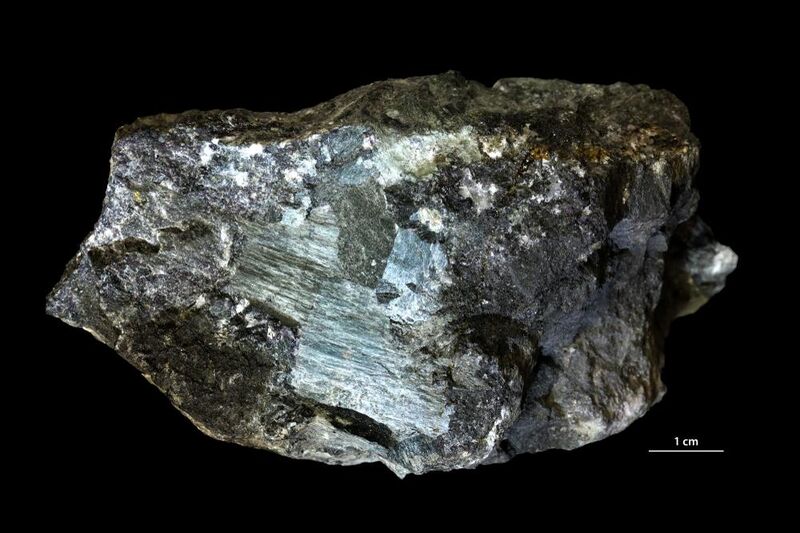
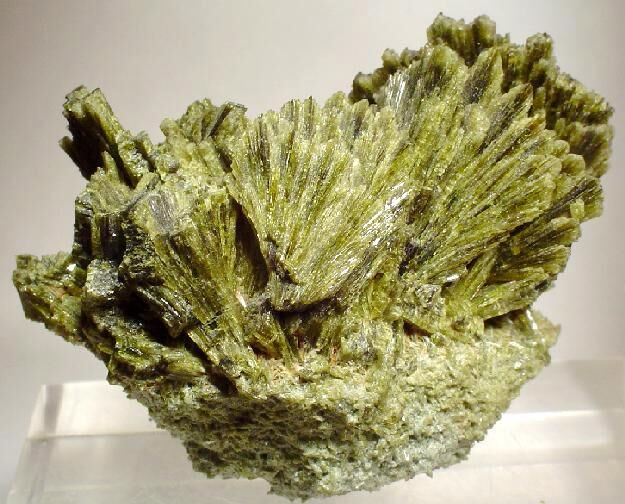
The mineral species itself received its modern name in 1794. The Irish chemist Richard Kirwan joined the Greek aktina — ray — with lithos — stone — to coin actinolite. The name records the radiating, fibrous habit of the original specimens: long thin crystals fanning out from a centre like spokes.
The jade question was settled later. In 1863, the French mineralogist Alexis Damour showed that jade was actually two distinct minerals. One was nephrite, in the amphibole group, the calcium and magnesium silicates. The other was jadeite, in the pyroxene group, built around sodium and aluminium. Nephrite and jadeite had been confused for centuries; Damour's analysis pulled them apart.
Older mineralogical writing kept a separate vocabulary for the felted forms of the series. Thin interwoven sheets of fibre were called mountain leather; thicker sheets, mountain cork; and compact, dry-wood-like masses, mountain wood. These were descriptive names for habit, not for chemistry — the substance underneath was actinolite or its close relative tremolite.
Industrial & practical applications
Actinolite has two faces in modern use, and they could not be more different. As a felted aggregate it is nephrite, one of the two true jades, still carved today into beads, cabochons and ornamental objects. As a fibrous habit it is actinolite asbestos, one of the six minerals regulated worldwide as asbestos. The same chemistry — a calcium-magnesium amphibole — does both jobs depending on how it grew.
As nephrite jade
Modern lapidary nephrite is sourced principally from western Canada, with Taiwan also a major producer. The stone is cut into the same forms it has worn for millennia: carvings, beads, and the rounded, polished cabochon. Transparent crystals of actinolite are far rarer. When they appear, they are faceted by gem cutters for collectors.
As regulated asbestos
The fibrous habit of actinolite tells a different story. Actinolite asbestos — Chemical Abstracts Service number 77536-66-4 — is one of the six minerals that fall under asbestos regulation in most jurisdictions. The other five are chrysotile, amosite, crocidolite, tremolite asbestos and anthophyllite asbestos. All six are recognised human carcinogens. Exposure causes asbestosis, lung cancer, and mesothelioma, an aggressive cancer of the lung lining.
Industrially, actinolite asbestos has always been a minor player next to its cousins. Chrysotile accounts for around 95 percent of the asbestos found in American buildings; the amphibole asbestos — actinolite included — is used in far smaller quantities. Contaminated vermiculite from a Montana mine has exposed workers to actinolite and tremolite fibres. In Australia, actinolite asbestos was mined along Jones Creek at Gundagai.
The regulatory net is broad and tight. Sixty-six countries and territories, including the entire European Union, have banned the use of asbestos. Australia banned it on 31 December 2003, Japan in March 2012, and Canada on 31 December 2018. The United States Occupational Safety and Health Administration caps workplace exposure at 0.1 fibre per cubic centimetre of air over an eight-hour day.
Where it forms, where it's found
- Geological setting
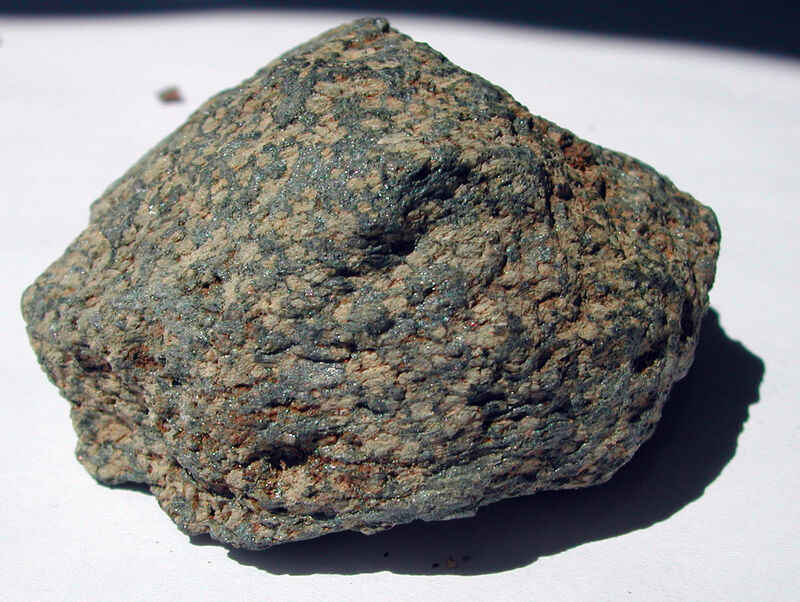
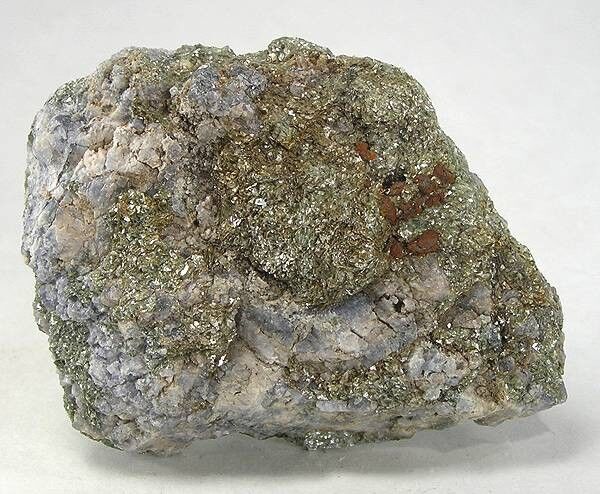
Produced by low-grade regional or contact metamorphism of magnesium carbonate, mafic, or ultramafic rocks; Also in glaucophane-bearing blueschists. Occurs in many localities. In Austria, on Mt. Greiner, Zillertal, and at Untersulzbachtal. From Zermatt, Valais, Switzerland. At Snarum and Arendal, Norway. From the Ural Mountains, Russia. In the USA, from Gouverneur, St. Lawrence Co., New York; Franklin and Newton, Sussex Co., New Jersey; Chester, Windsor Co., Vermont; in the Fairfax quarry, Centreville, Fairfax Co., Virginia; Crestmore, Riverside Co., California; at Salida, Chaffee Co., Colorado. Nephrite jade occurs, in the USA, south and east of Lander, Fremont Co., Wyoming; north from Cape San Martin, Monterey Co., California; and around Jade Mountain, near the Kobuk River, Alaska. Along the Fraser River, British Columbia, Canada. Around Mt. Cook, South Island, New Zealand. Fine material from the Kunlun Mountains, Sinkiang Uighur Autonomous Region, China.
Varieties
Safety & handling
Physical
- Hardness
- 1Talc
- 2Gypsum
- 3Calcite
- 4Fluorite
- 5Apatite
- 6Orthoclase
- 7Quartz
- 8Topaz
- 9Corundum
- 10Diamond
- Lustre
- Vitreous
- Transparency
- Transparent · Translucent
- Colour
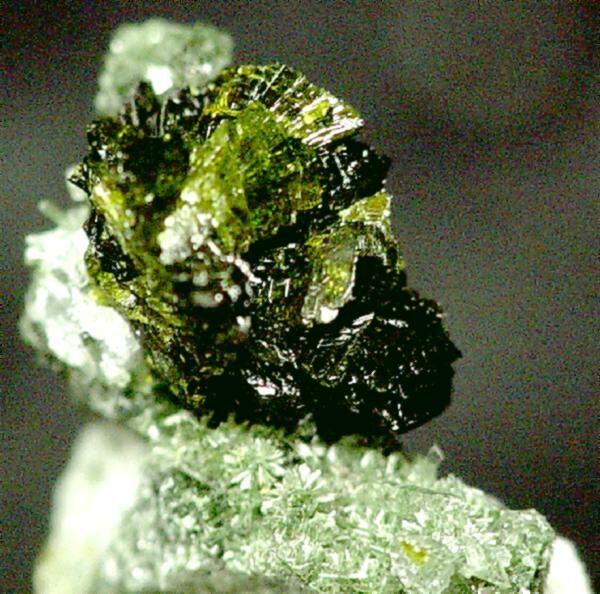
- Green · green-black · grey-green · or black
Colourless, pale green to deep green in thin section.
- Streak
- White
- Tenacity
- brittle
- Cleavage
- Distinct/Good
on (110)
- Fracture
- Splintery
- Density
- 3.03 g/cm³
Optical
- Optical type
- Biaxial (-) · 2V measured = 79 – 86° · 2V calc = 78 – 82°
- Refractive index
- 1.613 – 1.666
- Surface relief
- Moderate
- Principal indices
- nα 1.613 – 1.646 · nβ 1.624 – 1.656 · nγ 1.636 – 1.666
- Pleochroism
- Weak
X= pale yellow, yellowish green Y= pale yellow-green, green Z= pale green, deep greenish blue
- Dispersion
- r < v
- Luminescence
- Nonfluorescent
Crystallography
- Space group
- C2/m
- Cell parameters
- a = 9.891(1) Å · b = 18.200(1) Å · c = 5.305(1) Å
- Cell angles
- β = 104.64(1) °
- Ratio a:b:c
- 1 : 1.840 : 0.536
- Z
- 2
- Twinning
simple or lamellar, common parallel (100); lamellar, less common parallel (001)
- Parting
- on (100)
Chemical composition
- Impurities
- Mn
- Al
- Na
- K
- Ti
Synonyms
- Actinolithe
- Actinolota
- Actynolin
- Actynolit
- Actynolita
- Actynolite
- Attinoto
- Stibolit
- Stibolita
- Stibolite
- strahlite
- Strahlstein
- Stralit
- Stralita
- Stralite
- Zillerthit
- Zillerthita
- Zillerthite
- Zillertit
- Zillertite
In other languages
- French
- Actinolite · Actinolithe · actinote · Actynolite · Rayonnante · Stralite commun · Zillerthite
- German
- Actinolit · Aktinolith · Amiant · Strahlstein
- Spanish
- actinolita
- Italian
- actinolite · Attinolite
- Portuguese
- Actinolita · actinolite
- Japanese
- アクチノライト · アクチノ閃石 · 緑閃石 · 陽起石
- Chinese
- 鐵陽起石 · 铁阳起石 · 阳起石 · 陽起石
- Simplified Chinese
- 阳起石
- Traditional Chinese
- 陽起石
- Russian
- актинолит · лучистый камень
- Arabic
- أكتينولايت · أكتينوليت
Classification
9.DE.10
- 9SilicatesClass
- 9.DInosilicatesDivision
- 9.DEInosilicates with 2-periodic double chains, Si4O11; ClinoamphibolesGroup
- 9.DE.10ActinoliteSpecies
14.23.2
- 14Silicates not Containing AluminumClass
- 14.23Silicates of Fe, Mg, CaGroup
- 14.23.2ActinoliteSpecies
Group, growth & confusion
Literature, links & citation
- 1794Richard Kirwan (1794) Elements of Mineralogy - second edition Vol. 1. P. Elmsly, The Strand.
- 1923Washington, H. S., Merwin, H. E. (1923) Note on enstatite, hypersthene and actinolite. American Mineralogist, 8 (4) 63-66
- 1955Zussman, J. (1955) The crystal structure of an actinolite. Acta Crystallographica, 8 (6) 301-308 doi:10.1107/s0365110x55000959DOI: 10.1107/s0365110x55000959
- 1956Hutton, C. O. (1956) The composition of an actinolite. Acta Crystallographica, 9 (3) 231-232 doi:10.1107/s0365110x56000668DOI: 10.1107/s0365110x56000668
- 1959SHIDO, Fumiko (1959) Notes on Rock-Forming Minerals (8) Chemical, Optical and X-Ray Data on a Tremolite and Three Actinolites. The Journal of the Geological Society of Japan, 65 (768) 563-565 doi:10.5575/geosoc.65.563DOI: 10.5575/geosoc.65.563
Entry last updated
@misc{mineral2026,
  author    = {Mineral Index editorial board},
  title     = {Actinolite — Mineral Index},
  year      = {2026},
  url       = {https://mineralindex.org/minerals/actinolite-18}
}