History
The name almandine is a corruption of alabandicus — the term Pliny the Elder applied to a red stone found or worked at Alabanda, an ancient town in Caria, in what is now southwestern Turkey. Alabanda was a Roman-era gem cutting centre, and the name suggests almandine was fashioned into gemstones there.
In antiquity, the deep red almandine was the most prominent of several stones grouped under the Latin word carbunculus — "little coal" — for their glowing colour. Red garnets were the most commonly used gemstones in the Late Antique Roman world and in the Migration Period art of the peoples who succeeded Rome. They were set into gold cells in the cloisonné technique — small compartments of metal each holding one polished stone — a style so closely associated with garnet that it is often simply called garnet cloisonné. The technique runs from Anglo-Saxon England, as at the Sutton Hoo ship burial, to the Black Sea. The trade in raw stones reached far: thousands of gold, silver, and red garnet shipments moved from Tamraparniyan workshops, in what is now Sri Lanka, across the Old World to Rome, Greece, the Middle East, and the Anglo-Saxon north.
Through the medieval period, the gem-quality red almandine continued to be called carbuncle in European lapidaries. The English word descends from the same Latin carbunculus, and it remains the name applied to almandine cut with a domed face — en cabochon — to bring out the colour.
The modern mineral name was fixed in 1546, when the German mineralogist Georgius Agricola — Georg Bauer — published it as almandine in his early mineralogical writings, deriving it directly from Pliny's alabandicus.
Industrial & practical applications
Almandine has two working lives today: one as a gemstone, the other as the dominant raw material of the industrial garnet trade.
As an abrasive
The coarse, opaque varieties of almandine are crushed for use as an abrasive agent. Hard — between 6.5 and 7.5 on the Mohs scale — and angular when broken, the mineral powder cuts metals and other hard materials cleanly. Garnet sand is a good abrasive and a common replacement for silica sand in abrasive blasting operations. The grain shape matters: alluvial grains, rounder from river transport, suit blasting; angular grains broken from hard rock suit waterjet cutting, where the powder is mixed with very high pressure water to slice steel and other materials. Garnet paper, faced with finely sized grains, is favoured by cabinetmakers for finishing bare wood, and garnet sand is also used as a water filtration medium.
The supply base sits with two countries. The largest source today is garnet-rich beach sand on the coasts of India and Australia. These two are the main producers of abrasive garnet.
A third, harder stream comes from the Adirondack Mountains of New York. The open-pit Barton Garnet Mine at Gore Mountain, in Warren County, is a significant source of industrial abrasive. It also yields the world's largest single garnet crystals, commonly 10 to 18 centimetres across.
As a gemstone
Gem-quality almandine — transparent, deep red inclining to purple — is the most abundant of the garnets and the least expensive of the red ones. It is most often faceted for rings. Stones cut en cabochon — with a domed top — are sold as carbuncle, the same trade name the gem has carried since antiquity. Some cabochons show a four-rayed asterism — a star-shaped figure across the dome — when fine needle-shaped inclusions inside the stone are aligned by the crystal's structure.
Where it forms, where it's found
- Geological setting
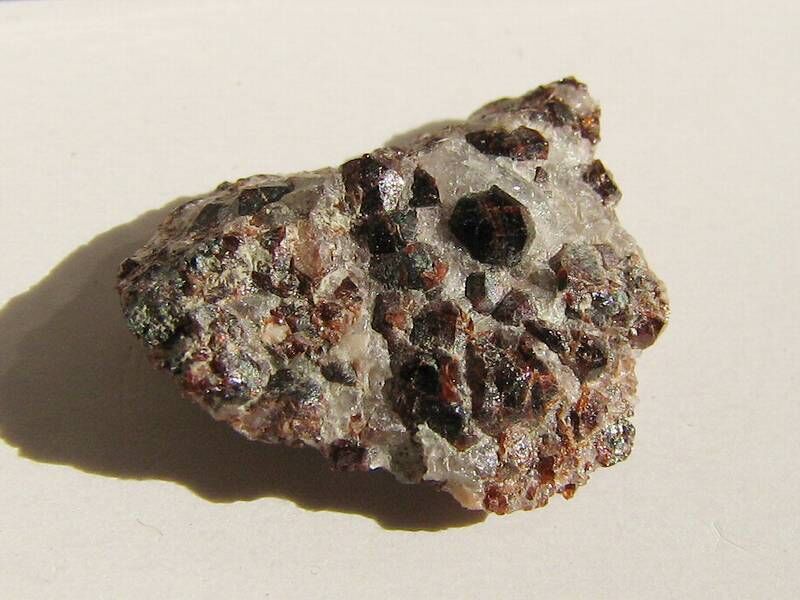
The most common garnet, typically in mica schists and gneisses, from regionally metamorphosed argillaceous sediments and pelites; also in contact metamorphic hornfels. In granites and eclogites; in sedimentary rocks; as a detrital mineral.
- Type locality
- Alabanda
- Çine District
- Aydin Province
- Turkey
37.5989°, 27.9589°
Varieties
Physical
Optical
- Optical type
- Isotropic
- Surface relief
- Very high
- Principal indices
- n 1.83
- Luminescence
- Non-fluorescent
- Notes
Anomalously biaxial.
- Single index
- n = 1.830
Crystallography
- Space group
- #225
- Cell parameters
- a = 11.526 Å
- Z
- 8
- Morphology
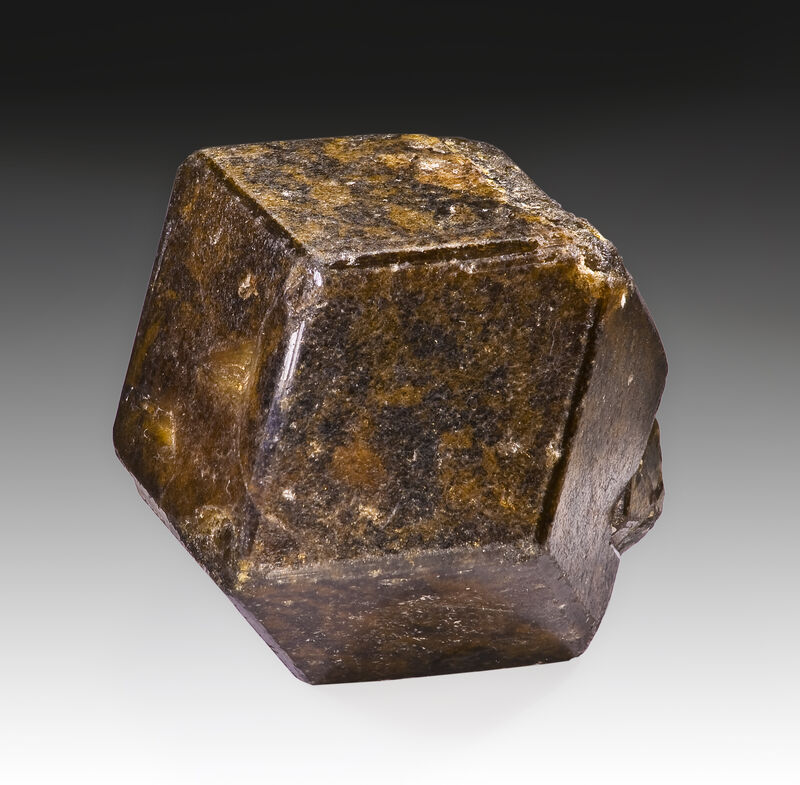
Typically well-formed dodecahedra or trapezohedra, to 1 m; also in rounded grains and massive.
- Parting
- On (110)
Chemical composition
Synonyms
- Adelaide ruby
- Adelaide-rubin
- Alabandicus (of Pliny)
- Alabandine Ruby
- Alamandine
- Almandine Garnet
- Almandit
- Almandita
- Almandite
- Greenlandite (of Klaproth)
- Oriental Garnet
In other languages
- French
- Alamandine · almandin · Almandite · Dhanrasite
- German
- Alabandin · Almandin · Eisen-Tonerdegranat · Eisentongranat
- Spanish
- almandina · almandines · almandino · almandita
- Italian
- almandine · almandini · almandino
- Japanese
- アルマンディン · 鉄礬柘榴石
- Chinese
- 鐵鋁榴石
- Traditional Chinese
- 鐵鋁榴石
- Russian
- альмандин
- Arabic
- ألمندين
Classification
9.AD.25
- 9SilicatesClass
- 9.ANesosilicatesDivision
- 9.ADNesosilicates without additional anions; cations in [6] and/or greater coordinationGroup
- 9.AD.25AlmandineSpecies
51.04.3a.02
- 51Nesosilicates Insular Sio4 Groups OnlyClass
- 51.04Insular SiO4 Groups Only with cations in [6] and >[6] coordinationType
- 51.04.3a— unnamed intermediate level —Group
- 51.04.3a.02AlmandineSpecies
16.17.1
- 16Silicates Containing Aluminum and other MetalsClass
- 16.17Aluminosilicates of FeGroup
- 16.17.1AlmandineSpecies
Group, growth & confusion
 AndraditeCa3Fe3+2(SiO4)3Mineral—
 CalderiteMn2+3Fe3+2(SiO4)3Mineral—
- EringaiteCa3Sc2(SiO4)3Mineral—
 GoldmaniteCa3V3+2(SiO4)3Mineral—
 GrossularCa3Al2(SiO4)3Mineral—
- KnorringiteMg3Cr2(SiO4)3Mineral—
 MajoriteMg3(MgSi)(SiO4)3Mineral—
- Menzerite-(Y)(CaY2)Mg2(SiO4)3Mineral—
 MomoiiteMn2+3V3+2(SiO4)3Mineral—
- MorimotoiteCa3(TiFe2+)(SiO4)3Mineral—
Literature, links & citation
- 1988Rossman, G.R., Rauch, F., Livi, R., Tombrello, T.A., Shi, C.R., Zhoi, Z.Y. (1988) Nuclear reaction analysis of hydrogen in almandine, pyrope and spessartine garnets. Neues Jahrbuch für Mineralogie Monatshefte: 4: 172-178.
- 1991Hofmeister, A.M., Chopelas, A. (1991) Vibrational spectroscopy of end-member silicate garnets. Physics and Chemistry of Minerals, 17 (6). 503-526 doi:10.1007/bf00202230DOI: 10.1007/bf00202230
- 1992Armbruster, Thomas, Geiger, Charles A., Lager, George A. (1992) Single-crystal X-ray structure study of synthetic pyrope almandine garnets at 100 and 293 K. American Mineralogist, 77 (5-6) 512-521
- 1992Geiger, C.A., Armbruster, Th., Lager, G.A., Jiang, K., Lottermoser, W., Amthauer, G. (1992) A combined temperature dependent 57Fe Mössbauer and single crystal X-ray diffraction study of synthetic almandine: Evidence for the Gol'danskii-Karyagin effect. Physics and Chemistry of Minerals, 19 (2). 121-126 doi:10.1007/bf00198609DOI: 10.1007/bf00198609
- 1996Pilati, T., Demartin, F., Gramaccioli, C. M. (1996) Atomic displacement parameters for garnets: a lattice-dynamical evaluation. Acta Crystallographica Section B Structural Science, 52 (2) 239-250 doi:10.1107/s0108768195010925DOI: 10.1107/s0108768195010925
Entry last updated
@misc{mineral2026,
  author    = {Mineral Index editorial board},
  title     = {Almandine — Mineral Index},
  year      = {2026},
  url       = {https://mineralindex.org/minerals/almandine-452}
}