History
The name chrysocolla is older than the mineral it now names. It comes from two Greek words — chrysos, gold, and kolla, glue — and the Greek philosopher Theophrastus used it in 315 BCE for a green paste applied to solder gold onto other metals. The mineral was named for the recipe, not the other way round.
In antiquity the word was generous. Ancient writers used chrysocolla for a range of green, copper-bearing materials gathered for one craft purpose — joining worked gold to gold. The label stretched across what later mineralogy would split into malachite, verdigris, and the specific hydrous copper silicate we now call chrysocolla. For two thousand years the word travelled with the trade.
The modern, narrower meaning is much younger. In 1808 the French mineralogist André-Jean-François-Marie Brochant de Villiers revived the ancient name and attached it to a single species — the soft, blue-green copper silicate that forms in the weathered tops of copper deposits. Brochant de Villiers was a founding figure of the École des Mines in Paris. He later directed the first geological map of France, and his 1808 choice fixed the modern usage of the name.
Industrial & practical applications
Chrysocolla earns its keep at the surface of copper mines, not at the smelter. It forms as crusts and masses where copper-bearing ores have been broken down by water carrying dissolved silica, mostly in arid country. When those crusts are mined out alongside richer sulfide ores, the copper they hold is recovered. On its own, the mineral is a very minor ore of copper — gathered up where it appears, not sought out as a primary target.
Its second life is in the lapidary trade — the cutting and polishing of stones for ornament. Chrysocolla yields a vivid blue-green stone that has stood in for turquoise in silversmithing and goldsmithing since antiquity. The catch is hardness. Pure chrysocolla is soft. Material that holds a polish well has usually been naturally silicified — the copper silicate threaded through harder quartz or chalcedony.
The most valuable of those silicified forms is gem silica, a translucent blue-green chalcedony coloured by chrysocolla and prized as the most valuable variety of chalcedony. The Miami-Inspiration Mine in Arizona is the leading recent source; fine cut stones sell for more than 100 dollars per carat.
A second named lapidary material is Eilat stone, mined in the Timna Valley of southern Israel. It is a natural intergrowth of chrysocolla with malachite, azurite and turquoise rather than a single phase. It has been Israel's national stone since the 1950s.
Where it forms, where it's found
- Geological setting
Found in the oxidation zone of copper deposits, often encrusting or replacing earlier secondary minerals.
Physical
- Hardness
- 1Talc
- 2Gypsum
- 3Calcite
- 4Fluorite
- 5Apatite
- 6Orthoclase
- 7Quartz
- 8Topaz
- 9Corundum
- 10Diamond
- Lustre
- Vitreous - Dull
- Transparency
- Translucent · Opaque
- Colour
- Green · bluish green · blue · blackish blue to black · or brown and rarely yellow
Fe-rich samples have yellowish colours, Mn-rich samples are blackish. Please see: https://www.mindat.org/forum.php?read,6,371164,371218#msg-371218 , https://www.mindat.org/forum.php?read,7,377608,377668#msg-377668 , https://www.mindat.org/forum.php?read,106,353156
- Streak
- Light green (unknown for black or yellow varieties)
- Tenacity
- brittle
- Cleavage
- None Observed
None
- Fracture
- Irregular/Uneven · Sub-Conchoidal
- Density
- 1.93 g/cm³
Optical
- Optical type
- Biaxial (-)
- Refractive index
- 1.575 – 1.635
- Surface relief
- Moderate
- Principal indices
- nα 1.575 – 1.585 · nβ 1.597 · nγ 1.598 – 1.635
- Luminescence
- None
Crystallography
- Cell parameters
- a = 5.7 Å · b = 8.9 Å · c = 6.7 Å
- Ratio a:b:c
- 1 : 1.561 : 1.175
- Morphology
Most often found as cryptocrystalline to amorphous botryoidal aggregates and crusts. Crystals reported as fine acicular to fibrous, very rare.
- Twinning
None reported.
- Comment
Point Group: n.d.; Space Group: n.d.
Synonyms
- Abdollah-Giw Turquoise
- Beaumontite (of Jackson)
- Berggrün
- Chalcostaktit
- Chalcostaktita
- Chalcostaktite
- Chalkostaktit
- Chalkostaktita
- Chalkostaktite
- Chrysocole
- Chrysocollite
- Chrysokolla
- Copper Pitchblende
- Crysocolla
- Cuivre carbonaté vert (of Haüy)
- Cuivre Hydrosiliceux
- Demidoffite
- Demidovit
- Demidovita
- Demidovite
- Dillenbergit
- Dillenbergita
- Kieselkupfer
- Kieselmalachit
- Kobberkisel
- Koppargrün
- Kupferkiesel
- Kupfermalachit
- Liparite (of Casoria)
- Llanca
- Pechkupfer
- Pechkupfer (of Hausmann)
- Somervillite (of Dufrénoy)
- Viride montanum
In other languages
- French
- chrysocolle
- German
- Chrysokoll · Kieselkupfer · Kupfergrün
- Spanish
- crisocola
- Italian
- Colla d'oro · crisocolla · Hispanicum · Krysocolla · Lutea · Orobitis · Verde di banda · Viride
- Portuguese
- crisocola
- Japanese
- クリソコラ · 珪孔雀石
- Chinese
- 矽孔雀石
- Russian
- хризоколла · эйлатский камень · элатский камень
- Arabic
- كريزوكولا · لزاق الذهب
Classification
9.ED.20
- 9SilicatesClass
- 9.EPhyllosilicatesDivision
- 9.EDPhyllosilicates with kaolinite layers composed of tetrahedral and octahedral netsGroup
- 9.ED.20ChrysocollaSpecies
74.03.02.01
- 74Phyllosilicates Modulated LayersClass
- 74.03Modulated Layers with joined stripsType
- 74.03.02— unnamed intermediate level —Group
- 74.03.02.01ChrysocollaSpecies
14.2.5
- 14Silicates not Containing AluminumClass
- 14.2Silicates of CuGroup
- 14.2.5ChrysocollaSpecies
Group, growth & confusion
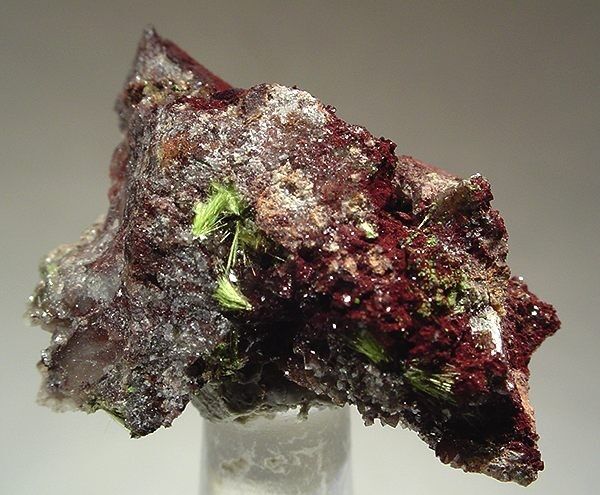 Agardite-(La)LaCu2+6(AsO4)3(OH)6 · 3H2OMineral—
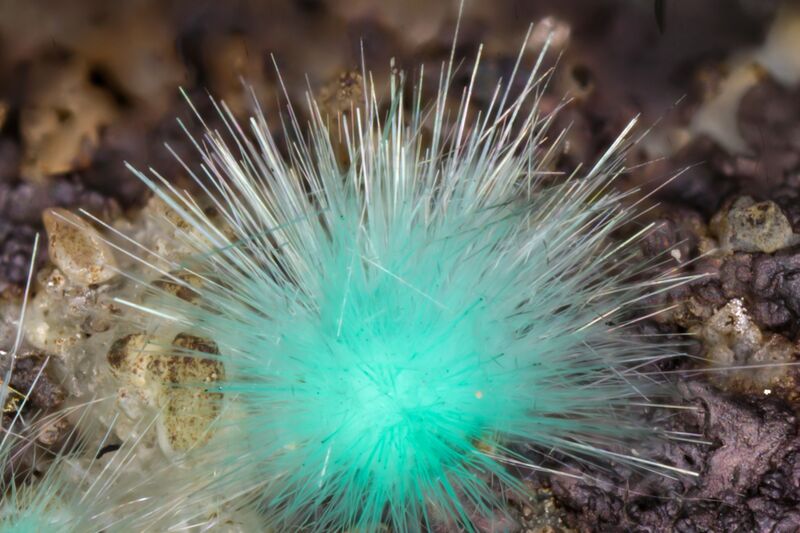 Agardite-(Y)YCu2+6(AsO4)3(OH)6 · 3H2OMineral—
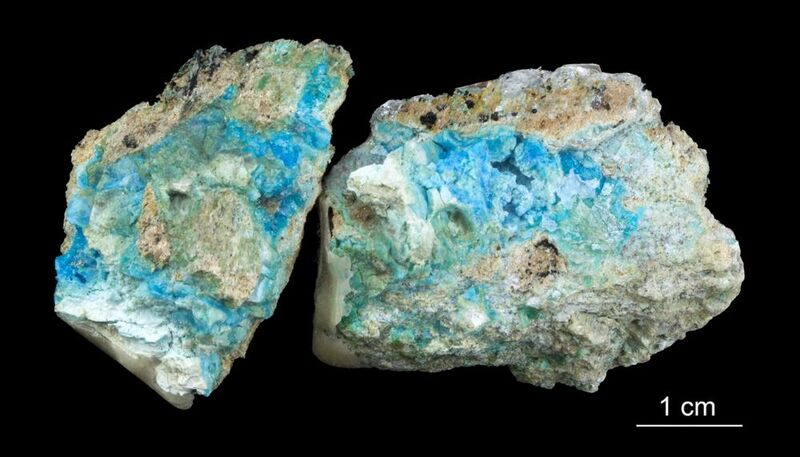 AllophaneAl2O3(SiO2)1.3-2.0 · 2.5-3.0H2OMineral—
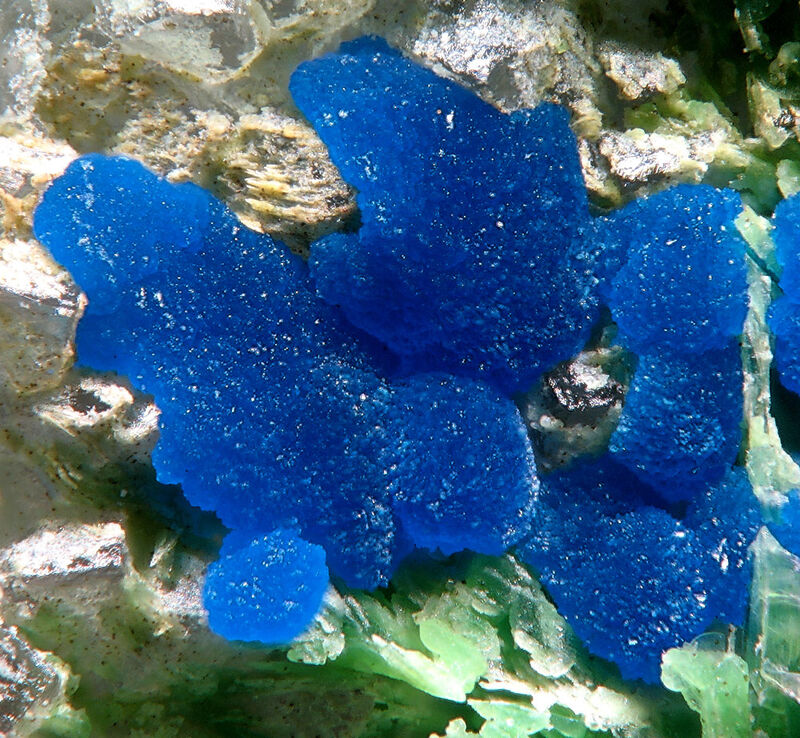 ArhbariteCu2Mg(AsO4)(OH)3Mineral—
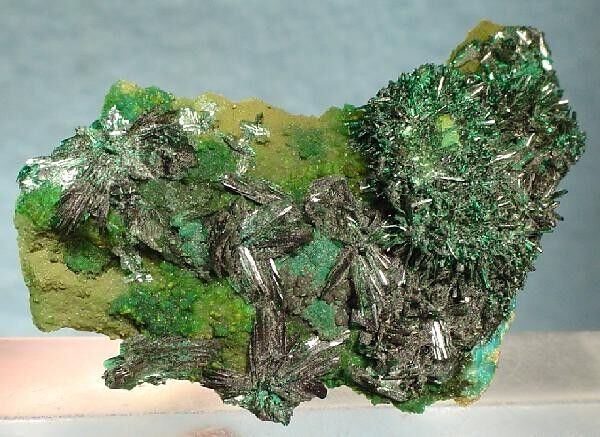 AtacamiteCu2Cl(OH)3Mineral—
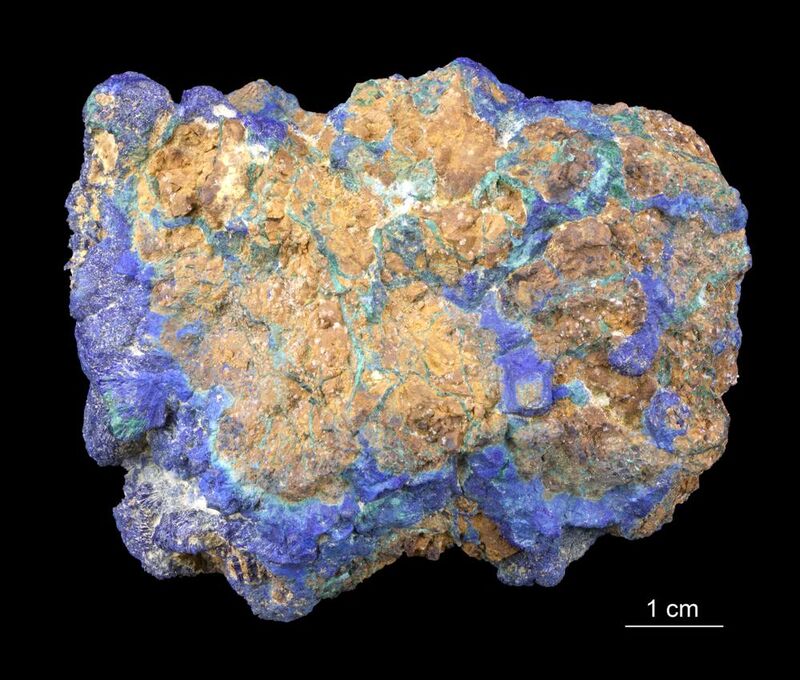 AzuriteCu3(CO3)2(OH)2Mineral—
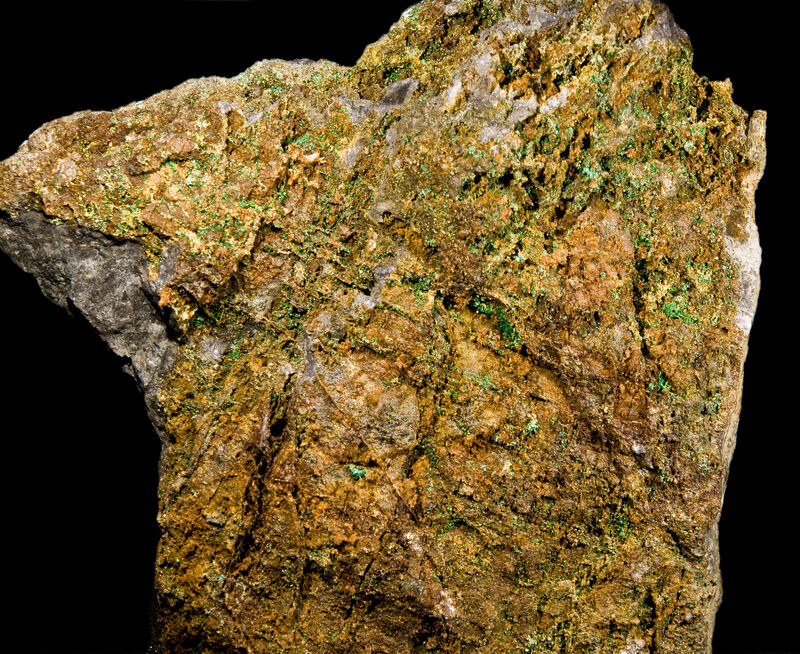 CornubiteCu5(AsO4)2(OH)4Mineral—
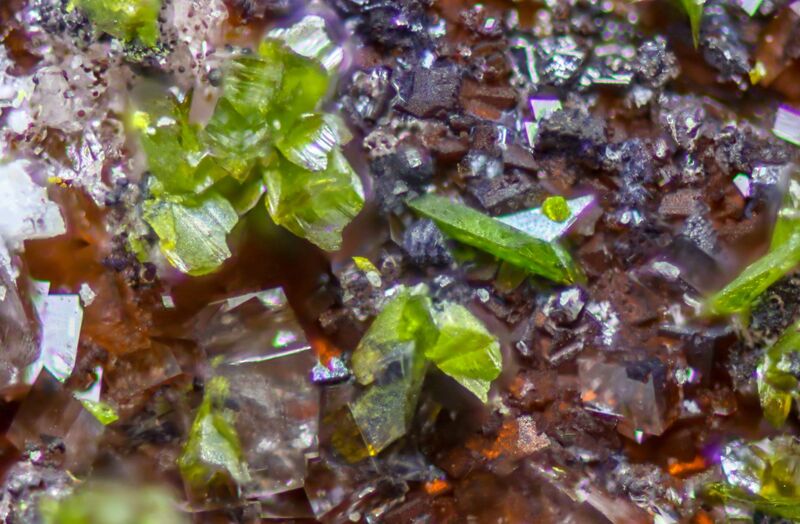 FornaciteCuPb2(CrO4)(AsO4)(OH)Mineral—
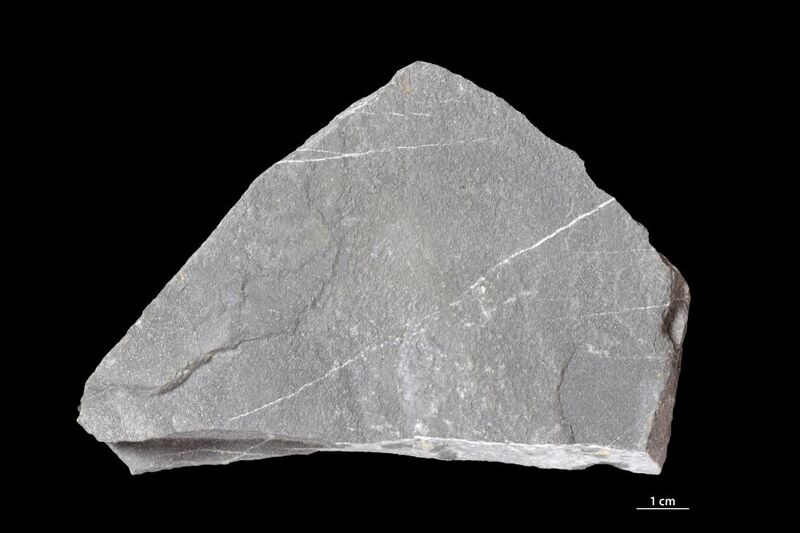 HalloysiteAl2Si2O5(OH)4Mineral—
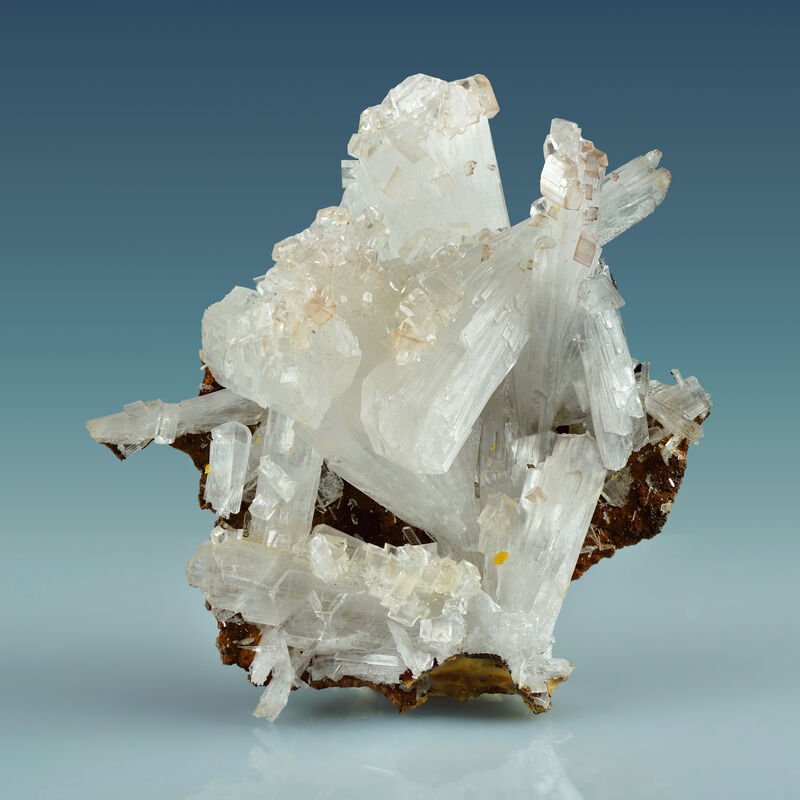 HemimorphiteZn4(Si2O7)(OH)2 · H2OMineral—
Literature, links & citation
- 1913Foote, H. W., Bradley, W. M. (1913) The Composition of Amorphous Minerals as illustrated by Chrysocolla. American Journal Of Science, S. 4 Vol. 36. 180-184
- 1956Caley, E.R., Richards, J.F.C. (1956) Theophrastus On Stones. Introduction, Greek text, English translation and commentary. Ohio State University, Columbus, Ohio.
- 1963Sun, Ming-Sban (1963) The nature of chrysocolla from Inspiration Mine, Arizona. American Mineralogist, 48 (5-6) 649-658
- 1968Chukhrov, F.V., Zvyagin, B.B., Gorshkov A.I., Ermilova, L.P., Rudnitskaya, E.S. (1968) Chrysocolla. Izv. Akad. Nauk SSSR, Ser. Geol.: 6: 29{44 (in Russian).
- 1969Fleischer, Michael (1969) New Mineral Names. American Mineralogist, 54 (5-6) 990-994
Entry last updated
@misc{mineral2026,
  author    = {Mineral Index editorial board},
  title     = {Chrysocolla — Mineral Index},
  year      = {2026},
  url       = {https://mineralindex.org/minerals/chrysocolla-1040}
}