Where it forms, where it's found
- Geological setting
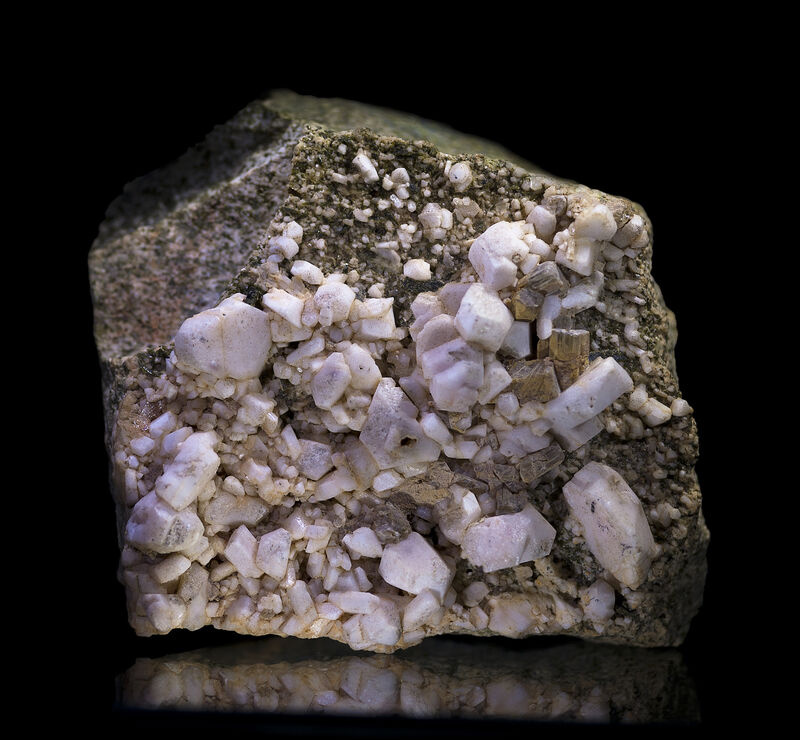
In miarolitic cavities in a permian sodic granite (ekerite).
- Type locality
- Gjerdingselva
- Lunner
- Akershus
- Norway
60.1840°, 10.6481°
1recorded occurrences
Physical
Optical
- Optical type
- Biaxial (+) · 2V measured = 58.5° · 2V calc = 63.7°
- Refractive index
- 1.6676 – 1.794
- Surface relief
- High
- Principal indices
- nα 1.6676 · nβ 1.7001 · nγ 1.794
- Pleochroism
- Non-pleochroic
- Extinction
- Y = b
- UV response
- none
Δ = 0Δmax
PPLpleochroism per grain
XPLindependent extinctions · rotate the stage
PPLpleochroism only · colour blends on rotation
XPLinterference colour · extinct every 90°
Retardation1264 nm
Order3rd order
XPL colour
Crystallography
- Space group
- C2/m
- Cell parameters
- a = 14.529(2) Å · b = 13.943(2) Å · c = 7.837(2) Å
- Cell angles
- β = 117.61 °
- Ratio a:b:c
- 1 : 0.960 : 0.539
- Unit cell volume
- 1406.8 ų
- Z
- 2
- Morphology
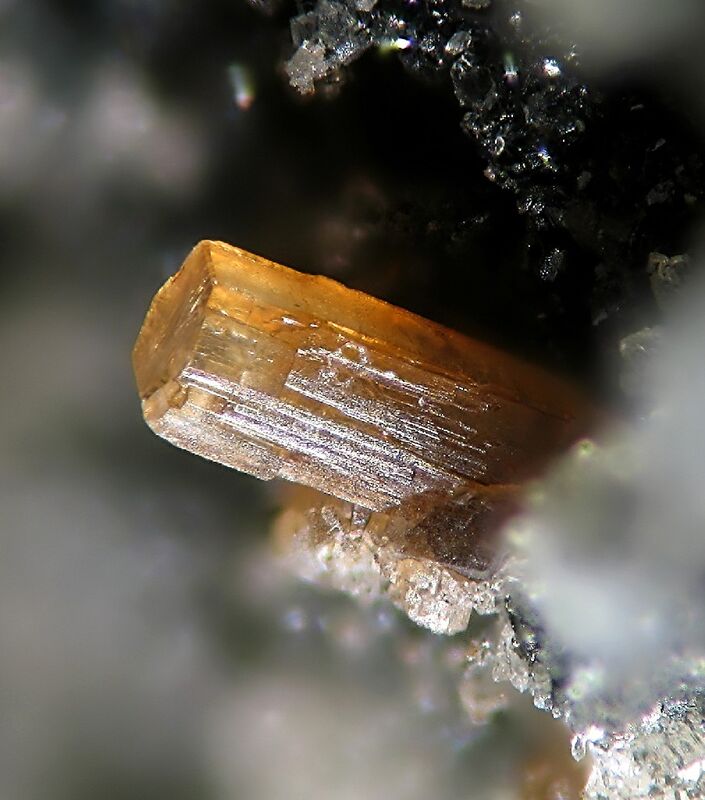
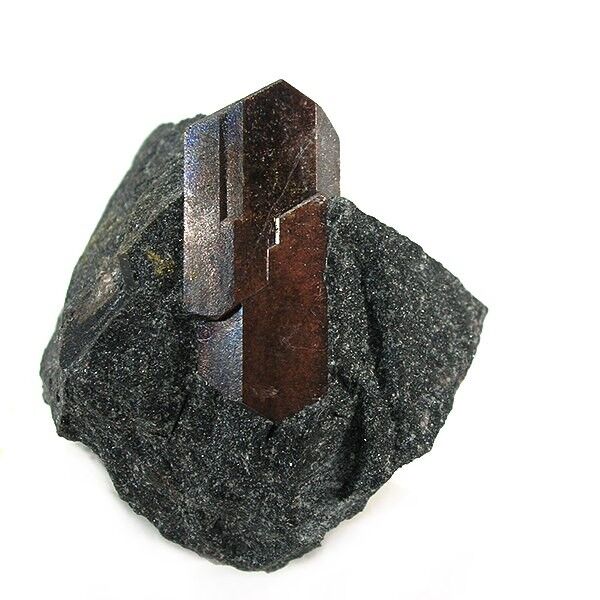
Pinacoids (100), (010), (001), (20), prism (021). The crystals are flattened on (001) and elongated along [010].
- Twinning
twinned according to the (001) plane
- Epitaxy
May form epitaxic overgrowth on <m>elpidite</m>; Coating of microcrystalline <m>hydrokenoralstonite</m> may occur.
- Type-locality form
Prismatic to lath-shaped crystals up to 1 mm in length.
Crystal structure
Chemical composition
Synonyms
- Gjerdingeniet-Fe
- IMA2001-009
In other languages
- German
- Gjerdingenit-Fe · IMA 2001-009
- Italian
- gjerdingenite-Fe
Classification
Strunz
10th ed.9.CE.30c
- 9SilicatesClass
- 9.CCyclosilicatesDivision
- 9.CE[Si4O12]8- 4-membered single rings (vierer-Einfachringe), without insular complex anionsGroup
- 9.CE.30cGjerdingenite-FeSpecies
Group, growth & confusion
- Burovaite-Ca(Na,K)4Ca2(Ti,Nb)8[Si4O12]4(OH,O)8 · 12H2OMineral—
- Gjerdingenite-CaK2Ca(Nb,Ti)4(Si4O12)2(O,OH)4 · 6H2OMineral—
- Gjerdingenite-MnK2Mn(Nb,Ti)4(Si4O12)2(O,OH)4 · 6H2OMineral—
- Gjerdingenite-NaK2Na(Nb,Ti)4(Si4O12)2(OH,O)4 · 5H2OMineral—
- Karupmøllerite-Ca(Na,Ca,K)2Ca(Nb,Ti)4(Si4O12)2(O,OH)4 · 7H2OMineral—
 Kuzmenkoite-MnK2MnTi4(Si4O12)2(OH)4 · 5-6H2OMineral—
- Kuzmenkoite-ZnK2ZnTi4(Si4O12)2(OH)4 · 6-8H2OMineral—
- Lepkhenelmite-ZnBa2Zn(Ti,Nb)4(Si4O12)2(O,OH)4 · 7H2OMineral—
Literature, links & citation
Citations
- 2002Raade, G.; Ferraris, G.; Gula, A.; Ivaldi, G. (2002) Gjerdingenite-Fe from Norway, a new mineral species in the labuntsovite group: description, crystal structure and twinning. The Canadian Mineralogist, 40 (6). 1629-1639 doi:10.2113/gscanmin.40.6.1629 DOI: 10.2113/gscanmin.40.6.1629
- 2021(2021) Gjerdingenite-Fe. Handbook of Mineralogy. Mineralogical Society of America
Cite this entry
Entry last updated
@misc{mineral2025,
  author    = {Mineral Index editorial board},
  title     = {Gjerdingenite-Fe — Mineral Index},
  year      = {2025},
  url       = {https://mineralindex.org/minerals/gjerdingenite-fe-11458}
}