History
Hübnerite carries a man's name, though it has worn two of them. Before it was hübnerite, it was megabasite — the name the German mineralogist A. Breithaupt gave it in 1852.
The name we use today arrived in 1865. Eugene N. Riotte, a German émigré from Elberfeld, described the mineral from veins in Nevada. He named it for Adolph Hübner, a German mining engineer and metallurgist from Freiberg, in Saxony. Riotte first announced the name in an English-language newspaper, which had no umlaut to give. That is why the spelling hubnerite still survives alongside hübnerite today.
The first specimens came from the Erie and Enterprise veins of the Mammoth district, in Nye County, Nevada. From the start, the mineral sat inside a family. Hübnerite is the manganese end of a pair. The same crystal structure can also host iron, and where iron wins out the mineral becomes ferberite instead. The two ends, with every blend between them, make up the wolframite series — long one of the workhorses of tungsten mining.
Industrial & practical applications
Hübnerite is mined for one reason: the tungsten locked inside it. It is counted among the principal ores of tungsten, the dense, hard metal that makes the mineral worth digging for. It is not the only such ore, nor the leading one. Tungsten comes mainly from two minerals — scheelite, a calcium tungstate, and wolframite, the iron–manganese series of which hübnerite is the manganese end. Hübnerite is a real but local contributor, worked where its veins are rich enough to pay.
What the smelter wants is the tungsten itself, and roughly half of all tungsten goes into one material: tungsten carbide. This is the wear-resistant cemented carbide, also called hardmetal — a tungsten-carbon compound bonded with metal that survives where ordinary steel wears away. It arms the cutting tools, drill bits and dies of the metalworking, mining and construction trades.
The rest is spread across metals and electronics. Tungsten hardens high-speed and specialty steels, and goes into superalloys for turbine blades and heavy alloys for armaments and counterweights. Drawn into fine wire, it becomes the electrodes, contacts and filaments of lighting, welding and electronic equipment.
One country dominates the whole chain. China leads the world not only in mining tungsten but in exporting and consuming its products.
Where it forms, where it's found
- Geological setting
High-temperature hydrothermal veins and pneumatolytically altered greisens; granite pegmatites and sedimentary alluvial deposits.
- Type locality
- Erie and Enterprize veins
- Ellsworth Mine
- Ellsworth
- Ellsworth Mining District (Mammoth Mining District)
- Nye County
- Nevada
- USA
Physical
- Hardness
- 1Talc
- 2Gypsum
- 3Calcite
- 4Fluorite
- 5Apatite
- 6Orthoclase
- 7Quartz
- 8Topaz
- 9Corundum
- 10Diamond
- Lustre
- Resinous to admantine-submetallic.
- Transparency
- Transparent · Translucent
- Colour
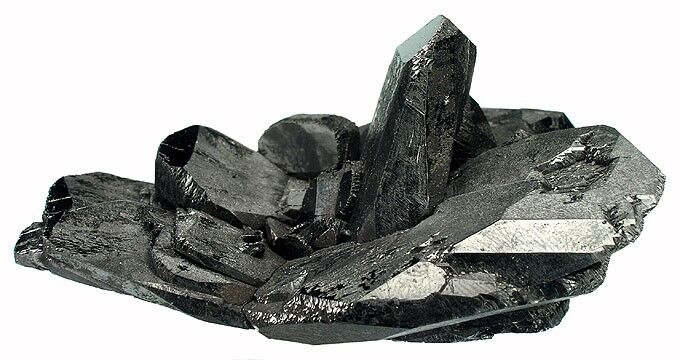
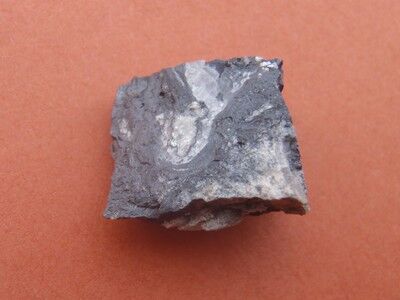
- Yellow-brown · reddish-brown · blackish brown · black · red (rare)
- Streak
- Greenish-grey, yellow to reddish-brown
- Tenacity
- brittle
- Cleavage
- Perfect
Perfect on (010)
- Fracture
- Irregular/Uneven
- Density
- 7.12 g/cm³
Optical
- Optical type
- Biaxial (+) · 2V measured = 73° · 2V calc = 73°
- Refractive index
- 2.17 – 2.32
- Surface relief
- Very high
- Principal indices
- nα 2.17 – 2.2 · nβ 2.22 · nγ 2.3 – 2.32
- Pleochroism
- Visible
X = Yellow to green, orange-red Y = Yellowish brown to greenish yellow, red-orange to red Z = Green, brick red to red
- Dispersion
- relatively strong
- Extinction
- Orientation: X = b; Z ∧ c = 17°–21°.
- Optical colour
- White to gray
- Anisotropism
- Distinct
- Internal reflections
- Deep blood red
- Tropism
- Anisotropic
- Reflectance R%
- (17.1,19.8) 400, (16.3,19.3) 420, (15.5,18.8) 440, (15.1,18.3) 460, (14.6,17.5) 480, (14.4,17.2) 500, (14.2,17.0) 520, (13.9,16.7) 540, (13.8,16.5) 560, (13.7,16.3) 580, (13.6,16.2) 600, (13.5,16.1) 620, (13.5,16.0) 640, (13.4,15.9) 660, (13.4,15.8) 680, (13.3,15.7) 700
- Luminescence
- Nonfluorescent
- Notes
Absorption: Z > Y > X.
Crystallography
- Space group
- #12
- Cell parameters
- a = 4.8238(7) Å · b = 5.7504(10) Å · c = 4.9901(8) Å
- Cell angles
- β = 91.18(1) °
- Ratio a:b:c
- 1 : 1.192 : 1.034
- Z
- 2
- Morphology
Crystals commonly prismatic and striated [001]; also tabular, to bladed, flatened (100) and exhibit numerous forms, including (010), (110), (100), (310), (112), (001), (102) and (011). Radiating groups or in parallel configuration.
- Twinning
Common as simple contact twins on (100), rarely on (001); as interpenetrant twins, lamellar.
- Parting
- On (100) and (102)
Chemical composition
Synonyms
- Blumit (of Liebe)
- Huebnerit
- Huebnerite
- Manganese tungstate
- Manganowolframit
- Manganowolframita
- Manganowolframite
- Megabasit
In other languages
- French
- Hübnérite · Huebnerite · Manganowolframite
- German
- Hübnerit
- Spanish
- Hübnerita · Huebnerita
- Italian
- hübnerite
- Japanese
- マンガン重石
- Chinese
- 鎢錳礦 · 钨锰矿
Classification
4.DB.30
- 4OxidesClass
- 4.DMetal: Oxygen = 1:2 and similarDivision
- 4.DBWith medium-sized cations; chains of edge-sharing octahedraGroup
- 4.DB.30HübneriteSpecies
48.01.01.01
- 48Anhydrous Molybdates and TungstatesClass
- 48.01AXO4Type
- 48.01.01Wolframite seriesGroup
- 48.01.01.01HübneriteSpecies
27.4.13
- 27Sulphites, Chromates, Molybdates and TungstatesClass
- 27.4TungstatesGroup
- 27.4.13HübneriteSpecies
Group, growth & confusion
Literature, links & citation
- —NOTE: See also: Wolframite references.
- 1852Breithaupt (1852) Berg.- und hüttenmännisches Zeitung, Freiberg, Leipzig (merged into Glückauf): 11: 189 (as Megabasit).
- 1863Liebe (1863) Neues Jahrbuch für Mineralogie, Geologie und Paleontologie, Heidelberg, Stuttgart: 652 (as Blumit).
- 1865Credner (1865) Berg.- und hüttenmännisches Zeitung, Freiberg, Leipzig (merged into Glückauf): 24: 370.
- 1865Riotte (1865) Reese River Reveille, Austin, Nevada.
Entry last updated
@misc{mineral2026,
  author    = {Mineral Index editorial board},
  title     = {Hübnerite — Mineral Index},
  year      = {2026},
  url       = {https://mineralindex.org/minerals/hubnerite-1940}
}