History
The name wolframite is older than the mineral that now carries it. It descends from the German wolf rahm, itself traceable to the Latin Lupi spuma — "wolf's froth". The Saxon scholar Georg Agricola used the label in 1546 for tungsten-bearing ore. Smelters had noticed that this ore consumed unusual amounts of tin when it sat with cassiterite in a furnace. Something inside the rock seemed to eat the metal — likened, in the language of the time, to a wolf devouring a sheep.
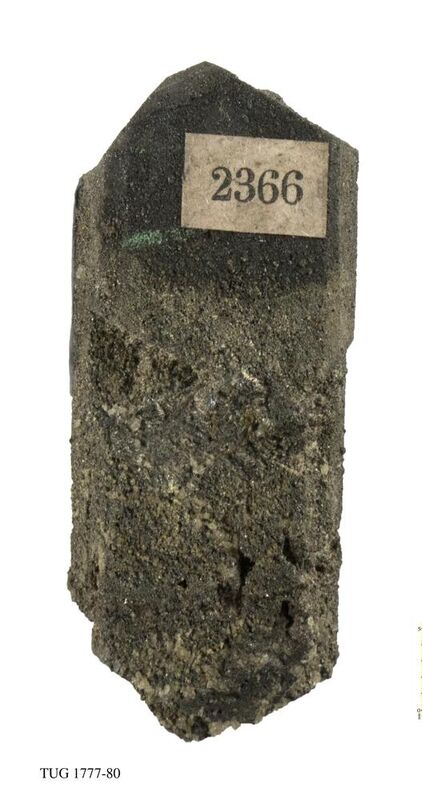
For three centuries "wolframite" remained a single, loose category. Then in 1863, miners working the Sierra Almagrera on the south-east coast of Spain turned up a heavy, near-black mineral. It did not match anything in the standard catalogues. The new species was named ferberite, in honour of Moritz Rudolph Ferber, a German amateur mineralogist from Gera who lived from 1805 to 1875. The type specimens came from Aquiles, in the Sierra Almagrera.
Ferberite did not stand alone for long. Mineralogists soon recognised that it sat at one end of a continuous series — a solid solution. Two minerals form a solid solution when they share a crystal structure and grade smoothly into one another by swapping atoms at a single site. At the iron-rich end of this series sits ferberite, FeWO₄. At the manganese-rich end sits hübnerite, MnWO₄. The intermediate compositions, where iron and manganese share the site in comparable amounts, kept the older name wolframite. The name now serves both as the series label and as the older industry term for any ore of the group.
Industrial & practical applications
Ferberite is an ore of tungsten. Alongside its sister mineral hübnerite and the wider wolframite series, it feeds the world's tungsten supply chain. The only rival source is scheelite, a calcium tungstate from which most of the rest of mined tungsten comes. The industrial life of ferberite is, almost entirely, the industrial life of the metal it carries.
About half of all mined tungsten ends up in tungsten carbide, the dominant industrial form of the element. The carbide is cemented into composites — also called hardmetals — in which extremely hard carbide grains are bonded by a metallic binder. These hardmetals are the wear-resistant cutting tools the metalworking, mining and construction industries reach for when steel is not hard enough.
The rest of mined tungsten goes into a second tier of demanding metal applications. Drawn into thin wire, it forms the electrodes used in welding and the filaments still found in some specialty lamps. Alloyed into high-speed steel at up to 18 percent tungsten content, it produces cutting steels that keep their edge even when red-hot from friction. Alloyed into superalloys — high-strength mixtures designed for extreme conditions — it strengthens the turbine blades of jet engines. Tungsten's exceptional density also feeds heavier roles: armour-piercing ammunition, heat sinks, and high-density counterweights.
Supply is the awkward part of the story. The wolframite series and scheelite together supply the world's tungsten, and the supply is highly concentrated. China holds about 1.8 million tonnes of the 3.2-million-tonne global reserve. In 2017 it produced 79,000 tonnes against Vietnam's 7,200 and Russia's 3,100, leading the world in production, export and consumption of tungsten products. Ferberite-bearing deposits outside China are mined commercially in Spain, Portugal and Bolivia, among other countries.
Where it forms, where it's found
- Geological setting
High temperature hydrothermal veins, greisens, granitic pegmatites.
- Type locality
- Niña Mine
- Sierra Almagrera
- Cuevas del Almanzora
- Almería
- Andalusia
- Spain
37.2917°, -1.7531°
Varieties
Physical
Optical
- Optical type
- Biaxial (+) · 2V measured = 66° · 2V calc = 72°
- Refractive index
- 2.255 – 2.414
- Surface relief
- Very high
- Principal indices
- nα 2.255 · nβ 2.305 · nγ 2.414
- Birefringence
- Weak
- Dispersion
- r > v extreme
- Optical colour
- Gray to white
- Anisotropism
- Distinct
- Bireflectance
- Weak
- Internal reflections
- Deep brownish red (less bright than Hübnerite)
- Tropism
- Anisotropic
- Reflectance R%
- (16.5,19.5) 400, (16.4,19.2) 420, (16.3,18.9) 440, (16.2,18.7) 460, (15.9,18.5) 480, (16.0,18.7) 500, (16.0,18.7) 520, (16.0,18.7) 540, (16.0,18.7) 560, (15.8,18.6) 580, (15.8,18.6) 600, (15.7,18.6) 620, (15.6,18.5) 640, (15.5,18.3) 660, (15.4,18.1) 680, (15.5,18.0) 700
- UV response
- Not fluorescent.
Crystallography
- Space group
- #12
- Cell parameters
- a = 4.72 Å · b = 5.70 Å · c = 4.96 Å
- Cell angles
- β = 90 °
- Ratio a:b:c
- 1 : 1.208 : 1.051
- Z
- 2
- Morphology
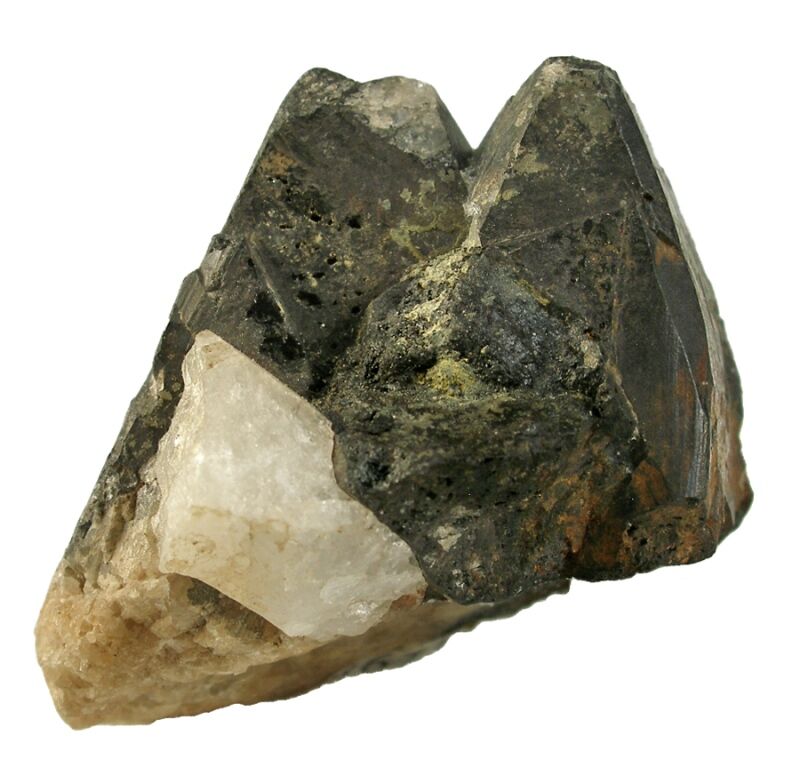
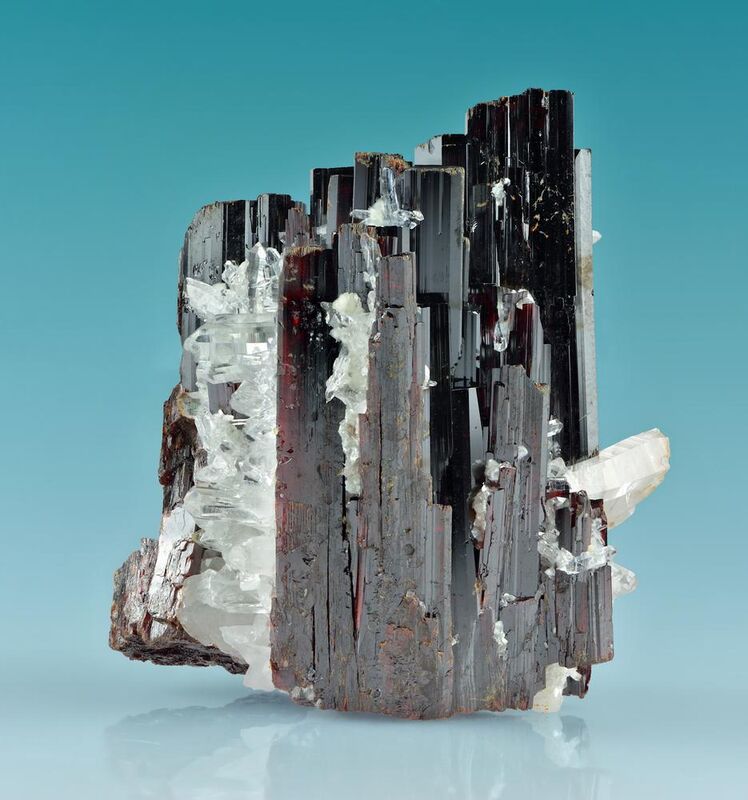
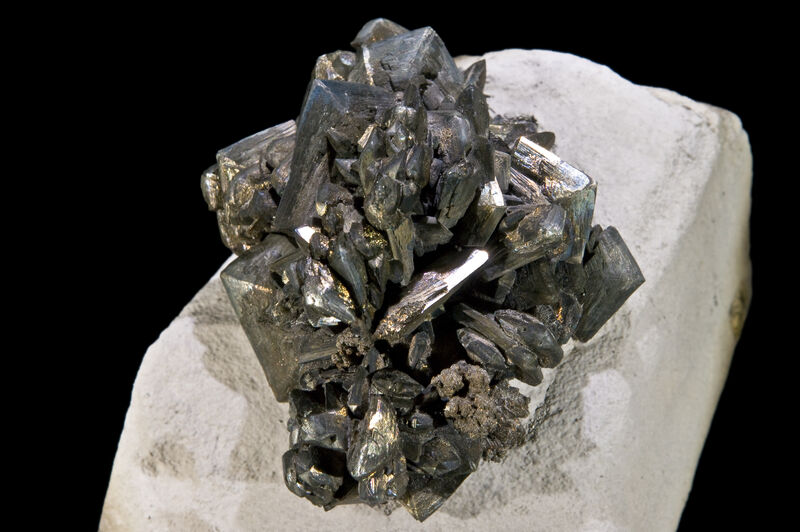
Crystals wedge-shaped, commonly flattened (100) and elongated [010] or, less commonly, along [001]. Crystal faces striated parallel (001) or (010); as groups of bladed crystals; less often short prismatic [001] and flattened (100). Massive.
- Twinning
Common with twin plane (100), rarely (001); simple contact twins with composition face (100) or, rarely (001); interpenetrant (simulating Carlsbad twins in orthoclase) or lamellar (very rare). Twin plane (023), common, usually as simple contact twins, rarely as repeated twins or interpenetrating.
- Parting
- On (100) and (102)
- Epitaxy
Discrete crystals of fluorite on ferberite from <l id=4549>Yaogangxian mine, China</l> (White and Richards, 2010).
Chemical composition
- Impurities
- Nb
- Ta
- Sc
- Sn
Synonyms
- Eisenwolframite
- Ferrotungstate
- Ferrowolframit
- Iron Tungstate
In other languages
- French
- Ferbérite · Reinite
- German
- Ferberit
- Spanish
- Ferberita
- Italian
- ferberite
- Japanese
- 鉄マンガン重石 · 鉄重石
- Chinese
- 鎢鐵礦 · 钨铁矿
- Arabic
- فيربريت
Classification
4.DB.30
- 4OxidesClass
- 4.DMetal: Oxygen = 1:2 and similarDivision
- 4.DBWith medium-sized cations; chains of edge-sharing octahedraGroup
- 4.DB.30FerberiteSpecies
48.01.01.02
- 48Anhydrous Molybdates and TungstatesClass
- 48.01AXO4Type
- 48.01.01Wolframite seriesGroup
- 48.01.01.02FerberiteSpecies
27.4.14
- 27Sulphites, Chromates, Molybdates and TungstatesClass
- 27.4TungstatesGroup
- 27.4.14FerberiteSpecies
Group, growth & confusion
Literature, links & citation
- —NOTE: See also: Wolframite references.
- 1847Kerndt (1847) Journal für praktische Chemie, Leipzig: 42: 81.
- 1863Liebe (1863) Jb. Min.: 641 (as Ferberit).
- 1875Weisbach, Albin (1875) Synopsis mineralogical, systematische Übersicht des Mineralreiches. 78 pp., Freiberg: 43 (as Ferrowolframit).
- 1878Fritsch (1878) Zeitschrift für Naturwissenschaften, Halle: 3: 864 (as Reinit [Reinite]).
Entry last updated
@misc{mineral2026,
  author    = {Mineral Index editorial board},
  title     = {Ferberite — Mineral Index},
  year      = {2026},
  url       = {https://mineralindex.org/minerals/ferberite-1476}
}