History
The name cassiterite is younger than the substance it labels by several millennia. The mineral itself — tin dioxide, the principal ore from which tin is smelted — was being worked in Bronze Age furnaces long before anyone called it by its modern name.
Tin extraction can be dated to the beginnings of the Bronze Age, around 3000 BCE. The metal mattered because of bronze — an alloy of roughly one-eighth tin and seven-eighths copper. Bronze is harder than copper alone, and gave its name to an era. Tin is rare in the Earth's crust, so the cassiterite-bearing regions that did exist became valuable trade hubs. A trade network linked those distant sources to the markets that needed them. The Cornwall and Devon workings in southwest England, threading through high-temperature quartz veins and pegmatites, reach back about four and a half thousand years.
Ancient writers called the supply regions the Cassiterides — literally "tin islands", applied in pre-Roman times to islands off the western coast of Europe. The exact location has been hotly debated over the years. Current thinking is that the source was probably mainland Spain. Even two thousand years ago, traders had a habit of giving misleading locality information to protect their sources. The Greek root kassiteros — tin — gave the islands their name. It would later give the mineral its own.
Medieval and early-modern mining
Mining moved from rumour to industry in central Europe. Early in the 15th century, the cassiterite veins in Saxony and Bohemia were mined for tin. Those workings sit in the Erzgebirge mountains, straddling today's Germany and Czechia. Peak production there came in the 17th century. In the 18th and much of the 19th centuries, the very large vein deposits of Cornwall became the world's major source of tin.
Modern naming and present geography
The mineral acquired its current scientific name in the 19th century, when the -ite suffix was being applied across mineralogy to regularise older trade names like tin stone and stannum. The root is the same Greek kassiteros that named the Cassiterides. Today most of the world's cassiterite is mined in Malaysia, Indonesia, Bolivia, Nigeria, Myanmar, Thailand, and parts of China.
Industrial & practical applications
Cassiterite is not a metal but the rock that yields one. It is the only mineral of commercial importance as a source of tin, smelted into the metal that quietly underpins canned food, modern electronics, and the world's window glass. Small quantities of tin are recovered from complex sulfides like stannite and franckeite, but cassiterite is where the supply actually comes from.
In industry
The single largest use of tin is solder — the low-melting alloy that joins electrical and electronic circuits, and that seals plumbing joints. In 2018, just under half of all tin produced went into solder. Solder formulations changed sharply after the European Union's 2006 directive restricting hazardous substances, which pushed the lead content of consumer electronics down toward zero. The replacement is a tin-rich, lead-free alloy.
Tin's other classic use is tinplate — thin steel sheets coated with a microscopic layer of tin to keep them from rusting. The coating is what made the modern food can possible. The same protective-coating logic carries tin into bearing alloys and a range of tin chemical applications.
A third industrial route uses tin in liquid form. In the Pilkington process, molten glass is floated on a bath of molten tin, producing a perfectly flat sheet with no grinding or polishing. Most window glass on Earth is made this way.
In specialised alloys and chemistry
Pewter is an alloy of 85 to 99 percent tin, used in tableware and decorative metalwork. At the high-technology end, the niobium–tin compound Nb₃Sn is used in coils of superconducting magnets for its high critical temperature of 18 kelvin. Worldwide industrial production of organotin compounds — chemical compounds in which tin atoms are bonded to carbon — likely exceeds 50,000 tonnes a year.
About 35 countries mine tin, with at least half of global supply coming from Southeast Asia. In 2011, mine production was led by China at 110,000 tonnes, then Indonesia at 51,000 tonnes, Peru at 34,600 tonnes, Bolivia at 20,700 tonnes, and Brazil at 12,000 tonnes. The single largest mining operation is Yunnan Tin in China, which produced 74,500 tonnes in 2017.
Where it forms, where it's found
- Geological setting
In medium- to high-temperature hydrothermal veins and greisens, alluvial placers.
Varieties
Physical
- Hardness
- 1Talc
- 2Gypsum
- 3Calcite
- 4Fluorite
- 5Apatite
- 6Orthoclase
- 7Quartz
- 8Topaz
- 9Corundum
- 10Diamond
- Lustre
- Adamantine · Metallic
- Transparency
- Transparent · Translucent · Opaque
- Colour
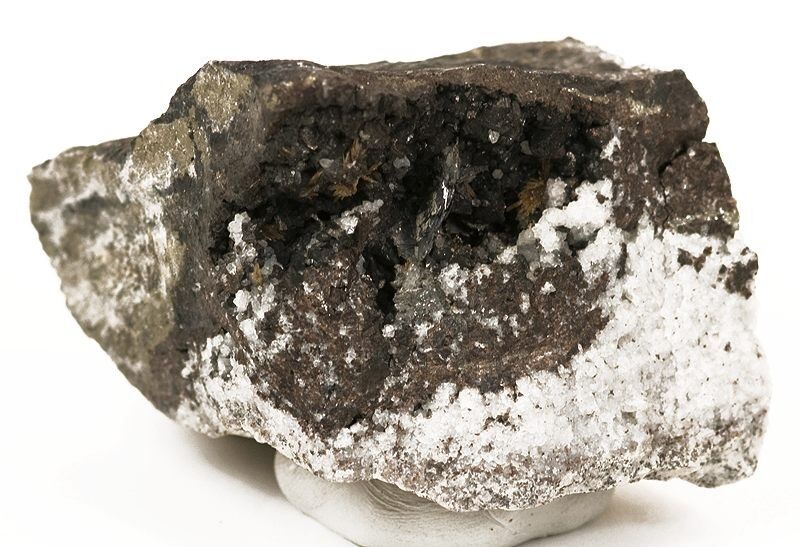
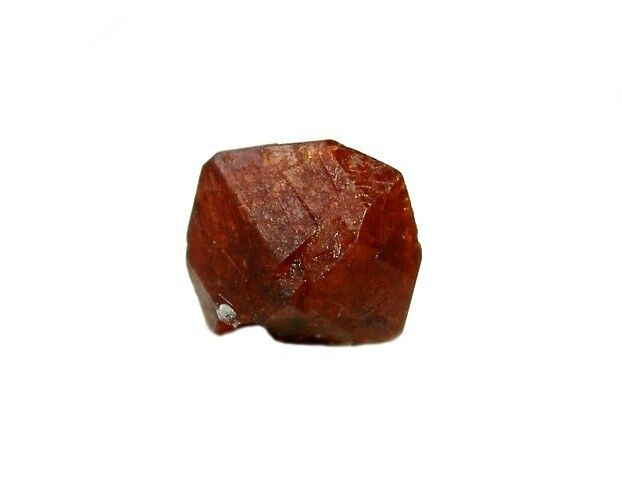
- Black · yellow · brown · red · white · colourless.
- Streak
- Brownish white, white, greyish
- Tenacity
- brittle
- Cleavage
- Imperfect/Fair
(100) imperfect, (110) indistinct.
- Fracture
- Irregular/Uneven · Sub-Conchoidal
- Density
- 6.98 g/cm³
Optical
- Optical type
- Uniaxial (+) · 2V measured = 38°
- Refractive index
- 1.99 – 2.1
- Surface relief
- Very high
- Principal indices
- nω 1.99 – 2.01 · nε 2.093 – 2.1
- Pleochroism
- Weak
Pleochroic haloes have been observed. Dichroic in yellow, green, red, brown, usually weak, or absent, but strong at times.
- Optical colour
- Light gray
- Anisotropism
- Strong
- Internal reflections
- white to brownish
- Tropism
- Anisotropic
- Reflectance R%
- (11.7,13.2) 400, (11.6,13.0) 420, (11.5,12.8) 440, (11.4,12.6) 460, (11.3,12.5) 480, (11.2,12.4) 500, (11.0,12.2) 520, (11.0,12.1) 540, (10.9,12.0) 560, (10.9,12.0) 580, (10.8,12.0) 600, (10.8,12.0) 620, (10.7,12.0) 640, (10.7,12.0) 660, (10.6,12.0) 680, (10.6,12.0) 700
- UV response
- Cassiterite will rarely show fluorescence, and only under SW UV, showing a yellow glow. See the caption and the child photos of: https://www.mindat.org/photo-693927.html https://www.mindat.org/photo-583447.html https://www.mindat.org/photo-915970.html See also: https://www.fluomin.org/uk/fiche.php?id=277
- Notes
Anomalously biaxial.
Crystallography
- Space group
- #190
- Cell parameters
- a = 4.7382(4) Å · c = 3.1871(1) Å
- Z
- 2
- Morphology
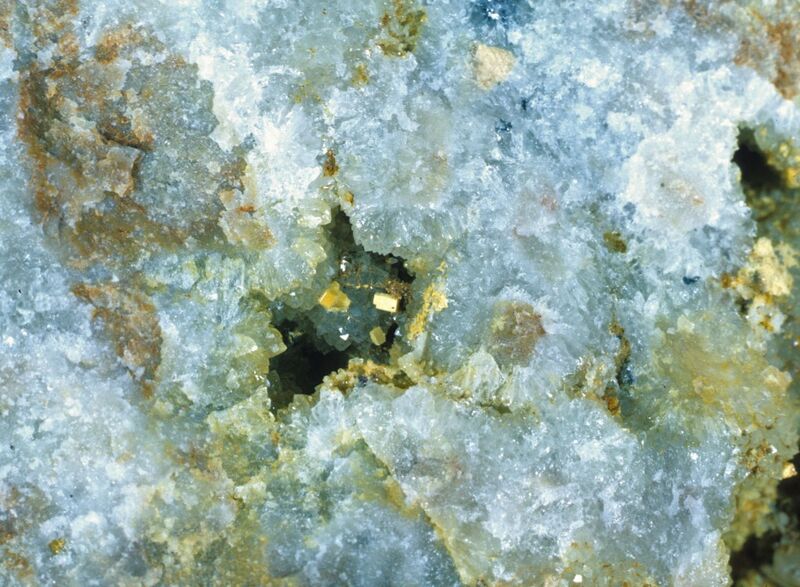
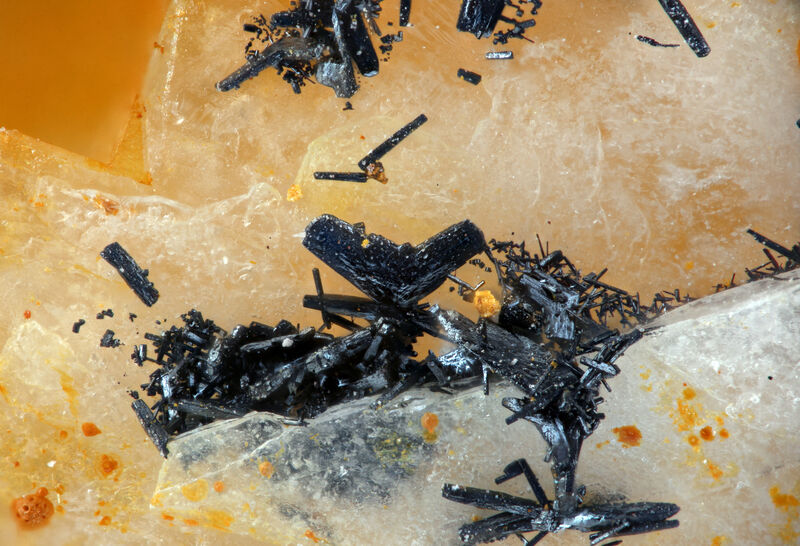
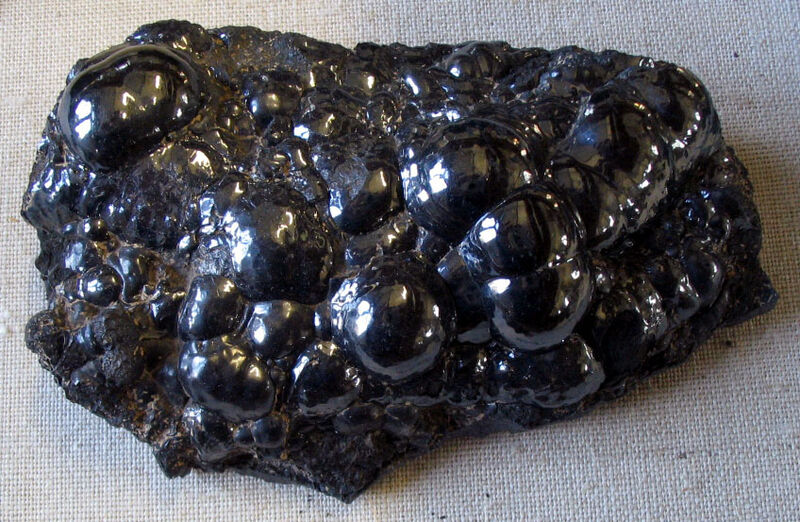
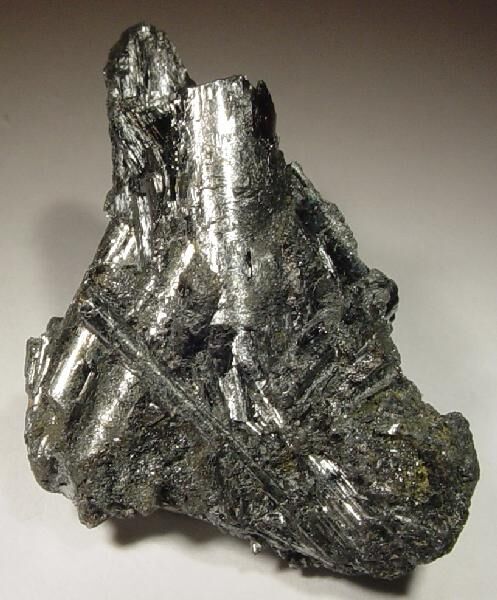
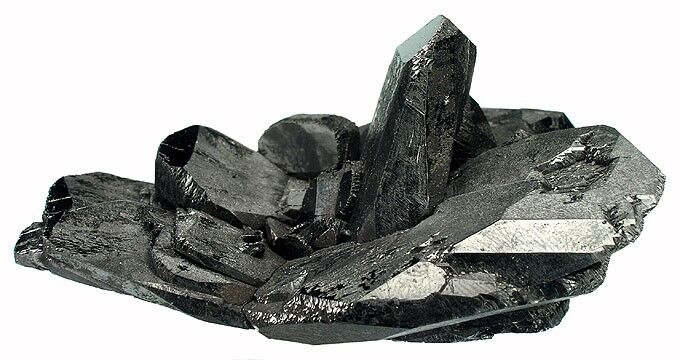
Untwinned crystals usually short prismatic [001] with (110) and (100) prominent. Long prismatic at times, or with acute terminations. Less commonly pyramidal. Faces (001) and (110) frequently uneven; faces in zone [10_1] and in zone [001] often striated parallel to their intersections. Fibrous, botryoidal crusts or concretionary masses. Granular, coarse to fine.
- Twinning
1. On (011), very common. Both contact and penetration twins; often repeated producing complex forms. Stellate fivelings at times. 2. Reported on (031).
- Parting
- More or less distinct on (111) or (011).
- Epitaxy
Oriented overgrowths of cassiterite on nordenskiöldine; oriented growths of quartz on cassiterite.
Chemical composition
- Impurities
- Fe
- Ta
- Nb
- Zn
- W
- Mn
- Sc
- Ge
- In
- Ga
Synonyms
- Etain oxydé
- Nadelzinnerz
- Needle-tin ore
- Ruby Tin
- Sparable tin
- Sperlingsschnabel
- Stagno ossidato
- Stannum calciforme
- Tennmalm
- Tin Spar
- Tinstone
- Visiererz
- Visiergraupen
- Zinngranate
- Zinngraupen
- Zinnschlich
- Zinnspat
- Zinnstein
- Zinnsten
- Zwitter
In other languages
- French
- ainalite · cassitérite · dneiproskite · étain oxydé · oxyde d'étain · stannum calciforme · zinnspat
- German
- Cassiterit · Kassiterit · Zinnstein
- Spanish
- casiterita
- Italian
- cassiterite
- Portuguese
- Cassiterita · cassiterite
- Japanese
- 砂すず · 砂錫 · 錫石
- Chinese
- 锡石
- Simplified Chinese
- 锡石
- Traditional Chinese
- 錫石
- Russian
- касситерит · оловянный камень
- Arabic
- الكستريت · كاسيتريت
Classification
4.DB.05
- 4OxidesClass
- 4.DMetal: Oxygen = 1:2 and similarDivision
- 4.DBWith medium-sized cations; chains of edge-sharing octahedraGroup
- 4.DB.05CassiteriteSpecies
04.04.01.05
- 04Simple OxidesClass
- 04.04AX2Type
- 04.04.01Rutile group (Tetragonal: P4/mnm)Group
- 04.04.01.05CassiteriteSpecies
7.11.2
- 7Oxides and HydroxidesClass
- 7.11Oxides of Sn and PbGroup
- 7.11.2CassiteriteSpecies
Group, growth & confusion
Literature, links & citation
- 1797Klaproth, M. H. (1797) Untersuchung der Zinnsteine. In Beiträge zur chemischen Kenntniss der Mineralkörper Vol. 2. Rottmann, Berlin. p.245-256.
- 1888Bourgeois, Léon (1888) Sur la présence de la cassitérite dans les scories de la fonte du bronze et sur une nouvelle méthode de reproduction de cette espèce minérale. Bulletin de Minéralogie, 11 (2) 58-61 doi:10.3406/bulmi.1888.3160DOI: 10.3406/bulmi.1888.3160
- 1944Palache, Charles, Berman, Harry, Frondel, Clifford (1944) The System of Mineralogy (7th ed.) Vol. 1 - Elements, Sulfides, Sulfosalts, Oxides. John Wiley and Sons, New York.
- 1969Ramdohr, Paul (1969) The Ore Minerals and their Intergrowths. Pergamon Press, Oxford. 1174pp. doi:10.1016/c2013-0-10027-xDOI: 10.1016/c2013-0-10027-x
- 1971Hall, M.R., Ribbe, P.H. (1971) An electron microprobe study of luminescence centers in cassiterite. The American Mineralogist, 56 (1-2). 31-45
Entry last updated
@misc{mineral2026,
  author    = {Mineral Index editorial board},
  title     = {Cassiterite — Mineral Index},
  year      = {2026},
  url       = {https://mineralindex.org/minerals/cassiterite-917}
}