History
A mineral that crumbles in your hand was always going to confuse the people who first named it. Laumontite belongs to the zeolites — a family of minerals whose crystals hold water loosely inside their structure. Lose that water and the crystal falls apart. The story of its name is partly the story of that instability.
The first specimens came from lead mines at Huelgoat in Brittany, France, which became the mineral's type locality — the place its scientific identity is anchored to. They were collected by François Pierre Nicolas Gillet de Laumont, an Inspector General of Mines and a keen mineral collector. He also turned up the first specimens of another mineral, plumbogummite. The mineral honours him.
His name reached print in stages, and the spelling wandered. The form Laumonit appears in 1805. René Just Haüy, a founder of crystallography, wrote it as laumonite in 1809. The version we use today, Laumontit, was settled in 1821 by Karl Cäsar von Leonhard. A partially dried-out form of the mineral was later called leonhardite after him, though that name was never accepted as a true species.
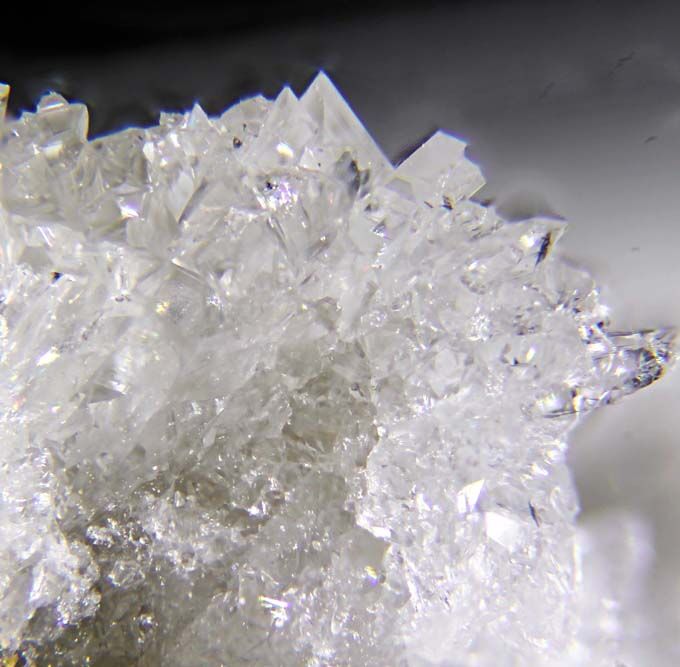
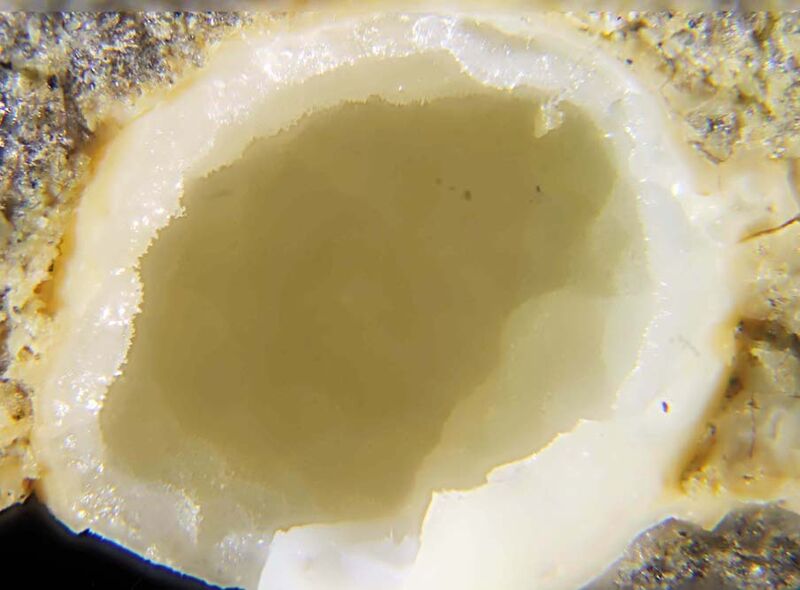
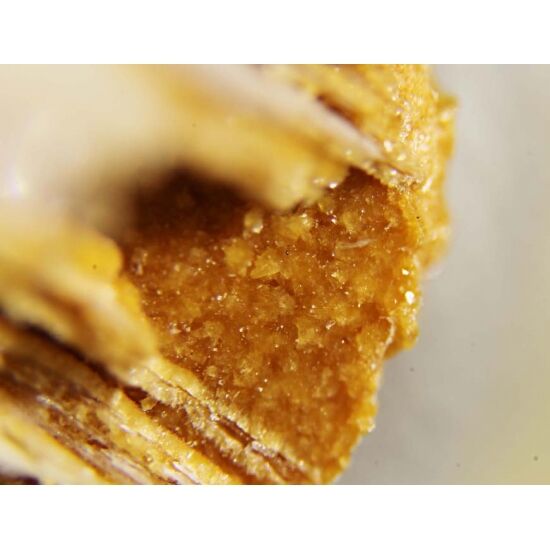
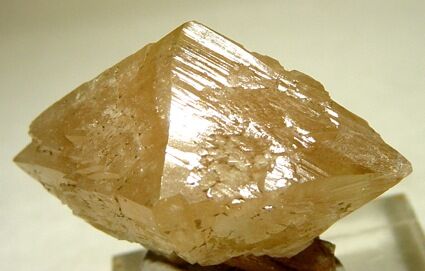
That drying-out is the mineral's signature trouble. Fresh from the ground, laumontite can be clear or translucent. Left in dry air, it slowly loses its water over hours or days and turns chalky white. It grows so brittle it can fall to powder at the slightest touch. Many early specimens reached collectors already crumbling — which is part of why pinning down a single name and form took so long.
Industrial & practical applications
Laumontite has no industrial use of its own. The trait that defines it rules one out: it gives up its water in dry air, turns chalky, and crumbles to powder at a touch. A mineral that destroys itself on a shelf cannot be packed, shipped, or built into a product. Other zeolites — minerals that trap water and small molecules in their crystal frameworks — earn their keep as filters and catalysts. Laumontite is far too unstable to join them.
Its value to people today is as evidence rather than material. Geologists read it as a temperature gauge for rock. It forms around 100 °C and breaks down above roughly 150 °C. So finding it in a sedimentary rock shows the rock has been heated and compacted to that middle range — a stage called intermediate diagenesis. The mineral also draws collectors, who prize fresh translucent crystals and keep them sealed or damp to hold off the crumbling that otherwise follows.
Where it forms, where it's found
- Geological setting
Hydrothermal origin, decomposition of analcime, sandstone cement.
- Type locality
- Huelgoat
- Châteaulin
- Finistère
- Brittany
- France
Physical
Optical
- Optical type
- Biaxial (-) · 2V measured = 26 – 47° · 2V calc = 34 – 44°
- Refractive index
- 1.502 – 1.525
- Surface relief
- Moderate
- Principal indices
- nα 1.502 – 1.514 · nβ 1.512 – 1.522 · nγ 1.514 – 1.525
- Dispersion
- r < v distinct
- Extinction
- Y = b; X ∧ a = 10°-26°; Z ∧ c = 8°-33°.
Crystallography
- Space group
- C2/m
- Cell parameters
- a = 14.724(9) Å · b = 13.075(6) Å · c = 7.559(2) Å
- Cell angles
- β = 112.01(3) °
- Ratio a:b:c
- 1 : 0.888 : 0.513
- Z
- 4
- Morphology
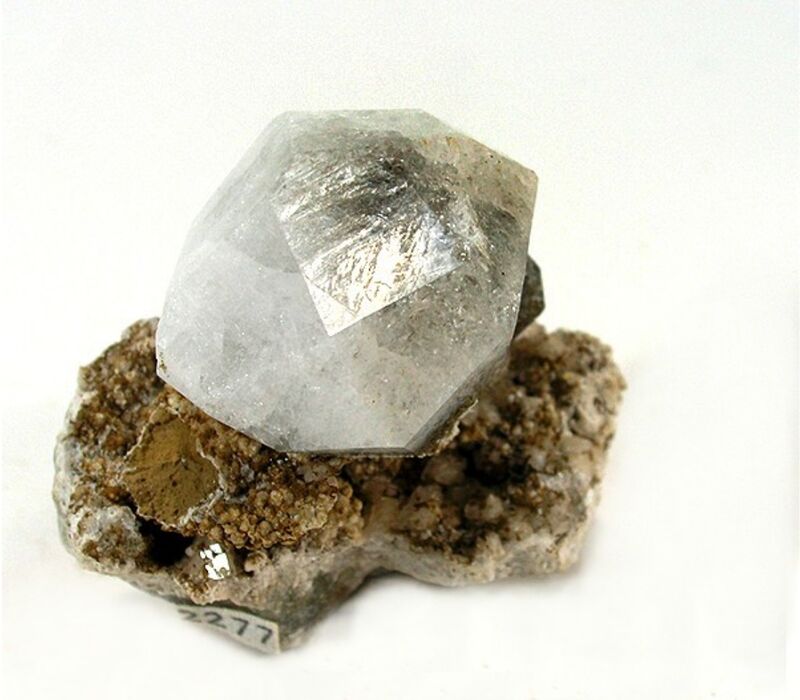
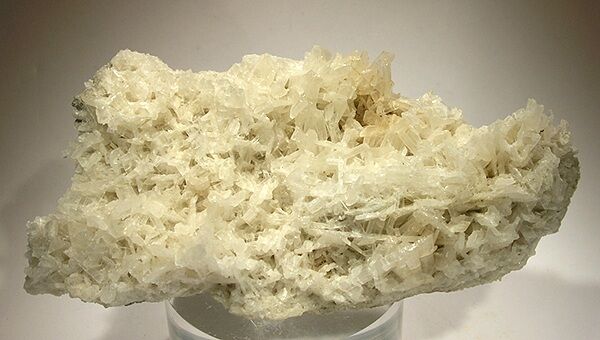
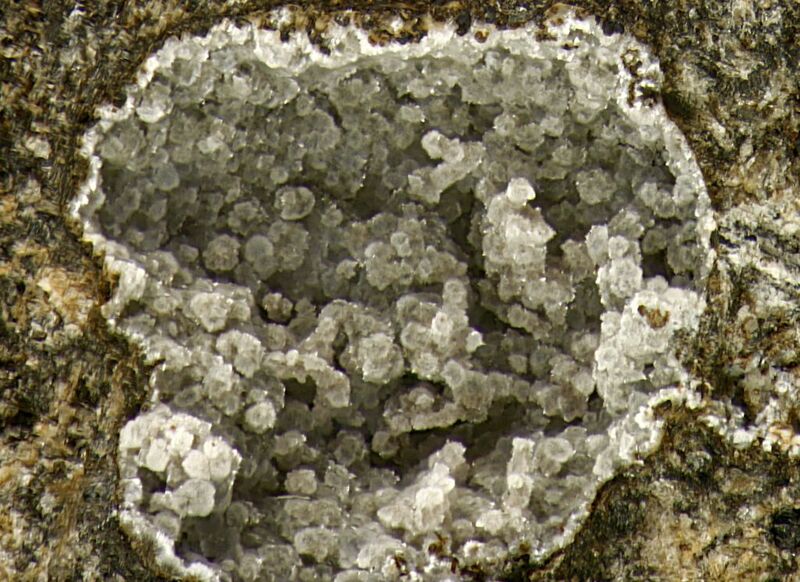
Square prisms with steep oblique terminations, radiating, columnar, fibrous, massive.
- Twinning
On (100), typically with terminal re-entrants.
Chemical composition
- Impurities
- Na
- K
- Fe
Synonyms
- Ädelforsit
- Schneiderite
In other languages
- French
- Laumontite
- German
- Laumontit
- Spanish
- Laumontita
- Italian
- laumontite
- Japanese
- 濁沸石
- Russian
- Ломонтит
Classification
9.GB.10
- 9SilicatesClass
- 9.GTektosilicates with zeolitic H2O; zeolite familyDivision
- 9.GBChains of single connected 4-membered ringsGroup
- 9.GB.10LaumontiteSpecies
77.01.01.04
- 77Tectosilicates ZeolitesClass
- 77.01Zeolite group - True zeolitesType
- 77.01.01Analcime and related speciesGroup
- 77.01.01.04LaumontiteSpecies
16.9.23
- 16Silicates Containing Aluminum and other MetalsClass
- 16.9Aluminosilicates of CaGroup
- 16.9.23LaumontiteSpecies
Group, growth & confusion
- AlflarseniteNaCa2Be3Si4O13(OH) · 2H2OMineral—
 AmiciteK2Na2(Al4Si4O16) · 5H2OMineral—
- Ammonioleucite(NH4)(AlSi2O6)Mineral—
 AnalcimeNa(AlSi2O6) · H2OMineral—
- ArzamastseviteK6Al5Si6O20(OH)4ClMineral—
 Bellbergite(K,Ba,Sr)2Sr2Ca2(Ca,Na)4(Si,Al)36O72 · 30H2OMineral—
 BikitaiteLiAlSi2O6 · H2OMineral—
 BoggsiteNa3Ca8(Si77Al19)O192 · 70H2OMineral—
 ChiavenniteCaMn2+(BeOH)2Si5O13 · 2H2OMineral—
 CowlesiteCa(Al2Si3)O10 · 5-6H2OMineral—
Literature, links & citation
- 1805Jameson, R. (1805) Lomonite. System of Mineralogy II, Bell and Bradfute (Edinburgh, U.K.): 539-540.
- 1809Haüy, René Just (1809) Tableau comparatif des résultats de la Cristallographie et de l'analyse Chimique, relativement a la Classification des Minéraux.. Chez Courcier, Paris.
- 1821von Leonhard, K.C. (1821) Laumontit. in Handbuch der Oryktognosie, Mohr and Winter (Heidelberg, Germany): 448-449.
- 1858How, Henry (1858) Chemical analysis of faroelite and some other zeolites occurring in Nova Scotia. American Journal of Science and Arts, S. 2 Vol. 26. 30-34
- 1876Liversidge, Archibald (1876) VI.—Note on a mineral from New South Wales, presumed to be Laumontite. Mineralogical Magazine and Journal of the Mineralogical Society, 1 (2) 54 doi:10.1180/minmag.1876.001.2.07 DOI: 10.1180/minmag.1876.001.2.07
Entry last updated
@misc{mineral2026,
  author    = {Mineral Index editorial board},
  title     = {Laumontite — Mineral Index},
  year      = {2026},
  url       = {https://mineralindex.org/minerals/laumontite-2340}
}