History
The mineral's name points to a single Spanish town. Linarite was christened in 1839 by the German mineralogist Ernst Friedrich Glocker, after Linares — the lead-and-silver mining district in Jaén province, Andalusia, that holds its type locality.
The story, though, begins thirty years earlier in Britain. The English naturalist James Sowerby published a coloured plate of the deep-blue crystals in 1809, but he did not yet recognise them as a distinct species — he labelled them Crystallized Blue Carbonate of Copper, mistaking them for azurite. The first formal description followed in 1822. The English crystallographer Henry James Brooke worked with Sowerby on specimens from Leadhills, a lead-mining village in southern Scotland. He showed that the blue crystals were a separate species, built around lead as well as copper.
Glocker's 1839 naming honoured a different occurrence. He took his specimens from a village just north of the city of Linares, at Guarromán, and fixed the species name to that Spanish locality rather than to the older Scottish one.
The azurite confusion that fooled Sowerby has shadowed linarite ever since. The two minerals share the same intense cobalt-blue colour but differ entirely in chemistry — azurite is a copper carbonate, linarite a lead-bearing sulfate. A drop of dilute hydrochloric acid separates them: azurite fizzes, while linarite instead clouds over with a white film of lead chloride.
Industrial & practical applications
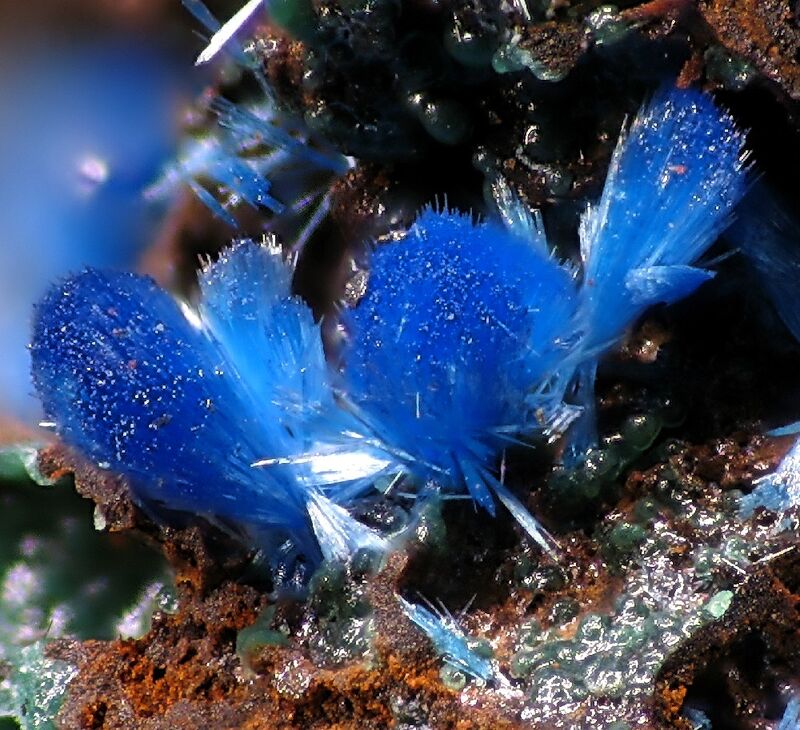
Linarite has no industrial use. It is too rare and too soft to mine as an ore, and the copper and lead it contains come from far more abundant species. The demand is almost entirely from collectors, who prize linarite for its unusually intense, pure blue colour — a saturated cobalt-blue that few minerals match.
The largest crystals known from the United States — up to about 4 millimetres on edge — come from the Mammoth-Saint Anthony Mine at Tiger, Arizona. Comparable specimens are found at Tsumeb in Namibia and in the British lead districts of Leadhills and the Caldbeck Fells.
For the field geologist, linarite also serves as an indicator. It forms in the secondary, weathered zone of lead-copper ore deposits, where sulfate-rich groundwater reacts with primary sulfides at the surface. A patch of vivid blue on oxidised vein material is a quick visual signal that lead and copper sit together below.
Where it forms, where it's found
- Geological setting
An uncommon secondary mineral found in the oxidation zone of lead mineral deposits.
- Type locality
- Linares
- Jaén
- Andalusia
- Spain
Safety & handling
Physical
- Hardness
- 1Talc
- 2Gypsum
- 3Calcite
- 4Fluorite
- 5Apatite
- 6Orthoclase
- 7Quartz
- 8Topaz
- 9Corundum
- 10Diamond
- Transparency
- Transparent · Translucent
- Colour
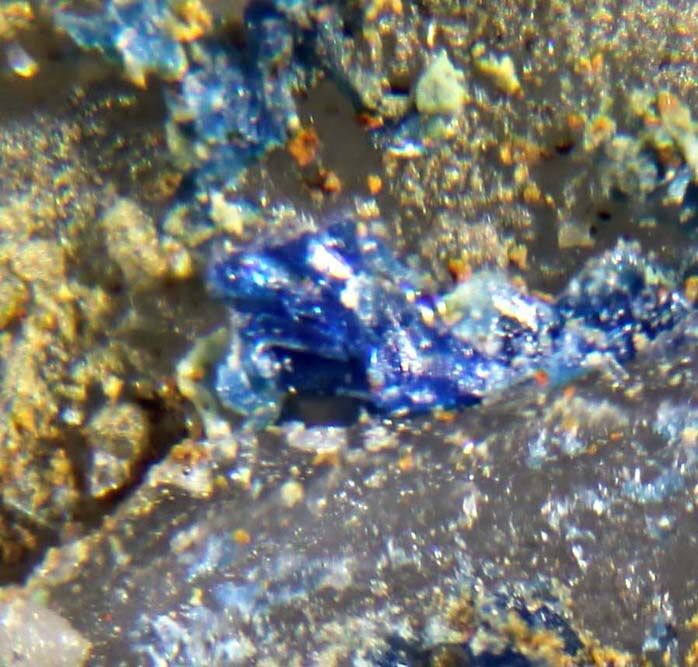
- Deep azure blue · deep blue in transmitted light.
Similar to azurite but not as deep.
- Streak
- Pale blue.
- Tenacity
- brittle
- Cleavage
- Perfect
On (100), perfect; on (001), imperfect.
- Fracture
- Conchoidal
- Density
- 5.35 g/cm³
Optical
- Optical type
- Biaxial (-) · 2V measured = 80° · 2V calc = 78°
- Refractive index
- 1.809 – 1.859
- Surface relief
- Very high
- Principal indices
- nα 1.809 · nβ 1.838 · nγ 1.859
- Pleochroism
- Visible
X ^c~ -24° = Pale blue Y = Clear blue Z = b = Prussian-blue
- Dispersion
- Strong r < v
Crystallography
- Space group
- #15
- Cell parameters
- a = 9.682(2) Å · b = 5.646(1) Å · c = 4.683(6) Å
- Cell angles
- β = 102.66(1) °
- Ratio a:b:c
- 1 : 0.583 : 0.484
- Unit cell volume
- 249.9 ų
- Z
- 2
- Morphology
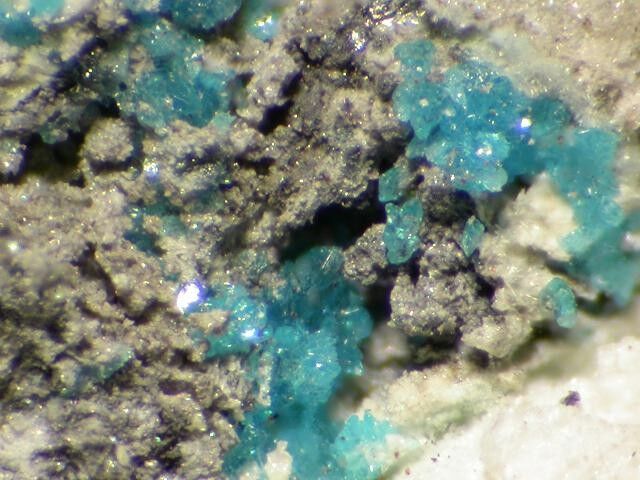
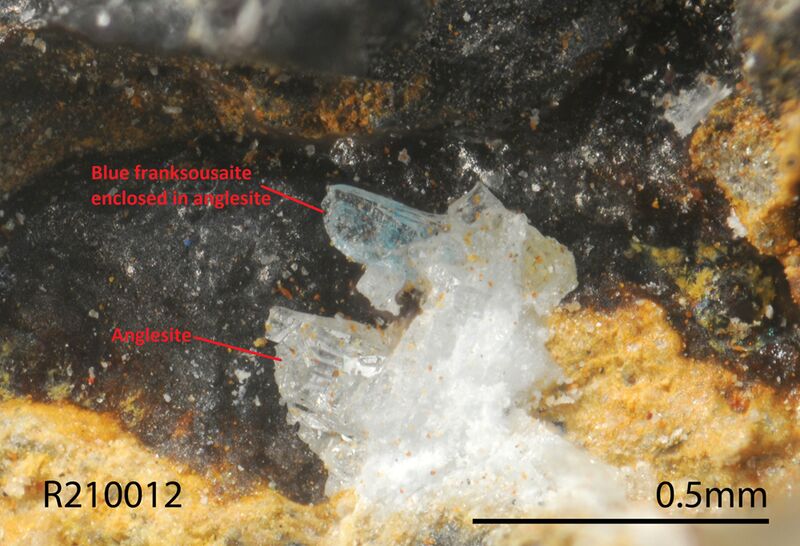
Crystals thin to thick tabular (01) and (001), also elongated parallel to [010]; usually found as small to microscopic clusters or crusts.
- Twinning
Twinning on (100) common; reported on (001).
- Type-locality form
Easily cleaved, brilliant blue crystals.
- Comment
a = 9.81, b = 5.65, c = 4.70, β = 104.7 (Bachmann and Zemann 1961). a = 9.701(2), b = 5.650(2), c = 4.690(2), β = 102.65(2) (Effenberger 1987). a = 9.682(2), b = 5.646(1), c = 4.683(6), β = 102.66(1) (Schofield et al. 2009, at 293 K)
Chemical composition
Synonyms
- Bleilasur
- Cupreous Anglesite
- Cupreous sulphate of Lead
- Kupferbleispat
- Kupferbleivitriol
- Plomb sulfaté cuprifère
In other languages
- French
- Linarite · Plomb sulfaté cuprifère
- German
- Anglesit-Cu · Bleilasur · Cu-Anglesit · Kupferbleispat · Kupferbleivitriol · Linarit
- Spanish
- Linarita
- Italian
- Linarite
- Portuguese
- Linarita · linarite
- Japanese
- 青鉛鉱
- Chinese
- 青鉛礦
Classification
7.BC.65
- 7SulfatesClass
- 7.BSulfates (selenates, etc.) with additional anions, without H2ODivision
- 7.BCWith medium-sized and large cationsGroup
- 7.BC.65LinariteSpecies
30.02.03.01
- 30Anhydrous Sulfates Containing Hydroxyl or HalogenClass
- 30.02(AB)2(XO4)ZqType
- 30.02.03— unnamed intermediate level —Group
- 30.02.03.01LinariteSpecies
25.7.6
- 25SulphatesClass
- 25.7Sulphates of PbGroup
- 25.7.6LinariteSpecies
Group, growth & confusion
Literature, links & citation
- 1809Sowerby, J. (1809) British Mineralogy, or Coloured Figures Intended to Elucidate the Mineralogy of Great Britain. 5 volumes, London: 3: 5, fig. 203 (as Crystallized Blue Carbonate of Copper).
- 1822Brooke, H.I. (1822) On a new lead ore. Annals of Philosophy, London: 4: 117 (as Cupreous Sulfate of Lead).
- 1822Brooke, H.I. (1822) On a new lead ore. The Annals of Philosophy: 4: 117-119.
- 1823Breithaupt, August (1823) Vollständige Charakteristik des Mineral-Systems (1st ed.). Arnoldischen Buchhandlung.
- 1838Lévy, Armand (1838) Description d'une collection de minéraux, formée par m. Henri Heuland, et appartenant à m. C.H. Hampden Turner, de Rooksnest, dans le comté de Surrey en Angleterre. Tome Deuxiéme Vol. 2. F. Richter et Haas.
Entry last updated
@misc{mineral2026,
  author    = {Mineral Index editorial board},
  title     = {Linarite — Mineral Index},
  year      = {2026},
  url       = {https://mineralindex.org/minerals/linarite-2403}
}