History
The name brochantite honours a French geologist most readers will never have heard of. In 1824, the crystallographer Serve-Dieu Abailard "Armand" Lévy described this green copper sulfate. He named it after his fellow Frenchman André-Jean-François-Marie Brochant de Villiers (1772–1840), a mineralogist and geologist active in early nineteenth-century Paris.
The mineral itself has no ancient story. It slipped into the mineralogical record only when chemistry had developed enough to tell one green copper crust from another — there are several, and the unaided eye cannot reliably separate them. Brochantite's discovery belongs entirely to the modern era of systematic mineral description.
Industrial & practical applications
Brochantite has almost no industrial role of its own. Where it matters today is on the surface of old bronze.
A copper or bronze statue left outdoors slowly grows a green crust. That crust is rarely one substance. In urban air loaded with sulfur dioxide — the pollutant released by coal smoke and diesel exhaust — brochantite is often the dominant green layer. It shares the surface with related basic copper sulfates and chlorides. Conservators of outdoor monuments therefore identify brochantite routinely when they analyse a patina. The mineral has become, in that work, a diagnostic label for one specific kind of weathered copper surface.
Beyond the patina story, brochantite is a collector and reference mineral. Specimens with crisp emerald-green crystals are valued by amateur mineralogists, and the mineral appears in research literature on copper corrosion and on the secondary mineralogy of oxidised copper deposits.
Where it forms, where it's found
- Geological setting
In arid climates or in rapidly oxidizing copper sulfide deposits under low acid conditions.
- Type locality
- Mednorudyanskoye Cu Deposit
- Nizhnii Tagil
- Sverdlovsk Oblast
- Russia
Physical
- Hardness
- 1Talc
- 2Gypsum
- 3Calcite
- 4Fluorite
- 5Apatite
- 6Orthoclase
- 7Quartz
- 8Topaz
- 9Corundum
- 10Diamond
- Lustre
- Vitreous · Pearly
- Transparency
- Transparent · Translucent
- Colour
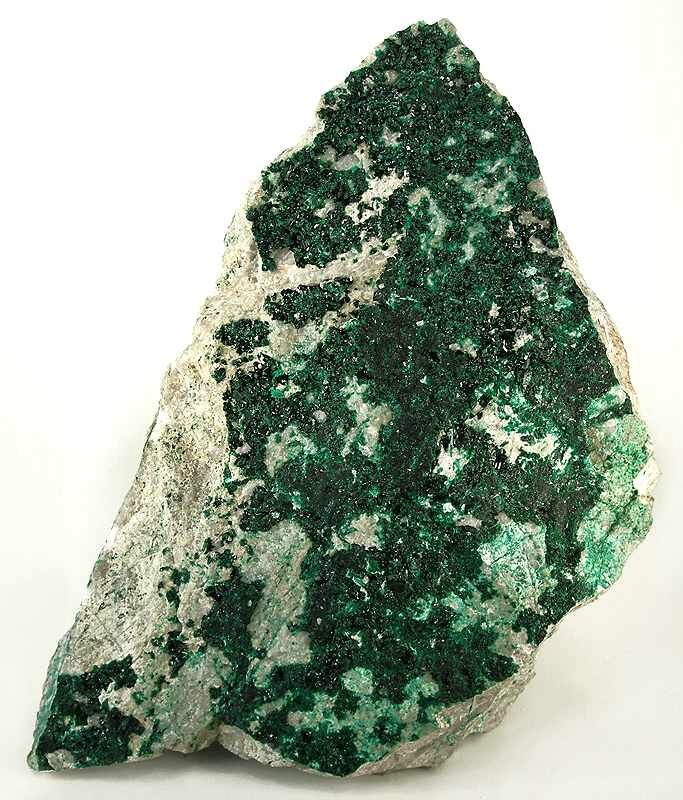
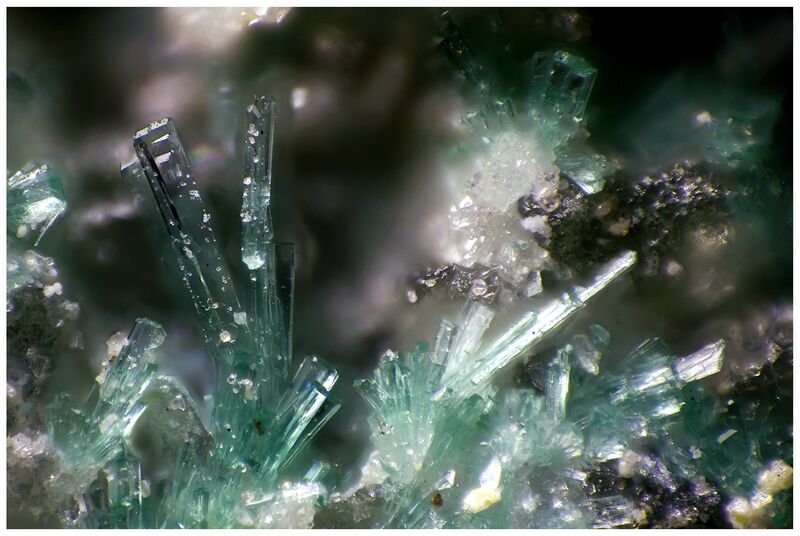
- Green · emerald green · green-black · light green · bluish green in transmitted light.
- Streak
- Pale green
- Cleavage
- Perfect
On (100) perfect.
- Fracture
- Irregular/Uneven · Conchoidal
- Density
- 3.97 g/cm³
Optical
- Optical type
- Biaxial (-) · 2V measured = 72° · 2V calc = 76°
- Refractive index
- 1.728 – 1.8
- Surface relief
- High
- Principal indices
- nα 1.728 · nβ 1.771 · nγ 1.8
- Pleochroism
- Weak
Slight in shades of bluish green.
- Dispersion
- medium r < v
- Luminescence
- None
Crystallography
- Space group
- P21/a
- Cell parameters
- a = 13.08 Å · b = 9.85 Å · c = 6.02 Å
- Cell angles
- β = 103.35 °
- Ratio a:b:c
- 1 : 0.753 : 0.460
- Z
- 4
- Morphology
Crystals stout prismatic to acicular [001], elongated [010] at times, or, [100] more rarely; also tabular (001). Loosely coherent aggregates of acicular crystals; groups and drusy crusts; massive, granular.
- Twinning
On (100) with composition surface (100), common. The twinned crystals are often symmetrical and pseudo-orthorhombic in appearance. When X-rayed using single-crystal methods, twins may yield an orthorhombic unit cell solution with cell metrics of a = ~3.0, b = ~9.8, c = ~12.7 Å.
- Comment
OD structure. The MDO1 polytype (P21/a; cell given above) corresponds to "normal" brochantite. The MDO2 polytype has space group P21/n and a = 12.776, b = 9.869, c = 6.026 A, beta = 90.15 (Merlino et al., 2003).
Chemical composition
Synonyms
- Blanchardit
- Blanchardite
- Brogniartine (of Huot)
- IMA1980-s.p.
- Kamarezit
- Kamarezite
- Koenigine
- Königine
- Konigit
- Konigite
- Krisuvigit
- Krisuvigite
- Waringtonit
- Waringtonite
- Warringtonite
In other languages
- French
- Brochantite
- German
- Brochantit
- Spanish
- Brocancita · Brochantita
- Italian
- Brochantite
- Japanese
- ブロシャン銅鉱
- Chinese
- 水膽礬
- Russian
- Брошантит
Classification
7.BB.25
- 7SulfatesClass
- 7.BSulfates (selenates, etc.) with additional anions, without H2ODivision
- 7.BBWith medium-sized cationsGroup
- 7.BB.25BrochantiteSpecies
30.01.03.01
- 30Anhydrous Sulfates Containing Hydroxyl or HalogenClass
- 30.01(AB)m(XO4)pZq, where m:p>2:1Type
- 30.01.03— unnamed intermediate level —Group
- 30.01.03.01BrochantiteSpecies
25.2.7
- 25SulphatesClass
- 25.2Sulphates of Cu and AgGroup
- 25.2.7BrochantiteSpecies
Group, growth & confusion
 AntleriteCu2+3(SO4)(OH)4Mineral—
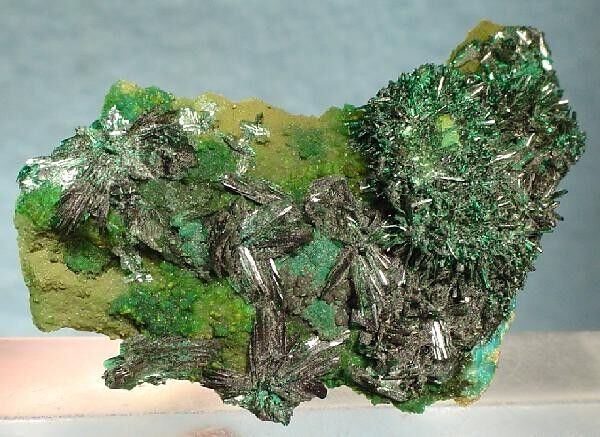
 ArhbariteCu2Mg(AsO4)(OH)3Mineral—
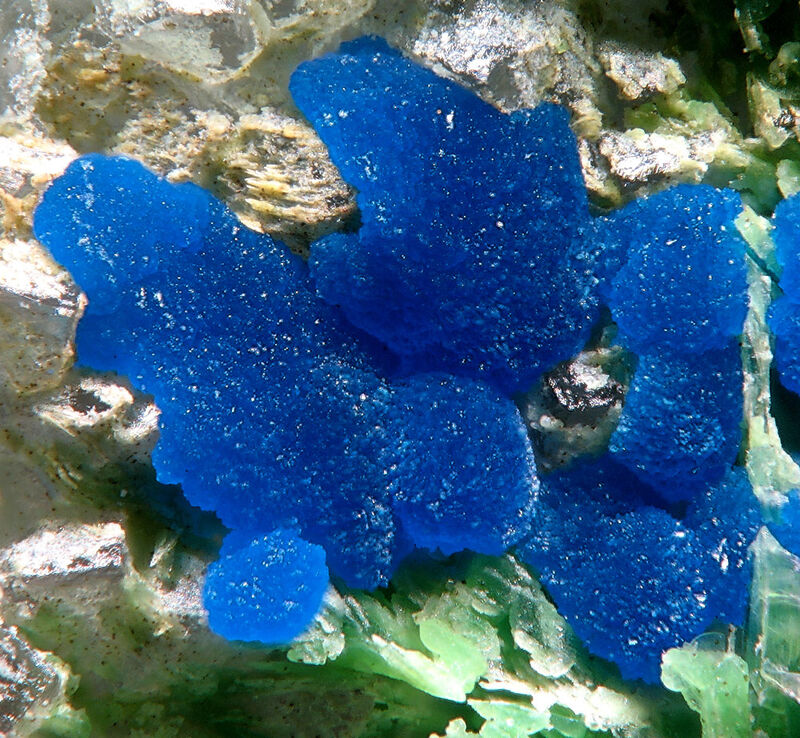
 AtacamiteCu2Cl(OH)3Mineral—
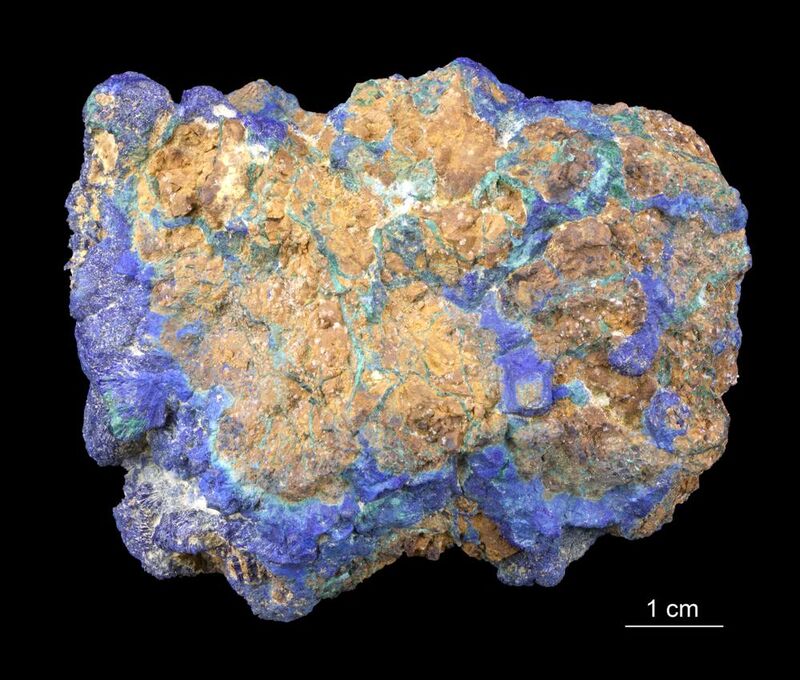 AzuriteCu3(CO3)2(OH)2Mineral—
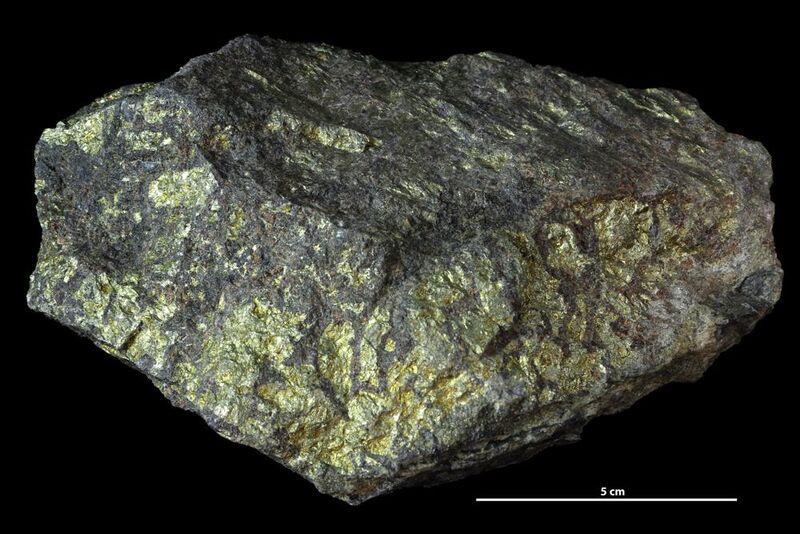 ChalcopyriteCuFeS2Mineral—
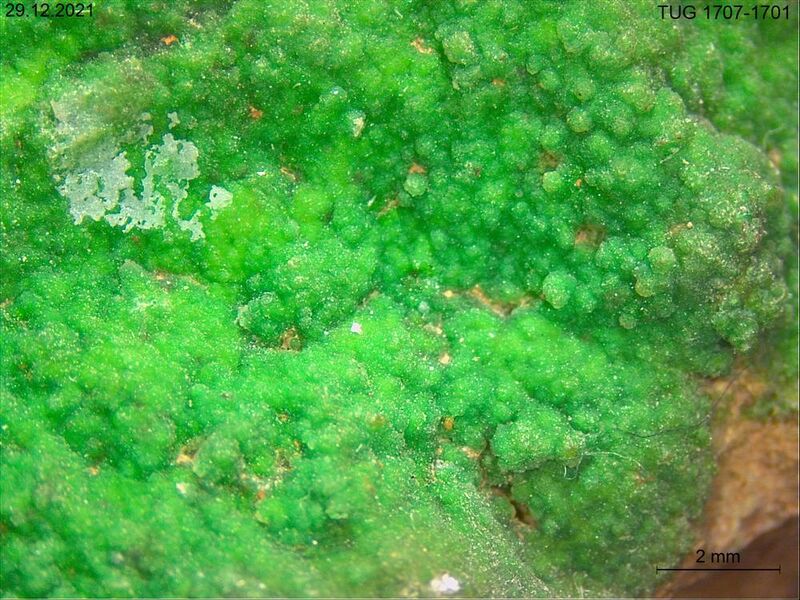 ConichalciteCaCu(AsO4)(OH)Mineral—
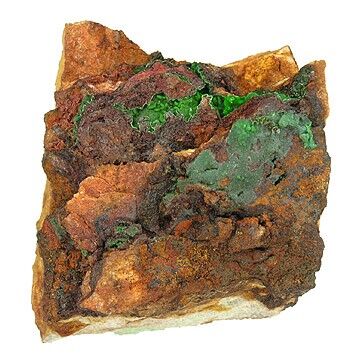 CornwalliteCu5(AsO4)2(OH)4Mineral—
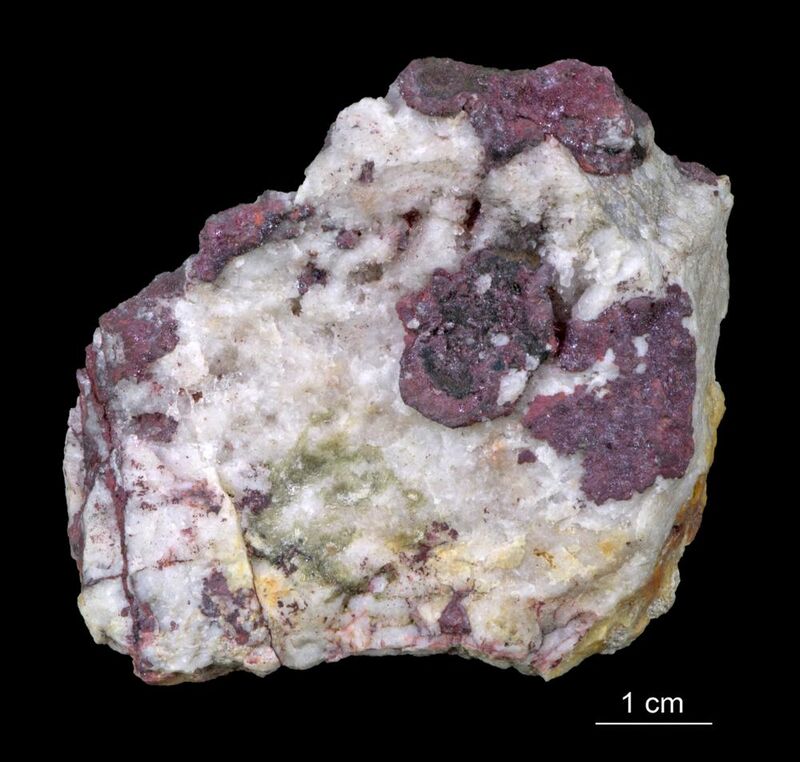 CupriteCu2OMineral—
- FermiiteNa4(UO2)(SO4)3 · 3H2OMineral—
 GobeliniteCoCu4(SO4)2(OH)6 · 6H2OMineral—
Literature, links & citation
- —Die metallenen Grabplatten im Kreuzgang des Erfurter Doms: Bestandsaufnahme und Erarbeitung eines präventiven Konservierungskonzeptes (https://www.uni-bamberg.de/restwiss/forschung/interdisziplinaere-forschung/dom-erfurt-grabplatten/)
- 1824Lévy, A. (1824) On a new mineral substance. Annals of Philosophy, London: 8: 241.
- 1826Lévy, A. (1826) Annals of Philosophy, London: 11: 194 (as Königine).
- 1841Huot, J.J. (1841) Manuel de Minéralogie. 2 volumes, Paris: 1: 331 (as Brongniartine).
- 1842Forchhammer (1842) Skand. Nat. Stockholm, Arsb. 192, 1843 (as Krisuvigite).
Entry last updated
@misc{mineral2026,
  author    = {Mineral Index editorial board},
  title     = {Brochantite — Mineral Index},
  year      = {2026},
  url       = {https://mineralindex.org/minerals/brochantite-779}
}