History
No other mineral has shaped human history the way native gold has — as ornament, as money, as the metal that anchored entire economies for nearly three thousand years.
Small amounts of natural gold were already being gathered in late Paleolithic Spain around 40,000 BCE. By the 5th millennium BCE the metal was being worked deliberately: the oldest gold artefacts in the world come from graves in the Varna Necropolis, on the Bulgarian Black Sea coast. Egyptian goldsmiths followed at the end of the same millennium, and over the course of the 4th millennium BCE they developed smelting — heating the metal to separate it from its host rock. Gold's softness made it workable with stone tools; its refusal to tarnish made it eternal in a way no other early metal was.
From ornament to money
Around 610 BCE, the kingdom of Lydia in western Anatolia struck the world's earliest coinage, drawing on alluvial gold from the silt of the Pactolus river that ran through the Lydian capital, Sardis. The first Lydian coins were electrum — a natural gold–silver alloy of variable composition. The decisive step came under King Croesus, who ruled from about 585 to 547 BCE. Croesus is credited with issuing the first true gold coins with a standardised purity for general circulation, the Croeseid. His engineers learned to purify the metal by heating it with common salt to drive off the silver, producing a coin whose value did not depend on guessing its alloy. The name Croesus became a Greek and Persian synonym for a wealthy man.
For the next two millennia, gold travelled the alchemists' workbench as much as the merchant's purse. The alchemists called it Sol — the sun. One of their central goals was to produce gold from base metals such as lead, supposedly through the agency of a mythical substance called the philosopher's stone.
The English name has its own slow biography. The word gold descends from a Proto-Indo-European root meaning to shine, to gleam, to be yellow or green, and the Old English form first appears in writing around 725. The chemical symbol Au comes from another lineage — the Latin aurum, fixed as the international symbol for the element by the Swedish chemist Jöns Jakob Berzelius when he established the modern system of chemical notation in the early 19th century.
The great rushes
On 24 January 1848, James W. Marshall found shiny metal in the tailrace of a lumber mill he was building for the Sacramento pioneer John Sutter — Sutter's Mill, near Coloma on the American River. Within a year word had crossed every continent, and roughly 300,000 people poured into California from the rest of the United States and abroad, a population shock that pushed California into statehood in the Compromise of 1850.
A second great rush opened in July 1886, when George Harrison declared a claim on the farm Langlaagte in the South African Republic. The reef he had stumbled into was the Witwatersrand, the largest gold deposit ever found; the mining camp that grew around it became Johannesburg, which within a decade was the largest city in South Africa and one of the triggers of the Second Boer War of 1899 to 1902. A decade later still, the Klondike Gold Rush of 1896 to 1899 opened the main goldfield along the south flank of the Klondike River in the Yukon Territory, near its confluence with the Yukon River, around what was to become Dawson City.
For most of recorded history, gold was money — its rarity, divisibility, and chemical stability made it the natural anchor for currencies. That arrangement ended on a Sunday evening in 1971. On 15 August of that year, President Richard Nixon announced from the White House that the United States would no longer convert dollars held by foreign governments into gold at a fixed rate. The decision effectively dismantled the Bretton Woods system that had governed international finance since the Second World War, and converted the dollar — and by extension every major currency tied to it — into a fiat instrument backed by government promise rather than metal.
Industrial & practical applications
About half of all newly mined gold is turned into jewellery, roughly two-fifths goes into investment, and the remaining tenth disappears into industry.
In jewellery and investment
The bulk of mined gold still travels straight to the goldsmith's bench. Because pure gold is too soft to hold a setting or take a polish on a ring band, jewellery gold is alloyed with copper, silver, or palladium and graded by karat — a 24ths fraction. Pure gold is 24 karat by definition; common jewellery alloys run at 18K (75% gold), 14K (58.3%), 10K (41.7%) or 9K (37.5%). The mix of co-metals colours the result: a 75% gold alloy with 25% copper yields red gold; a 22.25% copper / 2.75% silver mix gives the rose-gold tone fashionable in pink-toned jewellery.
The investment share moves as bars, coins and central-bank reserves. Even now that no major currency is redeemable for the metal, gold retains a unique status among all commodities as a long-term store of value.
In industry
Most of the industrial 10% goes into electronics. Gold's combination of high malleability, ductility, resistance to corrosion and most other chemical reactions, and electrical conductivity has made it the standard for corrosion-resistant electrical connectors in computerised devices — its chief industrial use. The same properties earn it work in communications equipment, spacecraft, and jet-aircraft engines, where a contact or coating cannot afford to oxidise.
A second domain is dentistry. Gold and high-gold alloys (often around 99.7% pure) remain a viable option for indirect restorations such as crowns and partial-coverage onlays, bonded permanently to the tooth with dental cement. Direct gold-foil fillings are rarely used today because of their expense and the specialist training they demand, though the technique survives.
A third runs on gold leaf — gold hammered to roughly 0.1 µm thickness by goldbeating. Architectural gilding still uses leaf to mark important structures, both for the visual effect and because gold's non-reactive nature gives the surface a durable protective finish.
Where it forms, where it's found
- Geological setting
1) Primary hydrothermal veins 2) Volcanic-exhalative sulphide deposits 3) Alluvial and eluvial
Varieties
Physical
- Hardness
- 1Talc
- 2Gypsum
- 3Calcite
- 4Fluorite
- 5Apatite
- 6Orthoclase
- 7Quartz
- 8Topaz
- 9Corundum
- 10Diamond
- Lustre
- Metallic
- Transparency
- Opaque
- Colour
- Rich yellow · paling to whitish-yellow with increasing silver · blue & green in transmitted light (only thinnest folia [gold leaf])
- Streak
- Shining yellow
- Tenacity
- malleable
- Cleavage
- None Observed
None
- Fracture
- Hackly
- Density
- 15 g/cm³
Optical
- Optical type
- Isotropic
- Pleochroism
- Non-pleochroic
- Optical colour
- Yellow to white with increasing silver, reddish with copper
- Tropism
- Isotropic
- Reflectance R%
- (36.8,25.8) 400, (36.8,25.8) 420, (36.5,25.9) 440, (36.1,26.0) 460, (36.0,26.5) 470, (36.7,27.8) 480, (45.3,37.9) 500, (62.5,55.9) 520, (74.0,69.1) 540, (77.0,71.5) 546, (82.2,77.0) 560, (86.8,82.3) 580, (88.2,84.1) 589, (89.7,85.9) 600, (91.9,88.7) 620, (93.3,90.3) 640, (93.8,91.0) 650, (94.1,91.8) 660, (94.8,92.5) 680, (95.3,93.2) 700
- Luminescence
- None
- UV response
- none
- Notes
Reflectivity from Criddle & Stanley (1993)
Crystallography
- Space group
- #224
- Cell parameters
- a = 4.0786 Å
- Z
- 4
- Morphology
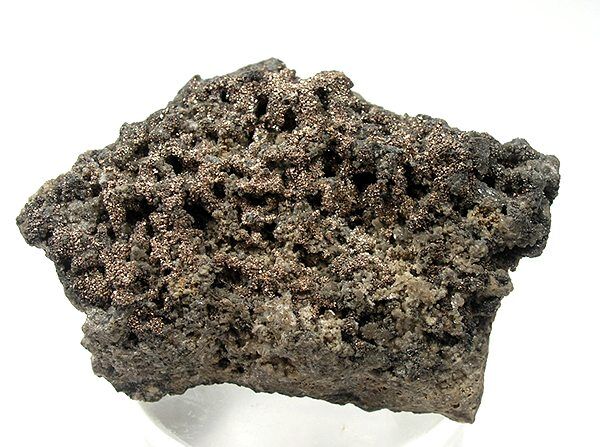
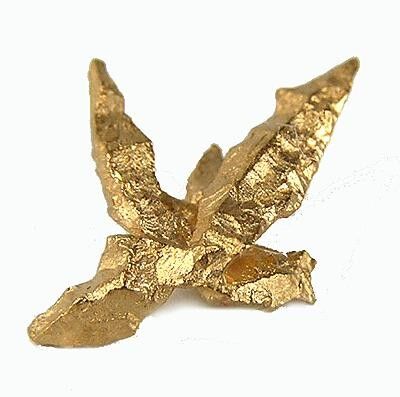
Usually crude to rounded octahedra, cubes, and dodecahedra to 2 cm. Often elongated along [100] or [111] directions, forming herringbone and dendritic twins. Flattened (111) plates with triangular octahedral faces. Rarely as wires ([111] elongation); reticulated; dendritic; arborescent; filiform; spongy; also massive in rounded fragments, flattened grains and scales (gold dust).
- Twinning
Common on (111) to give herringbone twins. Repeated on (111) to give stacks of spinel twins that form hexagonal wires.
Chemical composition
- Impurities
- Ag
- Cu
- Pd
- Hg
- Bi
Synonyms
- Airh
- Altın
- Arany
- Ari
- Au
- Auksas
- Aur
- Aurum
- Cōztic teōcuitlatl
- Dhahabu
- Emas
- Gediegen Gold
- Gedigent Gull
- Gediget Guld
- Gim
- Ginto
- Gintu
- Gold
- Goud
- Guld
- Igolide
- Jold
- Kîm
- Kuarepotiju
- Kuld
- Kulta
- Lò
- Oltin
- Or
- Ór
- Òr
- Ore (novial name for gold)
- Oro
- Oru
- Ouro
- Qızıl
- Qori
- Quri
- Sol
- Solji
- Urre
- Vàng
- Wolo
- Wólo
- Zelts
- Zêr
- Zern
- Złoto
- Χρυσός
- સોનું
- தங்கம்
- బంగారం
- ಚಿನ್ನ
- സ്വര്ണ്ണം
- ᎠᏕᎸ ᏓᎶᏂᎨ
In other languages
- French
- or natif
- German
- gediegen Gold · Gold, gediegen
- Spanish
- oro nativo
- Italian
- oro nativo
- Japanese
- 自然金
- Russian
- золото · золото самородное · Самородное золото
Classification
1.AA.05
- 1ElementsClass
- 1.AMetals and Intermetallic AlloysDivision
- 1.AACopper-cupalite familyGroup
- 1.AA.05Native GoldSpecies
01.01.01.01
- 01Native Elements and AlloysClass
- 01.01Metals, other than the Platinum GroupType
- 01.01.01Gold groupGroup
- 01.01.01.01Native GoldSpecies
1.5
- 1Elements and Alloys (including the arsenides, antimonides and bismuthides of Cu, Ag and Au)Class
- 1.5— unnamed intermediate level —Group
- 1.5Native GoldSpecies
Group, growth & confusion
Literature, links & citation
- —[Problem of gold-bearing conglomerates].
- 1852Wibel (1852) Naturwissenschaftlicher Verein, Hamburg . Abhandlungen und Verhandlungen: 2: 87.
- 1895Hatch, F.H. and J.A. Chalmers (1895) The Gold Mines of the Rand. London: Macmillan & Co.
- 1898Scupham, J.R. (1898) The Buried Rivers of California as a Source of Gold. Mines and Minerals - November 1898.
- 1899Outerbridge Jr., Alexander E. (1899) Marvellous Increase in Production of Gold. AP Popular Science Monthly, March 1899.
Entry last updated
@misc{mineral2026,
  author    = {Mineral Index editorial board},
  title     = {Native Gold — Mineral Index},
  year      = {2026},
  url       = {https://mineralindex.org/minerals/native-gold-1720}
}