History
Few minerals appear in scripture by name. Sulphur is one of them — the brimstone of biblical translations, literally a "burning stone", the yellow rock that catches fire and chokes the air with the smell of its own combustion. For most of human history, sulphur was less a mineral than a marvel: a substance that did things.
The name itself reached English through Latin sulpur, which probably entered Latin from Oscan, the language of an ancient people of the region around Mount Vesuvius, where sulphur deposits are widespread. Middle English borrowed the Latin form by at least 1390. The Greeks called it theîon, the root preserved in English today only as the chemical prefix thio-.
### Antiquity
The combustion of sulphur had a role in Egyptian religious ceremonials as early as 4000 years ago. The Ebers Papyrus also records a sulphur ointment used in ancient Egypt to treat granular eyelids. Preclassical Greece burned sulphur as a fumigant — a use the Odyssey already mentions. Further east, a natural form of the element was already known in 6th-century-BCE China.
Around 300 BCE, Theophrastus, in Peri Lithon (On Stones), described what may have been sulphur-impregnated pumice; the exact Greek word in the text has long been disputed by translators. Pliny the Elder devoted a passage of his Natural History to sulphur, naming the Aegean island of Melos as its best-known source and noting its use for fumigation, medicine, and the bleaching of cloth. By the 3rd century CE, Chinese chemists had learned to extract sulphur from pyrite.
From medieval recipe to industrial element
Sulphur entered the medieval armoury through gunpowder. The military compendium Wujing Zongyao, compiled in 1044 CE, set down formulas for black powder — a mixture of potassium nitrate, charcoal, and sulphur. That recipe travelled west and changed the world.
For all that history, sulphur was not understood as a chemical element until 1777, when Antoine Lavoisier recognised it as one — earlier chemists had suspected it might be a compound of hydrogen and oxygen.
By the late 18th century, about 2000 tonnes a year of Sicilian sulphur were being imported into Marseille for the production of sulphuric acid, the first step of the Leblanc process for making soda. Sicily was the dominant source for more than a century. Miners worked the deposits with a brutal technique called the Sicilian process: the ore was piled in brick kilns built on sloping hillsides and partly burned to melt the rest out. Booker T. Washington, who visited one such mine, wrote that it was "about the nearest thing to hell that I expect to see in this life".
In 1840, King Ferdinand II handed the Sicilian sulphur trade as a monopoly to a French firm, breaking an earlier 1816 treaty with Britain — the diplomatic standoff that followed became known as the Sulphur Crisis.
Sicily's dominance ended in North America. In 1867 elemental sulphur was discovered in underground deposits in Louisiana and Texas. Extraction was solved by Herman Frasch, whose method — now bearing his name — pumped superheated water into the deposit to melt the sulphur, then forced the molten product back up with compressed air, recovering it at 99.5% purity. The Frasch process dominated world production through most of the 20th century, and the last Frasch operation in the United States shut down in 2002.
Industrial & practical applications
The yellow stone of antiquity is now almost entirely a by-product. Native sulphur is still mined in a few volcanic localities, but the world's demand — tens of millions of tonnes a year — is met by stripping sulphur out of petroleum and natural gas before they are burned. The cleanup operation that began as an environmental obligation has become the largest source of one of the most industrially valuable elements.
Most of that recovered sulphur passes through the Claus process, in which some of the hydrogen sulphide pulled from hydrocarbons is first burned into sulphur dioxide, then made to react with the remaining hydrogen sulphide — SO₂ + 2 H₂S → 3 S + 2 H₂O — to drop out as solid elemental sulphur. The output piles up at every major refinery; large stockpiles sit at Alberta's oil-sands operations where production outpaces shipment.
Sulphuric acid and fertilisers
About 85% of all sulphur produced is converted to sulphuric acid — and in the United States, more sulphuric acid is produced every year than any other inorganic industrial chemical. Its principal use is the extraction of phosphate ores for fertiliser manufacturing: phosphate rock is dissolved in sulphuric acid to release the phosphate that crops need. Without sulphur, modern agriculture's nutrient supply chain does not close.
Rubber, fibres, and the rest
Sulphur underwrites the rubber industry. Heated with natural rubber, elemental sulphur forms cross-links — disulphide bridges — that turn a soft, sticky material into the hard, elastic compound used in tyres, hoses, seals, and gaskets. That reaction, called vulcanisation, is the standard route for converting raw rubber into anything mechanically useful.
The element also feeds the production of carbon disulphide — the solvent used to make cellophane film and rayon fibre. In agriculture, finely ground sulphur is sprayed as a fungicide on grapes and other vegetables; in pyrotechnics, it is the combustible component that gives matches their strike-ignition and fireworks their flash. The same element still goes into gunpowder used for mining and propellant blends.
World production was about 69 million tonnes (Mt) in 2011, with more than fifteen countries each contributing over a million tonnes. The leaders are China at 9.6 Mt, the United States at 8.8 Mt, and Canada and Russia at 7.1 Mt each.
Where it forms, where it's found
- Geological setting
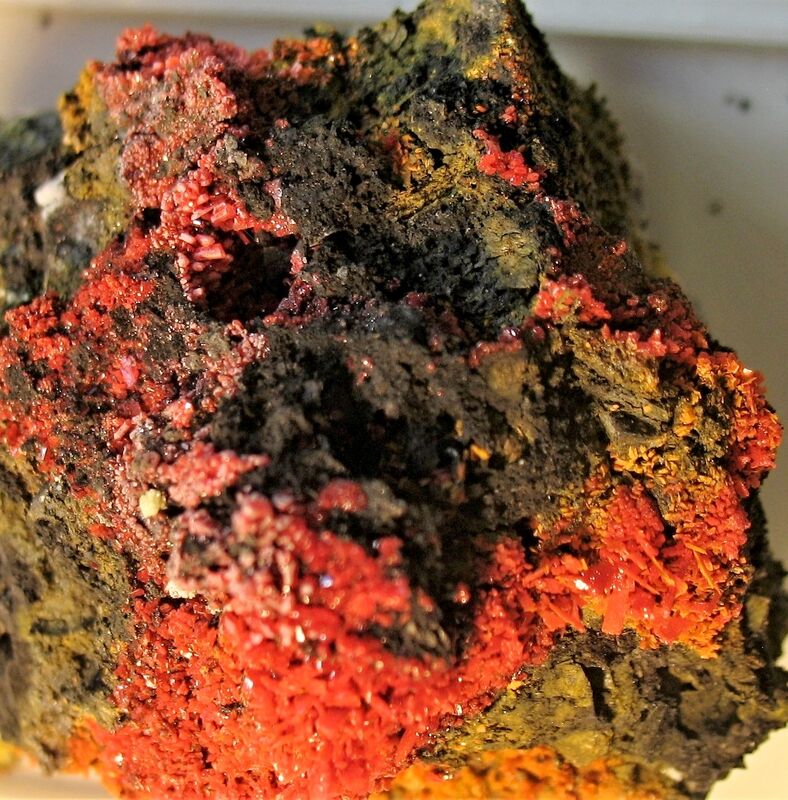
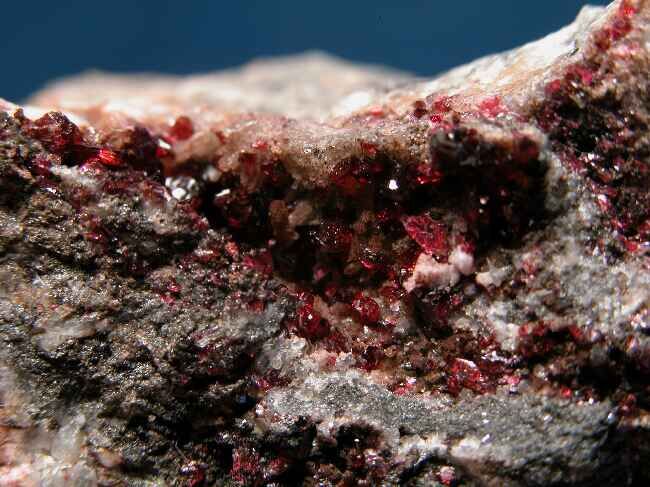
Usually formed from volcanic action - as a deposition product from volcanic gasses associated with realgar, cinnabar and other minerals. It is also found in some vein deposits and as an alteration product of sulphide minerals. It can also be formed biogenically - a major source being salt domes, where it has formed by the bacterial decomposition of calcium sulfate.
Varieties
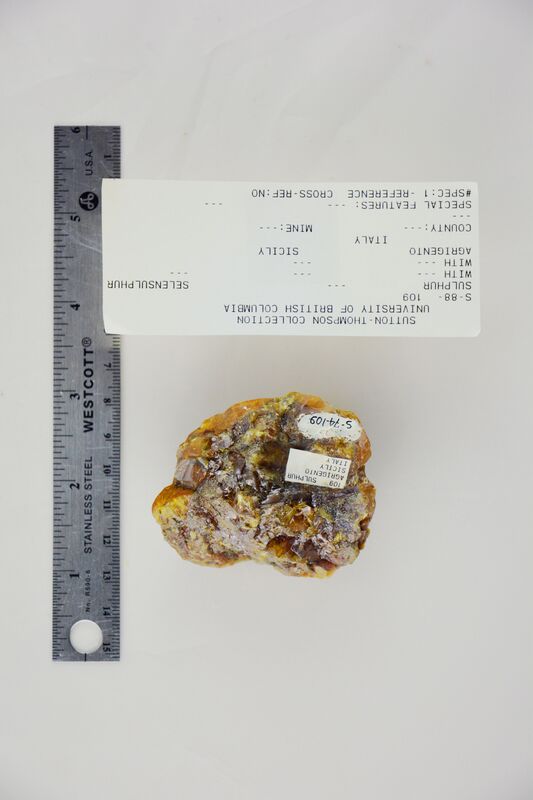
Physical
- Hardness
- 1Talc
- 2Gypsum
- 3Calcite
- 4Fluorite
- 5Apatite
- 6Orthoclase
- 7Quartz
- 8Topaz
- 9Corundum
- 10Diamond
- Lustre
- Resinous
- Transparency
- Transparent · Translucent
- Colour
- Yellow · sulphur-yellow · brownish or greenish yellow · orange · white
- Streak
- Colourless
- Tenacity
- brittle
- Cleavage
- Imperfect/Fair
Imperfect on (001), (110) and (111).
Also can be somewhat sectile
- Fracture
- Irregular/Uneven · Conchoidal
- Density
- 2.07 g/cm³
Optical
- Optical type
- Biaxial (+) · 2V measured = 68° · 2V calc = 70°
- Refractive index
- 1.9579 – 2.2452
- Surface relief
- Very high
- Principal indices
- nα 1.9579 · nβ 2.0377 · nγ 2.2452
- Pleochroism
- Visible
- Dispersion
- relatively weak r< v
- Luminescence
- None
Crystallography
- Space group
- #53
- Cell parameters
- a = 10.468 Å · b = 12.870 Å · c = 24.49 Å
- Ratio a:b:c
- 1 : 1.229 : 2.340
- Z
- 128
- Morphology
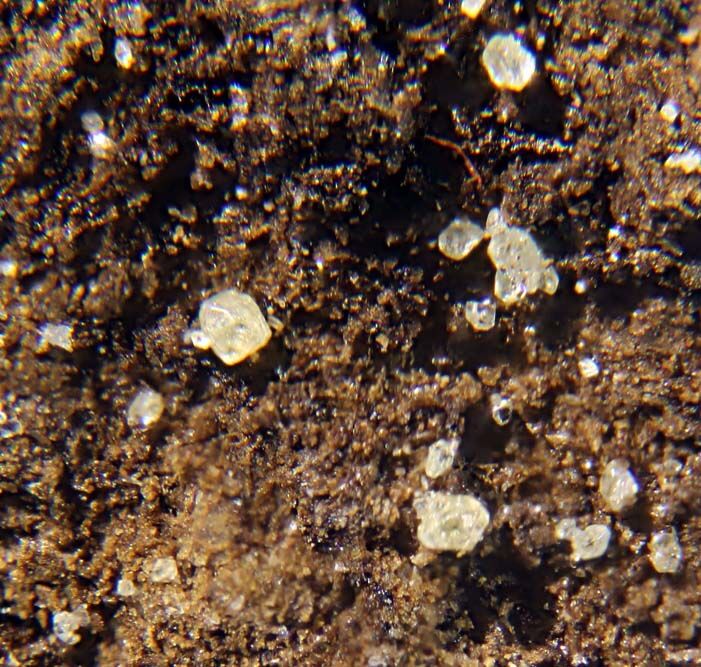
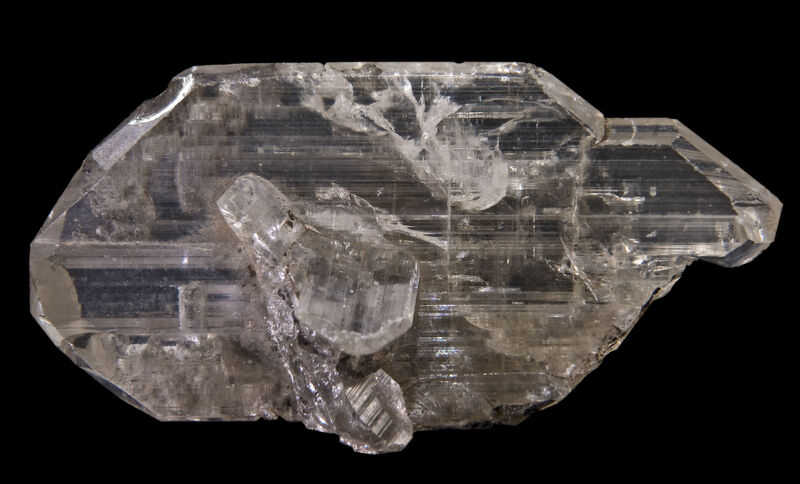
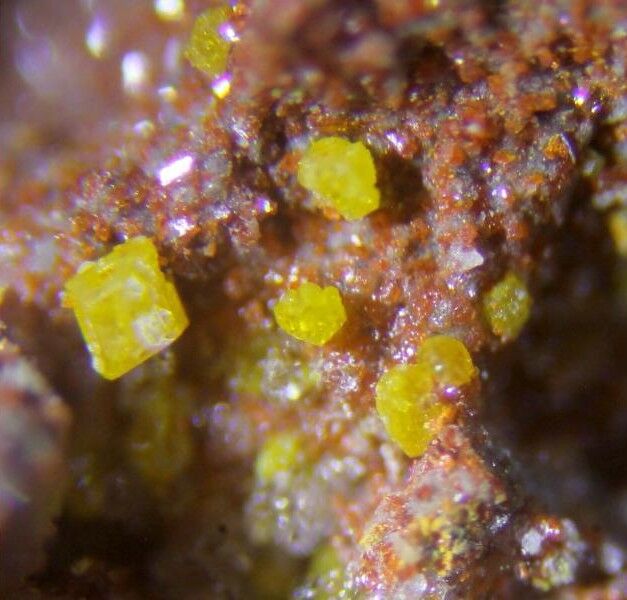
Over 50 forms have been noted, blocky dipyramidal ones most common, also tabular and sphenoidal; also found as powdery coatings, massive material, and in reniform and stalactic forms.
- Twinning
On (101)(011)(110) rare.
- Parting
- Parting on (111)
Chemical composition
- Impurities
- Se
- Te
Synonyms
- a-Sulphur
- Alpha-Sulfur
- Alpha-Sulphur
- Asuphri
- Azufre
- Belerang
- Brennisteinn
- Brimstone
- Enxofre
- Gediegen Schwefel
- Itaysy
- Kén
- Kibrît
- Kükürd
- Kükürt
- Liù-vòng
- Lưu huỳnh
- Native S
- Native Sulfur
- Pungatara
- Rikki
- Salina ( error)
- Schwefel
- Schwiefel
- Sērs
- Siarka
- Siera
- Sliri
- Sofre
- Solfar
- Solfer
- Solfo
- Squfuri
- Sufre
- Sulf
- Sulfar
- Sulfer
- Sulfo
- Sulfre
- Sulfur
- Sulfur-alpha
- Sulfur-α
- Sulfuri
- Sulfuro
- Sulphur
- Sulphur-alpha
- Sulphur-α
- Sumpor
- Sùrfuru
- Svavel
- Svovel
- Svovl
- Swawel
- Swevel
- Sylffwr
- Syrik
- Tlequiquiztlālli
- Walirang
- Welirang
- Xofre
- Zolfo
- Zolfu
- Zwavel
- α-Sulfur
- α-Sulphur
- Θείο
- கந்தகம்
- గంధకము
- ಗಂಧಕ
- ഗന്ധകം
In other languages
- French
- soufre
- German
- Schwefel, gediegen
- Italian
- sulphur · zolfo nativo
- Japanese
- 自然硫黄
- Russian
- Самородная сера
Classification
1.CC.05
- 1ElementsClass
- 1.CMetalloids and NonmetalsDivision
- 1.CCSulfur-selenium-iodineGroup
- 1.CC.05Native SulphurSpecies
01.03.05.01
- 01Native Elements and AlloysClass
- 01.03Semi-metals and non-metalsType
- 01.03.05Sulfur Polymorph groupGroup
- 01.03.05.01Native SulphurSpecies
1.51
- 1Elements and Alloys (including the arsenides, antimonides and bismuthides of Cu, Ag and Au)Class
- 1.51— unnamed intermediate level —Group
- 1.51Native SulphurSpecies
Group, growth & confusion
Literature, links & citation
- 1944Palache, Charles, Berman, Harry, Frondel, Clifford (1944) The System of Mineralogy (7th ed.) Vol. 1 - Elements, Sulfides, Sulfosalts, Oxides. John Wiley and Sons, New York.
- 1951Ventriglia, U. (1951) Sulla struttura dello zolfo rombico. Periodico di Mineralogia: 237-255.
- 1955Abrahams, S. C. (1955) The crystal and molecular structure of orthorhombic sulfur. Acta Crystallographica, 8 (11) 661-671 doi:10.1107/s0365110x55002089DOI: 10.1107/s0365110x55002089
- 1961Abrahams, S. C. (1961) Scale factors, form factors and bond lengths in orthorhombic sulfur. Acta Crystallographica, 14 (3) 311 doi:10.1107/s0365110x61000930DOI: 10.1107/s0365110x61000930
- 1961Cooper, A. S., Bond, W. L., Abrahams, S. C. (1961) The lattice and molecular constants in orthorhombic sulfur. Acta Crystallographica, 14 (9) 1008 doi:10.1107/s0365110x61002953DOI: 10.1107/s0365110x61002953
Entry last updated
@misc{mineral2026,
  author    = {Mineral Index editorial board},
  title     = {Native Sulphur — Mineral Index},
  year      = {2026},
  url       = {https://mineralindex.org/minerals/native-sulphur-3826}
}