Where it forms, where it's found
- Geological setting
In nepheline syenite and in miarolitic cavities in nepheline syenite.
- Type locality
- Poudrette quarry (De-Mix quarry
- Demix quarry
- Uni-Mix quarry
- Carrière Mont Saint-Hilaire
- MSH)
- Mont Saint-Hilaire
- La Vallée-du-Richelieu RCM
- Montérégie
- Québec
- Canada
45.5628°, -73.1417°
9recorded occurrences
Physical
Optical
- Optical type
- Biaxial (-) · 2V measured = 72 – 84° · 2V calc = 72°
- Refractive index
- 1.743 – 1.81
- Surface relief
- High
- Principal indices
- nα 1.743 · nβ 1.785 · nγ 1.810
- Pleochroism
- Strong
X = pale yellow; Y = yellow; Z = brownish red to deep red.
- Dispersion
- r > v moderate
- Extinction
- Y = b; X ∧ c = 15° (in obtuse angle β).
- UV response
- Not fluorescent.
Δ = 0Δmax
PPLpleochroism per grain
XPLindependent extinctions · rotate the stage
PPLpleochroism only · colour blends on rotation
XPLinterference colour · extinct every 90°
Retardation670 nm
Order2nd order
XPL colour
Crystallography
- Space group
- P21/a
- Cell parameters
- a = 10.798 Å · b = 9.835 Å · c = 7.090 Å
- Cell angles
- β = 108.08 °
- Ratio a:b:c
- 1 : 0.911 : 0.657
- Z
- 4
- Morphology
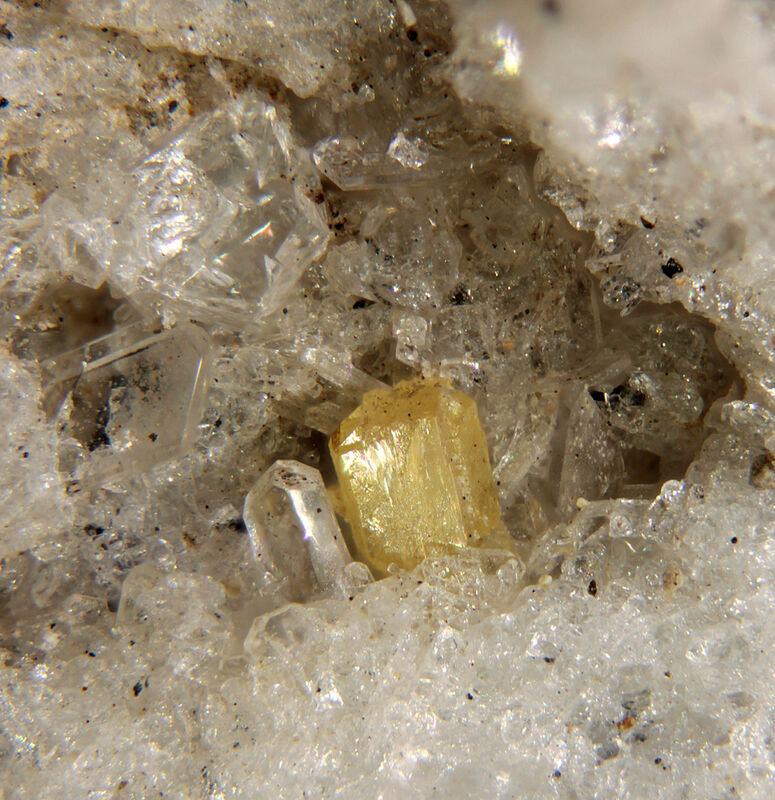
Elongate on [001] and flattened on (010). Forms include (100), (110) and (001). The (100) and (110) faces are commonly striated longitudinally.
- Type-locality form
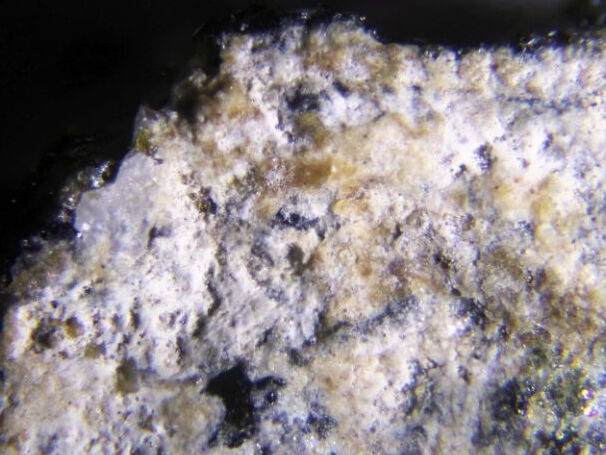
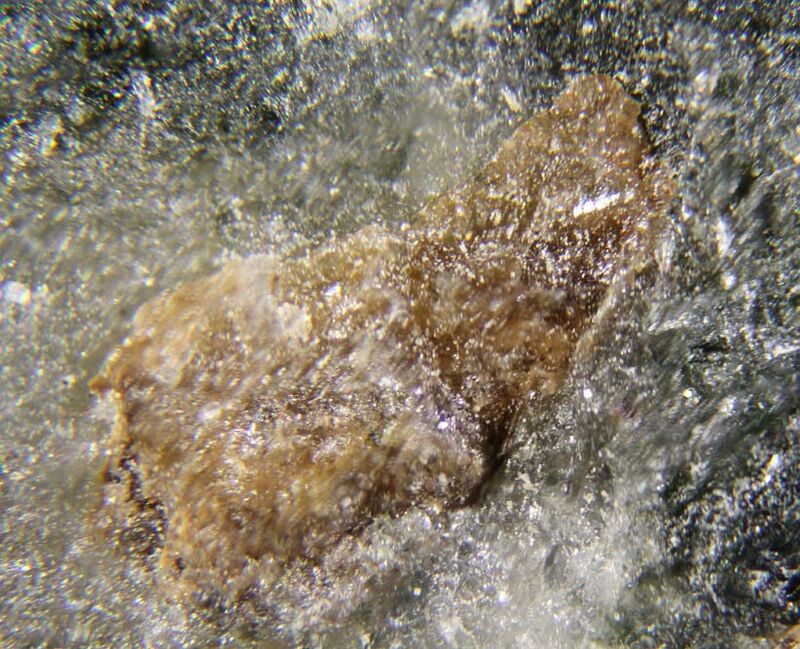
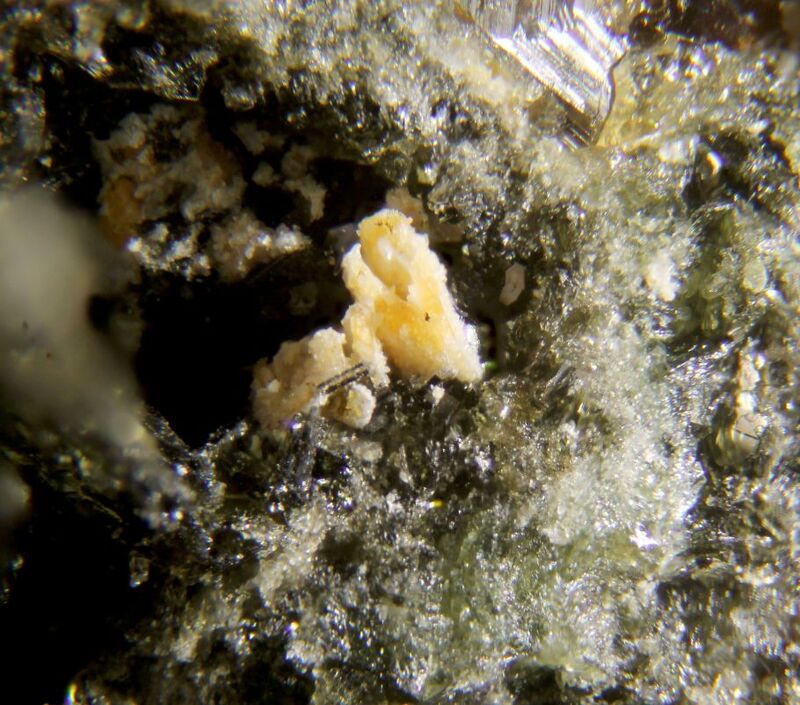
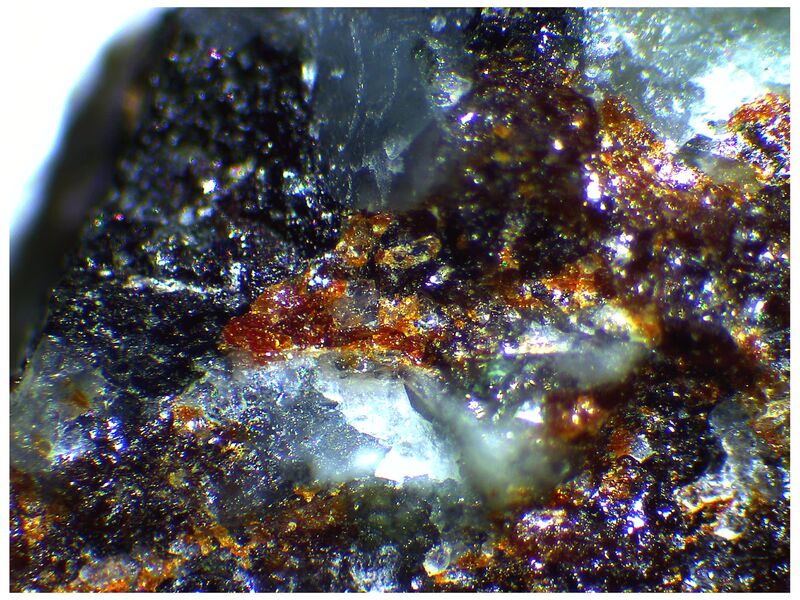
Orange-brown aggregates of subparallel acicular crystals up to 10 mm in length, and as patches of yellow, fibrous crystals.
Crystal structure
Chemical composition
Synonyms
- IMA1990-021
- Unnamed (MSH UK-59)
In other languages
- French
- Normandite
- German
- IMA 1990-021 · Normandit
- Italian
- Normandite
Classification
Strunz
10th ed.9.BE.17
- 9SilicatesClass
- 9.BSorosilicatesDivision
- 9.BESi2O7 groups, with additional anions; cations in octahedral [6] and greater coordinationGroup
- 9.BE.17NormanditeSpecies
Group, growth & confusion
 BaghdaditeCa6Zr2(Si2O7)2O4Mineral—
 BurpaliteNa4Ca2Zr2(Si2O7)2F4Mineral—
 CuspidineCa8(Si2O7)2F4Mineral—
 HiortdahliteNa2Ca4(Ca0.5Zr0.5)Zr(Si2O7)2OF3Mineral—
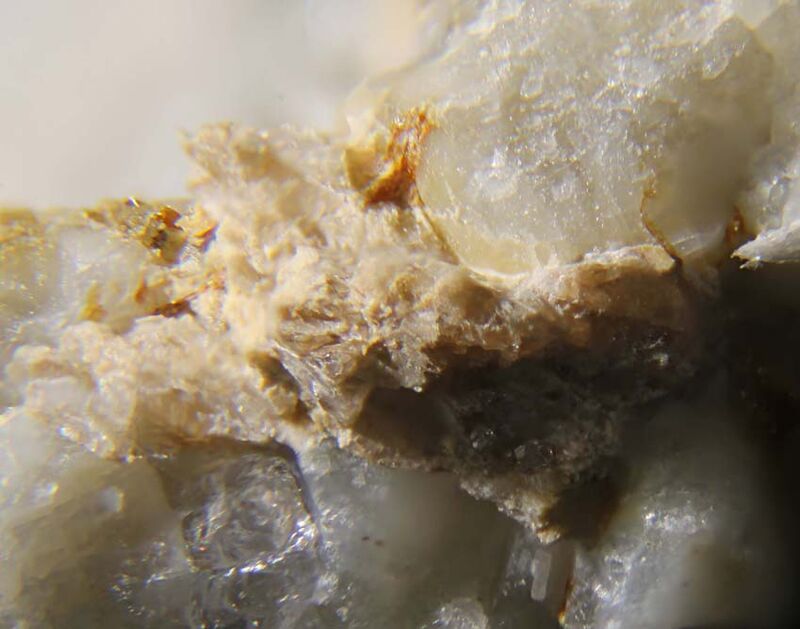 JanhaugiteNa3Mn2+3Ti2(Si2O7)2(O,OH,F)4Mineral—
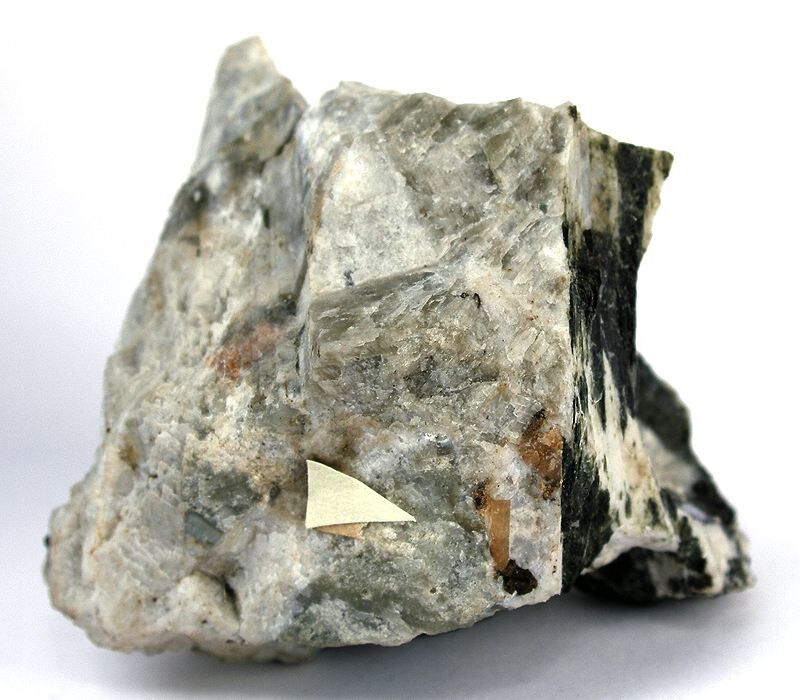 Låvenite(Na,Ca)4(Mn2+,Fe2+)2(Zr,Ti,Nb)2(Si2O7)2(O,F)4Mineral—
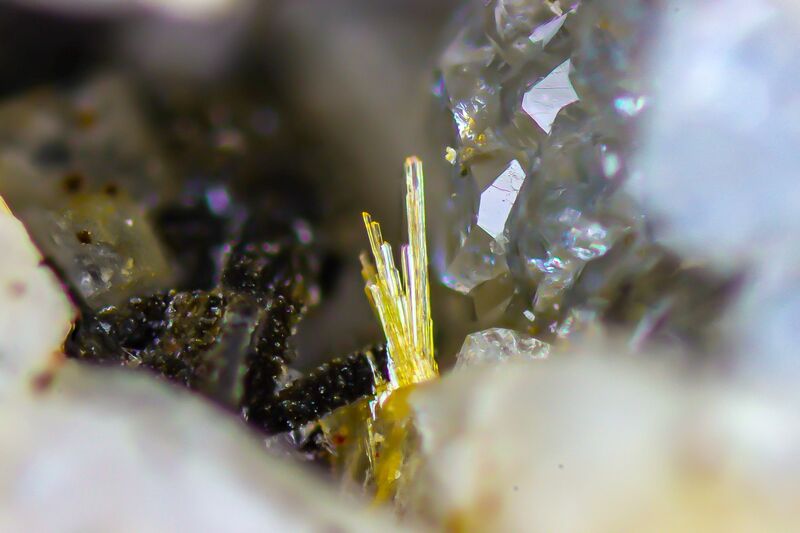 MadeiraiteNa2Ca2Fe2Zr2(Si2O7)2O2F2Mineral—
- MoxuanxueiteNaCa6Zr(Si2O7)2OF3Mineral—
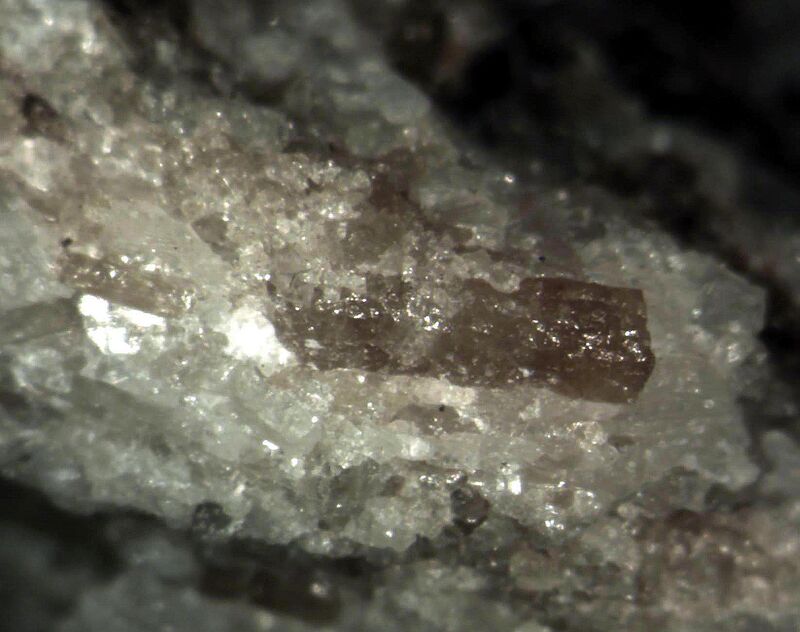 NiocaliteCa7Nb(Si2O7)2O3FMineral—
 PilanesbergiteNa2Ca2Fe2Ti2(Si2O7)2O2F2Mineral—
Literature, links & citation
Citations
- 1997Chao, G. Y., Gault, R. A. (1997) Normandite, the Ti-analogue of låvenite from Mont Saint-Hilaire, Quebec. The Canadian Mineralogist, 35 (4) 1035-1039
- 2000Perchiazzi, N., McDonald, A. M., Gault, R. A., Johnsen, O., Merlino, S. (2000) The crystal structure of normandite and its crystal-chemical relationships with låvenite. The Canadian Mineralogist, 38 (3). 641-648 doi:10.2113/gscanmin.38.3.641 DOI: 10.2113/gscanmin.38.3.641
Cite this entry
Entry last updated
@misc{mineral2025,
  author    = {Mineral Index editorial board},
  title     = {Normandite — Mineral Index},
  year      = {2025},
  url       = {https://mineralindex.org/minerals/normandite-2932}
}