Where it forms, where it's found
- Geological setting
Thin seams in fissures in trachytic rocks, with phosphate derived from guano.
- Type locality
- Sugar Loaf Islands
- New Plymouth
- New Plymouth District
- Taranaki Region
- New Zealand
-39.0494°, 174.0278°
50recorded occurrences
Physical
- Transparency
- Transparent
- Colour
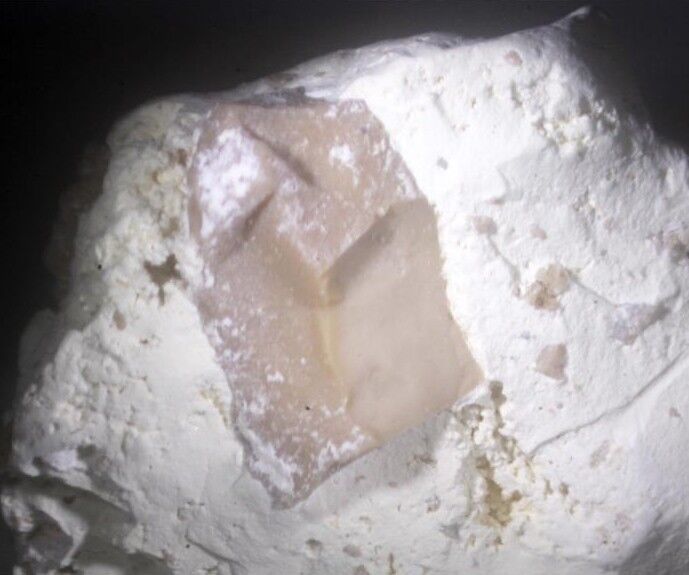
- Yellow · gray · white
Colourless in transmitted light.
- Tenacity
- malleable
- Density
- 2.12 g/cm³
Optical
- Optical type
- Uniaxial (-)
- Refractive index
- 1.5 – 1.51
- Surface relief
- Moderate
- Principal indices
- nω 1.506 – 1.51 · nε 1.5 – 1.503
Δ = 0Δmax
PPLpleochroism per grain
XPLindependent extinctions · rotate the stage
PPLpleochroism only · colour blends on rotation
XPLinterference colour · extinct every 90°
Retardation65 nm
Order1st order
XPL colour
Crystallography
- Space group
- #98
- Cell parameters
- a = 8.7025 Å · c = 95.05 Å
- Z
- 6
- Morphology
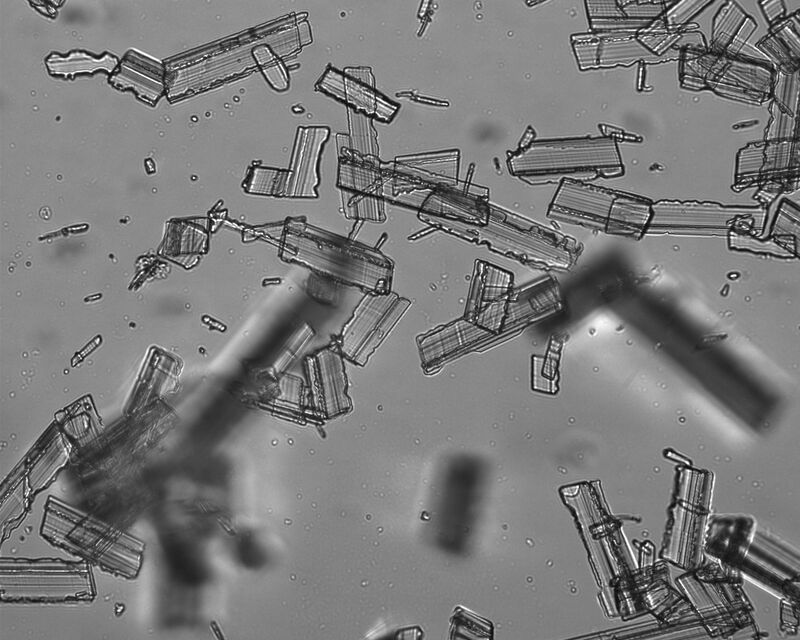
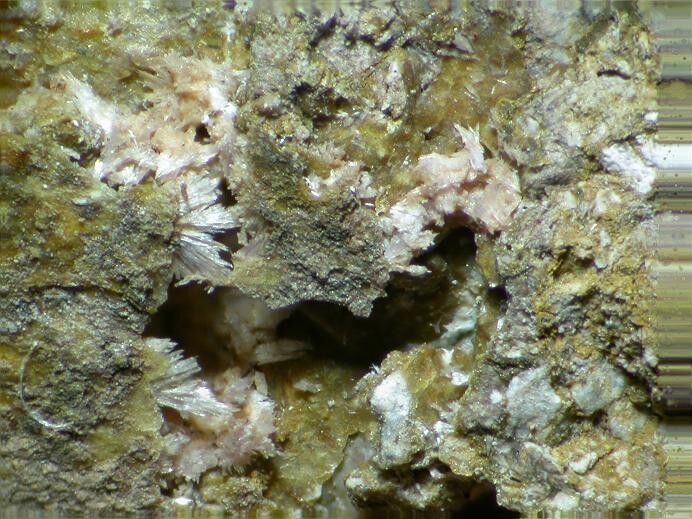
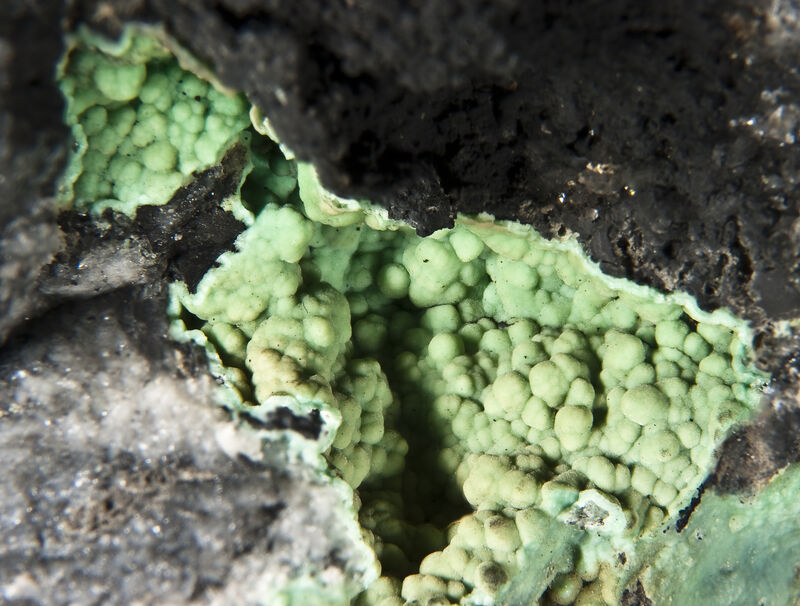
Crystals pseudohexagonal, platy; minute, lath-like and commonly in compact nodular aggregates, powdery, flour-like to claylike; massive.
- Comment
Space group determined from synthetic material.
Crystal structure
Chemical composition
Synonyms
- Minervit
- Minervita
- Minervite
- Palmerite
- Taranakiet
- Tarankite
In other languages
- French
- Taranakite
- German
- Taranakit
- Italian
- Taranakite
Classification
Strunz
10th ed.8.CH.25
- 8Phosphates, Arsenates, VanadatesClass
- 8.CPhosphates without additional anions, with H2ODivision
- 8.CHWith large and medium-sized cations, RO4:H2O < 1:1Group
- 8.CH.25TaranakiteSpecies
Dana
8th ed.39.03.06.01
- 39Hydrated Acid Phosphates, Arsenates and VanadatesClass
- 39.03MiscellaneousType
- 39.03.06— unnamed intermediate level —Group
- 39.03.06.01TaranakiteSpecies
CIM
—19.8.7
- 19PhosphatesClass
- 19.8Phosphates of Al and other metalsGroup
- 19.8.7TaranakiteSpecies
Group, growth & confusion
Literature, links & citation
Citations
- 1865Hector, J., Skey, W. (1865) Taranakite, a new phosphatic mineral, Taranaki, presented by H. Richmond, Esq. in Appendix A. Supplementary Report on Class 1. Reports of the Jurors, New Zealand Expedition, pg. 423.
- 1882Cox, S.H. (1882) Notes on the Mineralogy of New Zealand. Transactions and Proceedings of the New Zealand Institute, 15. 361-409
- 1893Gautier (1893) Comptes rendu de l’Académie des sciences de Paris: 116: 928, 102, 1171, 1271 (as Minervite).
- 1894Gautier (1894) V-Minervite; nouveau phosphate d'almine hydrat. Annales des mines: 5: 23 (as Minervite).
- 1895Carnot, M.-A. (1895) Sur un gisement de phosphates d'alumine et de potasse trouve en Algerie et sur la genese de ces mineraux. Annales des mines: 8: 319.
Cite this entry
Entry last updated
@misc{mineral2025,
  author    = {Mineral Index editorial board},
  title     = {Taranakite — Mineral Index},
  year      = {2025},
  url       = {https://mineralindex.org/minerals/taranakite-3890}
}