History
The name tremolite points at a place its founding specimens never came from. But the human story of the mineral begins thousands of years before anyone gave it that name — not with its clear crystals, but with its tangled, fibrous form.
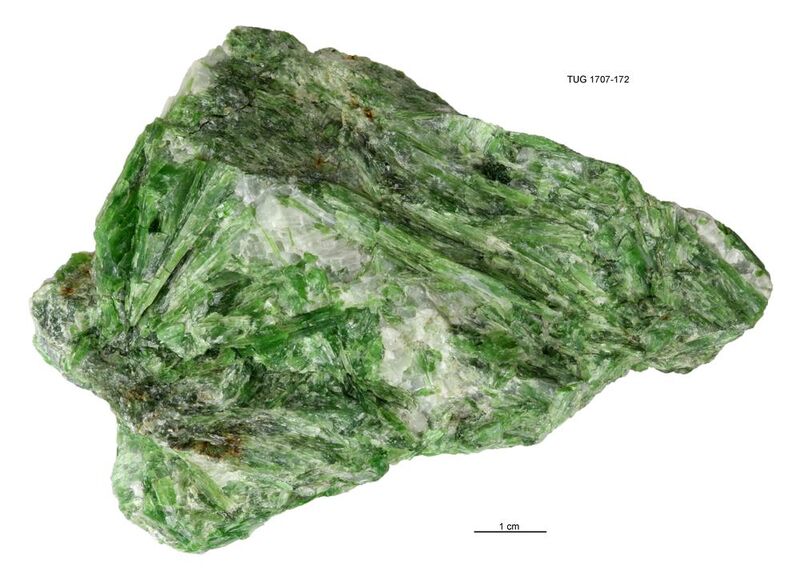
When countless tiny tremolite and actinolite fibres interlock, they make nephrite, one of the two stones the world calls jade. Nephrite is extraordinarily tough, and that toughness made it the working stone of several ancient cultures. In Neolithic China it was carved into ceremonial and everyday objects, from small ornaments to whole burial suits, by the Liangzhu and Hongshan cultures. In New Zealand the Māori worked the same stone — they call it pounamu — into weapons, ornaments, and tools. Among them were the short club known as the mere, the neck pendant called the hei-tiki, and adzes for cutting. Carved nephrite was also the main good traded along the prehistoric Maritime Jade Road across Southeast Asia, with production peaking between about 2000 BCE and 500 CE.
A formal mineral name came only at the close of the 18th century, and even then it arrived twice. In 1782 Johann Ehrenreich von Fichtel called material from Sebeşu de Jos, in Transylvania, Säulenspath and Sternspath — the column-spar and star-spar.
It was the second name that lasted. In 1789 the Swiss naturalist Johann Georg Albrecht Höpfner christened the mineral after Val Tremola, the Tremola valley in the central St Gotthard massif of Ticino, southern Switzerland. He chose that valley because the dealer who sold him the specimens said it was where they were found. The dealer was wrong. Modern study of the surviving type material, now kept in Geneva, places the true source at Campolungo, about 14 kilometres further south. The name stuck anyway, fixed to a valley that, unlike Campolungo, lies on the wrong side of the geological line where tremolite first appears.
Industrial & practical applications
Tremolite is not a mineral the world mines for its own sake. Its place in modern life is split between one prized ornamental form and a serious health hazard.
The ornamental form is nephrite, one of the two stones sold as jade and built from densely interlocked tremolite and actinolite fibres. Its toughness lets carvers cut fine, durable detail, and it remains a working material for jade jewellery and carved objects today.
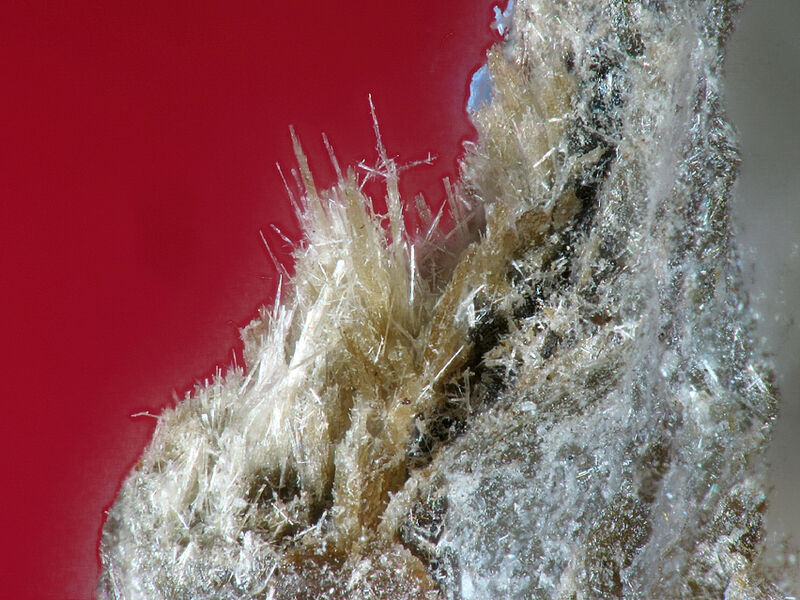
The hazard comes from tremolite's fibrous form, which is one of the six recognised types of asbestos. Breathing in asbestiform tremolite can cause asbestosis — scarring of the lungs — along with lung cancer and mesothelioma, a cancer of the lining around the lungs. Most exposure is not deliberate. Fibrous tremolite turns up as a contaminant in vermiculite, in talc, and in chrysotile, itself another form of asbestos.
The clearest illustration is Libby, Montana. A vermiculite mine there laced the town with tremolite fibres. By the time W.R. Grace bought the mine in 1963, it produced 80% of the world's vermiculite. Close to a tenth of the population later died of asbestos-related disease. The cleanup became the first public-health emergency the United States Environmental Protection Agency ever declared. Some tremolite asbestos is also still mined on purpose: about 40,200 tons a year in India.
Where it forms, where it's found
- Geological setting
Dolomite marble
A common rock-forming mineral in contact metamorphosed Ca+/-Mg siliceous carbonate sediments, regional greenschist to amphibolite facies metamorphosed mafic and ultramafic rocks and dolomitic rocks, many skarns and veins, and some metamorphic ore deposits. See Deer et al., 1997.
- Type locality
- Campolungo
- Piumogna Valley
- Leventina
- Ticino
- Switzerland
46.4594°, 8.7192°
Varieties
Safety & handling
Physical
- Hardness
- 1Talc
- 2Gypsum
- 3Calcite
- 4Fluorite
- 5Apatite
- 6Orthoclase
- 7Quartz
- 8Topaz
- 9Corundum
- 10Diamond
- Lustre
- Vitreous
- Transparency
- Transparent · Translucent
- Colour
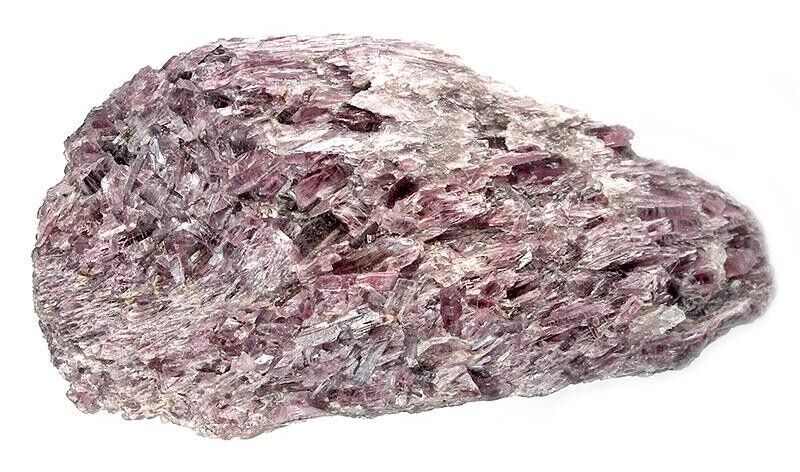
- White · brown · colourless · grey · light green · green · light yellow · pink-violet
- Streak
- White
- Tenacity
- brittle
- Cleavage
- Perfect
on (110)
- Fracture
- Splintery
- Density
- 2.99 g/cm³
Optical
- Optical type
- Biaxial (-) · 2V measured = 88 – 80° · 2V calc = 82 – 84°
- Refractive index
- 1.599 – 1.637
- Surface relief
- Moderate
- Principal indices
- nα 1.599 – 1.612 · nβ 1.613 – 1.626 · nγ 1.625 – 1.637
- Dispersion
- r < v weak
- Luminescence
- Nonfluorescent
Crystallography
- Space group
- C2/m
- Cell parameters
- a = 9.84 Å · b = 18.02 Å · c = 5.27 Å
- Cell angles
- β = 104.95 °
- Ratio a:b:c
- 1 : 1.831 : 0.536
- Z
- 2
- Morphology
Elongated, stout prismatic, bladed, fibrous, granular, columnar crystals and aggregates.
- Twinning
Simple or multiple: common parallel to (100), rarely parallel to (001)
- Parting
- on (010) (100)
Chemical composition
- Impurities
- Ti
- Mn
- Al
- Cr
- Na
- K
- F
- Cl
- H2O
Synonyms
- Abcasit
- Abchasit
- Abhazit
- Abhazita
- Abhazite
- Abkhazit
- Abkhazita
- Abkhazite
- Calamit
- Calamita
- Calamite
- Grammatite
- Kalamit
- Peponit
- Peponita
- Peponite
- Raphilite
- Säulenspath
- Sebesit
- Sebesita
- Sebesite
- Sternspath
- Tremolith
In other languages
- French
- Grammatite · Hoepfnerite · Nordenskiöldite · Péponite · Raphilite · Sebesite · Semi-néphrite · Trémolite · Zéolithe en colonne
- German
- Grammatit · Tremolit
- Spanish
- tremolita
- Italian
- säulenspath · sternspath · tremolite
- Portuguese
- Tremolita · tremolite
- Japanese
- トレモライト · 透角閃石 · 透閃石
- Chinese
- 透閃石 · 透闪石
- Simplified Chinese
- 透闪石
- Traditional Chinese
- 透閃石
- Russian
- Тремолит
Classification
9.DE.10
- 9SilicatesClass
- 9.DInosilicatesDivision
- 9.DEInosilicates with 2-periodic double chains, Si4O11; ClinoamphibolesGroup
- 9.DE.10TremoliteSpecies
66.01.3a.01
- 66Inosilicates Double-width, Unbranched Chains, (w=2)Class
- 66.01Amphiboles - Mg-Fe-Mn-Li subgroupType
- 66.01.3a— unnamed intermediate level —Group
- 66.01.3a.01TremoliteSpecies
14.6.13
- 14Silicates not Containing AluminumClass
- 14.6Silicates of Ca with alkali or Mg or bothGroup
- 14.6.13TremoliteSpecies
Group, growth & confusion
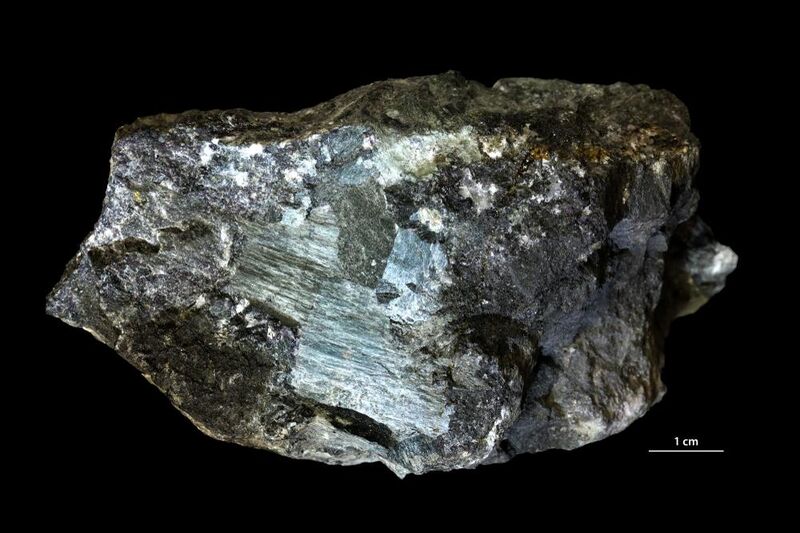
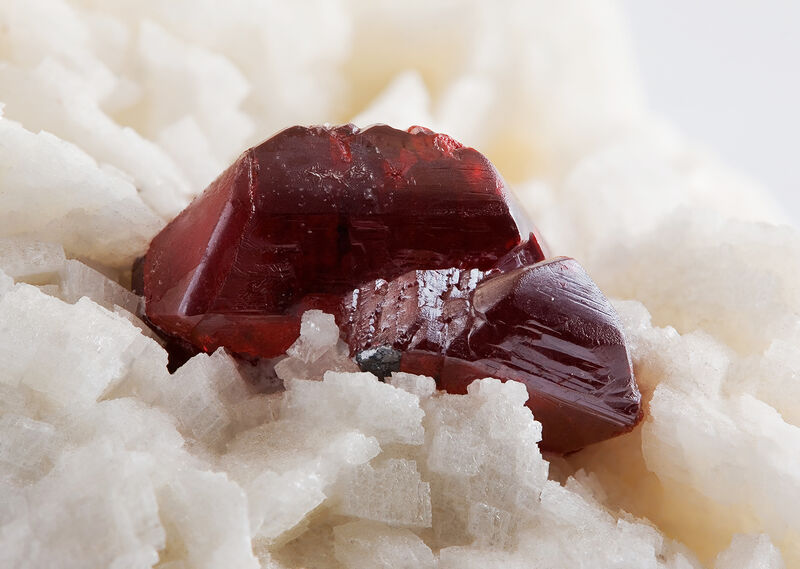
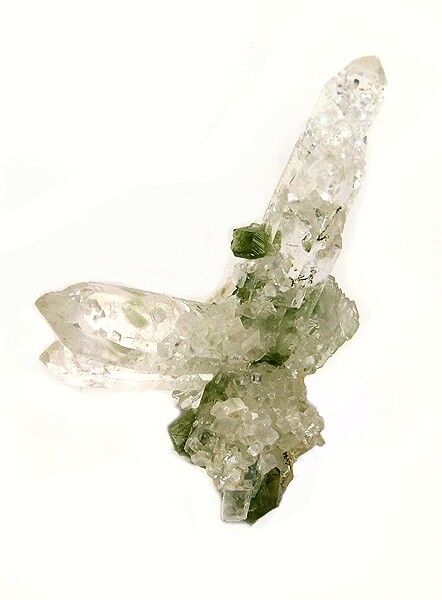
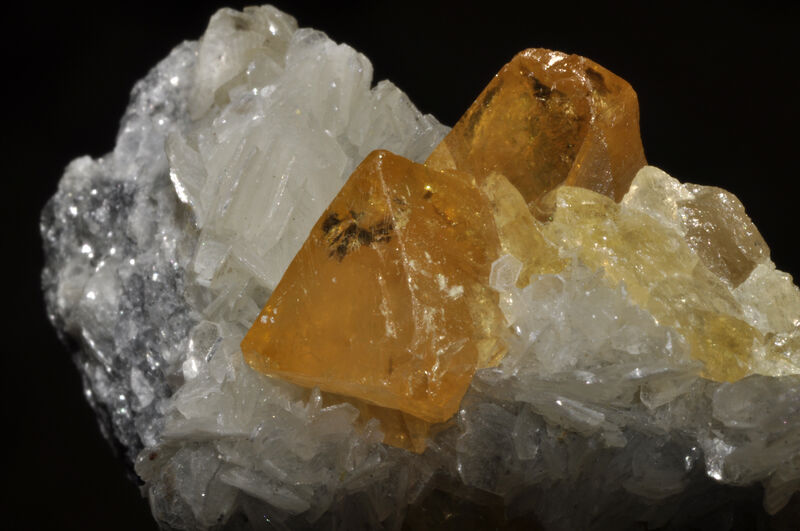
Literature, links & citation
- —Walitzi, E. M., Ettinger, K. (1986): Verfeinerung der Kristallstruktur eines Tremolites vom Ochsenkogel (Gleinalpe/Steiermark), Österreich. Neues Jahrb. Mineral. Monatsh., 1986: 360-366.
- 1782Fichtel, J.E.v. (1782) Geschichte und Beschreibung einer in Siebenbürgen neu entdeckten Steinart, welche man Säulenspath und Sternspath nennen könnte. Schriften der Berlinischen Gesellschaft naturforschender Freunde 3, 442-455. [as Säulenspath and Sternspath]
- 1789Höpfner, J.G.A. (1789) I. Ueber die Klassifikation der Fossilien in einem Schreiben des Herausgebers an Herrn Dr. Karsten in Halle. II. Versuch einer neuen Classifikationsmethode der Stein- und Erdarten, nach den neuesten chemischen Erfahrungen. Magazin für die Naturkunde Helvetiens: 4: 255-332.
- 1959SHIDO, Fumiko (1959) Notes on Rock-Forming Minerals (8) Chemical, Optical and X-Ray Data on a Tremolite and Three Actinolites. The Journal of the Geological Society of Japan, 65 (768) 563-565 doi:10.5575/geosoc.65.563DOI: 10.5575/geosoc.65.563
- 1960STEMPLE, IRENE S., BRINDLEY, G. W. (1960) A Structural Study of Talc and Talc-Tremolite Relations. Journal of the American Ceramic Society, 43 (1). 34-42 doi:10.1111/j.1151-2916.1960.tb09149.xDOI: 10.1111/j.1151-2916.1960.tb09149.x
Entry last updated
@misc{mineral2026,
  author    = {Mineral Index editorial board},
  title     = {Tremolite — Mineral Index},
  year      = {2026},
  url       = {https://mineralindex.org/minerals/tremolite-4011}
}