History
The mineral now called scheelite carried, for most of its early history, the name that today belongs to a chemical element. The Swedes called it tungsten — Swedish for heavy stone — because a crystal of it weighed far more than its size suggested. The terminology has been untangling itself ever since.
The mineral was first described in 1751, at Mount Bispbergs klack near Säter, in the Swedish province of Dalarna. At that point it was a curiosity — a dense, pale, well-formed crystal with no known purpose and an awkward name shared with no other substance.
That changed in 1781. The Swedish chemist and apothecary Carl Wilhelm Scheele dissolved the mineral in acid and recovered a new oxide, which he called tungstic acid. He had proved that the heavy stone contained an element no one had isolated. Two years later, in 1783, the Spanish chemists Juan José and Fausto Elhuyar reduced that acid with charcoal and obtained the metal itself.
This is where the names tangle. In English, the metal kept the Swedish word tungsten — even though the Swedes themselves used that word for the mineral, not the element. In German, Spanish, French and most Slavic languages, the metal is wolfram, after another tungsten ore called wolframite. The symbol W on the periodic table, introduced by the chemist Jöns Jacob Berzelius, preserves the wolfram lineage in chemistry worldwide.
The mineral itself needed a new name. In 1821, the German mineralogist Karl Caesar von Leonhard proposed scheelite, posthumously honouring Scheele. Leonhard's name held, and the older Swedish tungsten moved entirely to the element.
For the rest of the 19th century scheelite remained a curiosity of mineral cabinets. It acquired commercial value in the 20th century, when tungsten metal became used in alloy steels and in the filaments of electric lamps.
Industrial & practical applications
Scheelite is an important ore of tungsten. Its industrial life today is, almost entirely, the industrial life of the metal it carries.
The dominant use of tungsten, accounting for roughly half of global consumption, is tungsten carbide in cemented carbides. These are wear-resistant composites — also called hardmetals — in which hard carbide grains are held together by a metallic binder. The result is a cutting edge that lasts: drill bits, machining tools and gauges, and the dies used by the metalworking, mining and construction industries. When a metalworking, mining or construction operation needs something harder than steel and tougher than a ceramic, it reaches for tungsten carbide.
Tungsten metal goes into a second tier of demanding applications. Drawn into fine wire, it forms the electrodes used in welding and the filaments still found in some specialty lamps. Alloyed into tool steels, it produces cutting steels that hold their hardness even when red-hot from friction. Alloyed into superalloys, it strengthens the turbine blades of jet engines and the components of rocket-engine nozzles, where temperatures push other metals toward creep.
Two further uses lean on tungsten's exceptional density. Heavy-metal alloys are cast or sintered for armaments, heat sinks, counterweights and other high-density applications. Tungsten chemical compounds, meanwhile, serve as catalysts, inorganic pigments and high-temperature lubricants.
Scheelite also has a use that does not require extracting the metal at all. The mineral fluoresces under ultraviolet light, and that response is exploited in phosphors — scintillators for X-ray and gamma-ray detection, and fluorescent lighting that converts ultraviolet to visible light.
Supply is the awkward part of the story. China produced more than 80 percent of the world's mined tungsten in 2016 and holds nearly two-thirds of known reserves. One of the largest scheelite mining operations sits in Luoyang, in central China.
Where it forms, where it's found
- Geological setting
Contact metamorphic tactites, high-temperature hydrothermal veins, greisens, and granitic pegmatites; alluvial deposits.
- Type locality
- Bispbergs Klack
- Säter
- Dalarna County
- Sweden
60.3566°, 15.8157°
Varieties
Physical
- Hardness
- 1Talc
- 2Gypsum
- 3Calcite
- 4Fluorite
- 5Apatite
- 6Orthoclase
- 7Quartz
- 8Topaz
- 9Corundum
- 10Diamond
- Lustre
- Vitreous · adamantine
- Transparency
- Transparent · Opaque
- Colour
- Tan · golden-yellow · colourless · white · greenish · dark brown · etc. · colourless in transmitted light
May be compositionally colour zoned.
- Streak
- White
- Cleavage
- Distinct/Good
Distinct on (101), interrupted on (112), indistinct on (001).
- Fracture
- Irregular/Uneven · Sub-Conchoidal
- Density
- 6.1 g/cm³
Optical
- Optical type
- Uniaxial (+)
- Refractive index
- 1.918 – 1.938
- Surface relief
- Very high
- Principal indices
- nω 1.918 – 1.921 · nε 1.935 – 1.938
- UV response
- Inherently brightly fluorescent (SW UV & X-rays). Pure end-member material ubiquitously fluoresces bright blue-white (SW UV), but even a small amount of Mo substituting for W produces a creamy yellow fluorescence (SW UV), becoming more yellow with increasing % of Mo. A moderate Fe content can quench the fluorescence. It usually has no response to LW UV but some specimens will fluoresce pink to this band.
- Notes
May exhibit weak anomalous birefringence.
Crystallography
- Space group
- #136
- Cell parameters
- a = 5.2429(3) Å · c = 11.3737(6) Å
- Z
- 4
- Morphology
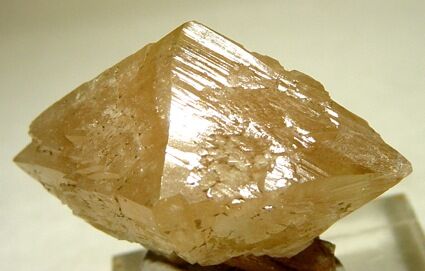
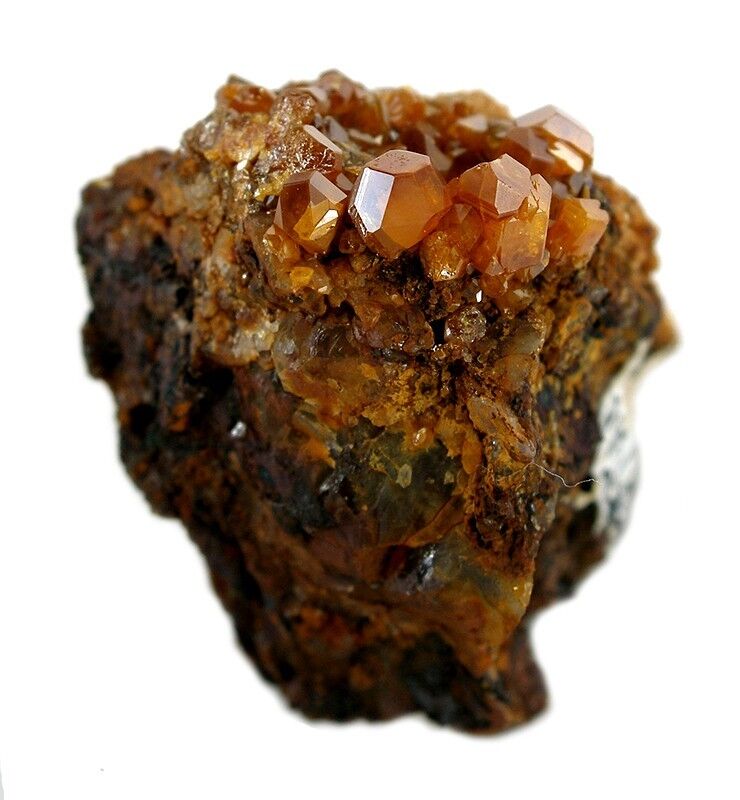
Crystals commonly pseudo-octahedral (011) or (112) predominant, with modifying forms include (001) (013), (121) and/or several additional; tabular on (001) at times; (001) commonly rough; (112) frequently diagonally striated, usually parallel to [_311], the intersection with (121). Usually granular, massive; also columnar.
- Twinning
On (110) common, penetration and contact twins with a composition plane of (110)or (001).
- Epitaxy
Scheelite on wolframite, with scheelite (001) [110] parallel to wolframite (010) [001]. Discrete crystals of fluorite on the (111) face of scheelite from the <l id=2235>Tae Hwa mine, Korea</l> (So et al. 1983).
- Comment
On synthetic material.
Chemical composition
- Impurities
- Mo
- Nb
- Ta
Synonyms
- Calcioscheelit
- Calcioscheelita
- Calcioscheelite
- Calcium tungstate
- Calciumwolframite
- Lapides stanniferi spathecei
- Scheelerz
- Scheelin calcaire
- Scheelspath
- Schwerstein
- Stannum spathosum subdiaphanum album
- Tennspat
- Trimonit
- Trimonita
- Trimonite
- Trimontit
- Trimontita
- Trimontite
- Tungstate of Lime
- Tungstein
- Tungsten (of Scheele)
- Tungstite (of Delamëtherie)
- Tunstitit
- Tunstitita
- Tunstitite
In other languages
- French
- 7790-75-2 · Calcioscheelite · Calciumwolframite · CaWO4 · Schéelin calcaire · Scheelite · Trimontite
- German
- Scheelit
- Spanish
- scheelita
- Italian
- Scheelite
- Portuguese
- scheelita · Scheelite
- Japanese
- 灰重石
- Chinese
- 白钨矿
- Simplified Chinese
- 白钨矿
- Traditional Chinese
- 白鎢礦
- Russian
- Шеелит
Classification
7.GA.05
- 7SulfatesClass
- 7.GMolybdates, Wolframates and NiobatesDivision
- 7.GAWithout additional anions or H2OGroup
- 7.GA.05ScheeliteSpecies
48.01.02.01
- 48Anhydrous Molybdates and TungstatesClass
- 48.01AXO4Type
- 48.01.02Scheelite SeriesGroup
- 48.01.02.01ScheeliteSpecies
27.4.2
- 27Sulphites, Chromates, Molybdates and TungstatesClass
- 27.4TungstatesGroup
- 27.4.2ScheeliteSpecies
Group, growth & confusion
Literature, links & citation
- 1747Wallerius, J.G (1747) Mineralogia, eller Mineralriket. Stockholm: 303 (as Tennspat, Lapides stanniferi spathecei).
- 1751Cronstedt, A. F. (1751) : Rön och Försök Gjorde med trenne Järnmalms arter. Kongl.Svenska VetenskapsAcademien Handlingar 1751: 226-231
- 1758Cronstedt, Axel Fredrik (1758) Försök till en Mineralogie eller Mineral Rikets Upställning. J. A. Carlbohm, Stockholm.
- 1781Scheele (1781) Ak. Stockholm, Handl. (as Tungsten).
- 1789Hoffmann, C.A.S. (1789) Mineralsystem des Herrn Inspektor Werners mit dessen Erlaubnis herausgegeben von C.A.S. Hoffmann. Bergmännisches Journal, 2 (1) 369-398
Entry last updated
@misc{mineral2026,
  author    = {Mineral Index editorial board},
  title     = {Scheelite — Mineral Index},
  year      = {2026},
  url       = {https://mineralindex.org/minerals/scheelite-3560}
}