History
The name says, almost apologetically, that this is something uranium-like. It joins uran, for uranium, to the Greek phainein — to appear. The early chemists could not pin down its exact composition, so they named it for what it merely seemed to be.
That naming came in 1853, from the German mineralogist Christian Friedrich Martin Websky. The bright yellow crystals plainly held uranium, but their full make-up — a calcium uranium silicate carrying water — stayed uncertain for some time. The name records that uncertainty rather than papering over it.
For most of its history the mineral wore a longer label. It was called uranophane-α, to set it apart from uranophane-β, a near-twin built from the same chemistry in a different crystal arrangement. The two are dimorphs — same recipe, different internal packing — and they often turn up in the same deposits. In 2022 the International Mineralogical Association dropped the suffix and let the plain name stand for both the species and its common form. An older name, uranotile, still appears in some literature.
Industrial & practical applications
No one mines uranophane for power. The uranium that drives reactors comes from primary minerals such as uraninite and its dense form pitchblende. Uranophane is a latecomer, forming when those primary minerals weather and oxidise. Where it gathers in quantity it can serve as a local ore of uranium, but it never carries the trade the primary minerals do.
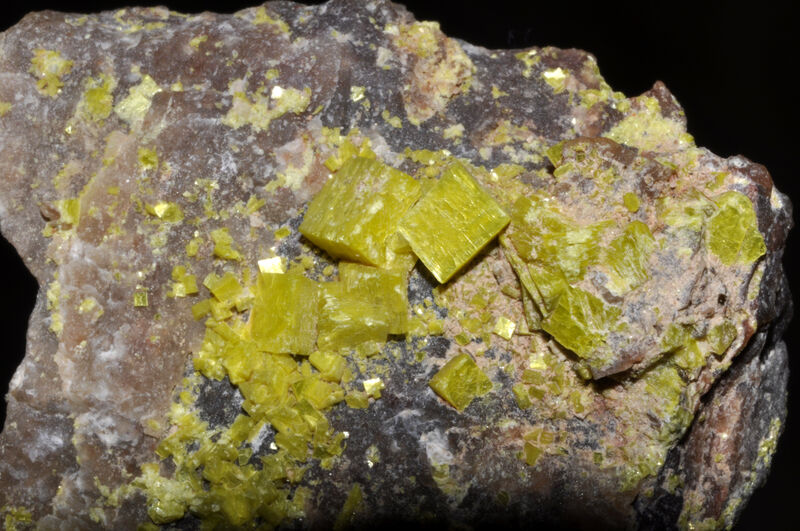
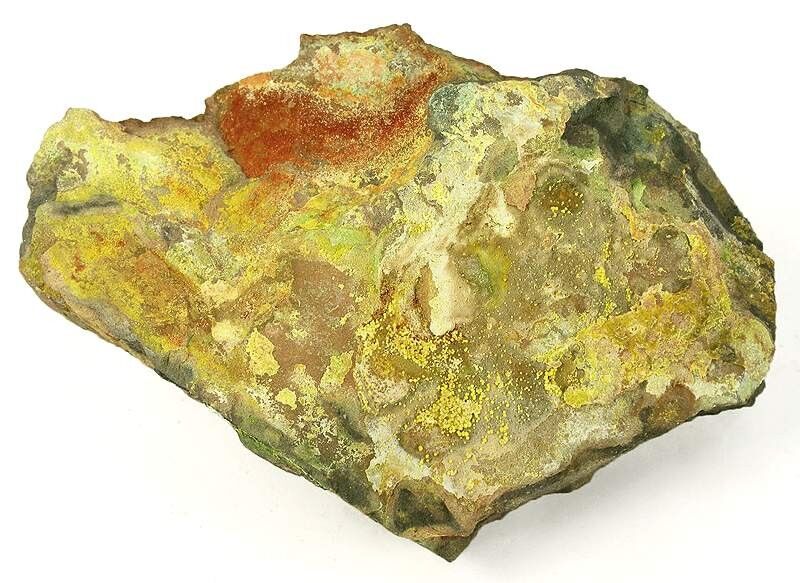
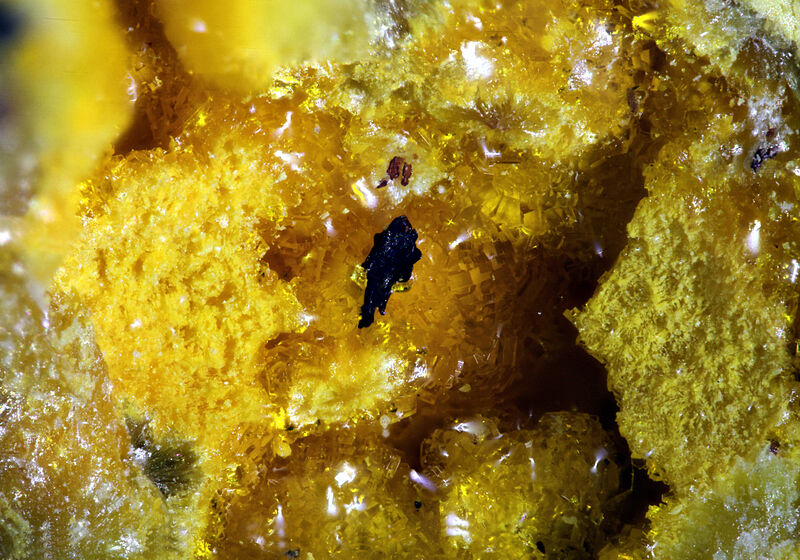
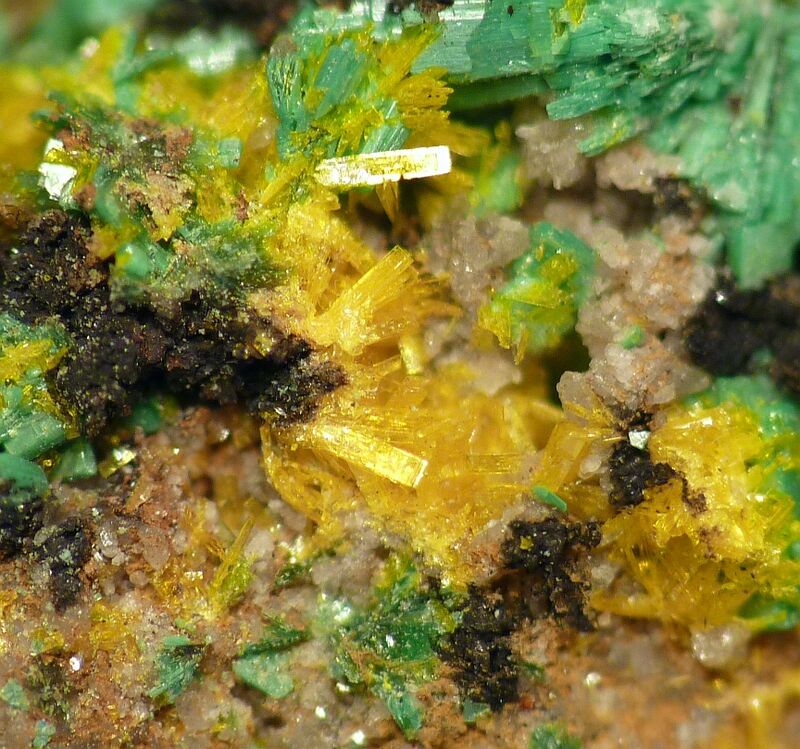
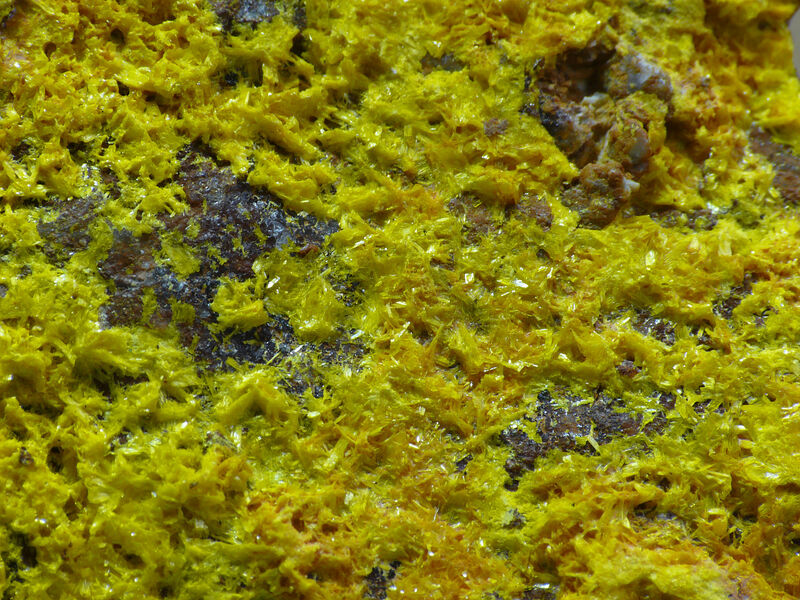
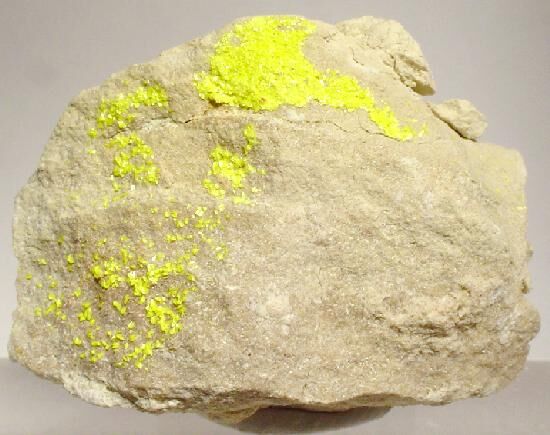
Its real value to industry is as a signpost. Bright yellow and easy to spot, it forms in the oxidised upper reaches of uranium deposits. A prospector who finds the yellow crust has good reason to believe primary uranium minerals lie below. The mineral is also the chief component of the soft yellow alteration crusts called yellow gummites, themselves a mix of secondary uranium silicates.
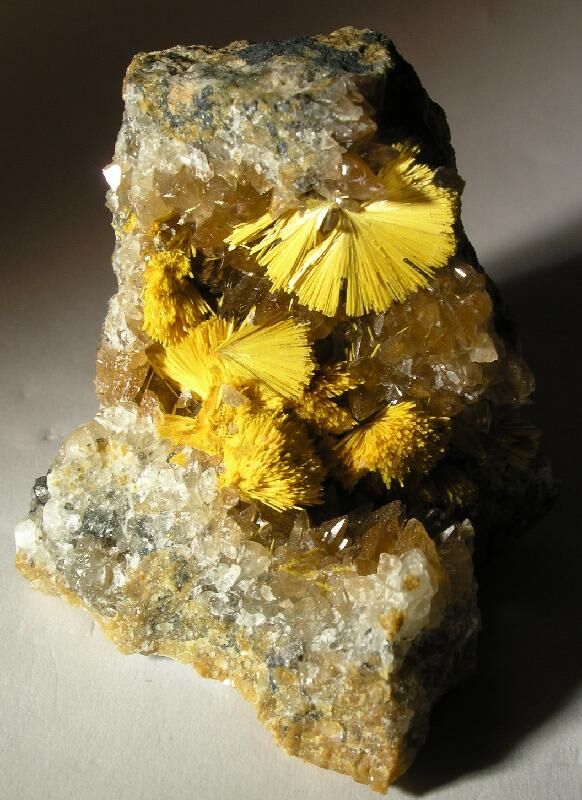
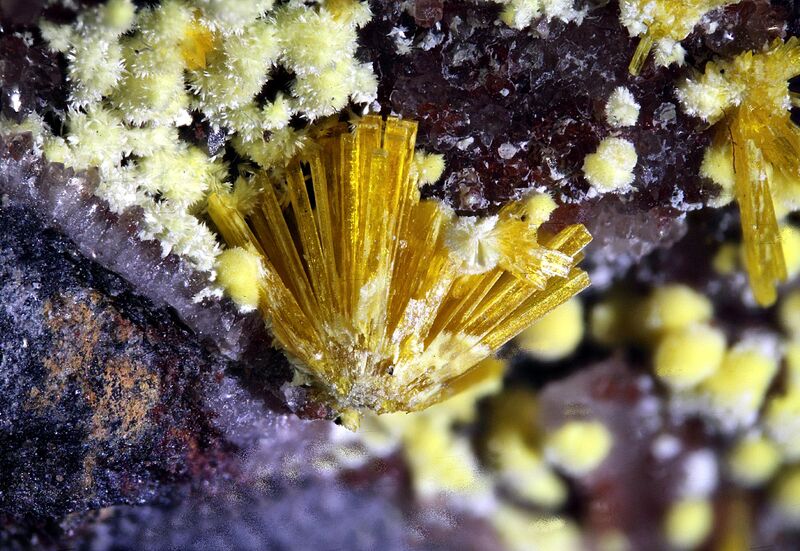
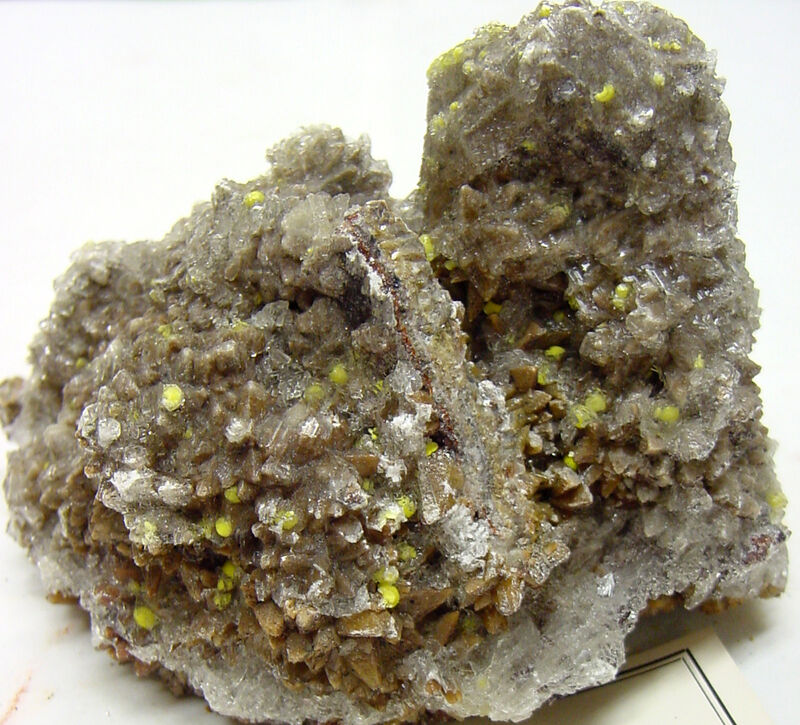
Beyond the field, it is mostly a specimen. Collectors and museums keep it for its colour and its fine needle-like crystals, often grouped in sheaves. It must be handled with care. Like other uranium minerals it is radioactive, and it dissolves in acid while giving off radon — a radioactive gas. Sealed storage and no handling of dust are the sensible rules; the mineral is a uranium and heavy-metal hazard, not a thing to keep loose on a shelf.
Where it forms, where it's found
- Geological setting
Secondary mineral in uranium deposits and pegmatites.
- Type locality
- Miedzianka
- Gmina Janowice Wielkie
- Karkonosze County
- Lower Silesian Voivodeship
- Poland
Radioactivity
Physical
Optical
- Optical type
- Biaxial (-) · 2V measured = 32 – 45° · 2V calc = 38°
- Refractive index
- 1.643 – 1.669
- Surface relief
- High
- Principal indices
- nα 1.643 · nβ 1.666 · nγ 1.669
- Pleochroism
- Weak
X= colorless Y= pale canary yellow Z= canary yellow
- Dispersion
- r < v strong
- UV response
- Weakly green, usually not fluorescent when massive.
Crystallography
- Cell parameters
- a = 15.909(6) Å · b = 7.002(3) Å · c = 6.665(3) Å
- Cell angles
- β = 97.27(4) °
- Ratio a:b:c
- 1 : 0.440 : 0.419
- Z
- 2
- Morphology
Composite needles, stellate aggregates, fibrous or felted crusts, massive.
- Comment
Cell from Ginderow (1988).
Chemical composition
Synonyms
- Alpha-Uranotile
- Lambertit
- Lambertite
- Uranophan-alpha
- Uranophan-α
- Uranophane-a
- Uranophane-alpha
- Uranophane-α
- Uranotil
- Uranotile
- α-Uranotile
In other languages
- French
- Uranophane
- German
- Uranophan · Uranophan-Alpha · Uranophan-α · Uranotil
- Spanish
- Uranofana · uranofano
- Italian
- Uranofane · Uranofano · uranophane-α
- Portuguese
- uranofano
- Japanese
- ウラノフェン
- Chinese
- 矽鈣鈾礦
Classification
9.AK.15
- 9SilicatesClass
- 9.ANesosilicatesDivision
- 9.AKUranyl neso- and polysilicatesGroup
- 9.AK.15UranophaneSpecies
53.03.01.02
- 53Nesosilicates Insular Sio4 Groups and Other Anions or Complex CationsClass
- 53.03Insular SiO4 Groups and Other Anions of Complex Cations with (UO2)Type
- 53.03.01Uranophane groupGroup
- 53.03.01.02UranophaneSpecies
14.16.10
- 14Silicates not Containing AluminumClass
- 14.16Silicates of UGroup
- 14.16.10UranophaneSpecies
Group, growth & confusion
 AutuniteCa(UO2)2(PO4)2 · 10-12H2OMineral—
 Calcurmolite(Ca1-xNax)2(UO2)3(MoO4)2(OH)6-x · nH2OMineral—
 CompreignaciteK2(UO2)6O4(OH)6 · 7H2OMineral—
 DewindtiteH2Pb3(UO2)6O4(PO4)4 · 12H2OMineral—
 Meta-autuniteCa(UO2)2(PO4)2 · 6H2OMineral—
- MetauranocirciteBa(UO2)2(PO4)2 · 6H2OMineral—
 PhosphuranyliteKCa(H3O)3(UO2)7(PO4)4O4 · 8H2OMineral—
 SaléeiteMg(UO2)2(PO4)2(H2O)10Mineral—
 TyuyamuniteCa(UO2)2(VO4)2 · 5-8H2OMineral—
Literature, links & citation
- 1853Websky, M. (1853) Ueber die geognostischen Verhältnisse der Erzlagerstätten von Kupferberg und Rudelstadt in Schlesien. Zeitschrift der Deutschen Geologischen Gesellschaft, 5. 373-438
- 1939Steinocher, V.; Nováček, Radim (1939) On β-uranotile. American Mineralogist, 24 (5). 324-338
- 1955Gorman, D. H., Nuffield, E. W. (1955) Studies of radioactive compounds: VIII-Uranophane and beta-uranophane. American Mineralogist, 40 (7-8) 634-645
- 1956Frondel, C.; Riska, D.; Frondel, J.D. (1956) X-ray powder data for uranium and thorium minerals. Bulletin 1036g. US Geological Survey doi:10.3133/b1036g DOI: 10.3133/b1036g
- 1981Stohl, Frances V., Smith, Deane K. (1981) The crystal chemistry of the uranyl silicate minerals. American Mineralogist, 66 (5-6) 610-624
Entry last updated
@misc{mineral2026,
  author    = {Mineral Index editorial board},
  title     = {Uranophane — Mineral Index},
  year      = {2026},
  url       = {https://mineralindex.org/minerals/uranophane-4107}
}