Where it forms, where it's found
- Geological setting
Granite pegmatite
Zoned granite pegmatites, high-temperature tin veins, greisens.
- Type locality
- Chursdorf
- Penig
- Mittelsachsen
- Saxony
- Germany
50.9195°, 12.7470°
Physical
- Hardness
- 1Talc
- 2Gypsum
- 3Calcite
- 4Fluorite
- 5Apatite
- 6Orthoclase
- 7Quartz
- 8Topaz
- 9Corundum
- 10Diamond
- Lustre
- Vitreous · greasy
- Transparency
- Transparent · Translucent
- Colour
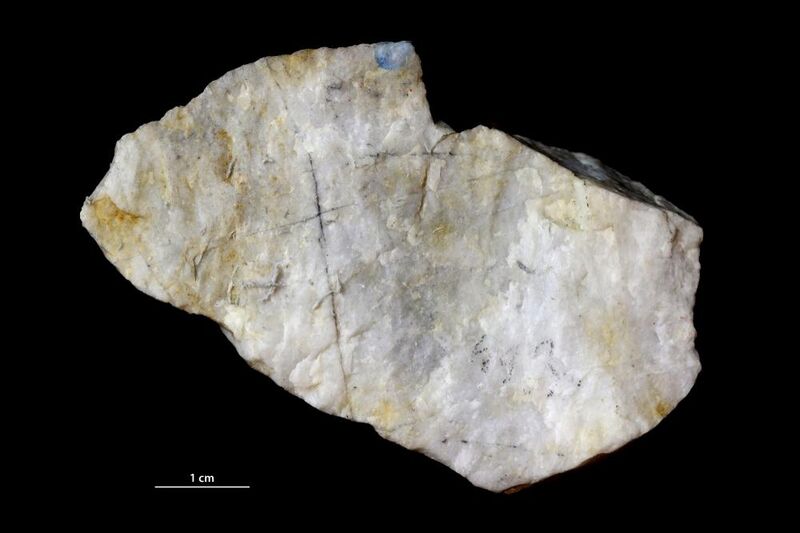
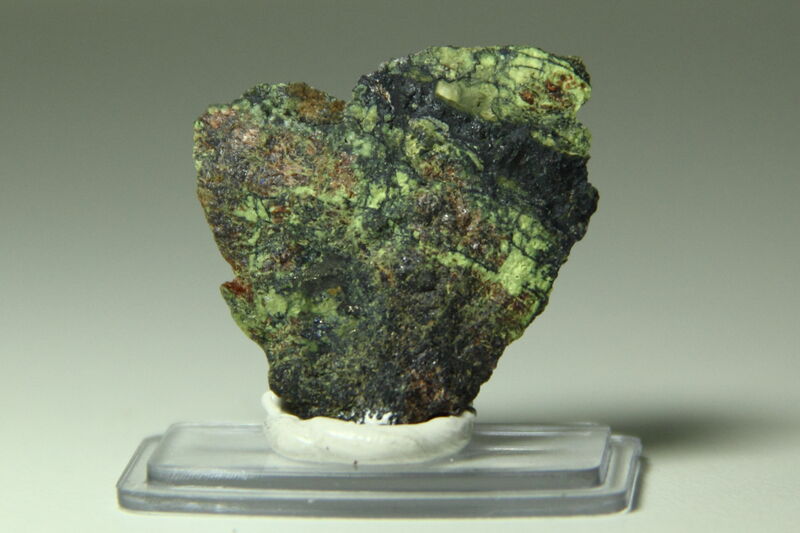
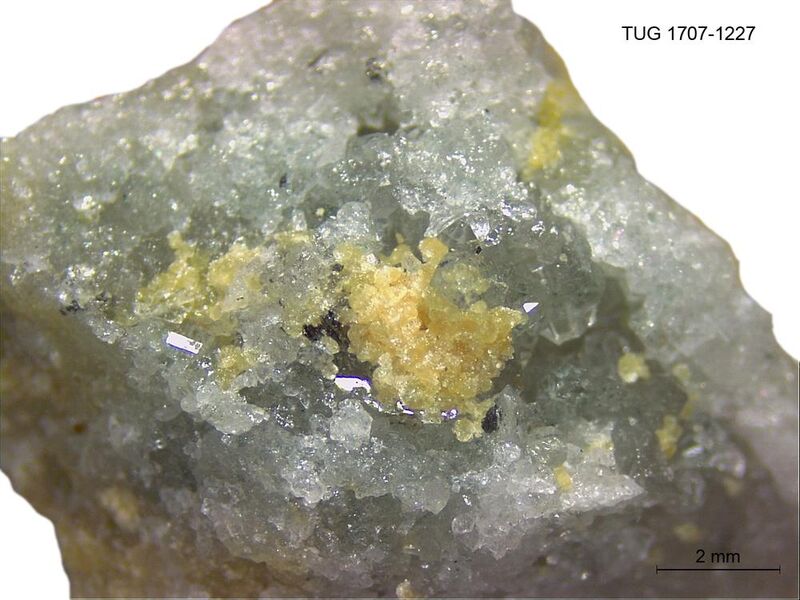
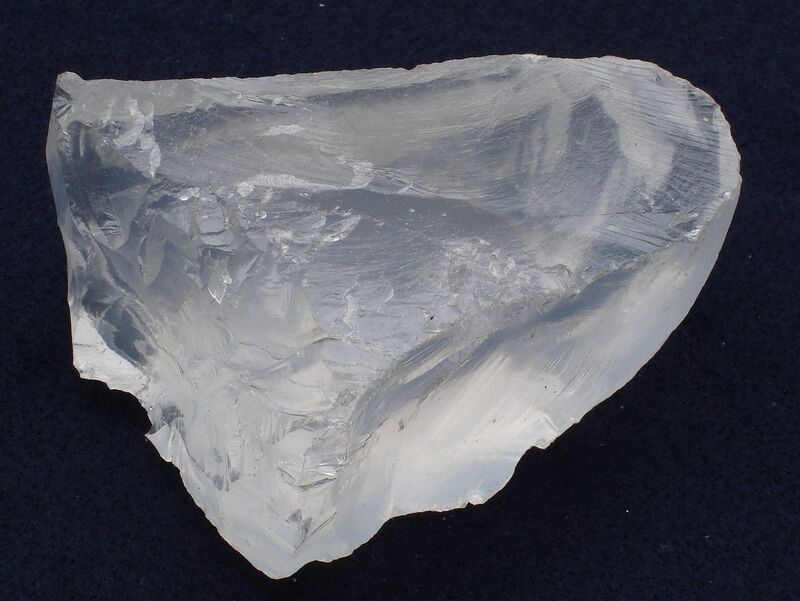
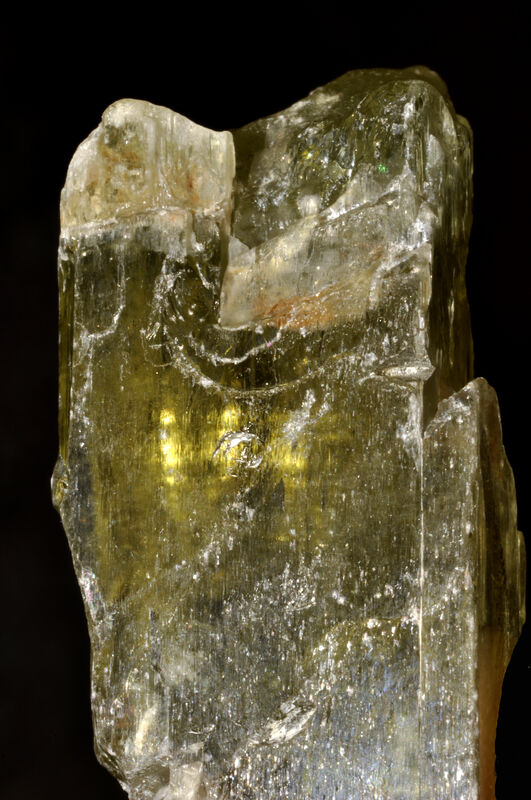
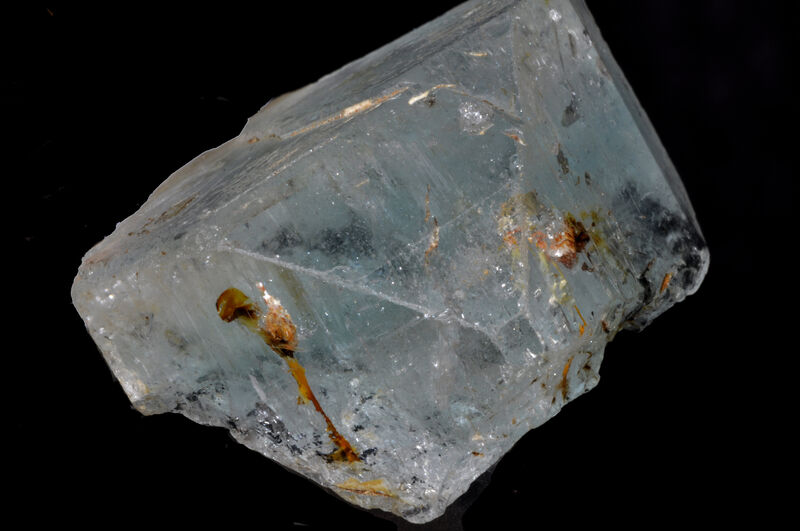
- Milk-white · yellow · beige · salmon-pink · pale green · light blue · grey · colourless in transmitted light.
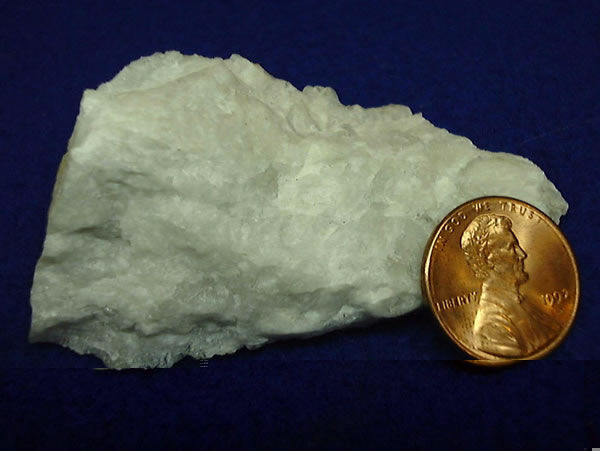
Almost always white to slightly gray-white; yellow specimens may be montebrasite
- Streak
- white
- Tenacity
- brittle
- Cleavage
- Perfect
On (100) perfect; (110) good; (01), distinct; (001), imperfect.
Breaks into blocky pieces and may superficially resemble beryl, petalite, and other species.
- Fracture
- Irregular/Uneven · Sub-Conchoidal
- Density
- 3.04 g/cm³
Optical
- Optical type
- Biaxial (-) · 2V measured = 107 – 129.5°
- Refractive index
- 1.577 – 1.613
- Surface relief
- Moderate
- Principal indices
- nα 1.577 – 1.591 · nβ 1.592 – 1.605 · nγ 1.596 – 1.613
- Birefringence
- 0.020
- Pleochroism
- Non-pleochroic
- Dispersion
- r > v
- UV response
- May fluoresce faint to medium cream yellow in SW and LW. Often shows patchy response.
- Notes
Refractive Index lowers with increased Fluorine substitution. (Greiner and Bloss, 1987).
Crystallography
- Space group
- P-1
- Cell parameters
- a = 6.644 Å · b = 7.744 Å · c = 6.91 Å
- Cell angles
- α = 90.35 ° · β = 117.33 ° · γ = 91.01 °
- Ratio a:b:c
- 1 : 1.166 : 1.040
- Z
- 4
- Morphology
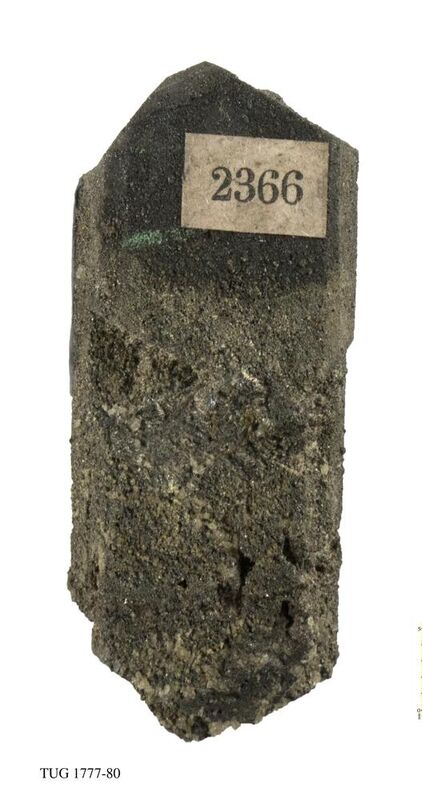
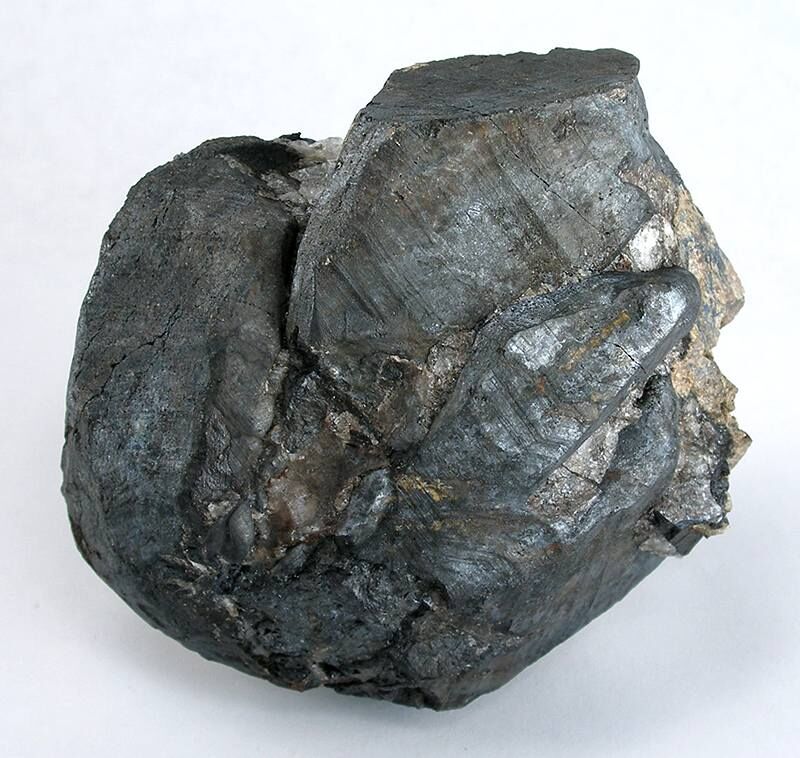
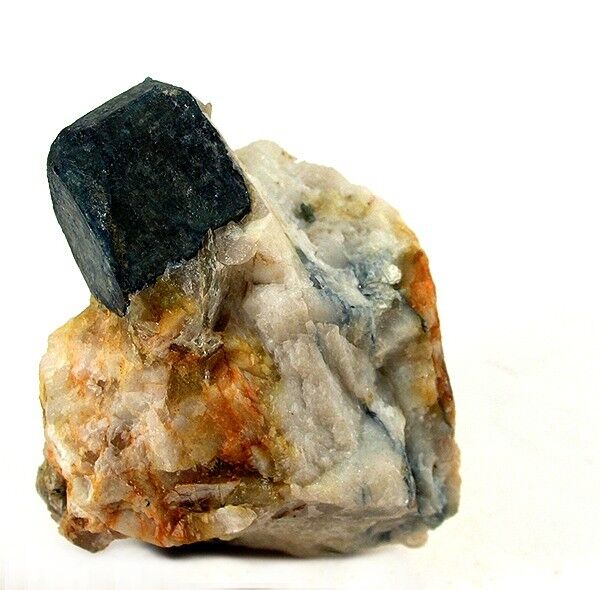
Crude crystals, typically equant to short prismatic [010], with complex form development, to 1.5 meters; also occurs as large cleavable masses; columnar; compact. Free-standing amblygonite crystals from crystal pockets are rare. Most pocket crystals are hydroxyl-rich montebrasite.
- Twinning
On (1), common, with composition plane (1) with the resulting twins commonly tabular parallel to (1) and the twinned individuals of about equal size; also tabular (110) and the twinned individuals of very unequal size. Also twins on (111), rare; lamellar. Microscopic polysynthetic twinning is common.
- Type-locality form
Massive
- Comment
Unit cell variability reported in Cerna, Cerrny, and Ferguson (1973)
Chemical composition
Synonyms
- Amblygonita
In other languages
- French
- Amblygonite · Hébronite
- German
- Amblygonit
- Spanish
- ambligonita
- Italian
- ambligonite · amblygonite
- Portuguese
- Ambligonita · ambligonite
- Japanese
- アンブリゴナイト
- Russian
- Амблигонит
- Arabic
- أمبليغونيت · الأمبليجونيت
Classification
8.BB.05
- 8Phosphates, Arsenates, VanadatesClass
- 8.BPhosphates, etc., with additional anions, without H2ODivision
- 8.BBWith only medium-sized cations, (OH, etc.):RO4 about 1:1Group
- 8.BB.05AmblygoniteSpecies
41.05.08.01
- 41Anhydrous Phosphates, Etc.containing Hydroxyl or HalogenClass
- 41.05(AB)2(XO4)ZqType
- 41.05.08Amblygonite GroupGroup
- 41.05.08.01AmblygoniteSpecies
22.1.1
- 22Phosphates, Arsenates or Vanadates with other AnionsClass
- 22.1Phosphates, arsenates or vanadates with fluorideGroup
- 22.1.1AmblygoniteSpecies
Group, growth & confusion
Literature, links & citation
- 1818Breithaupt, J.F.A. (1818) Amblygonit. C.A.S. Hoffmann´s Handbuch der Mineralogie, Vol. 4.2.- Freiberg, Verl. Craz & Gerlach, p. 159-161.
- 1863Des Cloizeaux (1863) Comptes rendus de l’Académie des sciences de Paris: 57: 357.
- 1864Des Cloiseaux (1864) Ueber die doppeltbrechenden Eigenschaften und die Krystallform des Amblygonits. Annalen der Physik: 199: 183-187.
- 1871Des Cloizeaux (1871) Comptes rendus de l’Académie des sciences de Paris: 73: 306 [as Montebrasite]
- 1872von Kobell (1872) Akademie der Wissenschaften, Munich, Sitzber.: 284. [as Hebronite]
Entry last updated
@misc{mineral2025,
  author    = {Mineral Index editorial board},
  title     = {Amblygonite — Mineral Index},
  year      = {2025},
  url       = {https://mineralindex.org/minerals/amblygonite-189}
}