History
The name apatite comes from the Greek apatáō — to deceive. The mineral earned it because it had so often been mistaken for others: beryl, milarite, and a handful of other gemmy crystals share its colour and outline, and early collectors kept getting it wrong.
The naming was the work of the German geologist Abraham Gottlob Werner, who introduced apatite in 1786. Werner treated the substance as a single mineral. Nearly a century would pass before chemistry caught up with that intuition and split it apart.
In 1860 the German mineralogist Karl Friedrich August Rammelsberg reclassified the specimen Werner had described. He gave it the more precise name fluorapatite, adding the Fluor- prefix to mark the dominance of fluorine in the composition. What Werner had called one mineral was in fact a family. Three endmembers are now recognised — fluorapatite, chlorapatite, and hydroxylapatite — each distinguished by which ion fills the same crystal site: fluoride, chloride, or hydroxide.
The relabelling mattered beyond mineralogy. Hydroxylapatite, the hydroxide-bearing endmember, turned out to be the main mineral component of vertebrate tooth enamel and bone — "the major component of tooth enamel and bone mineral". Fluorapatite became the resistant cousin: in the mid-20th century, researchers noticed that communities whose drinking water naturally contained fluorine had lower rates of dental caries. Fluoride ions taken up by tooth enamel convert surface hydroxylapatite into a fluorapatite-like phase, harder for acid to dissolve. That observation is the basis of fluoridated water and fluoride toothpaste.
Industrial & practical applications
Fluorapatite is the world's principal source of phosphorus. It is the dominant phosphate mineral in phosphate rock — the sedimentary deposits, technically called phosphorite, where "the phosphate is present as fluorapatite Ca₅(PO₄)₃F typically in cryptocrystalline masses". Almost everything in modern phosphorus chemistry begins by mining that rock and taking it apart.
The dominant end-use is agricultural. Roughly 90% of mined phosphate rock goes into fertilizer and animal feed supplements. The rock is digested with sulfuric acid to produce wet-process phosphoric acid, the starting point for most phosphate fertilizers. That phosphorus ends up as the principal component of nitrogen-phosphorus-potassium fertilizers, spread on food crops worldwide. Hydrogen fluoride is a byproduct of the acid digestion — the fluorine that gives fluorapatite its name leaves the rock as gas.
A smaller share of phosphate-rock output is refined further. Food-grade phosphates derived from it appear in preservatives and as additives in baking flour.
Production is dominated by a handful of countries. As of 2012, China led at 77 megatonnes per year, followed by the United States at 29.4 megatonnes and Morocco at 26.8 megatonnes. The United States remains "the world's leading producer and consumer of phosphate rock" for fertilizer manufacture and industrial use.
A caveat sits behind those numbers: published statistics aggregate the whole apatite group, not fluorapatite alone. Fluorapatite is the bulk of that aggregate, since sedimentary phosphorites are predominantly fluorapatitic. A strict species-by-species accounting is not how the commodity is tracked.
Where it forms, where it's found
- Geological setting
Most common rock forming phosphate. Accessory mineral in most igneous rocks with important concentrations in carbonatites. Common in marbles and skarns. Major mineral in sedimentary phosphorites.
- Type locality
- Sauberg Mine
- Ehrenfriedersdorf
- Erzgebirgskreis
- Saxony
- Germany
50.6408°, 12.9783°
Varieties
Physical
- Hardness
- 1Talc
- 2Gypsum
- 3Calcite
- 4Fluorite
- 5Apatite
- 6Orthoclase
- 7Quartz
- 8Topaz
- 9Corundum
- 10Diamond
- Lustre
- Vitreous · Resinous
- Transparency
- Transparent · Opaque
- Colour
- Colourless to white when pure · also green · blue · pink · yellow · brown · violet · purple.
- Streak
- White
- Tenacity
- brittle
- Cleavage
- Poor/Indistinct
Indistinct (0001) and (10_10)
- Fracture
- Irregular/Uneven · Conchoidal
- Density
- 3.1 g/cm³
Optical
- Optical type
- Uniaxial (-)
- Refractive index
- 1.627 – 1.65
- Surface relief
- Moderate
- Principal indices
- nω 1.631 – 1.650 · nε 1.627 – 1.646
- Birefringence
- 0.004
- Pleochroism
- Visible
Weak to strong in coloured crystals: Colour: .Violet .........Pale Green .............Yellow ..............Blue O = ..Deep violet .....Pale yellow ..Yellow-brown ......Sky-blue E = ..Red-violet .Pale blue-green ..Dark green ...Green-blue
- Luminescence
- Fluorescent & Phosphorescent.
- UV response
- Often fluorescent bright yellow or blue white and phosphorescent, especially the manganoan varieties. The REEs-doped FAp powders synthesized by hydrothermal methods produce fluorescence of different wavelengths. Er-, Eu-, Pr-, Ho-, and Yb-doped FAps can, respectively, emit blue, orange, red, orange, red, and green light under the excitation of ultraviolet light (250 nm). Compared with the Pr/Sm/Gd/Ho/Yb-doped FAps, Er/Eu-doped FAps exhibit high fluorescence intensity, attributed to their small lattice distortion, big grain size and suitable doping concentration.[[1]]
- Notes
Refractive index increases with diminished fluorine content.
Crystallography
- Space group
- P63/m
- Cell parameters
- a = 9.3973 Å · c = 6.8782 Å
- Z
- 2
- Morphology
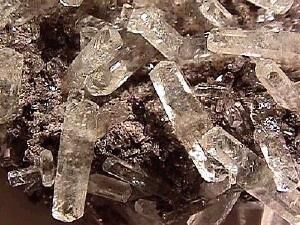
Crystals short to long hexagonal prisms [0001], with (100) and (101) dominant; also thick tabular (0001), frequently in the crystals of hydrothermal origin in pegmatites and veins, with (100), relatively large (0001), and often also (101) or low pyramids. Massive, coarse granular to compact.
- Twinning
Rare contact twins on (111). Twin plane (103) rare. Also twinning reported on (100) and (113).
- Epitaxy
Needle-like rutile crystals included in the apatite with the c-axes of the two species parallel; Monazite in oriented inclusions; Carbonate-fluorapatite enclosing fluorapatite.
- Comment
May be space group P21/b.
Chemical composition
- Impurities
- OH
- Cl
- TR
- La
- Ce
- Pr
- Nd
- Sm
- Eu
- Gd
- Dy
- Y
- Er
- Mn
Synonyms
- Agustit
- Apatite-(CaF)
- Chlor-fluorapatite
- Chrysolite d'Espagne
- Crisolito de España
- Fluor-apatite
- Fluorapatito
- Fluoroapatite
- Hydroxyl-fluorapatite
- Mangualdite
- Nauruite
- Oxyapatite
- Voelckerite
In other languages
- French
- fluorapatite
- German
- Apatit-(CaF) · Fluorapatit
- Spanish
- Fluorapatita · Fluorapatito
- Italian
- fluorapatite
- Japanese
- フッ素燐灰石 · フルオロアパタイト · 弗素燐灰石
- Chinese
- 氟磷灰石
- Russian
- Фторапатит
- Arabic
- فلورأباتيت
Classification
8.BN.05
- 8Phosphates, Arsenates, VanadatesClass
- 8.BPhosphates, etc., with additional anions, without H2ODivision
- 8.BNWith only large cations, (OH, etc.):RO4 = 0.33:1Group
- 8.BN.05FluorapatiteSpecies
41.08.01.01
- 41Anhydrous Phosphates, Etc.containing Hydroxyl or HalogenClass
- 41.08A5(XO4)3ZqType
- 41.08.01Apatite GroupGroup
- 41.08.01.01FluorapatiteSpecies
22.1.9
- 22Phosphates, Arsenates or Vanadates with other AnionsClass
- 22.1Phosphates, arsenates or vanadates with fluorideGroup
- 22.1.9FluorapatiteSpecies
Group, growth & confusion
 AlforsiteBa5(PO4)3ClMineral—
 ChlorapatiteCa5(PO4)3ClMineral—
- FluoralforsiteBa5(PO4)3FMineral—
- FluorpyromorphitePb5(PO4)3FMineral—
 HydroxylapatiteCa5(PO4)3OHMineral—
- HydroxylpyromorphitePb5(PO4)3(OH)Mineral—
 JohnbaumiteCa5(AsO4)3(OH)Mineral—
 MimetitePb5(AsO4)3ClMineral—
- PieczkaiteMn5(PO4)3ClMineral—
- PliniusiteCa5(VO4)3FMineral—
 AlbiteNa(AlSi3O8)Mineral—
- AlforsiteBa5(PO4)3ClMineral—
- AlfredcaspariteSr2TiO(Si2O7)Mineral—
 AlthausiteMg4(PO4)2(OH,O)(F,◻)Mineral—
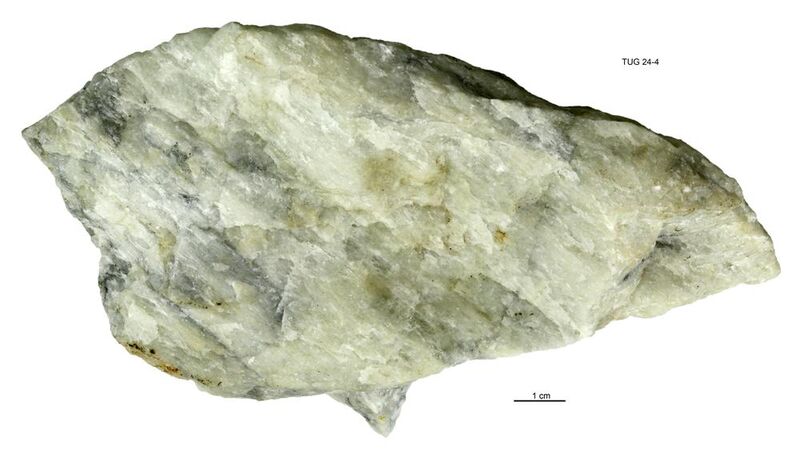 AmblygoniteLiAl(PO4)FMineral—
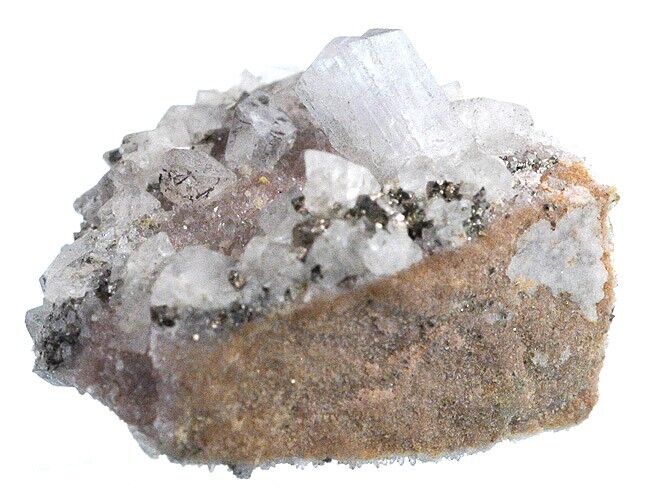 AugeliteAl2(PO4)(OH)3Mineral—
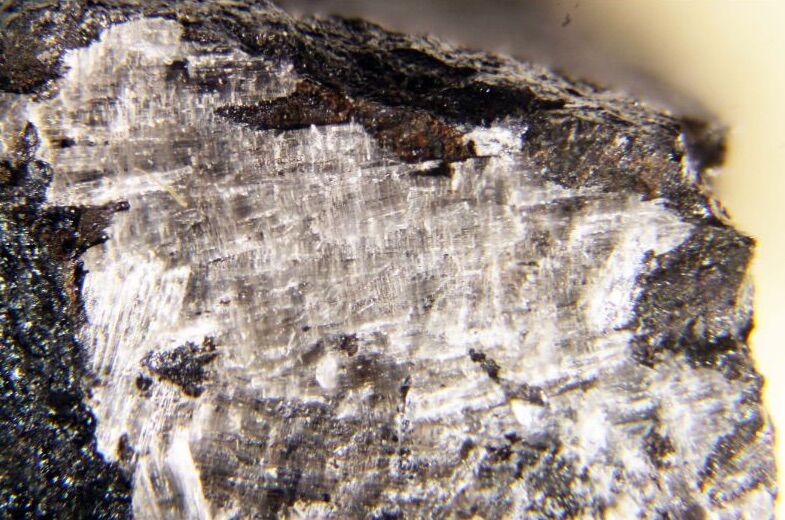 BobierriteMg3(PO4)2 · 8H2OMineral—
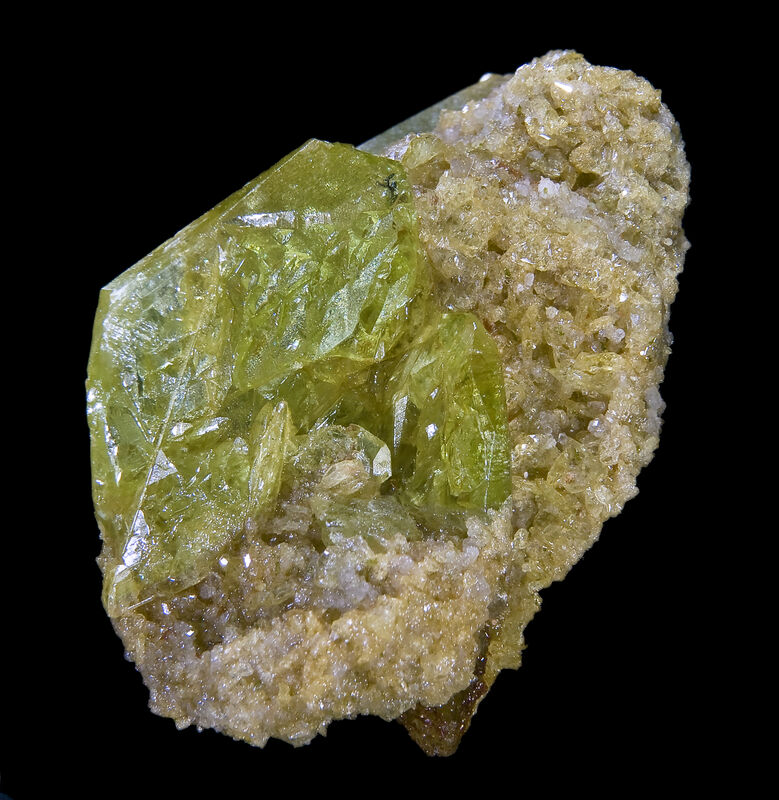 BrazilianiteNaAl3(PO4)2(OH)4Mineral—
 CalciteCa(CO3)Mineral—
 JohnwalkiteK(Mn2+,Fe3+)2(Nb,Ta)O2(PO4)2 · 2(H2O,OH)Mineral—
Literature, links & citation
- —Manceau, A., Mathon, O., Lomachenko, K.A., Rovezzi, M., Kvashnina, K.O., Boiron, M.-C., Brossier, R., Steinmann, S.N. (2023): Revealing the Incorporation of Cerium in Fluorapatite. ACS Earth Space Chemistry, (in press).
- 1788Werner, A. G. (1788). Geschichte, Karakteristik, und kurze chymische Untersuchung des Apatits. Bergmännisches Journal, 1, 76-96.
- 1827Rose, G. (1827): Ueber die chemische Zusammensetzung der Apatite. Annalen der Physik 1827 (2), 185f.
- 1854Koksharov, Nikolai (1854) Materialien zur Mineralogie Russlands Vol. 2. Carl Kray.
- 1860Rammelsberg, Carl Friedrich (1860) Handbuch der Mineralchemie (1st ed.) Wilhelm Engelmann, Leipzig.
Entry last updated
@misc{mineral2026,
  author    = {Mineral Index editorial board},
  title     = {Fluorapatite — Mineral Index},
  year      = {2026},
  url       = {https://mineralindex.org/minerals/fluorapatite-1572}
}