History
The mineral's name is simply its recipe read aloud. Bismuthinite is bismuth sulfide — bismuth bonded to sulfur — and it was named for that composition. The metal itself lent the name, and the metal's own story is older and stranger than the mineral's.
For centuries, no one was sure bismuth was its own thing. Early on it was confused with tin and lead, which it resembles. The first written hint that it stood apart came in 1546. The German scholar Georgius Agricola described it as a distinct metal, in a family that also held tin and lead. The word bismuth traces back to this period too — a neo-Latin form, bisemutum, derived from the German Wismut, perhaps from weiße Masse, meaning "white mass".
Certainty took two more centuries. Johann Heinrich Pott began clearing up the confusion in 1738, and in 1753 Claude François Geoffroy showed that bismuth is distinct from lead and tin. Only after the metal was pinned down could its ores be named for it.
That naming came in 1832, when the French mineralogist François Sulpice Beudant called the sulfide bismuthine. The mineral was first reported the same year, from the silver mines of Potosí in Bolivia.
Industrial & practical applications
Bismuthinite earns its keep underground, not on the shelf. It is mined as an ore — a rock worth digging for the metal locked inside it — and that metal is bismuth. Everything people actually handle is made from the refined metal, not the raw mineral. So the uses below belong to smelted bismuth and its compounds, drawn from this ore and others.
Most bismuth never starts as bismuthinite at all. The metal is mostly produced by refining, as a byproduct of extracting lead, copper, tin, molybdenum, and tungsten. The ore is one feedstock among several for the smelter.
The refined metal's standout trick is melting at low temperatures. Bismuth goes into low-melting alloys, also called fusible alloys, that turn liquid in hot water or a small flame. Many automatic sprinklers, electric fuses, and safety devices in fire detection and suppression systems rely on such an alloy, tuned to melt at 47 °C.
Its other use leans on a quirk of chemistry: unlike its old look-alike lead, bismuth is essentially non-toxic. That makes it a replacement for lead in shot, bullets, and less-lethal riot gun ammunition. The European Union's restriction on lead has also widened its use in electronics. There it goes into low-melting-point solders that stand in for traditional tin-lead solders.
Bismuth compounds reach into the medicine cabinet and the makeup bag. Bismuth subsalicylate treats diarrhoea and is the active ingredient in "pink bismuth" preparations such as Pepto-Bismol. Bismuth oxychloride lends a pearly sheen to cosmetics, used as a pigment in eye shadows, hair sprays, and nail polishes.
Where it forms, where it's found
- Geological setting
Low to high-temperature hydrothermal veins
Varieties
Physical
Optical
- Anisotropism
- Strong, especially in oil
- Tropism
- Anisotropic
- Reflectance R%
- (35.7, 46.2) 400, (36.4, 47.2) 420, (37.2, 47.9) 440, (37.7, 48.3) 460, (37.7, 48.8) 480, (37.6, 49.4) 500, (37.3, 49.6) 520, (37.1, 49.1) 540, (36.9, 48.7) 560, (36.8, 48.3) 580, (36.6, 47.8) 600, (36.4, 47.3) 620, (36.3, 46.8) 640, (36.1, 46.3) 660, (36.0, 45.8) 680, (35.9, 45.4) 700
Crystallography
- Space group
- #71
- Cell parameters
- a = 11.12 Å · b = 11.25 Å · c = 3.97 Å
- Ratio a:b:c
- 1 : 1.012 : 0.357
- Z
- 4
- Morphology
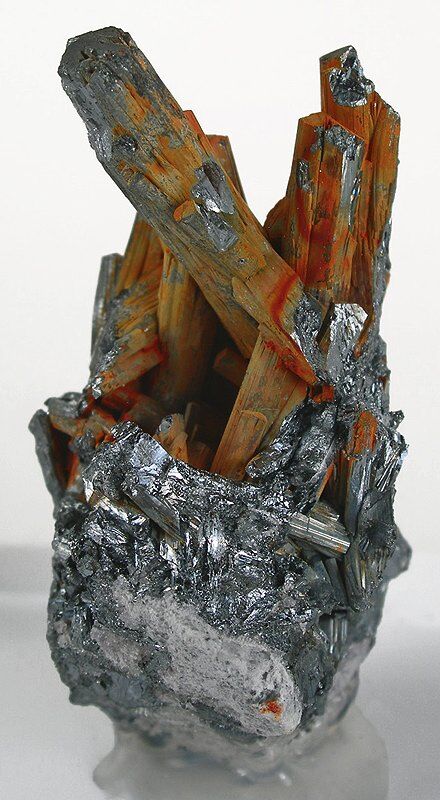
Stout prismatic to acicular.
- Comment
Space group Pbnm.
Chemical composition
- Impurities
- Pb
- Cu
- Fe
- As
- Sb
- Se
- Te
Synonyms
- Bismuth Glance
- Bismuthine
- Bismutholamprite
- Bizmutyn
- Wismutglanz
In other languages
- French
- 12233-37-3 · Bismuthine · Bismuthinite · Bismutholamprite · Bismutinite · Cheleutite · Csiklovaite · Horobetsuite
- German
- Bismutglanz · Bismuthin · Bismuthinit · Bismutin · Wismutglanz
- Spanish
- Bismutina · Bismutinita
- Italian
- bismutinite
- Japanese
- 輝蒼鉛鉱
- Chinese
- 辉铋矿
- Russian
- Bi2S3 · Бисмутин · Висмутин · Висмутинит · Висмутовый блеск
Classification
2.DB.05
- 2Sulfides and SulfosaltsClass
- 2.DMetal Sulfides, M: S = 3 :4 and 2:3Division
- 2.DBM:S = 2:3Group
- 2.DB.05BismuthiniteSpecies
02.11.02.03
- 02SulfidesClass
- 02.11AmBnXp, with (m+n):p = 2:3Type
- 02.11.02Stibnite Group (Orthorhombic: Pbnm)Group
- 02.11.02.03BismuthiniteSpecies
3.7.17
- 3Sulphides, Selenides, Tellurides, Arsenides and Bismuthides (except the arsenides, antimonides and bismuthides of Cu, Ag and Au, which are included in Section 1)Class
- 3.7Sulphides etc. of V, As, Sb and BiGroup
- 3.7.17BismuthiniteSpecies
Group, growth & confusion
Literature, links & citation
- 1827Phillips, William (1827) Ueber die Krystallform des natürlichen und künstlichen Schwefelwismuths. Annalen der Physik und Chemie, 87. 476-478 doi:10.1002/andp.18270871113DOI: 10.1002/andp.18270871113
- 1827Phillips, W. (1827) On the crystalline forms of the natural and artificial sulphuret of bismuth. The Philosophical Magazine: 2: 181-182.
- 1830Beudant, François-Sulpice (1830) Traité élémentaire de minéralogie. Deuxiéme Edition [Elementary Treatise on Mineralogy. Second Edition] (2nd ed.) Vol. 1 - Tome Premier [Volume One]. Chez Verdière.
- 1854Rose, G. (1854) Ueber die Krystallform des künstlichen Schwefelwismuths. Annalen der Physik und Chemie, 167. 401-403 doi:10.1002/andp.18541670305DOI: 10.1002/andp.18541670305
- 1881Groth, P. (1881) Zeitschrift für Kristallographie: 5: 252.
Entry last updated
@misc{mineral2026,
  author    = {Mineral Index editorial board},
  title     = {Bismuthinite — Mineral Index},
  year      = {2026},
  url       = {https://mineralindex.org/minerals/bismuthinite-686}
}