Where it forms, where it's found
- Geological setting
late or hydrothermal mineral in nepheline syenite pegmatite composed of mainly albite, alkali pyroxenes, amphiboles, biotite, nepheline,and zeolites
- Type locality
- Sakharjok Massif (Sakhariok Massif
- Sakharjok deposit)
- Murmansk Oblast
- Russia
67.6944°, 36.4511°
1recorded occurrences
Physical
Optical
- Optical type
- Biaxial (+) · 2V measured = 60° · 2V calc = 65°
- Refractive index
- 1.745 – 1.752
- Surface relief
- High
- Principal indices
- nα 1.745 · nβ 1.747 · nγ 1.752
Δ = 0Δmax
PPLpleochroism per grain
XPLindependent extinctions · rotate the stage
PPLpleochroism only · colour blends on rotation
XPLinterference colour · extinct every 90°
Retardation70 nm
Order1st order
XPL colour
Crystallography
- Cell parameters
- a = 9.4024(8) Å · b = 5.5623(5) Å · c = 7.3784(6) Å
- Cell angles
- α = 89.919(2) ° · β = 101.408(2) ° · γ = 96.621(2) °
- Ratio a:b:c
- 1 : 0.592 : 0.785
- Unit cell volume
- 375.65 ų
- Z
- 1
- Parting
- not observed
Crystal structure
Chemical composition
- Impurities
- F
- Mn
- Na
- Zr
- Yb
- Nb
Synonyms
- Batievaiet-(Y)
- IMA2015-016
In other languages
- German
- Batievait-(Y) · IMA 2015-016
Classification
Strunz
10th ed.9.BE
- 9SilicatesClass
- 9.BSorosilicatesDivision
- 9.BESi2O7 groups, with additional anions; cations in octahedral [6] and greater coordinationGroup
- 9.BEBatievaite-(Y)Species
Group, growth & confusion
 Fogoite-(Y)Ca2Y2Na3Ti(Si2O7)2(OF)F2Mineral—
 GötzeniteCa4NaCa2Ti(Si2O7)2(OF)F2Mineral—
- GrenmariteNa2Zr2Na2MnZr(Si2O7)2O2F2Mineral—
 Hainite-(Y)(Ca3Y)Na(NaCa)Ti(Si2O7)2(OF)F2Mineral—
- KochiteCa2MnZrNa3Ti(Si2O7)2(OF)F2Mineral—
 Mosandrite-(Ce)(Ca3REE)[(H2O)2Ca0.5◻0.5]Ti(Si2O7)2(OH)2(H2O)2Mineral—
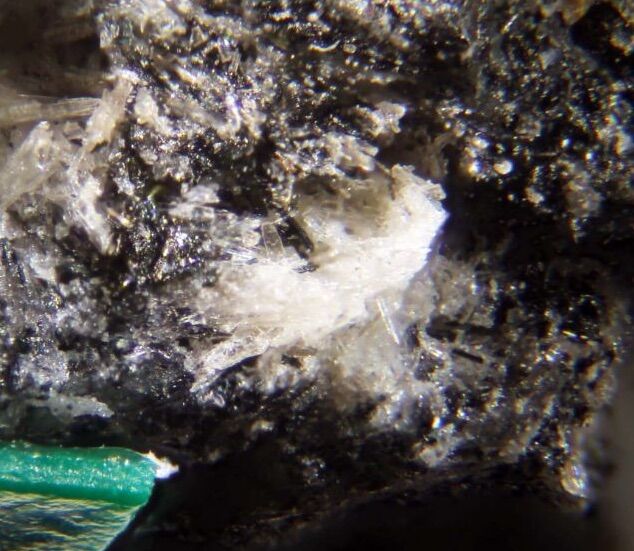 Nacareniobsite-(Ce)(Ca3REE)Na3Nb(Si2O7)2(OF)F2Mineral—
- Nacareniobsite-(Y)Na3Ca3YNb(Si2O7)2OF3Mineral—
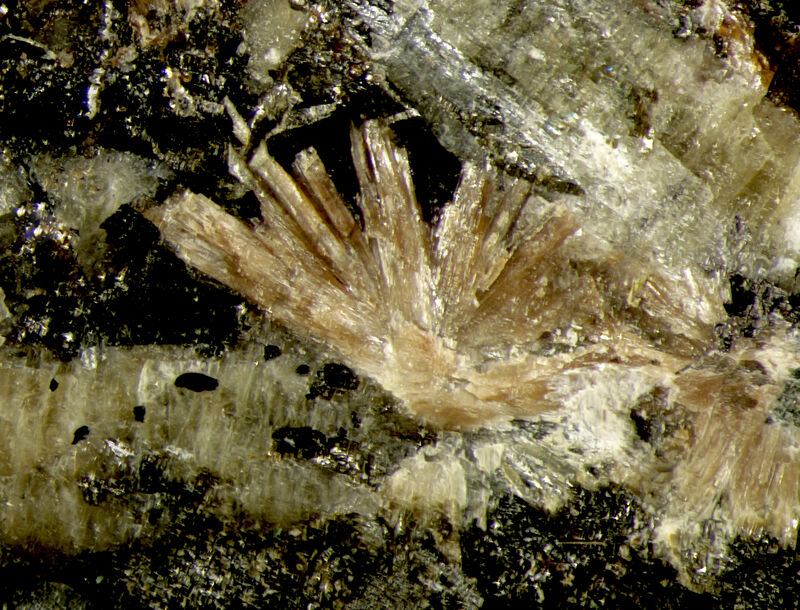 Rinkite-(Ce)(Ca3REE)Na(NaCa)Ti(Si2O7)2(OF)F2Mineral—
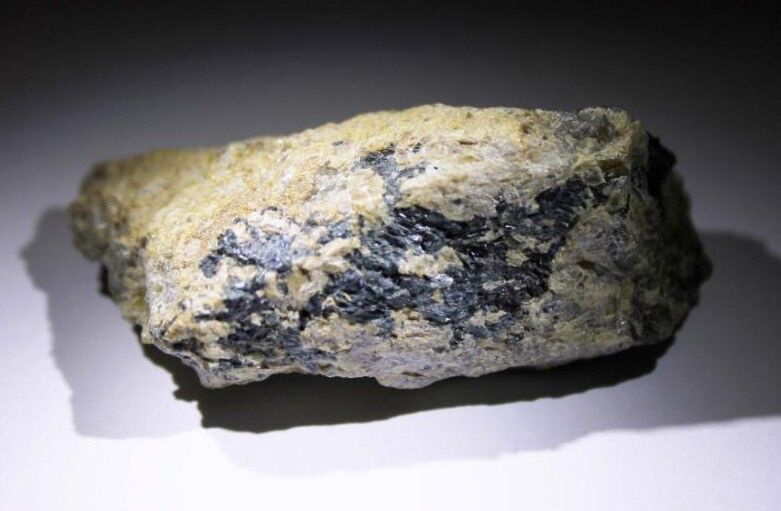 Rinkite-(Y)Na2Ca4YTi(Si2O7)2OF3Mineral—
Literature, links & citation
Citations
- 2015Hålenius, U., Hatert, F., Pasero, M., Mills, S. J. (2015) New minerals and nomenclature modifications approved in 2015, CNMNC Newsletter 26. Mineralogical Magazine, 79 (4) 941-947 doi:10.1180/minmag.2015.079.4.05DOI: 10.1180/minmag.2015.079.4.05
- 2016Lyalina, L. M.; Zolotarev, A. A.; Selivanova, E. A.; Savchenko, Ye. E.; Krivovichev, S. V.; Mikhailova, Yu. A.; Kadyrova, G. I.; Zozulya, D. R. (2016) Batievaite-(Y), Y2Ca2Ti[Si2O7]2(OH)2(H2O)4, a new mineral from nepheline syenite pegmatite in the Sakharjok massif, Kola Peninsula, Russia. Mineralogy and Petrology, 110 (6). 895-904 doi:10.1007/s00710-016-0444-4DOI: 10.1007/s00710-016-0444-4
- 2017(2017) Batievaite-(Y). Handbook of Mineralogy. Mineralogical Society of America
- 2017Cámara, Fernando; Belakovskiy, Dmitriy I.; Uvarova, Yulia (2017) New Mineral Names. American Mineralogist, 102 (4). 916-920 doi:10.2138/am-2017-nmn10247DOI: 10.2138/am-2017-nmn10247
- 2017Sokolova, E., Cámara, F. (2017) The seidozerite supergroup of TS-block minerals: nomenclature and classification, with change of the following names: rinkite to rinkite-(Ce), mosandrite to mosandrite-(Ce), hainite to hainite-(Y) and innelite-1T to innelite-1A. Mineralogical Magazine, 81 (6) 1457-1484 doi:10.1180/minmag.2017.081.010 DOI: 10.1180/minmag.2017.081.010
Cite this entry
Entry last updated
@misc{mineral2025,
  author    = {Mineral Index editorial board},
  title     = {Batievaite-(Y) — Mineral Index},
  year      = {2025},
  url       = {https://mineralindex.org/minerals/batievaite-y-46675}
}