History
Long before it was a mineral, halite was a salary. The Latin salārium — the root of our word salary — referred to a Roman soldier's allowance. The persistent claim that the legions were paid in salt is baseless, but the linguistic link survives. The mineral name came much later. It derives from the Greek for sea, háls, by way of the older form halites, and was modified to halite by the mineralogist J.D. Dana.
The substance, of course, far predates the name. Some of the earliest evidence of salt processing dates to around 6000 BC. At Poiana Slatinei, in present-day Romania, people boiled spring water to extract the salts — a technique called briquetage. Salt harvesting at Xiechi Lake in China dates back to at least the same period, making it one of the oldest verifiable saltworks.
In Iron-Age Austria, around 800 BC, the Hallstatt culture began mining salt from the rock. By about 400 BC the townsfolk had also begun open-pan salt making. Celtic communities there grew rich trading salt and salted meat to Ancient Greece and Ancient Rome in exchange for wine and other luxuries. In the early Roman Empire, roads were built specifically for the transportation of salt, from the works at Ostia to the capital.
Medieval and early modern trade
Demand drew long-distance trade across the medieval world. South of the Sahara, salt itself functioned as money. Tuareg caravans of as many as forty thousand camels crossed four hundred miles of desert bearing salt to inland markets in the Sahel. Timbuktu was a noted salt market. In Poland, the Wieliczka and Bochnia mines worked the same deposit from the 13th century until 1964. In prosperous periods they supplied up to a third of the royal treasury's income.
States learned early that a substance everyone needed could be taxed. France's gabelle — the salt tax — was enacted in 1286 and was reimposed by Napoleon to fund his wars. Across the world, the British colonial salt tax in India provoked Mahatma Gandhi's 1930 Dandi March, also known as the Salt Satyagraha. The act of civil disobedience helped transform the independence movement into a national struggle. The gabelle itself was not abolished in France until 1946.
Industrial & practical applications
Most of the world's salt never reaches a dinner plate. The greatest single use for halite is as a feedstock for the chemical industry — fed into the chloralkali process to produce caustic soda and chlorine. Those two chemicals in turn become polyvinyl chloride plastics and paper-pulping chemicals. Food uses account for only about 17.5% of total global production; in Europe the food share is closer to 7%.
In the kitchen, halite is the seasoning at the centre of nearly every cuisine. It is ground in a salt mill or dusted over food from a shaker as a finishing salt. Beyond flavour, it is the workhorse of food preservation. Salt is used to cure a wide variety of foods such as bacon and fish, and salting remains a primary preservation method across many cultures. The transformation it triggers is dramatic — fresh herring carries about 67 milligrams of sodium per 100 grams; kipper, its preserved form, carries 990.
On the road and in the home
In cold climates, halite is what keeps the asphalt drivable. Cities spread a mixture of sand and salt on roads during and after a snowstorm. Homeowners scatter the same rock salt on sidewalks and driveways. The mechanism is straightforward: brine — a solution of water and salt — has a lower freezing point than pure water. A thin film of dissolved salt prevents new ice from forming. Spreading salt brine directly is more effective than spreading dry salt. Halite also turns up as a household cleaning agent for grease, oil, and stain removal.
How it is mined and produced
World production reached 300 million tonnes in 2018. The top six producers were China at 68 million tonnes, the United States at 42 million, India at 29 million, and Germany, Canada, and Australia at roughly 13 million tonnes each. Three production methods supply that demand. Underground mining lifts solid rock salt directly from ancient evaporite beds. The Sifto mine, 550 metres below Lake Huron in Goderich, Ontario, is the largest of its kind, yielding about seven million tonnes a year. The Khewra mine in Pakistan uses the room-and-pillar method, where about half the material is left in place to support the upper levels. The third route is solar evaporation of seawater, which contains about 35 grams of dissolved salts per kilogram of water. It is the production method of choice in marine countries with high evaporation and low precipitation.
Beyond chemistry, food, and roads, halite shows up across other industries. It serves as a flux in the production of aluminium, in the manufacture of soaps and glycerine and synthetic rubber, as a mordant in textile dyeing, and in pottery firing where it forms ceramic glazes.
Where it forms, where it's found
- Geological setting
Sedimentary evaporite deposits. In fluid inclusions. As a fumarole product.
Varieties
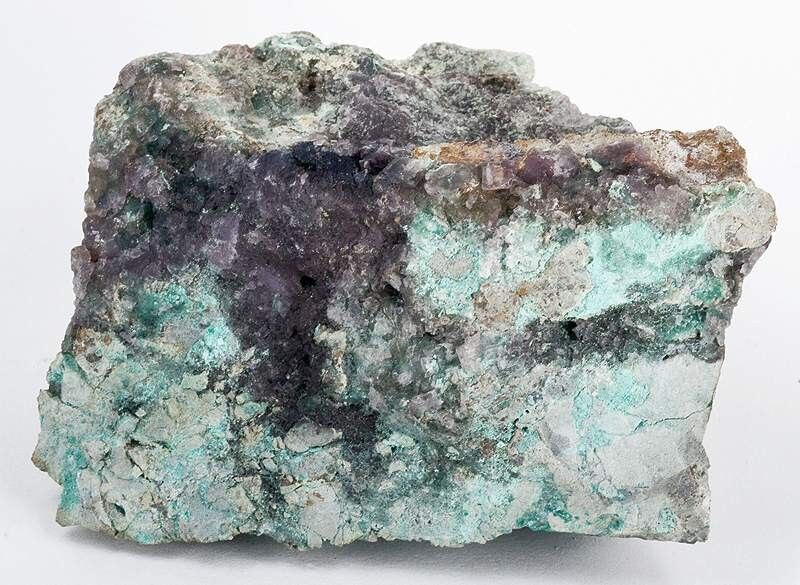
Physical
- Hardness
- 1Talc
- 2Gypsum
- 3Calcite
- 4Fluorite
- 5Apatite
- 6Orthoclase
- 7Quartz
- 8Topaz
- 9Corundum
- 10Diamond
- Lustre
- Vitreous
- Transparency
- Transparent · Translucent
- Colour
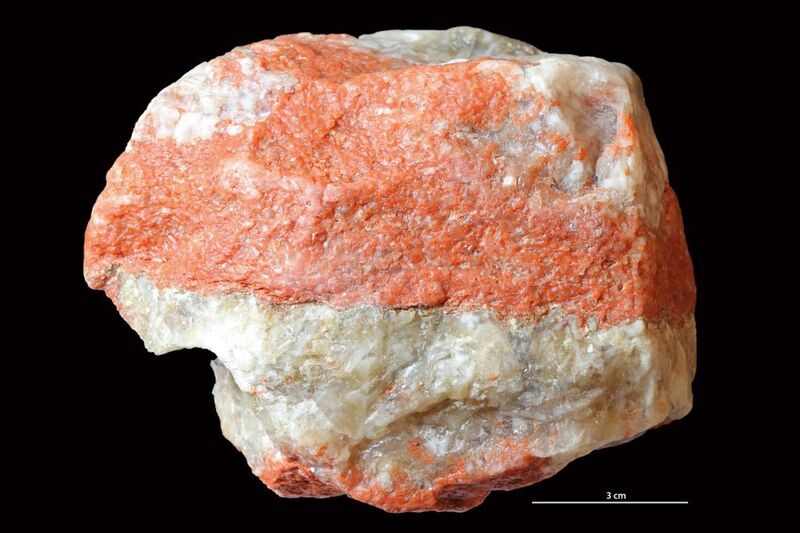
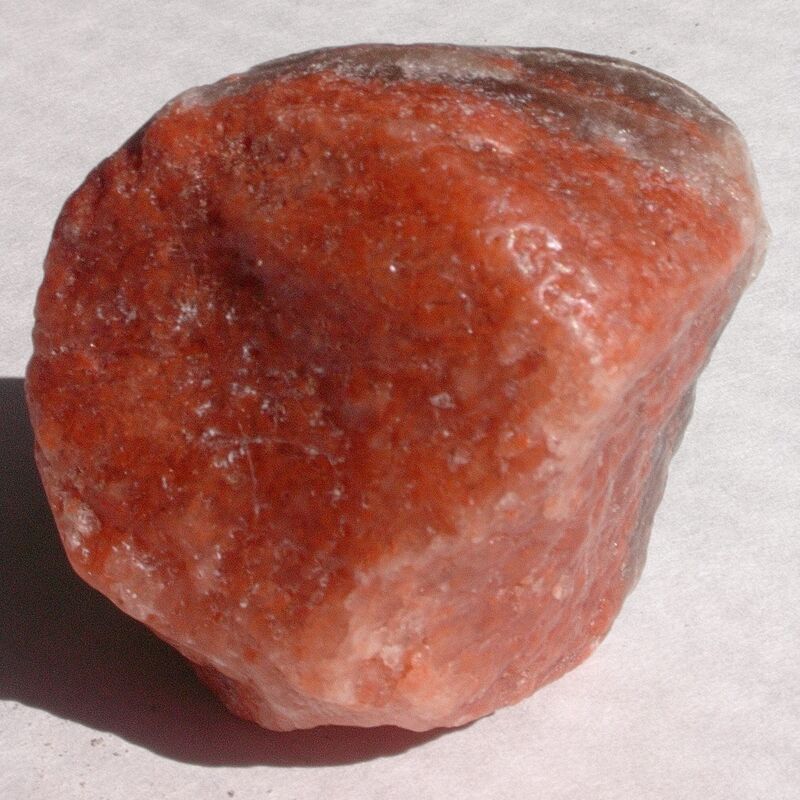
- Colourless · whitish · yellow · red · purple or blue
Calas, G., Galoisy, L., & Geisler, A. (2021). Sodium nanoparticles in alkali halide minerals: Why is villiaumite red and halite blue?. American Mineralogist: Journal of Earth and Planetary Materials, 106(5), 838-842.
- Streak
- White
- Tenacity
- brittle
- Cleavage
- Perfect
On (001)
- Fracture
- Conchoidal
- Density
- 2.168 g/cm³
Optical
- Optical type
- Isotropic
- Surface relief
- Moderate
- Principal indices
- n 1.5443
- Pleochroism
- Weak
The pleochroism is sometimes developed in coloured material after being subjected to pressure.
- Dispersion
- Moderately strong
- UV response
- Red (SW UV)[Searles Lake, CA]. Orange (SW) [Poland]
- Notes
Weakly anisotropic due to stress.
- Single index
- n = 1.544
Crystallography
- Space group
- #224
- Cell parameters
- a = 5.6404(1) Å
- Z
- 4
- Morphology
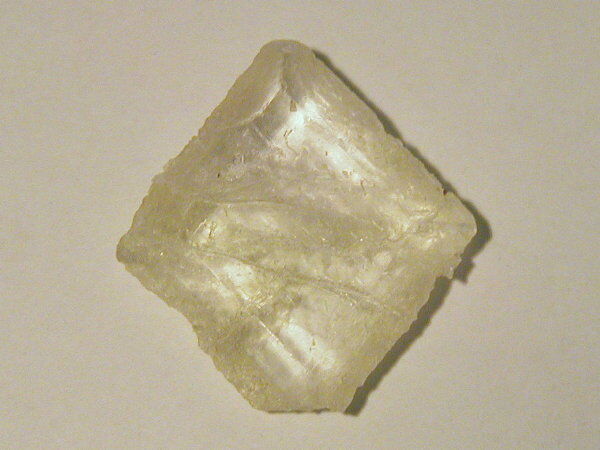
Normally cubic, rarely octahedral. Crystal faces often cavernous and stepped (hopper crystals). Massive. Coarsely granular to compact; columnar, stalactitic or capillary forms rare.
- Twinning
On (111) (artificial crystals).
Chemical composition
- Impurities
- I
- Br
- Fe
- O
Synonyms
- Alit
- Alita
- Alite
- b-Halit
- Bergsalz
- Chlorure de sodium
- Common Salt
- Halites
- Knistersalz
- Kochsalz
- Martinsite (of Karsten)
- Muriate of Soda
- Natrikalite
- Rock Salt
- Sal gema
- Sal Mare
- Sal marina
- Salgemma
- Salt
- Saltspar
- Sel gemme
- Soude muriatée
- Steinsalz
- β-Halite
In other languages
- French
- halite
- German
- Halit
- Spanish
- halita
- Italian
- halite · salgemma
- Portuguese
- Halita · halite
- Japanese
- 岩塩
- Chinese
- 石鹽
- Russian
- галит · каменная соль · минеральная соль
- Arabic
- الملح الصخري · الملحة الحية · ملح صخري · ملحة حية · هاليت
- Hindi
- सेंधा नमक
Classification
3.AA.20
- 3HalidesClass
- 3.ASimple halides, without H2ODivision
- 3.AAM:X = 1:1, 2:3, 3:5, etc.Group
- 3.AA.20HaliteSpecies
09.01.01.01
- 09Normal HalidesClass
- 09.01AXType
- 09.01.01Halite GroupGroup
- 09.01.01.01HaliteSpecies
8.1.3
- 8Halides - Fluorides, Chlorides, Bromides and Iodides; also Fluoborates and FluosilicatesClass
- 8.1Halides of the alkali metals and ammoniumGroup
- 8.1.3HaliteSpecies
Group, growth & confusion
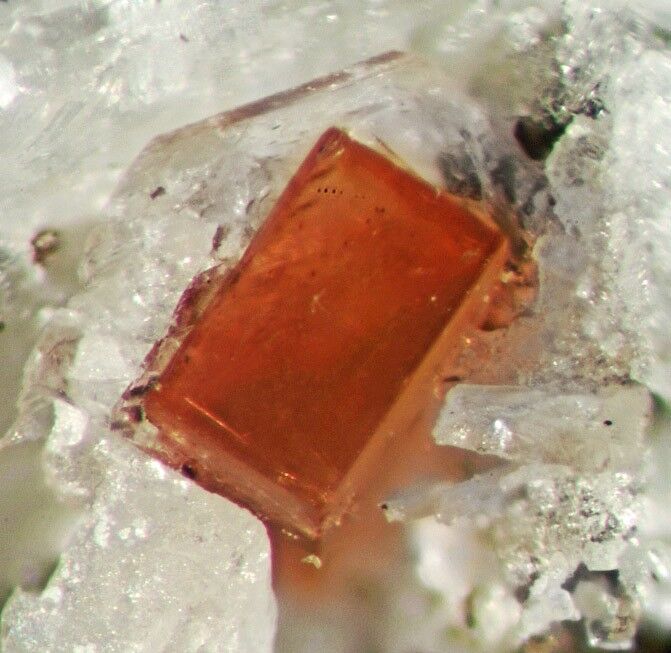
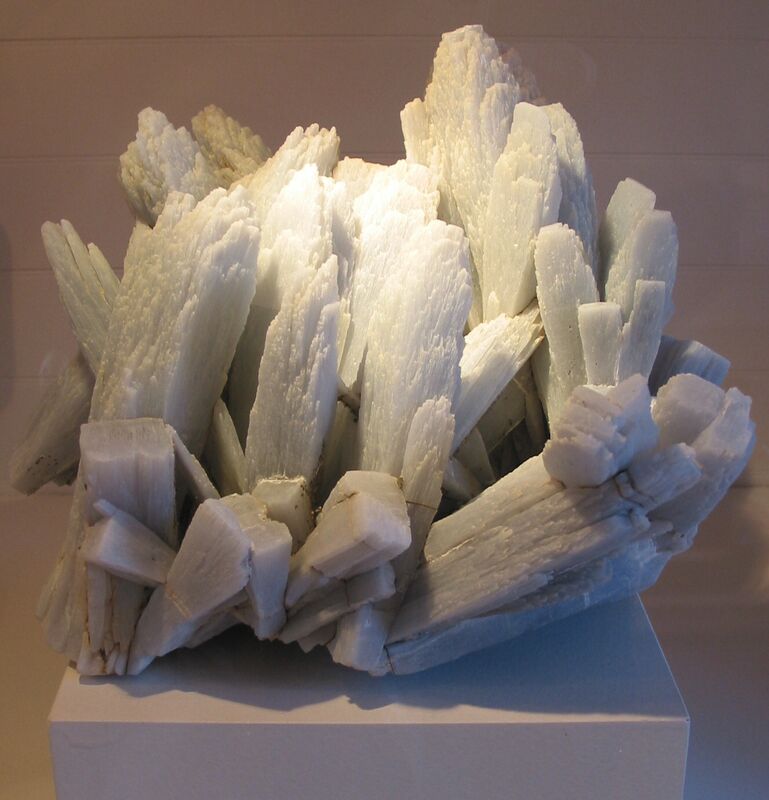 AnhydriteCa(SO4)Mineral—
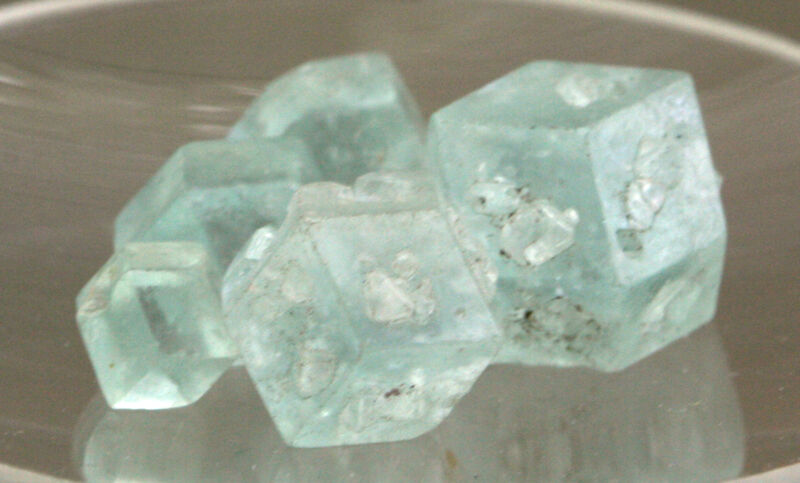 BoraciteMg3B7O13ClMineral—
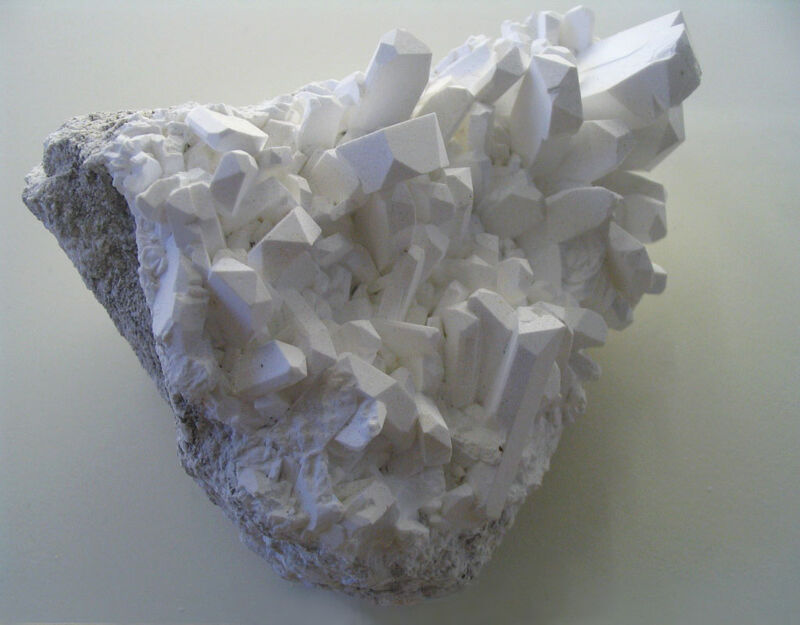 BoraxNa2B4O5(OH)4 · 8H2OMineral—
 CarnalliteKMgCl3 · 6H2OMineral—
 DarapskiteNa3(SO4)(NO3) · H2OMineral—
- EspadaiteNa4Ca3Mg2[AsO3(OH)]2[AsO2(OH)2]10(H2O)6 · H2OMineral—
- FermiiteNa4(UO2)(SO4)3 · 3H2OMineral—
- FlinteiteK2ZnCl4Mineral—
 GypsumCa(SO4) · 2H2OMineral—
 KainiteKMg(SO4)Cl · 2.75H2OMineral—
Literature, links & citation
- 1845Karsten (1845) Journal für praktische Chemie, Leipzig: 36: 127. [as Martinsite].
- 1868Dana, James D., Brush, George Jarvis (1868) A System of Mineralogy (5th ed.). p.882
- 1869Adam, M. (1869) Tableau minéralogique, Paris. [as Natrikalite].
- 1873Exner (1873) Härte an Krystallflächen, Wien.
- 1876Raimondi (1876) in: Domeyko, Min. Chili, 5th. Appendix (as Huantajayite).
Entry last updated
@misc{mineral2026,
  author    = {Mineral Index editorial board},
  title     = {Halite — Mineral Index},
  year      = {2026},
  url       = {https://mineralindex.org/minerals/halite-1804}
}