History
For two centuries after Europeans began handling it, the metal we now call bismuth hid in plain sight. Miners pulled it from the ground and chemists worked with it, yet most took it for a strange form of lead, tin, or antimony. Telling it apart took until the 1700s.
People used it long before they understood it. The Incas alloyed bismuth with copper and tin in a special bronze for knives.
The name itself records the old confusion. It likely comes from the early-16th-century German Wismuth or Wissmuth, perhaps tied to a word meaning "white". The Swiss physician Paracelsus wrote it as Bisemutum and traced it to a German term. One reading links the word to the mineral being dug ("gemutet") in the fields ("in den Wiesen") around St. Georges in Saxony. Another reads it as Weissmuth — "white material" — a good fit for a bright, silvery-white metal. Alchemists of the period had a more poetic name: tectum argenti, "silver being made", imagining the metal as silver still forming inside the Earth.
The first clear statement that bismuth was its own metal came from the German scholar Georgius Agricola. In 1546 he placed it in a family of metals alongside tin and lead — a distinct member, not a variant.
Recognition as a true chemical element came more slowly. The German chemist Johann Heinrich Pott began the work in 1738. The French chemist Claude Geoffroy settled it in 1753, showing this metal was genuinely distinct from lead and tin.
Industrial & practical applications
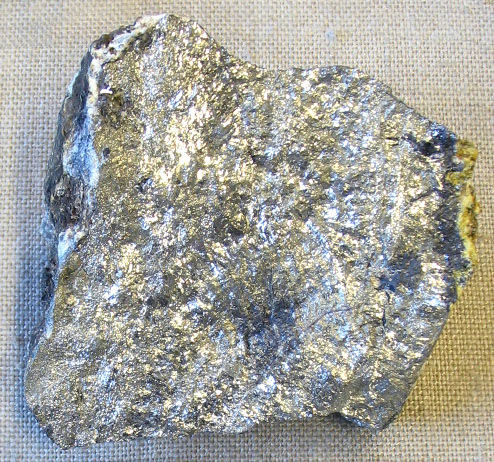
Almost none of the bismuth in modern use comes from native bismuth, the mineral specimen prized by collectors. The mineral is too scarce to mine for the metal. Instead, bismuth is recovered as a byproduct during the processing of lead ores, and from the refining of copper, tin, tungsten, and molybdenum.
Medicine is one of its most familiar uses. Bismuth subsalicylate is the active ingredient in "pink bismuth" preparations such as Pepto-Bismol, taken to treat diarrhea.
Paired with bismuth subcitrate, it also forms part of the treatment for the stomach bacterium that causes peptic ulcers — sores in the stomach lining.
A second strength is its low melting point. Bismuth makes fusible alloys that melt at modest heat. Wood's metal — bismuth with lead, tin, and cadmium — triggers automatic sprinkler systems for fires, melting to release the water when a fire raises the temperature.
Bismuth is also a non-toxic stand-in for lead. Research in the early 1990s tested it as a replacement in ceramic glazes, fishing sinkers, food-processing equipment, free-machining brasses for plumbing, and shot for waterfowl hunting. Today about a third of global bismuth production goes to needs once met by lead. As a dense metal it serves in fishing sinkers and as shot, bullets, and less-lethal riot-gun ammunition.
In cosmetics, bismuth oxychloride is used as a pigment in eye shadows, hair sprays, and nail polishes; its layered crystals refract light into a pearly, iridescent sheen.
One point catches out newcomers: the striking, rainbow-tinted "hopper" crystals sold to collectors are virtually unseen in nature. They are grown from high-purity bismuth in the lab.
The metal is a commodity with concentrated supply. China is the leading producer and exporter, and world production runs near 16,000 tonnes a year. The United States imports almost all it uses, with import reliance around 89%.
Where it forms, where it's found
- Geological setting
In hydrothermal veins with ores of Co, Ni, Ag, and Sn; in pegmatites and topaz-bearing Sn–W quartz veins.
- Type locality
- Schneeberg
- Erzgebirgskreis
- Saxony
- Germany
Physical
- Hardness
- 1Talc
- 2Gypsum
- 3Calcite
- 4Fluorite
- 5Apatite
- 6Orthoclase
- 7Quartz
- 8Topaz
- 9Corundum
- 10Diamond
- Lustre
- Metallic
- Transparency
- Opaque
- Colour
- Reddish-white to creamy-white · tarnishes iridescent pinkish · yellowish or bluish
- Streak
- Silver-white
- Tenacity
- sectile
- Cleavage
- Perfect
Perfect (0001), Good (101), poor (104)
- Density
- 9.7 g/cm³
Optical
- Pleochroism
- Weak
- Optical colour
- Brilliant creamy white, tarnishing to yellow
- Anisotropism
- Distinct
- Tropism
- Anisotropic
- Reflectance R%
- (47.0, 58.2) 400, (49.3, 58.8) 420, (51.4, 59.7) 440, (52.9, 60.9) 460, (54.4, 62.4) 480, (56.2, 63.9) 500, (57.8, 65.3) 520, (59.3, 66.6) 540, (60.4, 67.8) 560, (61.4, 69.0) 580, (62.4, 69.9) 600, (63.1, 70.7) 620, (63.6, 71.5) 640, (63.9, 72.2) 660, (64.0, 72.8) 680, (64.1, 73.2) 700
Crystallography
- Space group
- #99
- Cell parameters
- a = 4.55 Å · c = 11.85 Å
- Z
- 6
- Morphology
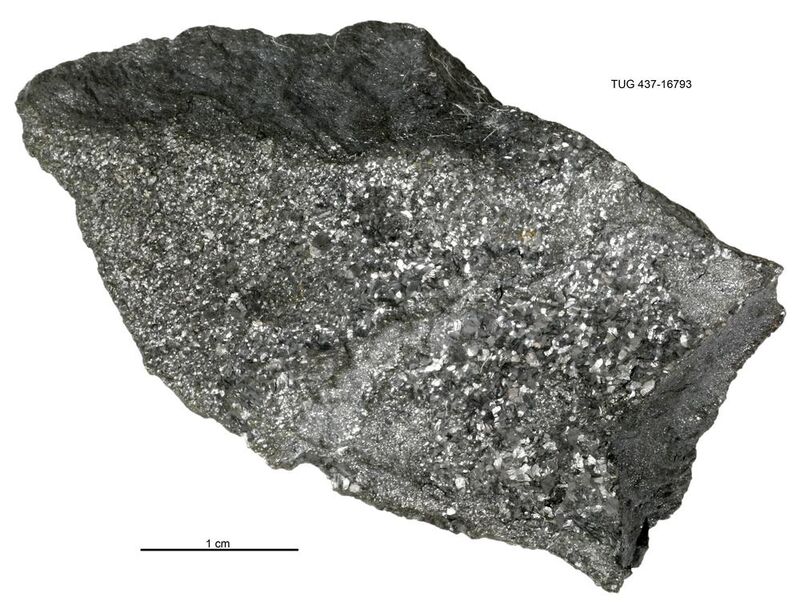
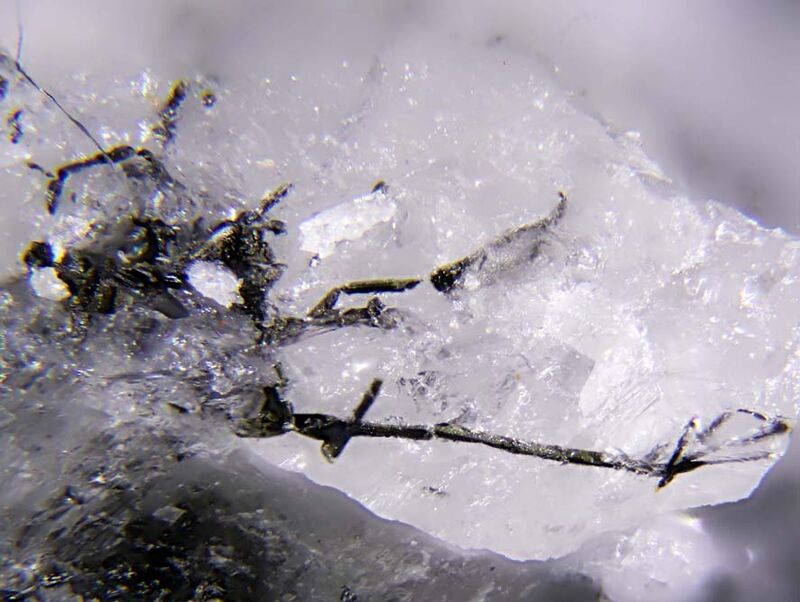
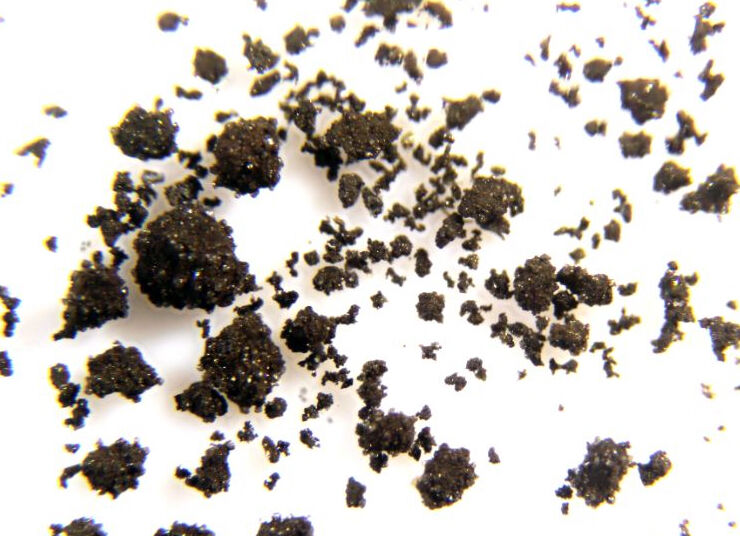
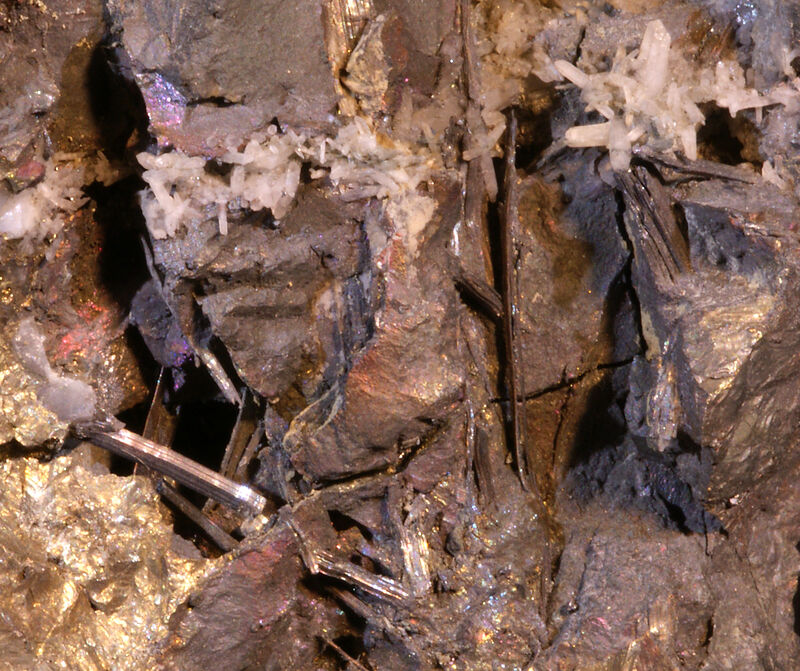
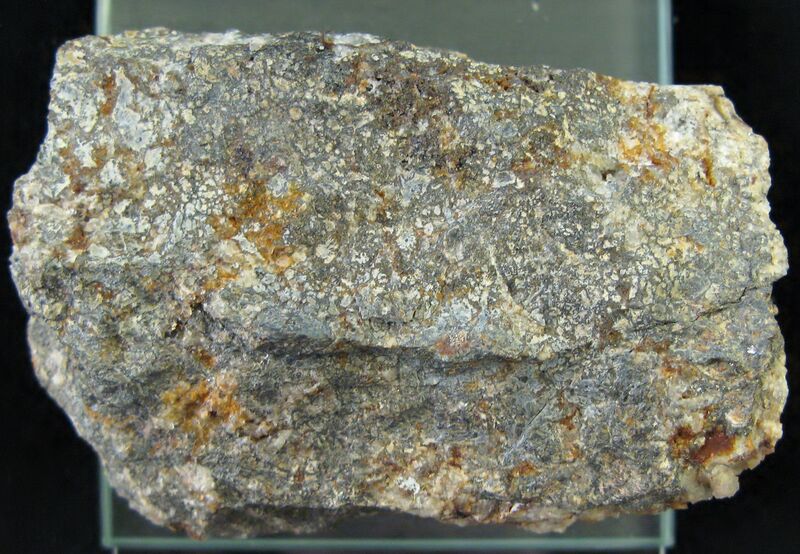
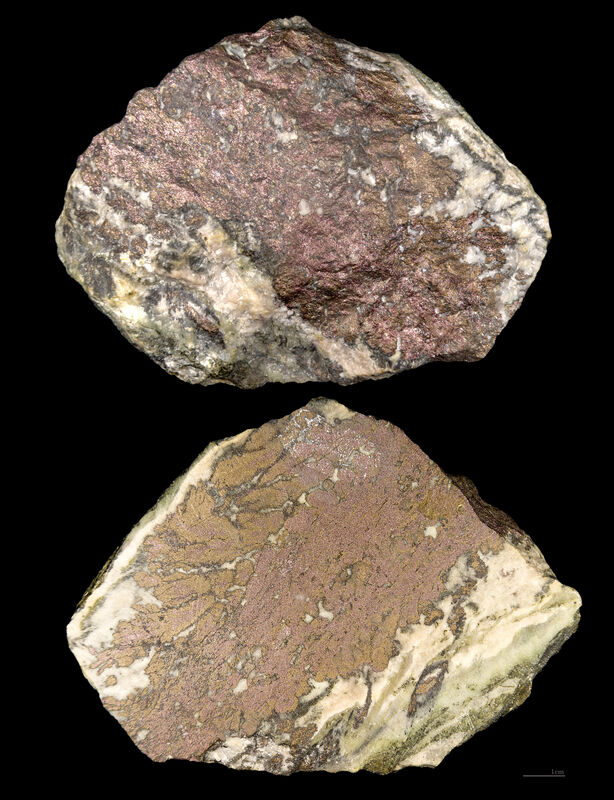
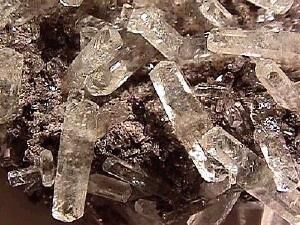
Crystals, to 12 cm, but indistinct, commonly in parallel groupings, or hoppered; reticulated, arborescent, foliated, granular.
- Twinning
Polysynthetic
Chemical composition
- Impurities
- Fe
- Te
- As
- S
- Sb
Synonyms
- Biosmat
- Bisemutum
- Bismut
- Bismút
- Bismût
- Bismutas
- Bismuth
- Bismuthi
- Bismuto
- Bismuts
- Bismutu
- Bismwth
- Bitmut
- Bizmut
- Bîzmût
- Gediegen Wismut
- Jinmrbismu
- Oktoedrisches Wismuth
- Vismut
- Vismutti
- Wismut
- Wismutu
- Βισμούθιο
In other languages
- French
- Bismuth natif
- German
- Bismut · Bismut, gediegen · Wismut
- Spanish
- bismuto nativo
- Italian
- bismuto nativo
- Japanese
- 自然ビスマス · 自然蒼鉛
- Russian
- Самородный висмут
Classification
1.CA.05
- 1ElementsClass
- 1.CMetalloids and NonmetalsDivision
- 1.CAArsenic group elementsGroup
- 1.CA.05Native BismuthSpecies
01.03.01.04
- 01Native Elements and AlloysClass
- 01.03Semi-metals and non-metalsType
- 01.03.01Arsenic groupGroup
- 01.03.01.04Native BismuthSpecies
1.49
- 1Elements and Alloys (including the arsenides, antimonides and bismuthides of Cu, Ag and Au)Class
- 1.49— unnamed intermediate level —Group
- 1.49Native BismuthSpecies
Group, growth & confusion
Literature, links & citation
- 1530Agricola, G. (1530) Bisemutum. in Bermannvs Sive De Re Metallica, Froben (Basileae), 75-76.
- 1556Agricola, G. (1556) Bismuth. in De Re Metallica, translated by Hoover, H.C. and Hoover, L.H. (1950), Dover (New York), 433-433.
- 1944Palache, Charles, Berman, Harry, Frondel, Clifford (1944) The System of Mineralogy (7th ed.) Vol. 1 - Elements, Sulfides, Sulfosalts, Oxides. John Wiley and Sons, New York.
- 1954Swanson, H.E., Fuyat, R.K., Ugrinic, G.M. (1954) Standard X-ray Diffraction Powder Patterns. United States Department of Commerce, National Bureau of Standards, Circular 539, 3, 20.
- 1969Ramdohr, Paul (1969) The Ore Minerals and their Intergrowths. Pergamon Press, Oxford. 1174pp. doi:10.1016/c2013-0-10027-xDOI: 10.1016/c2013-0-10027-x
Entry last updated
@misc{mineral2026,
  author    = {Mineral Index editorial board},
  title     = {Native Bismuth — Mineral Index},
  year      = {2026},
  url       = {https://mineralindex.org/minerals/native-bismuth-684}
}