History
Hold a crystal of scorodite over a candle and it betrays itself. The mineral gives off a sharp smell of garlic — the signature whiff of warmed arsenic — and that smell is how it earned its name.
The German mineralogist Johann Friedrich August Breithaupt described and named it in 1818. He was working from material found in the silver-mining country around Schwarzenberg, in the Saxon Ore Mountains; the type locality is the Stamm Asser Mine at Graul, near Raschau-Markersbach. Breithaupt drew the name from the Greek skorodion — garlicky — after the odour the mineral releases when heated.
That odour was a useful identification cue in the early nineteenth century, when chemistry was only beginning to put names on the elements inside a mineral. Scorodite is a hydrated iron arsenate, FeAsO₄·2H₂O, and it forms in the gossan — the rust-coloured, oxidised cap that develops over an arsenic-bearing sulfide deposit when groundwater and air slowly chew through it. Wherever older miners worked arsenopyrite or other arsenide ores, the weathered upper levels eventually yielded scorodite as one of the secondary minerals on the dump.
Notable collector localities
Two later localities turned scorodite from a regional curiosity into a sought-after collector mineral.
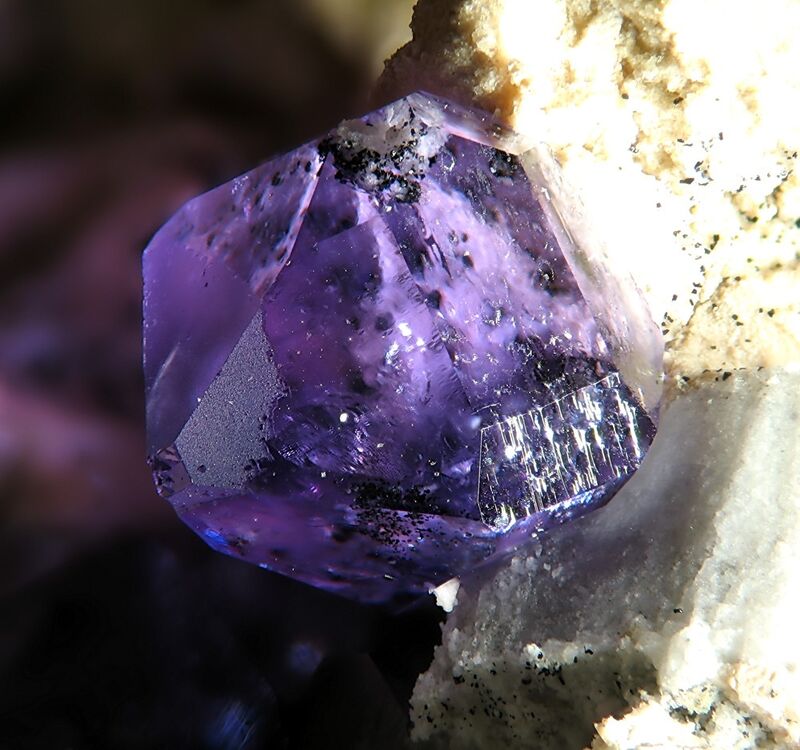
The first is Tsumeb, in northern Namibia, where the copper-lead-zinc orebody produced exceptional crystals from its deep oxidation zone. The first published mention of Tsumeb scorodite came in 1971, with material from a 1964 find at East 49 on the 30 Level. Pinch and Wilson described the crystals in 1977: in daylight they read as blue-green, but under incandescent light they shift to an intense bluish-purple — a pronounced alexandrite effect, the colour-change behaviour normally associated with the gem chrysoberyl. One collector recalled being shown a roughly 25-centimetre hemispherical aggregate of gemmy blue crystals in the early 1970s — the finest specimen of any species he had ever encountered from Tsumeb.
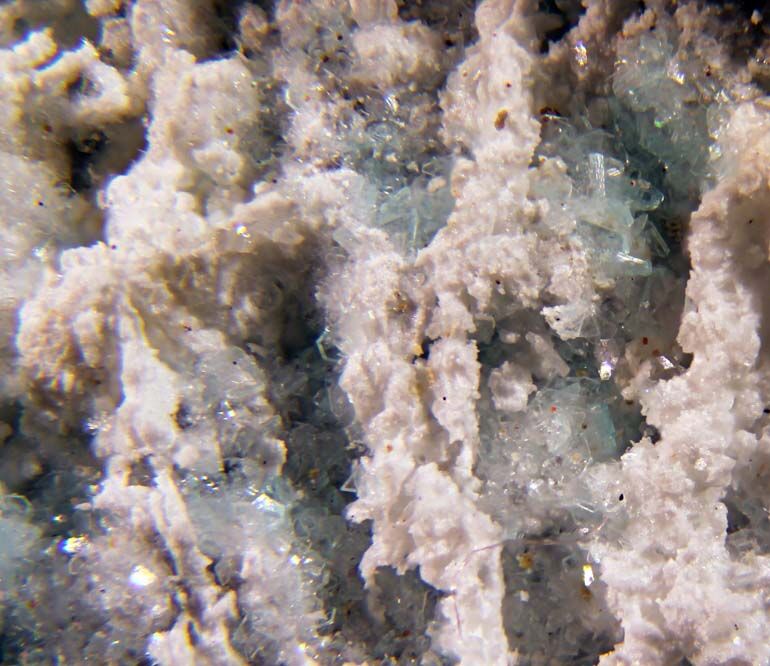
The second is Hemerdon Bal, a tungsten-tin mine near Sparkwell in Devon, England. The mine is one of the few British localities to yield well-formed scorodite, often perched on the brown cubes of pharmacosiderite, and produced fresh pockets through the late 1990s.
Industrial & practical applications
Scorodite is not mined as an ore of arsenic. The world's arsenic supply comes from sulfide minerals — chiefly arsenopyrite — processed alongside copper, lead, and gold. Scorodite's modern industrial importance runs the other way around. It is the target product hydrometallurgists try to make on purpose. The aim is to lock arsenic away once it has been pulled out of a sulfide ore.
The setting is the pressure oxidation of refractory gold ores. Many gold deposits hold their gold inside arsenopyrite, finely intergrown with pyrite — sulfide minerals that trap the gold within them. To free the gold for cyanide leaching, the concentrate is treated in an autoclave, a sealed pressurised reactor. Inside, high-purity oxygen oxidises the sulfides at high temperature and releases everything they hold. The arsenic released in that step is the problem. Roasting would send it up the stack as arsenic trioxide gas. The wet, pressurised route instead converts it to solid scorodite inside the reactor, which is then easy to dispose of.
Synthetic scorodite is preferred because it is the most stable common form of ferric arsenate at the disposal pH range. It carries roughly 33 weight percent arsenic — a given mass of waste locks away a lot of toxic element. Its solubility stays low between pH 4 and pH 7 under oxic conditions, which is enough for long-term tailings storage.
The standard industrial route forms it at elevated temperature and pressure inside the autoclave. An atmospheric variant precipitates it from acidic solutions below pH 2, at 70 to 95 °C, with lower operating cost. The alternative — co-precipitating arsenic with ferrihydrite at room temperature — produces much larger waste volumes at only 3 to 8 percent arsenic.
Outside the autoclave, natural scorodite is sought by collectors and museums rather than by industry. The blue-green gem-quality crystals from Tsumeb and from Hemerdon Bal are the most prized — Tsumeb material is now very scarce on the market, ranking among the most desired of that mine's rarities.
Where it forms, where it's found
- Geological setting
In the secondary oxidation zone of iron bearing arsenides, in gossans; also observed in a primary hydrothermal deposit (Saubach).
- Type locality
- Stamm Asser Mine
- Graul
- Langenberg
- Raschau-Markersbach
- Erzgebirgskreis
- Saxony
- Germany
50.5469°, 12.8306°
Varieties
Safety & handling
Physical
- Hardness
- 1Talc
- 2Gypsum
- 3Calcite
- 4Fluorite
- 5Apatite
- 6Orthoclase
- 7Quartz
- 8Topaz
- 9Corundum
- 10Diamond
- Lustre
- Vitreous to Resinous · Dull
- Transparency
- Translucent
- Colour
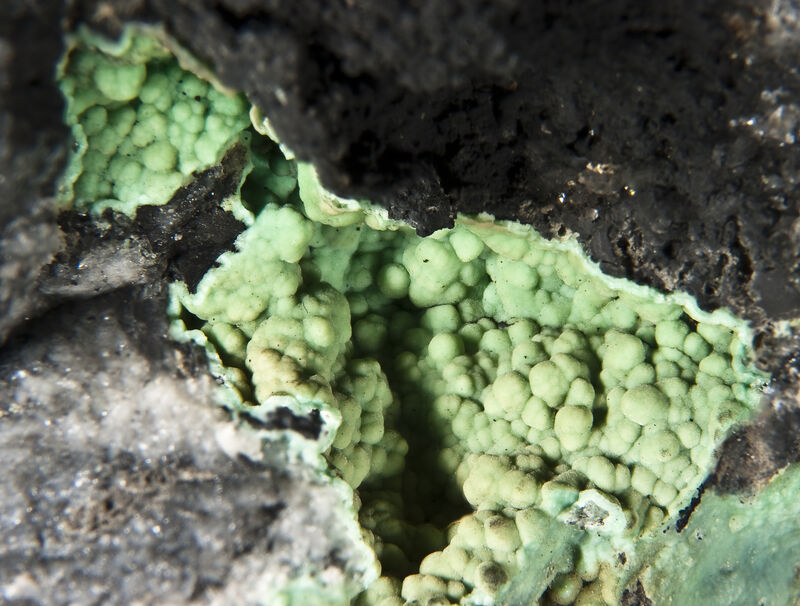
- Green · blue-green · grey · grayish-green · blue · yellow-brown · nearly colourless · violet · colourless to faintly greenish or greenish brown in transmitted light.
Earthy material: light green to light grayish or brownish green.
- Streak
- Greenish-White
- Cleavage
- Imperfect/Fair
Imperfect on (201), traces on (001)(100)
- Fracture
- Sub-Conchoidal
- Density
- 3.27 g/cm³
Optical
- Optical type
- Biaxial (+) · 2V measured = 40 – 75° · 2V calc = 46 – 80°
- Refractive index
- 1.741 – 1.82
- Surface relief
- High
- Principal indices
- nα 1.741 – 1.784 · nβ 1.744 – 1.805 · nγ 1.768 – 1.82
- Pleochroism
- Weak
blue-violet to blue-green
- Dispersion
- relatively strong r > v
Crystallography
- Cell parameters
- a = 8.937 Å · b = 10.278 Å · c = 9.996 Å
- Ratio a:b:c
- 1 : 1.150 : 1.118
- Unit cell volume
- 918.2 ų
- Z
- 8
- Morphology
Crystals commonly pyramidal (111) (sometimes pseudo-octahedral), tabular (001), or prismatic [010]. Commonly aggregated into crusts or irregular groups. Also occurs massive, crystalline or porous and sinter-like, earthy.
- Comment
space group is Pcab
Chemical composition
Synonyms
- Arsenic Sinter
- Arseniksinter
- Cuivre arseniaté ferrifère
- Cupreous Arsenate of Iron
- Cupromartial Arsenate
- Eisensinter
- Ioguneite
- Jogynaite
- Kobalt-Skorodit
- Loaisita
- Loaisite
- Martial Arsenate of Copper
- Néoctèse
- Prismatisches Flusshaloid
- Scorodiet
- Scorodit
- Scorodita
- Skorodite
In other languages
- French
- scorodite
- German
- Skorodit
- Spanish
- Escorodita
- Italian
- Scorodite
- Japanese
- スコロド石
- Chinese
- 臭蔥石
- Russian
- скородит
Classification
8.CD.10
- 8Phosphates, Arsenates, VanadatesClass
- 8.CPhosphates without additional anions, with H2ODivision
- 8.CDWith only medium-sized cations, RO4:H2O = 1:2Group
- 8.CD.10ScoroditeSpecies
40.04.01.03
- 40Hydrated Normal Phosphates, Arsenates and VanadatesClass
- 40.04(AB)5(XO4)2·xH2OType
- 40.04.01Variscite GroupGroup
- 40.04.01.03ScoroditeSpecies
20.9.2
- 20Arsenates (also arsenates with phosphate, but without other anions)Class
- 20.9Arsenates of FeGroup
- 20.9.2ScoroditeSpecies
Group, growth & confusion
 AbernathyiteK(UO2)(AsO4) · 3H2OMineral—
 AdamiteZn2(AsO4)(OH)Mineral—
 ArseniosideriteCa2Fe3+3O2(AsO4)3 · 3H2OMineral—
 BeudantitePbFe3+3(AsO4)(SO4)(OH)6Mineral—
 CarminitePbFe3+2(AsO4)2(OH)2Mineral—
 ChalcedonySiO2Variety—
 ChenevixiteCuFe3+(AsO4)(OH)2Mineral—
 DussertiteBaFe3+3(AsO4)(AsO3OH)(OH)6Mineral—
 ErythriteCo3(AsO4)2 · 8H2OMineral—
 FerrihydriteFe3+10O14(OH)2Mineral—
Literature, links & citation
- 1801Bournon (1801) Royal Society of London, Philosophical Transactions: 191 (as Cupromartial Arsenate).
- 1809Haüy, René Just (1809) Tableau comparatif des résultats de la Cristallographie et de l'analyse Chimique, relativement a la Classification des Minéraux.. Chez Courcier, Paris.
- 1818Breithaupt, A. (1818): Skorodit.- C.A.S. Hoffmann´s Handbuch der Mineralogie, Vol. 4.2. Freiberg, Verl. Craz & Gerlach, p. 182-185 (as Scorodit).
- 1832Beudant, François-Sulpice (1832) Traité élémentaire de minéralogie. Deuxiéme Edition [Elementary Treatise on Mineralogy. Second Edition] (2nd ed.) Vol. 2 - Tome II [Volume II]. Chez Verdière.
- 1844Des Cloizeaux (1844) Annales de chimie et de physique, Paris: 10: 402.
Entry last updated
@misc{mineral2026,
  author    = {Mineral Index editorial board},
  title     = {Scorodite — Mineral Index},
  year      = {2026},
  url       = {https://mineralindex.org/minerals/scorodite-3595}
}