History
The name wavellite honours a country physician who noticed what trained chemists had missed. In 1805, the English mineralogist William Babington proposed the name in tribute to Dr. William Wavell (1750–1829), a Devon-based physician, botanist, historian, and naturalist who had brought the mineral to the attention of fellow mineralogists.
Wavell practised medicine in Barnstaple, in north Devon, where he was in partnership with Dr. William Curtis on Gracechurch Street. He had been educated in Edinburgh and corresponded with several naturalists of his generation. The type specimens came from a quarry at High Down, near the village of Filleigh, a few miles inland from his Barnstaple practice.
The discovery had a quietly important chemical edge. The same translucent green crusts had been examined before and grouped under the older name hydrargilite — an aluminium hydroxide. Non-contemporary accounts credit Wavell with detecting phosphate in the material, a constituent earlier analysts had missed. That single observation moved the mineral out of the hydroxide family and into the aluminium phosphates, where it has remained.
Industrial & practical applications
Wavellite has no significant industrial use. It is not mined as an ore, not refined into a commodity, and not produced at any meaningful scale. What demand exists comes almost entirely from mineral collectors and museums.
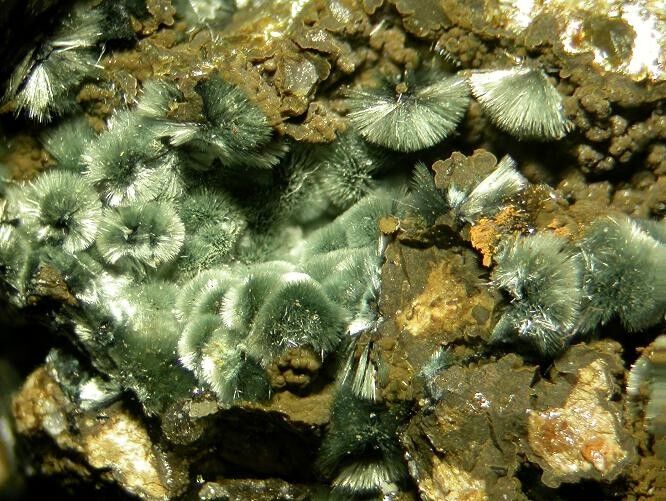
Collectors prize the mineral for one form in particular: tight green or yellowish-green spheres made of fine crystals radiating from a single point. Specimens of this kind reach the market from a small number of localities, including the Ouachita Mountains around Mount Ida in Arkansas, the original Devon quarry, and historic occurrences in Bolivia and the Czech Republic.
Cut stones appear from time to time. Wavellite is occasionally faceted or polished as a gemstone, but it is too soft to survive daily wear. Cut wavellite is therefore a cabinet curiosity, not a stone for rings or pendants.
Where it forms, where it's found
- Geological setting
A secondary mineral of aluminous low-grade metamorphic rocks, in phosphate and limonitic deposits; more rarely as a late-forming hydrothermal vein mineral.
- Type locality
- High Down Quarry
- West Buckland
- North Devon
- Devon
- England
- UK
51.0442°, -3.9251°
Physical
- Hardness
- 1Talc
- 2Gypsum
- 3Calcite
- 4Fluorite
- 5Apatite
- 6Orthoclase
- 7Quartz
- 8Topaz
- 9Corundum
- 10Diamond
- Transparency
- Transparent · Translucent
- Colour
- Green to yellowish-green and yellow · greenish white · yellowish-brown · brown · brownish-black · blue · white and colourless · colourless in transmitted light.
Colouration may be zoned.
- Streak
- White.
- Tenacity
- brittle
- Cleavage
- Perfect
Perfect on (110), good on (101), distinct on (010).
- Fracture
- Irregular/Uneven · Sub-Conchoidal
- Density
- 2.36 g/cm³
Optical
- Optical type
- Biaxial (+) · 2V measured = 60 – 72° · 2V calc = 60 – 70°
- Refractive index
- 1.518 – 1.561
- Surface relief
- Moderate
- Principal indices
- nα 1.518 – 1.535 · nβ 1.524 – 1.543 · nγ 1.544 – 1.561
- Pleochroism
- Weak
X= Greenish Z= Yellowish
- Dispersion
- r > v weak
Crystallography
- Cell parameters
- a = 9.621 Å · b = 17.363 Å · c = 6.994 Å
- Ratio a:b:c
- 1 : 1.805 : 0.727
- Z
- 4
- Morphology
Crystals rare, stout to long prismatic parallel to [001], with (110) striated parallel to [001]. Found as hemispherical or globular aggregates with an internal radial or stellate structure of fibrous crystals; as crusts and stalactic; more rarely in chalcedony-like opaline masses.
- Twinning
None reported
- Comment
Space Group: Pcmn (non-standard setting).
Chemical composition
- Impurities
- F
- Fe
Synonyms
- Alumine phosphatée
- Bialit
- Bialita
- Bialite
- Bialith
- Brazilianite (of Mawe)
- Devonit
- Devonita
- Devonite (of von Moll)
- Fischerit
- Fischerita
- Fischerite
- Hydrargillite (of Davy)
- Kapnicite
- Kapnikite (of Kenngott)
- Lasionit
- Lasionita
- Lasionite
- Lazionit
- Lazionita
- Lazionite
- Striegisan
- Thonerdephosphat
- Uhligite (of Slavik)
- Wavellite (of Babington)
- Zepharovichit
- Zepharovichita
- Zepharovichite
In other languages
- French
- wavellite
- German
- Fischerit · Lasionit · Wavellit
- Spanish
- wavelita · wavellita
- Italian
- Wavellite
- Japanese
- 銀星石
- Chinese
- 磷铝石 · 銀星石
- Simplified Chinese
- 磷铝石
- Traditional Chinese
- 磷鋁石
- Russian
- вавеллит · фишерит
- Arabic
- ويفيليت
Classification
8.DC.50
- 8Phosphates, Arsenates, VanadatesClass
- 8.DPhosphates, etc. with additional anions, with H2ODivision
- 8.DCWith only medium-sized cations, (OH, etc.):RO4 = 1:1 and < 2:1Group
- 8.DC.50WavelliteSpecies
42.10.02.01
- 42Hydrated Phosphates, Etc.containing Hydroxyl or HalogenClass
- 42.10A3(XO4)2Zq·xH2OType
- 42.10.02Wavellite GroupGroup
- 42.10.02.01WavelliteSpecies
19.7.8
- 19PhosphatesClass
- 19.7Phosphates of Al aloneGroup
- 19.7.8WavelliteSpecies
Group, growth & confusion
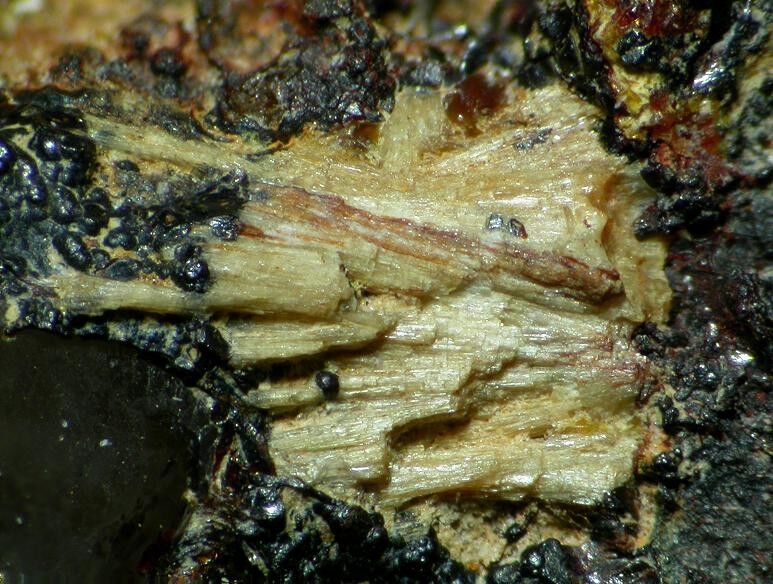
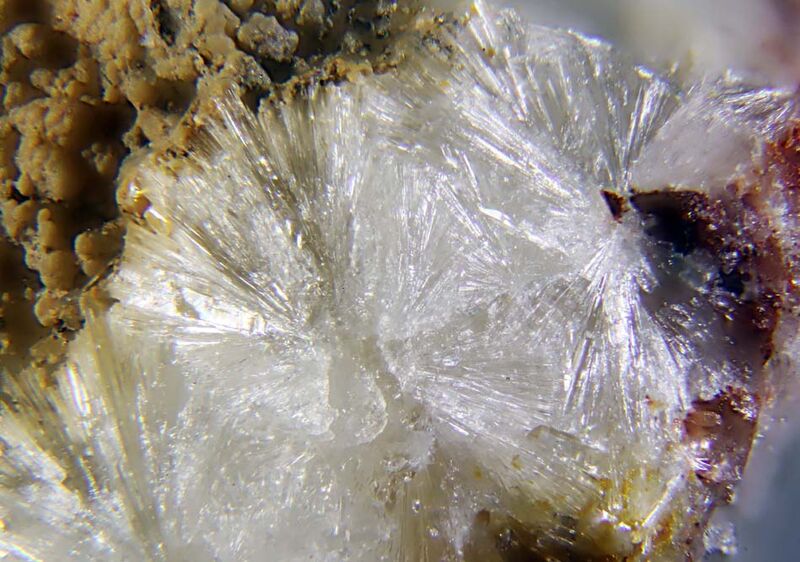
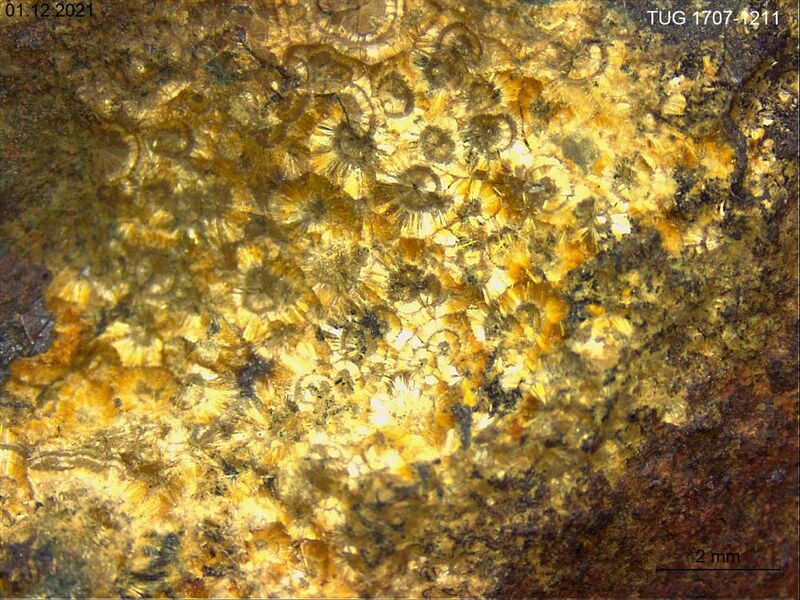
 BerauniteFe3+6(PO4)4O(OH)4 · 6H2OMineral—
 CacoxeniteFe3+24AlO6(PO4)17(OH)12 · 75H2OMineral—
 Churchite-(Y)Y(PO4) · 2H2OMineral—
 CrandalliteCaAl3(PO4)(PO3OH)(OH)6Mineral—
 DiadochiteFe3+2(PO4)(SO4)(OH) · 6H2OMineral—
 MatulaiteFe3+Al7(PO4)4(PO3OH)2(OH)8(H2O)8 · 8H2OMineral—
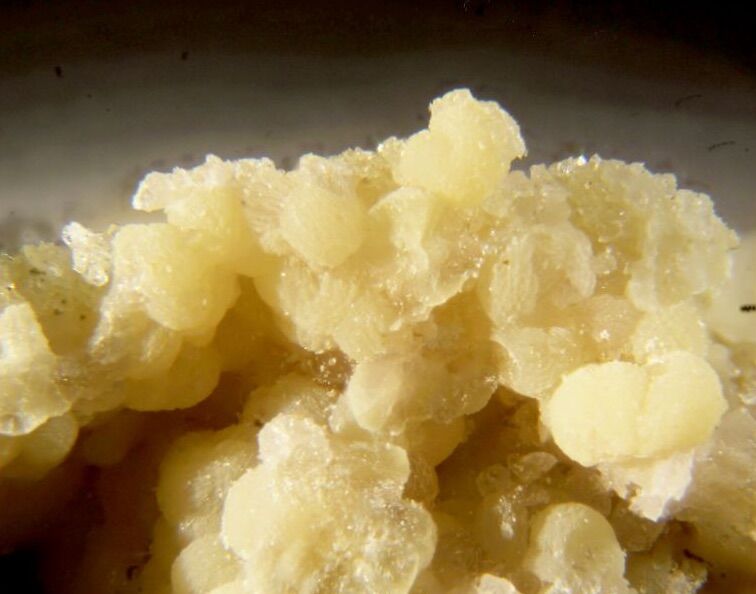 MillisiteNaCaAl6(PO4)4(OH)9 · 3H2OMineral—
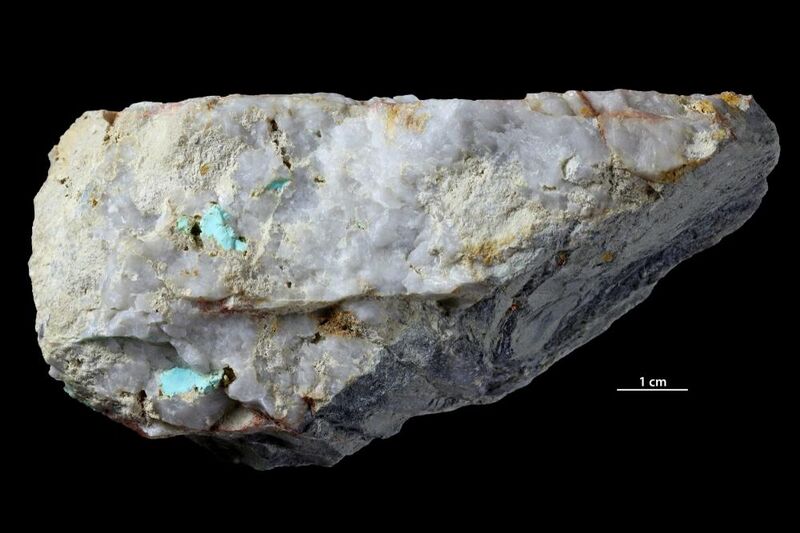 TurquoiseCuAl6(PO4)4(OH)8 · 4H2OMineral—
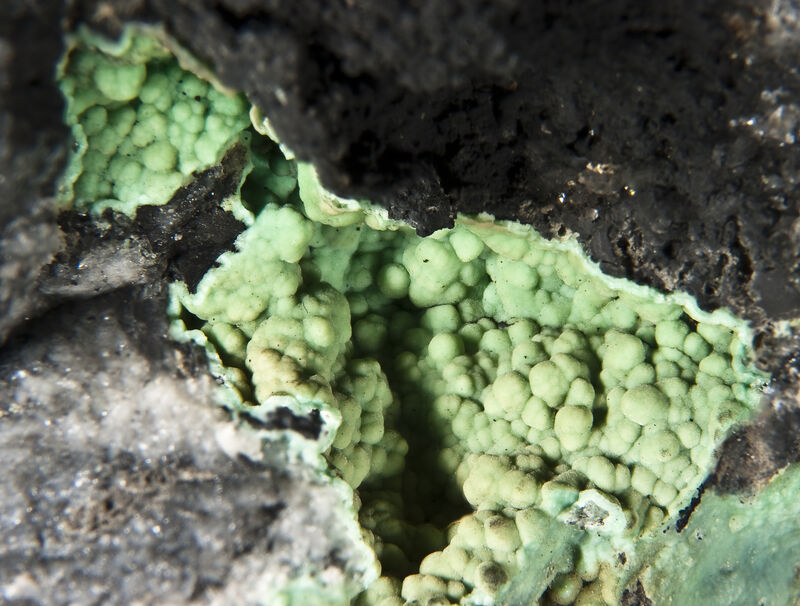 VarisciteAl(PO4) · 2H2OMineral—
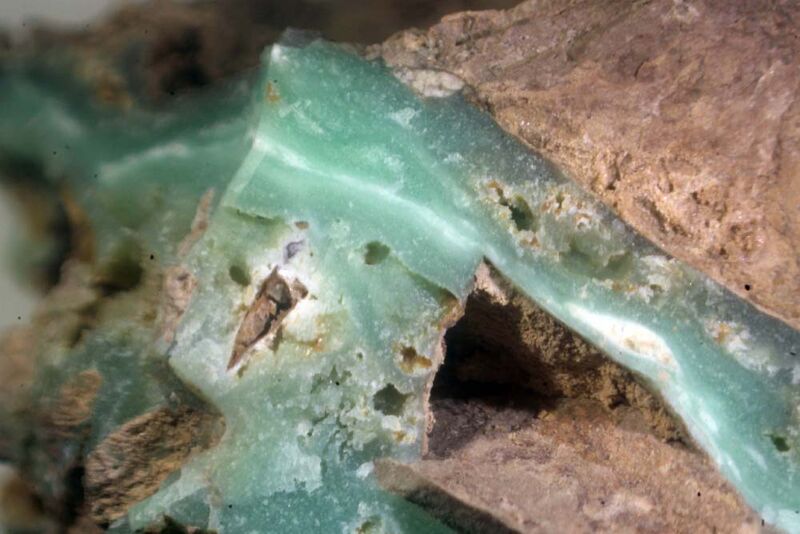 VashegyiteAl11(PO4)9(OH)6 · 38H2OMineral—
Literature, links & citation
- 1805Davy, Humphrey (1805) VII. An account of some analytical experiments on a mineral production from Devonshire, consisting principally of alumine and water. Philosophical Transactions Of The Royal Society Of London, 95. 155-162 doi:10.1098/rstl.1805.0009DOI: 10.1098/rstl.1805.0009
- 1805Gregor, W. (1805) XXIII. Experiments on a mineral substance formerly supposed to be zeolite; with some remarks on two species of uran-glimmer. Philosophical Transactions Of The Royal Society Of London, 95. 331-348 doi:10.1098/rstl.1805.0025DOI: 10.1098/rstl.1805.0025
- 1809Thomson & von Moll (1809) Jahrb. Efem.: 5: 148 (as Devonite).
- 1819Fuchs, J. N. (1819) On lasionite and wavellite. Annals of Philosophy, S. 1 Vol. 14. 276-281
- 1827Curtis, Samuel and Hooker, William Jackson (1827) Memoirs of the Life and Writing of the Late Mr. William Curtis, Curtis's Botanical Magazine; or Flower Garden Displayed, v. 1 (new series), v-xxxii.
Entry last updated
@misc{mineral2026,
  author    = {Mineral Index editorial board},
  title     = {Wavellite — Mineral Index},
  year      = {2026},
  url       = {https://mineralindex.org/minerals/wavellite-4250}
}