History
The mineral spent its first seventy years under a name almost as heavy as its lead content. In 1772, the mineralogist Ignaz von Born called it plumbum spatosum flavo-rubrum, ex Annaberg, Austria. Roughly translated, that mouthful means "yellow-red lead spar from Annaberg". It described the same orange-to-yellow tabular crystals collectors prize today. But in the descriptive Latin of 18th-century mineralogy, every property still had to be packed into the name itself.
A few years later, in 1781, Joseph Franz Edler von Jacquin tried a shorter alternative — Kärntherischer bleispath, the "Carinthian lead spar". The Latin name and the German name circulated together for decades, with other proposals piling up alongside them.
The work that mattered most was published in 1785. Franz Xaver von Wulfen wrote Abhandlung vom Kärntner Bleispate — a monograph dedicated entirely to the lead ores of Bleiberg, in the Austrian region of Carinthia. The lead-ore monograph was his side-project, but it was thorough enough to fix the mineral in scholarly memory.
In 1845, Wilhelm Karl von Haidinger swept away the older Latin and German names. He proposed wulfenite in honor of Wulfen, forty years after his death. The new name fit the 19th-century convention of ending mineral names with the -ite suffix, and it stuck. The type locality remained where Wulfen had studied it — Bad Bleiberg, in Carinthia.
The mineral has had one further honor. In 2017, Arizona adopted wulfenite as its official state mineral. The choice recognised the deep red, sharply tabular crystals produced from oxidized lead deposits across the desert southwest.
Industrial & practical applications
Wulfenite earns its place in industry as a minor secondary ore of molybdenum. It ranks as the second most common molybdenum mineral after molybdenite, but its contribution to global supply stays modest. Most molybdenum mined today comes from molybdenite. Wulfenite is processed only where it concentrates richly enough in oxidized lead deposits to be worth recovering on its own.
When the mineral is processed for the metal, the ore is crushed to about 60 to 80 mesh. It is then mixed with sodium nitrate or sodium hydroxide and heated to around 700°C to release the molybdenum for extraction.
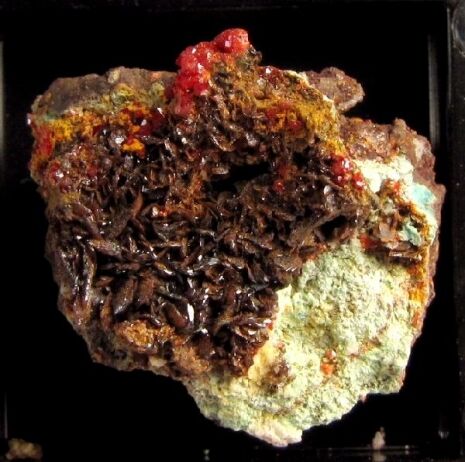
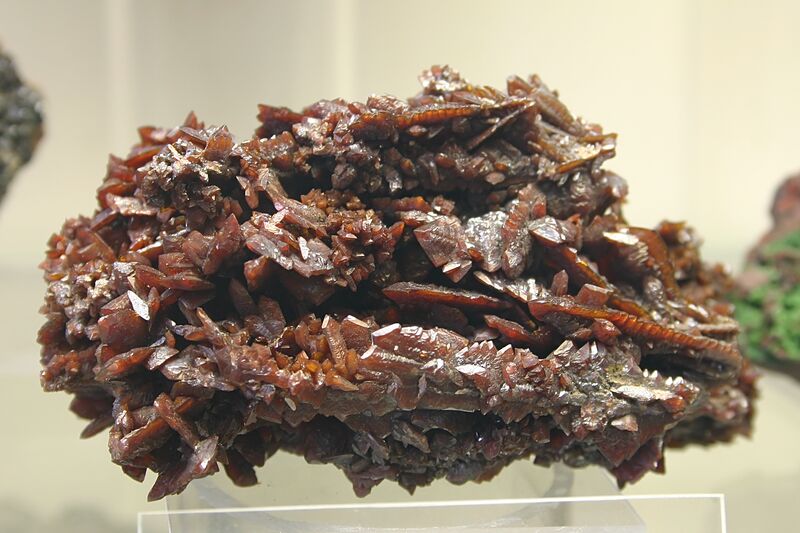
The larger modern role for wulfenite is in mineral collecting. Sharply formed, often vividly orange-red tabular crystals make the species sought after by collectors and museums. Specimens from the Red Cloud Mine in Arizona, with their deep red colour and well-developed crystal faces, are among the most prized in the trade.
No other significant industrial application is documented for the mineral.
Where it forms, where it's found
- Geological setting
Secondary mineral in weathering zone of lead deposits.
- Type locality
- Bad Bleiberg
- Villach-Land District
- Carinthia
- Austria
46.6167°, 13.6833°
Varieties
Safety & handling
Physical
- Hardness
- 1Talc
- 2Gypsum
- 3Calcite
- 4Fluorite
- 5Apatite
- 6Orthoclase
- 7Quartz
- 8Topaz
- 9Corundum
- 10Diamond
- Lustre
- Resinous · Adamantine
- Transparency
- Transparent · Translucent · Opaque
- Colour
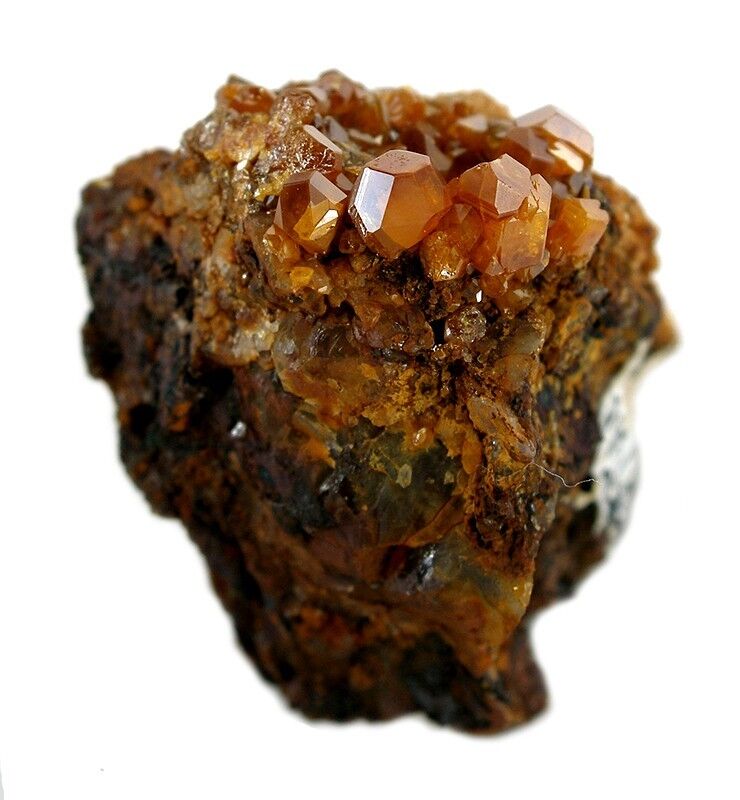
- Orange-yellow · yellow · honey-yellow · reddish-orange · rarely colourless · grey · brown · olive-green and even black.
- Streak
- White
- Tenacity
- brittle
- Cleavage
- Distinct/Good
Distinct on (011); indistinct on (001), (013).
- Fracture
- Irregular/Uneven · Sub-Conchoidal
- Density
- 6.5 g/cm³
Optical
- Optical type
- Uniaxial (-) · 2V measured = 8°
- Refractive index
- 2.283 – 2.405
- Surface relief
- Very high
- Principal indices
- nω 2.405 · nε 2.283
- Birefringence
- 0.122
- Pleochroism
- Weak
Orange and yellow
- Extinction
- Parallel
- UV response
- Fluorescence noted from a small number of localities. Medium intensity Yellow in LW
- Notes
May be anomalously biaxial.
Crystallography
- Space group
- I41/a
- Cell parameters
- a = 5.433 Å · c = 12.110 Å
- Z
- 4
- Morphology
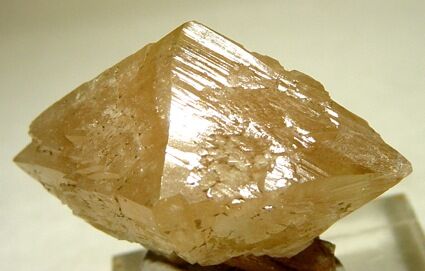
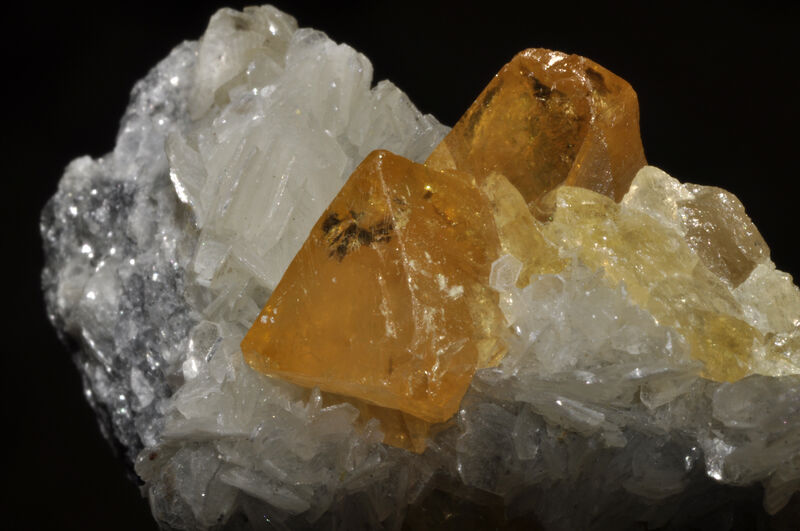
Crystals commonly thin tabular (001), square, exhibiting (001), with flat or rounded vicinal faces, (010); may be elongated [001], or pyramidal (011), with the pyramid truncating or replacing (001); more rarely pseudo-octahedral; and very rarely either cubic or short prismatic pyramidal. Commonly exhibits additional forms, some exhibiting pyramidal hemihedrism; granular, massive.
- Twinning
Twinning on (001) as contact twins; common but rarely seen due to the typical (001) morphology.
- Comment
Class may be 4/m or -4; space Group may be I41/a or I-4. Cell parameters for space group I-4: a = 5.441, c = 12.068 A.
Chemical composition
- Impurities
- W
- Ca
- V
- As
- Cr
- W
- Ti
Synonyms
- Bleimolybdat
- Carinthit
- Carinthita
- Carinthite
- Gelbbleierz
- Kärntherischer Bleispath
- Lead molybdate
- Mélinose
- Molybdänbleierz
- Molybdänbleirz
- Molybdänbleispath
- Molybdate of Lead
- Molybdenated Lead Ore
- Plomb jaune
- Plomb molybdaté
- Plumbum spatosum flavo-rubrum
- Yellow Lead Ore
- Yellow Leadspar
In other languages
- French
- 10190-55-3 · Carinthite · Lyonite · Mélinose · PbMoO4 · Plomb jaune · Plomb molybdaté · wulfénite
- German
- Gelbbleierz · Wulfenit
- Spanish
- wulfenita
- Italian
- Wulfenite
- Portuguese
- Vulfenita · Wulfenita · wulfenite
- Japanese
- ウルフェナイト · モリブデン鉛鉱
- Chinese
- 鉬鉛礦 · 钼铅矿
- Traditional Chinese
- 鉬鉛礦
- Russian
- Вульфенит
- Arabic
- فولفينيت
Classification
7.GA.05
- 7SulfatesClass
- 7.GMolybdates, Wolframates and NiobatesDivision
- 7.GAWithout additional anions or H2OGroup
- 7.GA.05WulfeniteSpecies
48.01.03.01
- 48Anhydrous Molybdates and TungstatesClass
- 48.01AXO4Type
- 48.01.03Wulfenite SeriesGroup
- 48.01.03.01WulfeniteSpecies
27.3.3
- 27Sulphites, Chromates, Molybdates and TungstatesClass
- 27.3MolybdatesGroup
- 27.3.3WulfeniteSpecies
Group, growth & confusion
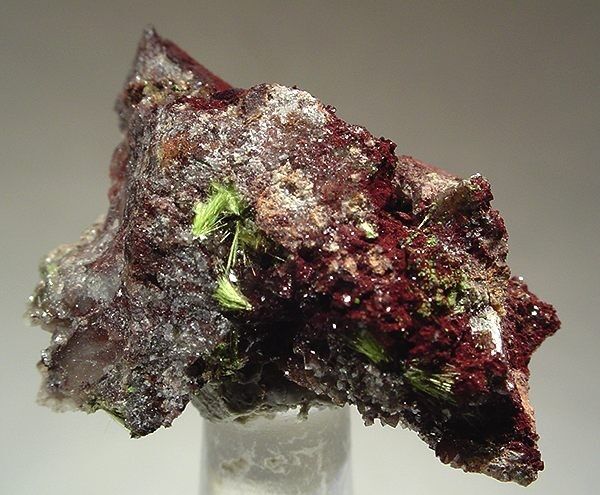 Agardite-(La)LaCu2+6(AsO4)3(OH)6 · 3H2OMineral—
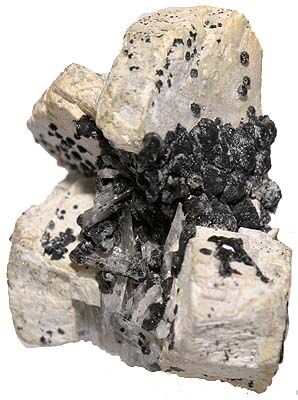 AlamositePbSiO3Mineral—
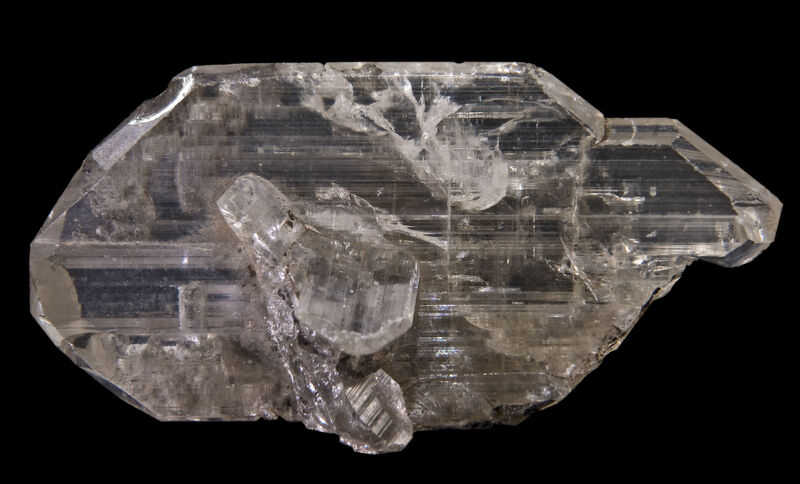 AnglesitePb(SO4)Mineral—
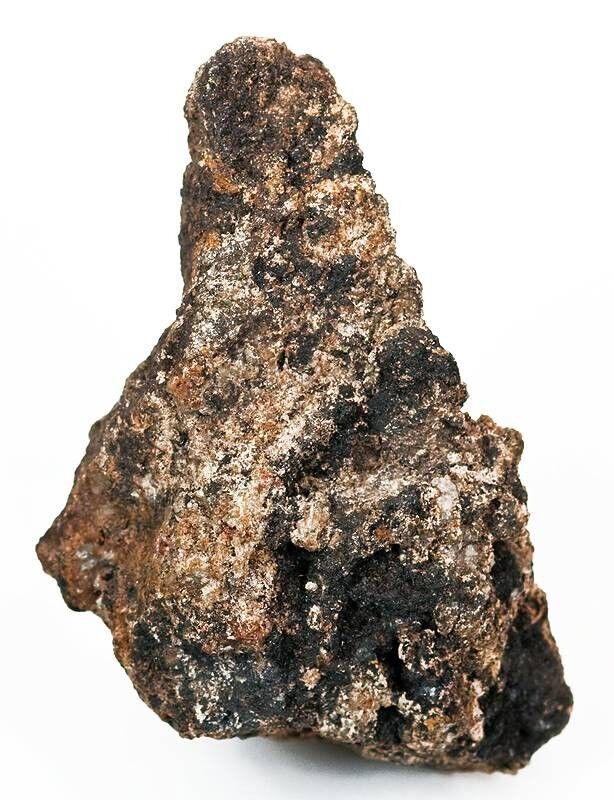 BrackebuschitePb2Mn3+(VO4)2(OH)Mineral—
 BromargyriteAgBrMineral—
 CarminitePbFe3+2(AsO4)2(OH)2Mineral—
 CerussitePb(CO3)Mineral—
 ChlorargyriteAgClMineral—
 DescloizitePbZn(VO4)(OH)Mineral—
 DuftitePbCu(AsO4)(OH)Mineral—
Literature, links & citation
- 1772von Born, I. (1772) Lythophylacium Bornianum; Index fossiliumquae colligit, etc., Prague. part 1: 90. [as Plumbum spatosum flavo-rubrum].
- 1781Jacquin (1781) Misc. Austriaca, Vienna: 2 (as Kärntherischer Bleispath).
- 1783Lisle, Jean-Baptiste-Louis Romé de, Romé de L'Isle, Jean-Baptiste Louis de (1783) Cristallographie, ou Description des formes propres à tous les corps du règne minéral dans l'état de combinaison saline, pierreuse ou métallique [Crystallography, or Description of the forms specific to all bodies of the mineral kingdom in the state of saline, stony or metallic combination] (2nd ed.). L'Imprimerie de Monsieur.
- 1785von Wulfen, F.X. (1785): Abhandlung vom kärnthnerischen Bleyspate. J. P. Krauß, Vienna, 150 pp. [as Kärntherischer Bleispat].
- 1794Richard Kirwan (1794) Elements of Mineralogy - second edition Vol. 1. P. Elmsly, The Strand.
Entry last updated
@misc{mineral2026,
  author    = {Mineral Index editorial board},
  title     = {Wulfenite — Mineral Index},
  year      = {2026},
  url       = {https://mineralindex.org/minerals/wulfenite-4322}
}